As global data consumption continues to surge, traditional wireless technologies are reaching their limits. In response, major technology companies are turning their attention to alternative communication solutions that promise faster speeds, greater security, and more efficient use of the spectrum. Among the most promising of these are Free Space Optics (FSO) and Visible Light Communication (VLC), including its popular variant, Li-Fi (Light Fidelity). Once considered niche or experimental, these technologies are now being seriously explored and adopted by tech giants looking to stay ahead in an increasingly connected world.
The Bandwidth Bottleneck and the Search for Alternatives
The exponential growth in mobile devices, video streaming, cloud computing, and Internet of Things (IoT) applications is putting unprecedented strain on traditional radio frequency (RF) spectrum. With the limited availability of RF bandwidth and increased competition among providers, there is a growing need for supplementary communication channels that can handle large data volumes without interference or congestion.
This is where FSO and VLC come into play. Both use light — rather than radio waves — to transmit data, offering significantly higher bandwidth potential and immunity to electromagnetic interference. FSO utilizes laser beams to transmit data through the air, while VLC uses the visible light spectrum, typically through LED bulbs, to enable wireless communication.
Why Tech Giants Are Investing in Light-Based Technologies
Several major technology players are now investing in or partnering with companies focused on FSO and VLC for a variety of strategic reasons.
The FSO & VLC/Li-Fi market was valued at USD 2.78 billion in 2024 and is projected to reach USD 7.39 billion by 2029, growing at a CAGR of 21.6% from 2024 to 2029
First, speed and bandwidth are major attractions. Li-Fi, for example, has demonstrated the potential to transmit data at speeds over 100 Gbps in lab conditions — far surpassing the capabilities of current Wi-Fi technologies. FSO also supports gigabit-level data rates over long distances, making it suitable for high-capacity, point-to-point backhaul solutions.
Second, security is a growing concern in the era of cyber threats. VLC and FSO offer inherent advantages in this area. Because light cannot penetrate walls or other obstacles, it’s significantly harder to intercept than RF signals, making it ideal for environments requiring secure communications such as military operations, data centers, and financial institutions.
Download PDF Brochure @ https://www.marketsandmarkets.com/pdfdownloadNew.asp?id=946
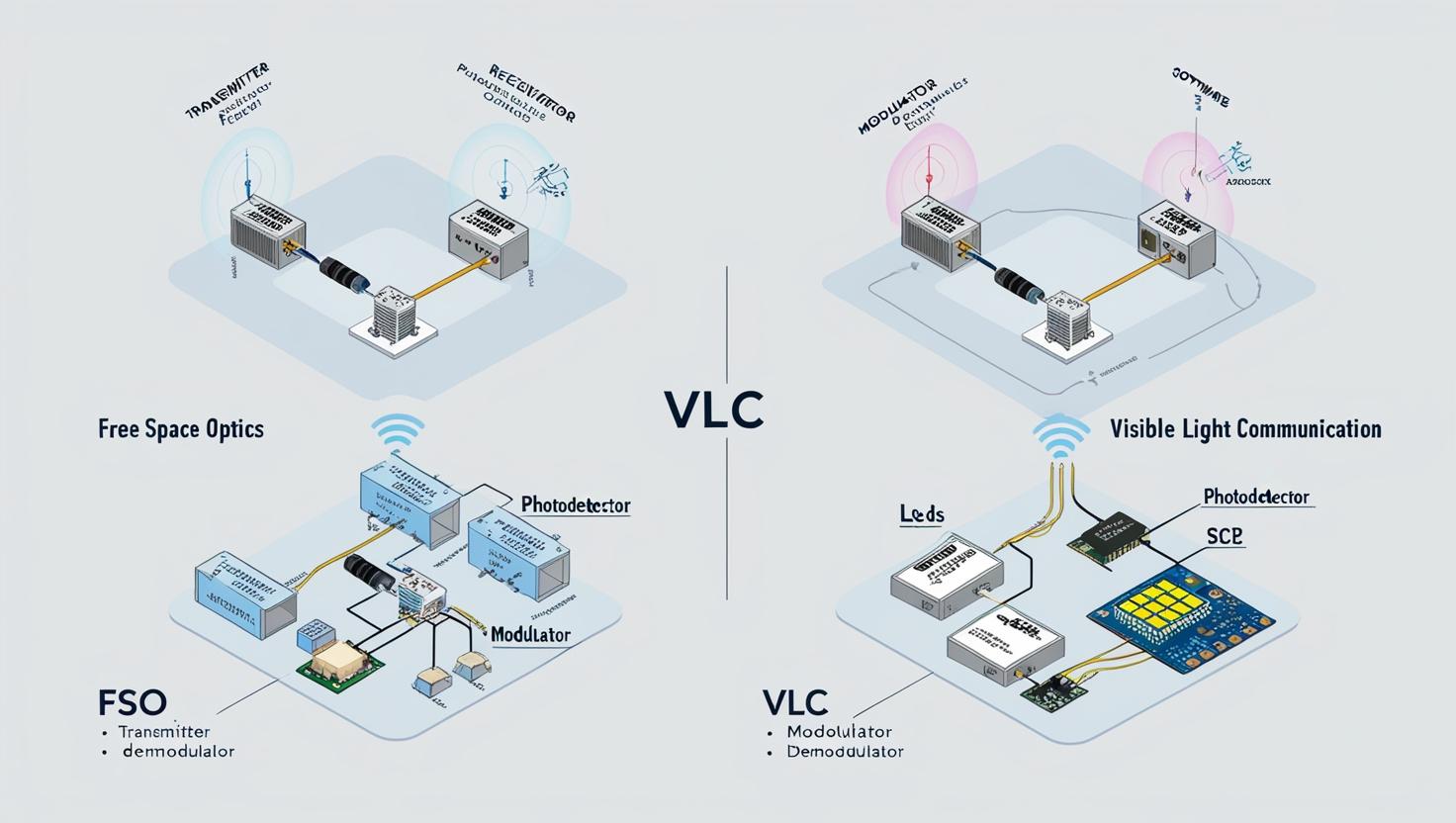
Third, spectrum availability is becoming a serious issue in densely populated urban areas. VLC opens up an entirely untapped spectrum — the visible light spectrum — which is 10,000 times larger than the RF spectrum. This means fewer regulatory hurdles and less interference, providing tech companies with more freedom to innovate.
Finally, there is the push toward smart environments and IoT. VLC can be seamlessly integrated into existing LED lighting infrastructure, allowing companies to turn everyday light sources into high-speed data transmitters. This makes it ideal for smart homes, offices, hospitals, and even public spaces like airports and shopping malls.
Real-World Applications Gaining Momentum
Tech leaders are not just theorizing about the potential of these technologies — they’re actively exploring real-world applications.
In 2018, Signify (formerly Philips Lighting) began experimenting with Li-Fi-enabled office spaces, enabling employees to access secure, high-speed internet through ceiling lights. pureLiFi, a pioneer in Li-Fi, has partnered with defense and aerospace companies to deliver secure communication systems. Meanwhile, Google’s parent company Alphabet has explored FSO through its Project Taara, which aims to bring high-speed internet to remote regions using light-based communication links.
These initiatives underscore the growing confidence that tech companies have in light-based communication as a scalable and viable solution to current network challenges.
Challenges and the Road Ahead
Despite the excitement, there are still obstacles to widespread adoption. FSO systems can be affected by weather conditions like fog or rain, which can disrupt the laser beam path. VLC and Li-Fi require a direct line of sight and cannot function in complete darkness, limiting their flexibility in some environments.
However, advancements in adaptive optics, beam steering, and hybrid communication systems are addressing many of these limitations. As research continues and production costs drop, experts believe that these technologies will complement existing networks, rather than replace them outright.
Conclusion: Light at the End of the Wireless Tunnel
The growing interest in FSO and VLC technologies among tech giants is not just a passing trend — it’s a response to a very real and growing problem in the global communications landscape. With increasing demands on bandwidth, stricter security requirements, and the relentless push for faster, more reliable data transmission, companies are beginning to realize that light-based communication holds enormous potential.
As innovation continues and standards evolve, FSO and VLC may soon become mainstream technologies, illuminating a new path for wireless communication — one that is faster, safer, and more efficient than ever before.
Investor FAQ: FSO & VLC / Li-Fi Technologies
Why are FSO and Li-Fi technologies attracting investor interest?
FSO and Li-Fi represent emerging, high-potential markets within the broader wireless communication sector. With global data demands growing exponentially and traditional RF spectrum facing congestion, these light-based technologies offer scalable, high-speed, and secure alternatives that can complement or even replace existing infrastructure in key use cases. This makes them attractive for long-term investment as part of next-generation communication networks.
What is the market size and projected growth for FSO and Li-Fi?
FSO & VLC / Li-Fi Industry worth $7.39 billion by 2029. Key drivers include demand for high-speed communication, 5G and beyond, smart cities, IoT, and defense applications.
Which industries are most likely to adopt FSO and Li-Fi technologies?
High-growth sectors include defense, healthcare, telecom, aerospace, education, and smart infrastructure. These industries prioritize secure, high-bandwidth communication where traditional RF is limited or inefficient. Additionally, government and military contracts are emerging as major revenue channels for FSO/Li-Fi vendors.
Are there any major tech companies currently involved in these technologies?
Yes. Companies such as Alphabet (Google), through its Project Taara, have invested in FSO to deliver high-speed internet in hard-to-reach areas. Firms like Signify (Philips Lighting) and pureLiFi are pioneering Li-Fi technology. Additionally, several defense contractors and semiconductor companies are actively researching and developing light-based communication systems, signaling strong industry validation.
What are the competitive advantages of FSO and Li-Fi over traditional RF technologies?
Key advantages include significantly higher bandwidth potential, enhanced data security (as light-based signals do not penetrate walls), no spectrum licensing costs, and low interference in high-density environments. These features make the technologies particularly appealing for mission-critical and high-performance applications.
About MarketsandMarkets™
MarketsandMarkets™ is a blue ocean alternative in growth consulting and program management, leveraging a man-machine offering to drive supernormal growth for progressive organizations in the B2B space. We have the widest lens on emerging technologies, making us proficient in co-creating supernormal growth for clients.
The B2B economy is witnessing the emergence of $25 trillion of new revenue streams that are substituting existing revenue streams in this decade alone. We work with clients on growth programs, helping them monetize this $25 trillion opportunity through our service lines – TAM Expansion, Go-to-Market (GTM) Strategy to Execution, Market Share Gain, Account Enablement, and Thought Leadership Marketing.
Built on the ’GIVE Growth’ principle, we work with several Forbes Global 2000 B2B companies – helping them stay relevant in a disruptive ecosystem. Our insights and strategies are molded by our industry experts, cutting-edge AI-powered Market Intelligence Cloud, and years of research. The KnowledgeStore™ (our Market Intelligence Cloud) integrates our research, facilitates an analysis of interconnections through a set of applications, helping clients look at the entire ecosystem and understand the revenue shifts happening in their industry.
To find out more, visit www.MarketsandMarkets™.com or follow us on Twitter, LinkedIn and Facebook.
Contact:
Mr. Rohan Salgarkar
MarketsandMarkets™ INC.
630 Dundee Road
Suite 430
Northbrook, IL 60062
USA : 1-888-600-6441