As cities become smarter and public transportation systems more complex, the need for accurate, real-time passenger data and dynamic communication tools is more critical than ever. Enter the Automated Passenger Counting and Information System (APCIS)—a transformative solution that is quickly becoming an integral part of intelligent transportation networks worldwide. Designed to monitor ridership patterns and deliver live updates to passengers, APCIS is poised to revolutionize how transit systems operate and communicate.
Why APCIS Is Gaining Momentum
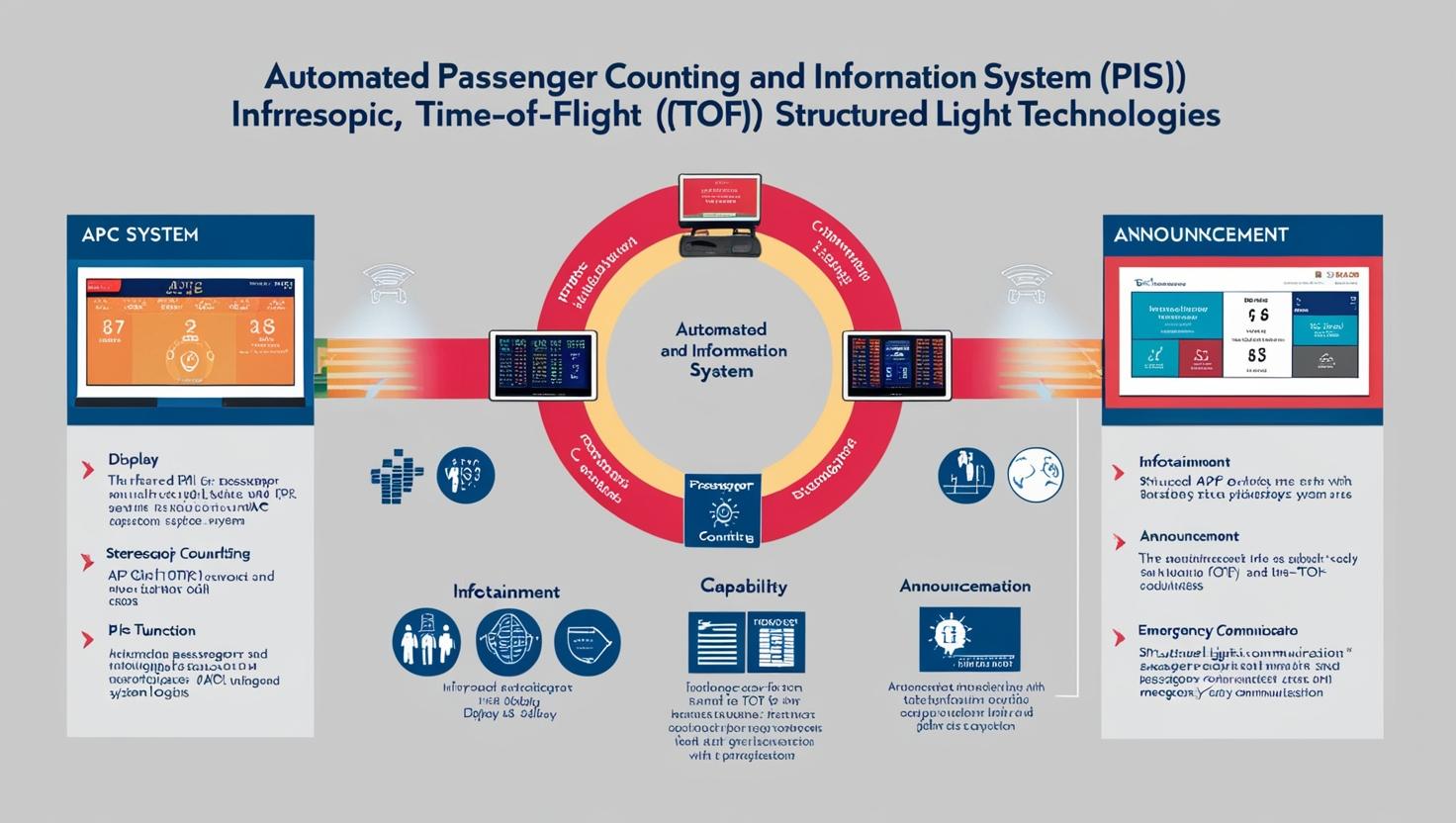
The APCIS market is growing rapidly, driven by increasing urbanization, smart city initiatives, and the urgent need for efficient transit operations. Traditional manual methods of tracking passengers are prone to errors and delays. In contrast, automated systems leverage technologies such as infrared sensors, stereo cameras, LiDAR, and AI-based image processing to deliver highly accurate real-time passenger counts and flow analytics.
Simultaneously, passenger information systems (PIS) provide live updates on arrival times, service disruptions, and route changes, enhancing the commuter experience and reducing uncertainty. These two functionalities—automated counting and real-time information—are converging to form a robust ecosystem that supports smarter, safer, and more reliable public transportation.
Technology Behind the Transformation
Automated passenger counting uses a variety of sensor technologies—ranging from infrared beams to AI-enabled cameras—that are installed at vehicle doors or along transit entry points. These systems not only count boarding and alighting passengers but can also track occupancy levels, peak usage hours, and even demographic trends.
Passenger information systems, on the other hand, integrate with GPS, scheduling software, and cloud-based control centers to deliver location-specific, real-time updates through onboard displays, station monitors, and mobile apps. When integrated, APCIS enables seamless coordination between ridership data and dynamic information delivery, allowing transit operators to make data-driven decisions.
Download PDF Brochure @ https://www.marketsandmarkets.com/pdfdownloadNew.asp?id=17856390
Applications Across Transport Modes
APCIS is seeing strong adoption across various public transport modes, including buses, trams, subways, and commuter rail networks. In high-density urban areas, these systems are crucial for managing crowding, especially during peak hours or special events.
Metro and rail systems are using APCIS to inform passengers of train occupancy levels—an especially relevant feature in post-pandemic transit planning where social distancing and comfort are priorities. Meanwhile, bus rapid transit (BRT) systems are deploying APCIS to improve schedule adherence and fleet allocation based on real-time demand.
Benefits for Operators and Commuters
For transit authorities, APCIS provides unparalleled insights into passenger trends, enabling smarter route planning, real-time fleet adjustments, and optimized resource utilization. This translates into reduced operational costs, improved service delivery, and greater adaptability in responding to disruptions or emergencies.
For passengers, APCIS significantly improves the travel experience. Real-time information displays help reduce waiting times, prevent overcrowding, and increase trust in public transport systems. In a competitive urban mobility landscape where convenience is key, these enhancements boost ridership satisfaction and loyalty.
Market Outlook and Growth Potential
Automated Passenger Counting and Information System Industry worth $14.80 billion by 2030, fueled by investments in smart infrastructure, sustainable transport solutions, and digital transformation initiatives. Regions such as North America, Europe, and Asia-Pacific are leading adopters, with cities like London, Singapore, and New York deploying APCIS to enhance transit transparency and performance.
Government mandates for data-driven planning, increased funding for intelligent transport systems, and integration of AI and IoT technologies are further accelerating market expansion. Moreover, private sector innovation—especially from transit tech startups—is contributing to more flexible, scalable APCIS solutions suitable for diverse environments.
Challenges and the Path Ahead
Despite its potential, the APCIS industry faces challenges such as system integration with legacy infrastructure, data privacy concerns, and upfront deployment costs. However, as the benefits of these systems become increasingly apparent, public and private stakeholders are working together to address these hurdles through pilot programs, public-private partnerships, and open data initiatives.
Going forward, the integration of AI, cloud analytics, and machine learning will take APCIS capabilities to new heights, enabling predictive maintenance, demand forecasting, and fully autonomous fleet management. The convergence of APCIS with mobility-as-a-service (MaaS) platforms will also open new business models and user experiences.
The Automated Passenger Counting and Information System (APCIS) industry is not just evolving—it is shaping the future of public transportation. With its ability to bring real-time transparency, operational efficiency, and improved passenger experiences, APCIS is fast becoming a cornerstone of smart, responsive mobility systems. As cities worldwide continue to prioritize smarter, greener transport, the APCIS market is well-positioned for sustained and impactful growth.
Leading players in the global automated passenger counting and information system companies include Eurotech S.p.A. (Italy), iris-GmbH (Germany), DILAX Intelcom GmbH (Germany), Infodev EDI inc. (Canada), Siemens (Germany), Hitachi, Ltd. (Japan), innovation in traffic systems SE (Germany), Cisco Systems, Inc. (US), Cubic Corporation (US), BlueSurge Technologies (Canada), Clever Devices Ltd. (US), Teleste Information Solutions SRL (Finland), ETA Transit (US), EXEROS TECHNOLOGIES LTD. (UK), EYERIDE (US), GIKEN TRASTEM CO., LTD. (Japan), GMV (US), Masstrans Technologiies Private Limited (India), Passio Technologies (US), Postec Technology (Brazil), R-Com Technical (UK), Retail Sensing Limited. (UK), R2P GmbH (Germany), Xovis AG (Switzerland), and ALSTOM SA (France).
About MarketsandMarkets™
MarketsandMarkets™ is a blue ocean alternative in growth consulting and program management, leveraging a man-machine offering to drive supernormal growth for progressive organizations in the B2B space. We have the widest lens on emerging technologies, making us proficient in co-creating supernormal growth for clients.
The B2B economy is witnessing the emergence of $25 trillion of new revenue streams that are substituting existing revenue streams in this decade alone. We work with clients on growth programs, helping them monetize this $25 trillion opportunity through our service lines – TAM Expansion, Go-to-Market (GTM) Strategy to Execution, Market Share Gain, Account Enablement, and Thought Leadership Marketing.
Built on the ’GIVE Growth’ principle, we work with several Forbes Global 2000 B2B companies – helping them stay relevant in a disruptive ecosystem. Our insights and strategies are molded by our industry experts, cutting-edge AI-powered Market Intelligence Cloud, and years of research. The KnowledgeStore™ (our Market Intelligence Cloud) integrates our research, facilitates an analysis of interconnections through a set of applications, helping clients look at the entire ecosystem and understand the revenue shifts happening in their industry.
To find out more, visit www.MarketsandMarkets™.com or follow us on Twitter, LinkedIn and Facebook.
Contact:
Mr. Rohan Salgarkar
MarketsandMarkets™ INC.
1615 South Congress Ave.
Suite 103
Delray Beach, FL 33445
USA : 1-888-600-6441
