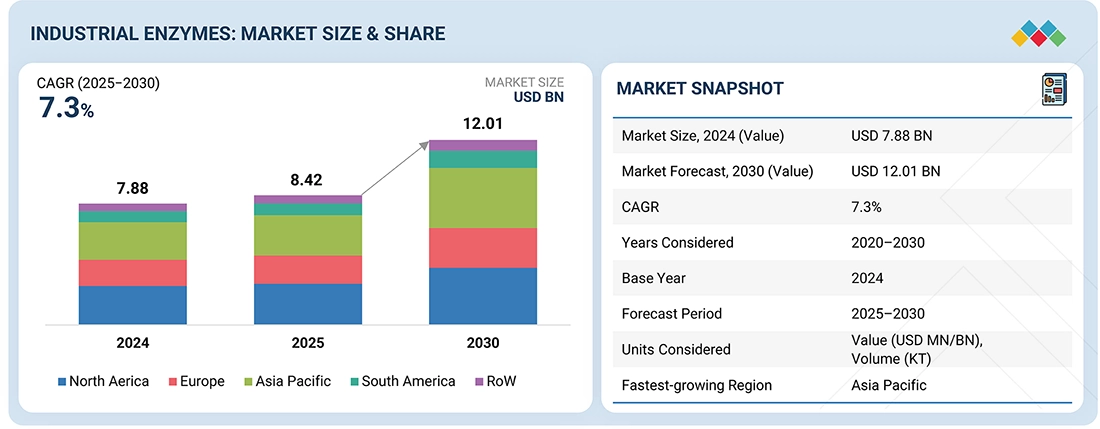
The industrial enzymes market is on a strong upward trajectory, reflecting the global shift toward greener, more efficient, and cost-effective manufacturing solutions. Valued at USD 8.42 billion in 2025, the market is projected to reach USD 12.01 billion by 2030, growing at a steady CAGR of 7.3%. As industries embrace sustainability, enzymes are becoming essential catalysts that enable cleaner processes, improved energy efficiency, and enhanced product quality.
Why Are Industrial Enzymes Becoming Essential?
Across core manufacturing sectors—from food & beverage to textiles, bioethanol, detergents, and wastewater treatment—the demand for enzyme-driven processes is accelerating. The push toward reducing environmental impact is reshaping production methods, and enzymes offer a powerful bio-based alternative to traditional chemical-intensive processes.
Enzymes operate under mild pH and temperature conditions, helping industries lower energy usage, reduce water consumption, and improve operational efficiency. With global regulations tightening, industries are increasingly turning to these biological catalysts to meet sustainability targets, enhance yields, and ensure compliance.
Advancements in enzyme engineering, fermentation technologies, and immobilisation techniques are further broadening enzyme applications, making them more resilient and adaptable even in harsh industrial environments. Accelerated adoption is also supported by government initiatives in Europe, India, and Southeast Asia, promoting circular economy models and bio-based production.
Download PDF Brochure: https://www.marketsandmarkets.com/pdfdownloadNew.asp?id=237327836
Microorganisms: The Powerhouse Behind Industrial Enzyme Production
Microorganisms hold the largest share of the industrial enzymes market, and for good reason. Enzymes sourced from bacteria and fungi—especially species like Bacillus and Aspergillus—offer unmatched efficiency, stability, and versatility.
Why Microbial Enzymes Dominate?
- High adaptability across temperature and pH ranges
- Cost-effective large-scale production through fermentation
- Consistent quality and reliability
- Ease of genetic modification to enhance activity, stability, and specificity
- Fewer supply chain constraints compared to plant- or animal-based sources
Continuous advancements in strain improvement and fermentation processes are strengthening the commercial viability of microbial enzymes. Their alignment with sustainability goals and regulatory standards makes them the most preferred source in the industrial enzymes landscape.
Wastewater Treatment: The Fastest-Growing Segment
The wastewater treatment industry is witnessing a surge in enzyme adoption, making it the fastest-growing segment in the industrial enzymes market.
Why Enzymes Are Transforming Wastewater Treatment
Growing industrialization, rising urban wastewater loads, and stringent environmental regulations have intensified the need for efficient treatment solutions. Enzyme-based treatments offer significant advantages:
- Biodegradable and eco-friendly
- Efficient breakdown of organic pollutants, fats, oils, and complex compounds
- Reduced reliance on harsh chemicals
- Lower sludge generation and disposal costs
- Higher treatment efficiency and compliance with discharge norms
Breakthrough Innovation: NIT Rourkela’s Sunlight-Based Treatment System (May 2025)
Researchers at NIT-R introduced an eco-friendly wastewater treatment solution using sunlight and reusable spherical concrete beads as photocatalysts. This system achieved the following:
- 82% reduction in COD under natural sunlight
- Over 90% efficiency after 15 reuse cycles
The innovation eliminates the need for artificial UV light, making it especially valuable for rural and resource-limited settings. The findings, published in the Journal of Water Processing Engineering, have led to two patent filings—marking a significant milestone in sustainable water treatment.
Request Sample Pages: https://www.marketsandmarkets.com/requestsampleNew.asp?id=237327836
Asia Pacific: The Dominant and Fastest-Expanding Regional Market
The Asia Pacific region continues to lead the global industrial enzymes market, driven by rapid industrial expansion and growing sustainability mandates.
Key Growth Drivers
Strong performance in enzyme-heavy sectors:
- food & beverage, textiles, biofuels, detergents, and wastewater treatment
- Rising consumption of processed foods, boosting demand for food-grade enzymes
- Accelerated urbanization and environmental challenges
- Robust government support for biotechnology and the bioeconomy
- Cost-effective labor and raw material availability
- Increasing local production and foreign investment in enzyme manufacturing
Policies like India’s BioE3 policy (August 2024) are boosting R&D, innovation, and enzyme production capacity across the region.
Notable Industry Development: Novus International’s Acquisition (March 2024)
Novus International, Inc. acquired US-based enzyme manufacturer BioResource International, Inc., gaining access to new technologies, product lines, and R&D capabilities. This move enhances their global enzyme portfolio, strengthening innovation and enabling better solutions for animal health and feed efficiency.
Key Players Shaping the Global Industrial Enzymes Market
Leading companies driving innovation and market growth include:
- BASF SE (Germany)
- International Flavors & Fragrances Inc. (US)
- DSM-Firmenich (Switzerland)
- Kerry Group plc (Ireland)
- Dyadic International Inc. (US)
- Advanced Enzyme Technologies (India)
- Aumgene Biosciences (India)
- Amano Enzyme Inc. (Japan)
- Associated British Foods plc (England)
- Novozymes A/S (Denmark)
- F. Hoffmann-La Roche Ltd (Switzerland)
- Codexis, Inc. (US)
- Sanofi (France)
- Merck KGaA (Germany)
- Adisseo (China)