The eVTOL Aircraft Market is emerging as one of the most transformative segments in the global aerospace and defense industry. As urban populations grow rapidly and traffic congestion intensifies across major cities, the need for innovative transportation solutions has become more urgent than ever. Electric Vertical Takeoff and Landing aircraft are designed to address these challenges by offering faster, cleaner, and more efficient point to point mobility.
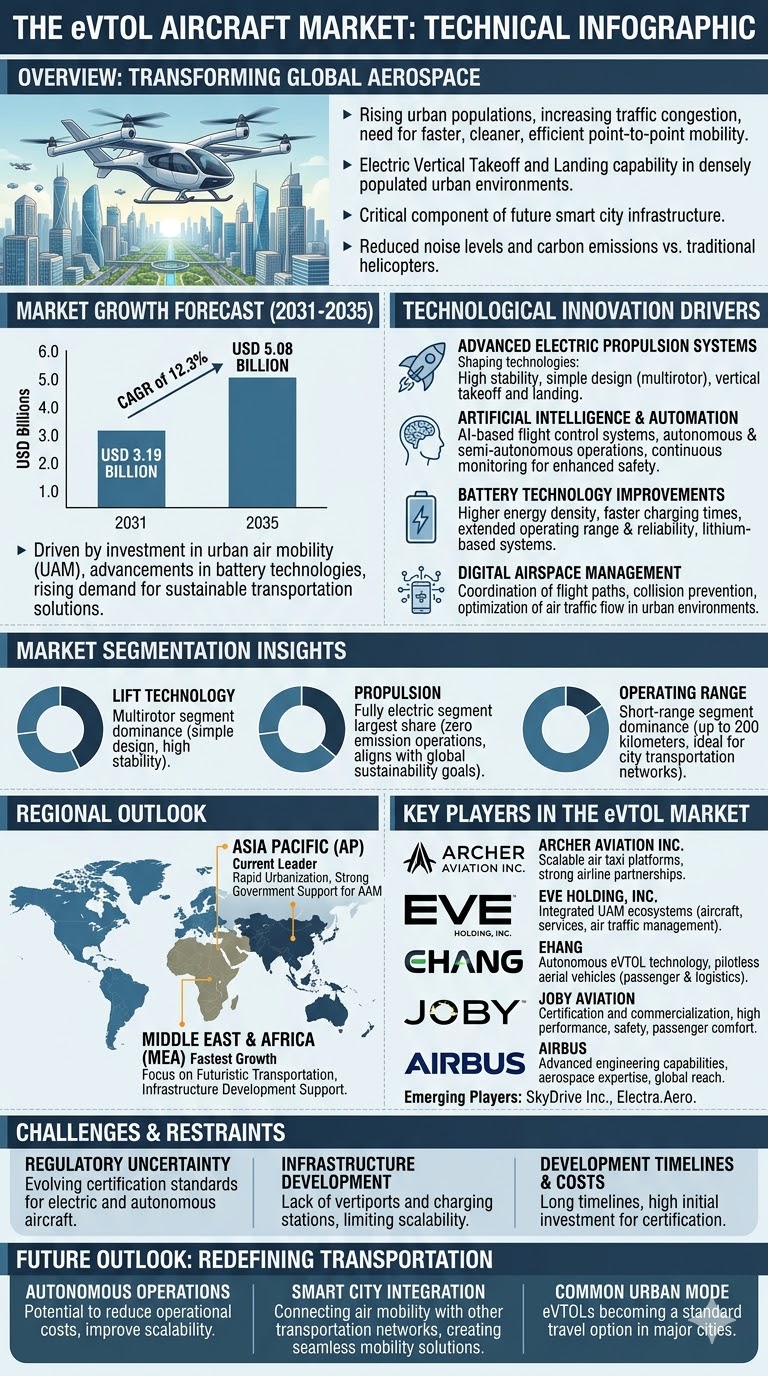
The eVTOL Aircraft Market is expected to grow from USD 3.19 billion in 2031 to USD 5.08 billion by 2035, reflecting a CAGR of 12.3%. This growth is driven by increasing investments in urban air mobility, advancements in battery technologies, and the rising demand for sustainable transportation solutions.
Unlike traditional helicopters, eVTOL aircraft operate using electric propulsion systems, which significantly reduce noise levels and carbon emissions. These aircraft are capable of vertical takeoff and landing, allowing them to operate in densely populated urban environments where conventional runways are not available. This capability positions the eVTOL Aircraft Market as a critical component of future smart city infrastructure.
What Is Driving the Growth of the eVTOL Aircraft Market?
The growth of the eVTOL Aircraft Idustry is fueled by a combination of urbanization, technological innovation, and evolving transportation demands. Rapid urban expansion has led to increased traffic congestion, longer commute times, and higher environmental concerns. Governments and private operators are actively exploring new mobility solutions that can alleviate these challenges.
Urban air mobility has emerged as a key driver of the eVTOL Aircraft Market. Cities are investing in aerial transportation networks that enable passengers to travel quickly between locations without being affected by ground traffic. These systems are particularly beneficial for airport transfers, business travel, and high density urban routes.
Technological advancements in battery performance are also playing a crucial role in the growth of the eVTOL Aircraft Market. Improvements in energy density and battery efficiency are extending the operating range and reliability of electric aircraft. This enables operators to deploy eVTOL aircraft for both passenger and cargo applications.
Additionally, increasing environmental regulations are encouraging the adoption of low emission transportation solutions. eVTOL aircraft align with sustainability goals by offering zero emission operations and reduced noise pollution, making them ideal for urban environments.
How Is Technology Shaping the eVTOL Aircraft Market?
Technological innovation is at the core of the eVTOL Aircraft Market. The integration of advanced electric propulsion systems, artificial intelligence, and digital airspace management is transforming how aircraft operate in urban environments.
AI based flight control systems are enabling autonomous and semi autonomous operations. These systems enhance safety by continuously monitoring flight conditions and making real time adjustments. As automation technologies mature, the fully autonomous segment of the eVTOL Aircraft Market is expected to experience rapid growth.
Battery technology is another critical factor influencing the market. Lithium based battery systems are being continuously improved to deliver higher energy density, faster charging times, and enhanced safety. These advancements directly impact aircraft performance, operating range, and cost efficiency.
Digital airspace management systems are also becoming essential. These systems coordinate flight paths, prevent collisions, and optimize air traffic flow in urban environments. As the number of eVTOL aircraft increases, efficient airspace management will be crucial for ensuring safe and scalable operations.
Download PDF Brochure: https://www.marketsandmarkets.com/pdfdownloadNew.asp?id=28054110
Why Is Urban Air Mobility Accelerating the eVTOL Aircraft Market?
Urban air mobility represents one of the most significant opportunities for the eVTOL Aircraft Market. As cities become more crowded, traditional transportation systems struggle to meet the growing demand for mobility. eVTOL aircraft provide a viable solution by enabling fast and direct travel between urban locations.
Air taxi services are expected to become a major application within the eVTOL Aircraft Market. These services offer on demand transportation for passengers, reducing travel time and improving convenience. Premium travelers and business professionals are likely to be early adopters of these services.
Cargo transport and last mile delivery are also emerging as key growth segments. eVTOL aircraft can be used to transport goods quickly across cities, improving logistics efficiency and reducing delivery times. This capability is particularly valuable for e-commerce companies and logistics providers.
Market Segmentation Insights in the eVTOL Aircraft Market
The eVTOL Aircraft Market is segmented based on lift technology, propulsion, operating range, system, and application. Each segment plays a crucial role in shaping the overall market landscape.
The multirotor segment currently dominates the market due to its simple design and high stability. This configuration is well suited for urban operations where precise vertical takeoff and landing are required.
The fully electric propulsion segment holds the largest share in the eVTOL Aircraft Market. Electric propulsion systems support zero emission operations and align with global sustainability goals. As battery technology continues to improve, fully electric aircraft are expected to become even more efficient and cost effective.
The short range segment, typically up to 200 kilometers, dominates the market. Most urban air mobility routes involve short distance travel, making this range ideal for city transportation networks.
Regional Outlook of the eVTOL Aircraft Market
Asia Pacific currently dominates the eVTOL Aircraft Market, holding a significant market share. The region’s rapid urbanization and strong government support for advanced air mobility are key factors driving growth.
Countries in Asia Pacific are investing heavily in smart city infrastructure and innovative transportation systems. These initiatives are creating a favorable environment for the adoption of eVTOL aircraft.
The Middle East and Africa are expected to experience the fastest growth in the eVTOL Aircraft Market. Governments in this region are focusing on futuristic transportation solutions and are actively supporting the development of advanced air mobility infrastructure.
Key Players in the eVTOL Aircraft Market
The eVTOL Aircraft Market is highly competitive, with several companies leading innovation and commercialization efforts.
Archer Aviation Inc. is a prominent player in the eVTOL Aircraft Market, known for its electric air taxi platforms designed for urban mobility. The company focuses on building scalable solutions supported by strong airline partnerships.
Eve Holding, Inc. is actively developing integrated urban air mobility ecosystems, including aircraft, services, and air traffic management solutions. Its approach positions it as a key contributor to the market’s long term growth.
EHang is recognized for its leadership in autonomous eVTOL technology. The company has developed pilotless aerial vehicles that support passenger transport and logistics operations.
Joby Aviation is one of the most advanced companies in the eVTOL Aircraft Market, with a strong focus on certification and commercialization. Its electric aircraft are designed for high performance, safety, and passenger comfort.
Airbus is leveraging its aerospace expertise to develop innovative eVTOL solutions. The company’s involvement strengthens the market by bringing advanced engineering capabilities and global reach.
Emerging players such as SkyDrive Inc. and Electra.Aero are also contributing to the evolution of the eVTOL Aircraft Market through technological innovation and product development.
Challenges and Restraints in the eVTOL Aircraft Market
Despite its strong growth potential, the eVTOL Aircraft Market faces several challenges. Regulatory uncertainty remains a major barrier, as certification standards for electric and autonomous aircraft are still evolving.
Infrastructure development is another critical challenge. The lack of vertiports and charging stations limits the scalability of eVTOL operations. Governments and private companies must collaborate to build the necessary infrastructure for widespread adoption.
Long development timelines and high initial costs also pose challenges for market players. Developing and certifying new aircraft technologies requires significant investment and time.
Future Outlook of the eVTOL Aircraft Market
The future of the eVTOL Aircraft Market is highly promising, driven by continuous innovation and growing demand for urban air mobility. As technology advances and regulatory frameworks become more established, eVTOL aircraft are expected to become a common mode of transportation in major cities.
Autonomous operations will play a significant role in shaping the future of the market. Fully autonomous eVTOL aircraft have the potential to reduce operational costs and improve scalability.
The integration of eVTOL aircraft into smart city ecosystems will further enhance their adoption. These systems will connect air mobility with other transportation networks, creating seamless and efficient urban mobility solutions.
The eVTOL Aircraft Market is set to redefine the future of transportation by offering faster, cleaner, and more efficient travel options. As investments continue to grow, the market will play a crucial role in shaping the next generation of aviation and urban mobility.
