Quantum computing is no longer a distant scientific concept—it is rapidly evolving into one of the most transformative technologies of the 21st century. Leveraging the principles of quantum mechanics, quantum computers have the potential to solve problems that are currently intractable for classical systems. As governments, technology giants, and startups invest heavily in this space, the quantum computing market is gaining significant momentum. The quantum computing market is projected to reach USD 20.20 billion by 2030 from USD 3.52 billion in 2025, at a CAGR of 41.8% during the forecast period. The quantum computing market presents vast opportunities in drug discovery, financial modeling, supply chain optimization, and cybersecurity, where classical computing falls short. Rapid advancements in hardware, software, and cloud-based access enable broader adoption across industries. As governments and enterprises increase investments, players can tap into these opportunities by focusing on scalability, partnerships, and application-specific solutions.
Top 10 Key Takeaways
The quantum computing market is growing rapidly due to strong global investments.
- Hardware development remains a critical focus area.
- Cloud-based access is making quantum computing more accessible.
- Enterprises across industries are exploring quantum applications.
- Software and algorithm development is accelerating innovation.
- Cybersecurity concerns are driving the need for quantum-resistant encryption.
- Talent shortage is a major challenge for the industry.
- Industry-academia collaborations are fostering innovation.
- High costs and technical limitations remain barriers.
- The long-term potential of quantum computing is transformative across sectors.
Explores the top 10 insights shaping the quantum computing market, offering a comprehensive view of its growth, challenges, and future potential.
1. Rapid Market Growth Driven by Strategic Investments
One of the most defining insights of the quantum computing market is the surge in global investments. Governments and private enterprises are allocating billions of dollars toward research, development, and commercialization.
Countries such as the United States, China, and members of the European Union are competing to establish leadership in quantum technologies. Public funding initiatives, combined with venture capital investments, are accelerating innovation and market expansion.
This influx of capital is not only fueling technological advancements but also encouraging startups and new entrants to explore niche applications in quantum computing.
2. Quantum Hardware Development Remains a Core Focus
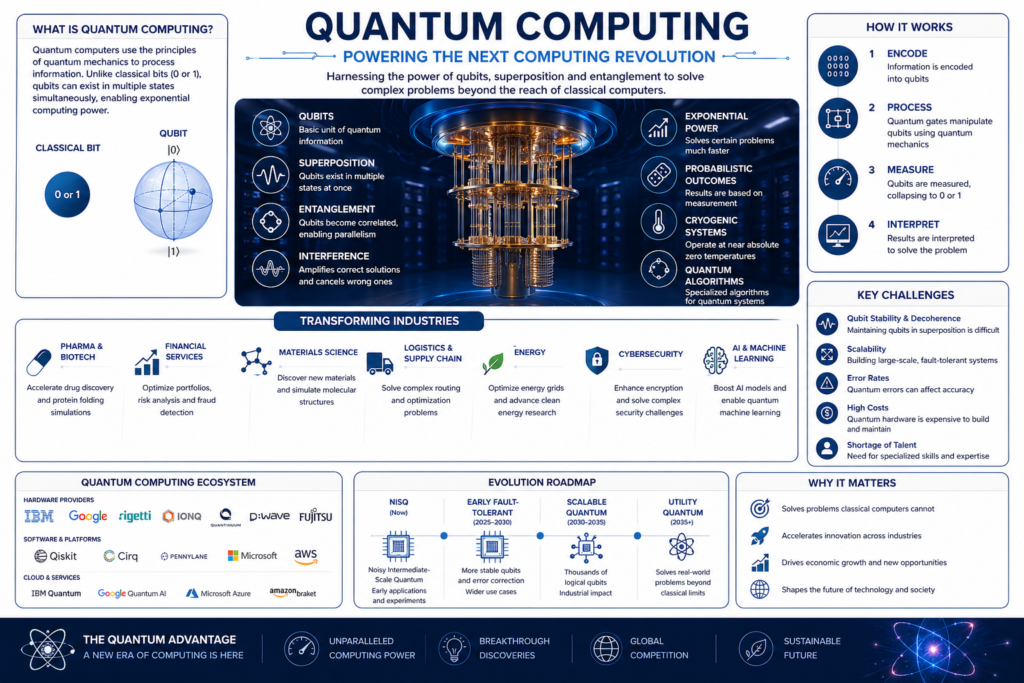
The development of stable and scalable quantum hardware is central to the market’s progress. Unlike classical computers, quantum systems rely on qubits, which are highly sensitive to environmental conditions.
Companies are exploring multiple approaches, including:
- Superconducting qubits
- Trapped ions
- Photonic systems
- Topological qubits
Each technology has its advantages and challenges, and the race to achieve quantum supremacy—where quantum computers outperform classical systems—is intensifying.
Download PDF Brochure @ https://www.marketsandmarkets.com/pdfdownloadNew.asp?id=144888301
3. Cloud-Based Quantum Computing is Expanding Accessibility
Cloud platforms are playing a crucial role in democratizing access to quantum computing. Instead of requiring expensive hardware, organizations can now access quantum systems via cloud-based services.
This model allows researchers, developers, and enterprises to experiment with quantum algorithms without significant upfront investment. It is also fostering collaboration and accelerating innovation across industries.
4. Growing Enterprise Interest Across Industries
Enterprises are increasingly exploring quantum computing for real-world applications. Industries such as pharmaceuticals, finance, logistics, and energy are investing in quantum research to gain a competitive edge.
Key use cases include:
- Drug discovery and molecular simulation
- Portfolio optimization and risk analysis
- Supply chain optimization
- Energy grid management
Although widespread commercial adoption is still in its early stages, enterprise interest is steadily growing.
5. Software and Algorithm Development is Gaining Momentum
While hardware often receives the spotlight, software development is equally critical. Quantum algorithms and programming frameworks are evolving to make quantum computing more practical and accessible.
Developers are working on:
- Quantum machine learning algorithms
- Optimization techniques
- Cryptographic solutions
The emergence of quantum programming languages and development kits is enabling a broader community to participate in quantum innovation.
6. Cybersecurity Implications are Driving Urgency
Quantum computing poses both opportunities and threats in the field of cybersecurity. On one hand, it can enhance encryption methods; on the other, it has the potential to break widely used cryptographic systems.
This dual impact is driving the development of post-quantum cryptography, which aims to create encryption methods resistant to quantum attacks.
Organizations and governments are prioritizing cybersecurity readiness to prepare for a future where quantum capabilities become mainstream.
7. Talent Shortage is a Key Market Constraint
The quantum computing market faces a significant shortage of skilled professionals. Expertise in quantum physics, computer science, and advanced mathematics is required to develop and operate quantum systems.
This talent gap is slowing down innovation and adoption. Educational institutions and companies are investing in training programs and collaborations to build a skilled workforce.
8. Collaboration Between Industry and Academia is Accelerating Innovation
Partnerships between academic institutions, research organizations, and industry players are driving breakthroughs in quantum computing.
These collaborations enable:
- Knowledge sharing
- Access to specialized expertise
- Faster development cycles
Joint research initiatives are helping bridge the gap between theoretical research and practical applications.
9. High Costs and Technical Challenges Remain Barriers
Despite its potential, quantum computing faces significant barriers to widespread adoption. The cost of building and maintaining quantum systems is extremely high.
Technical challenges include:
- Qubit stability and error rates
- Scalability of quantum systems
- Environmental sensitivity
Overcoming these challenges will be critical for the market to achieve commercial viability.
10. Long-Term Potential Across Emerging Applications
The long-term potential of quantum computing is vast. As technology matures, it is expected to revolutionize multiple sectors.
Future applications may include:
- Climate modeling and environmental analysis
- Advanced material design
- Artificial intelligence optimization
- Space exploration
The ability to process complex calculations at unprecedented speeds positions quantum computing as a game-changing technology for the future.
Market Outlook
The quantum computing market is still in its early stages but is progressing rapidly. Over the next decade, advancements in hardware, software, and infrastructure are expected to drive significant growth.
Key trends to watch include:
Increased commercialization of quantum solutions
Integration with classical computing systems
Expansion of quantum-as-a-service models
Development of industry-specific applications
As the ecosystem evolves, early adopters will gain a competitive advantage by leveraging quantum capabilities.
Frequently Asked Questions (FAQs)
1. What is quantum computing?
Quantum computing is a technology that uses quantum mechanics principles to process information, enabling faster and more complex computations than classical computers.
2. Why is the quantum computing market growing?
The market is growing due to increased investments, technological advancements, and rising demand for solving complex problems across industries.
3. What are the main challenges in quantum computing?
Key challenges include high costs, technical limitations, qubit instability, and a shortage of skilled professionals.
4. Which industries will benefit the most from quantum computing?
Industries such as healthcare, finance, energy, logistics, and cybersecurity are expected to benefit significantly.
5. When will quantum computing become mainstream?
While progress is rapid, widespread adoption is expected over the next decade as technology matures and becomes more cost-effective.
About MarketsandMarkets™
MarketsandMarkets™ has been recognized as one of America’s Best Management Consulting Firms by Forbes, as per their recent report.
MarketsandMarkets™ is a blue ocean alternative in growth consulting and program management, leveraging a man-machine offering to drive supernormal growth for progressive organizations in the B2B space. With the widest lens on emerging technologies, we are proficient in co-creating supernormal growth for clients across the globe.
Today, 80% of Fortune 2000 companies rely on MarketsandMarkets, and 90 of the top 100 companies in each sector trust us to accelerate their revenue growth. With a global clientele of over 13,000 organizations, we help businesses thrive in a disruptive ecosystem.
The B2B economy is witnessing the emergence of $25 trillion in new revenue streams that are replacing existing ones within this decade. We work with clients on growth programs, helping them monetize this $25 trillion opportunity through our service lines – TAM Expansion, Go-to-Market (GTM) Strategy to Execution, Market Share Gain, Account Enablement, and Thought Leadership Marketing.
Built on the ‘GIVE Growth’ principle, we collaborate with several Forbes Global 2000 B2B companies to keep them future-ready. Our insights and strategies are powered by industry experts, cutting-edge AI, and our Market Intelligence Cloud, KnowledgeStore™, which integrates research and provides ecosystem-wide visibility into revenue shifts.
To find out more, visit www.MarketsandMarkets™.com or follow us on Twitter , LinkedIn and Facebook .
Contact:
Mr. Rohan Salgarkar
MarketsandMarkets™ INC.
1615 South Congress Ave.
Suite 103, Delray Beach, FL 33445
USA: +1-888-600-6441
