Advanced loitering munitions are rapidly emerging as one of the most transformative technologies in modern warfare, combining the precision of guided missiles with the intelligence, flexibility, and surveillance capabilities of unmanned aerial systems. Often referred to as “kamikaze drones” or “suicide drones,” these systems are redefining battlefield tactics by enabling autonomous target acquisition, persistent surveillance, and precision strike capability within a single integrated platform.
Download Brochure Analyst-Verified Insights @ https://www.marketsandmarkets.com/pdfdownloadNew.asp?id=139489979
As global defense modernization accelerates, loitering munitions are becoming central to next-generation smart combat systems designed for highly dynamic and contested operational environments. Modern military forces increasingly rely on these systems to improve operational agility, reduce collateral damage, enhance strike precision, and support distributed combat operations across multi-domain battlefields.
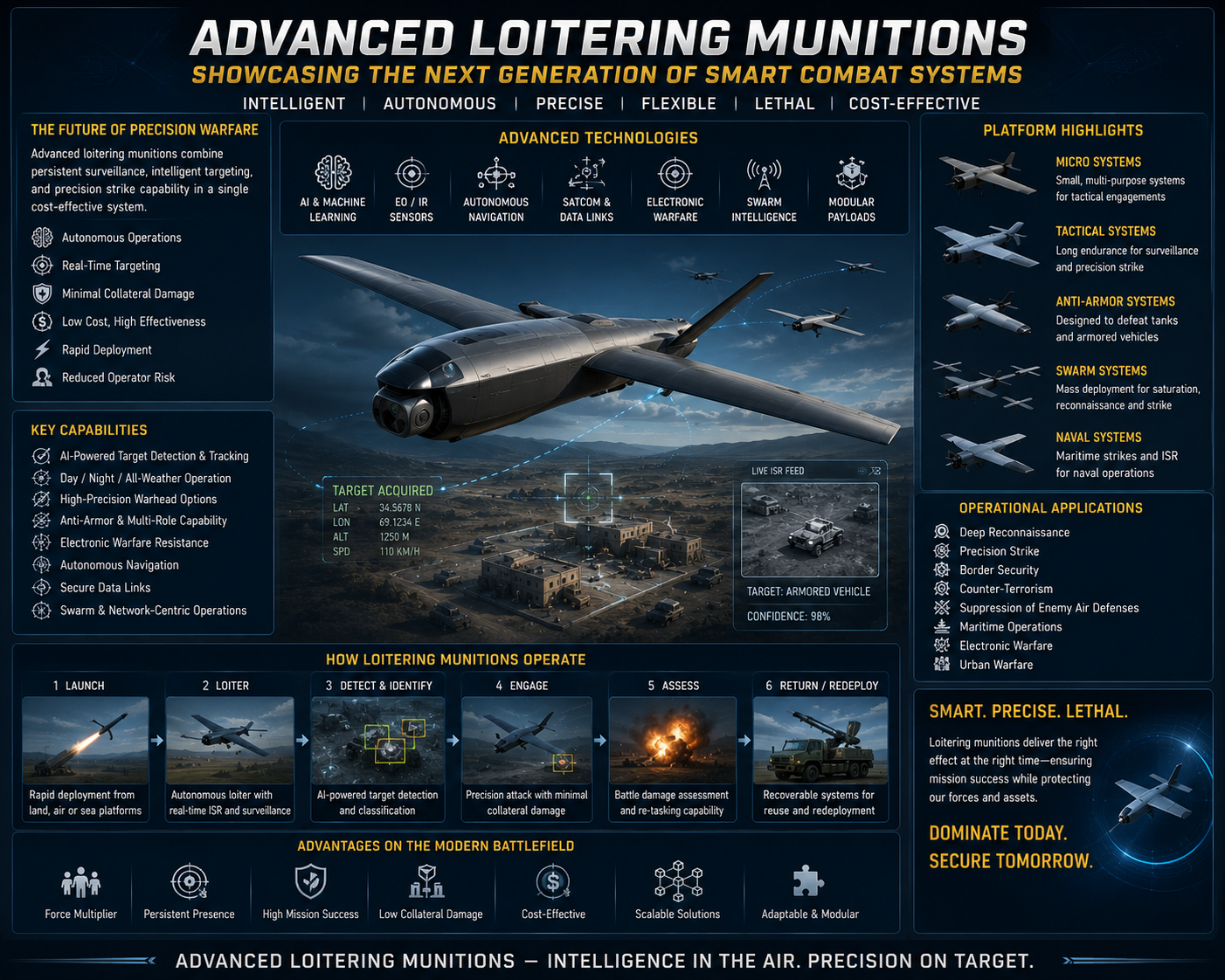
Evolution of Loitering Munitions in Modern Warfare
Traditional precision-guided munitions were designed primarily for pre-planned strikes with limited adaptability once launched. Loitering munitions represent a major advancement because they can remain airborne for extended periods while searching for targets in real time before initiating an attack.
Modern loitering munitions combine:
- Intelligence, surveillance, and reconnaissance (ISR)
- Autonomous navigation
- Precision targeting
- Real-time communication systems
- AI-assisted threat recognition
- Network-centric battlefield integration
This fusion of capabilities allows military operators to conduct highly adaptive strike missions against time-sensitive and mobile targets.
Rising Demand for Smart Combat Systems
Modern conflicts increasingly require weapons capable of operating effectively within contested and rapidly evolving environments. Advanced loitering munitions provide several operational advantages over conventional strike systems, including:
- Lower operational cost
- Rapid deployment capability
- Reduced risk to personnel
- Precision engagement
- Flexible mission adaptability
- Extended battlefield surveillance
- Improved situational awareness
These systems are especially valuable in asymmetric warfare scenarios where traditional large-scale military platforms may be less effective or economically impractical.
Artificial Intelligence Transforming Autonomous Strike Capability
Artificial intelligence is becoming one of the most influential technologies shaping next-generation loitering munition systems.
AI-enabled capabilities now support:
- Autonomous target identification
- Threat prioritization
- Real-time route optimization
- Object recognition and tracking
- Swarm coordination
- Adaptive mission planning
- Electronic warfare resistance
Machine learning algorithms allow loitering munitions to analyze battlefield conditions and adjust operational behavior dynamically during missions.
AI integration also improves precision targeting while reducing operator workload and response times in high-pressure combat environments.
Swarm Technology Expanding Battlefield Effectiveness
One of the most significant developments in smart combat systems is the integration of swarm warfare capabilities into loitering munition platforms.
Autonomous swarms allow multiple systems to coordinate collaboratively during operations such as:
- Saturation attacks
- Air defense suppression
- Distributed ISR missions
- Cooperative target engagement
- Electronic warfare operations
- Decoy and deception missions
Swarm-enabled loitering munitions significantly increase battlefield complexity for adversaries by overwhelming defensive systems with highly coordinated autonomous attacks.
AI-assisted networking enables swarms to continue functioning even when portions of the network experience disruption or individual drone losses.
Long-Range Connectivity Enhancing Mission Flexibility
Modern loitering munitions increasingly incorporate advanced communication systems that support beyond-line-of-sight operations and real-time battlefield coordination.
Advanced connectivity technologies include:
Satellite Communication (SATCOM)
Satellite-based communication enables long-range mission control across extended operational theaters.
Mesh Networking
Decentralized communication networks allow munitions to share intelligence and coordinate dynamically.
Software-Defined Radios (SDR)
Adaptive radios improve operational resilience against jamming and interference.
AI-Driven Spectrum Management
Artificial intelligence continuously optimizes communication frequencies during missions.
These communication architectures significantly improve survivability and mission effectiveness within electronically contested environments.
Multi-Domain Operations Accelerating Adoption
Modern military doctrine increasingly focuses on Multi-Domain Operations (MDO), integrating coordinated activities across:
- Air
- Land
- Sea
- Space
- Cyber
- Electromagnetic spectrum
Loitering munitions are becoming highly valuable within this framework because they support real-time coordination between autonomous systems, ground forces, naval platforms, and airborne assets.
This integration enhances:
- Battlefield situational awareness
- Precision engagement capability
- Distributed targeting operations
- Real-time intelligence sharing
- Rapid decision-making
As defense organizations continue shifting toward network-centric warfare, loitering munitions are becoming foundational components of integrated combat ecosystems.
Electronic Warfare and Countermeasure Resistance
Electronic warfare resilience is increasingly important for advanced loitering munition systems operating in highly contested environments.
Modern systems now incorporate:
Anti-Jamming Technologies
Adaptive communication systems resist hostile electronic interference.
GPS-Independent Navigation
Alternative navigation systems maintain operational capability during GPS denial.
Autonomous Mission Continuity
AI allows systems to continue operations despite communication disruption.
Low Observable Designs
Stealth-oriented architectures reduce radar and infrared detectability.
Cybersecurity Protection
Encrypted communication networks improve resilience against cyber intrusion.
These capabilities improve survivability and operational reliability in modern electronic warfare environments.
Attritable Combat Systems Reducing Operational Costs
Loitering munitions are increasingly categorized as “attritable” systems — relatively low-cost autonomous platforms designed for scalable deployment with acceptable battlefield loss tolerance.
Attritable smart combat systems provide several strategic benefits:
- Lower procurement costs
- High-volume deployment capability
- Reduced operational risk
- Faster manufacturing scalability
- Greater tactical flexibility
This approach allows militaries to deploy large numbers of autonomous precision strike systems without relying solely on expensive conventional platforms.
Defense Modernization Programs Driving Global Investment
Global defense agencies are significantly increasing investment in loitering munition technologies as geopolitical tensions and asymmetric threats continue to evolve.
Key drivers accelerating market growth include:
- Rising demand for autonomous warfare systems
- Expansion of ISR and precision strike missions
- Growing electronic warfare threats
- Increasing adoption of swarm warfare strategies
- Advancements in AI and autonomous navigation
- Military modernization initiatives worldwide
Defense contractors are focusing heavily on developing longer-range, smarter, and more autonomous loitering munition systems capable of operating across diverse combat scenarios.
For More In-Depth Analysis: https://www.marketsandmarkets.com/Market-Reports/loitering-munition-market-139489979.html
Challenges Facing Advanced Loitering Munition Development
Despite rapid technological progress, several challenges remain.
Ethical and Legal Concerns
Autonomous strike systems raise international debates regarding human oversight and rules of engagement.
Electronic Warfare Vulnerability
Communication disruption and GPS denial remain operational risks.
Cybersecurity Threats
Connected autonomous systems face growing cyberattack exposure.
Counter-UAS Technologies
Adversaries are developing advanced anti-drone defense systems.
Interoperability Requirements
Coalition operations require compatibility across multiple military communication architectures. Addressing these challenges will be essential as autonomous combat systems continue evolving.
Future Outlook
Advanced loitering munitions are expected to play an increasingly central role in future combat operations. As artificial intelligence, autonomous networking, swarm coordination, and electronic warfare technologies continue advancing, these systems will become more intelligent, adaptable, and operationally effective.
The convergence of artificial intelligence, autonomous systems, precision targeting, and resilient networking is reshaping the future battlefield. Advanced loitering munitions are no longer simply tactical weapons—they are becoming intelligent combat systems capable of delivering persistent surveillance, adaptive targeting, and precision strike capability across highly contested operational environments. As military operations continue evolving toward distributed and autonomous warfare, loitering munitions will remain at the forefront of next-generation smart combat innovation.
