Modern warfare is rapidly evolving toward autonomous precision strike systems capable of operating across highly contested and electronically complex battlefields. Among the most disruptive technologies driving this transformation are advanced loitering munitions, often referred to as “kamikaze drones,” which combine intelligence, surveillance, reconnaissance (ISR), and precision strike capability into a single autonomous platform. The emergence of systems such as the K2 loitering munition reflects the growing military focus on long-range autonomous strike operations, distributed warfare, and cost-effective battlefield dominance.
Designed to provide extended operational range, precision targeting, and autonomous mission adaptability, next-generation loitering munitions are reshaping modern combat doctrine by enabling militaries to conduct persistent surveillance and precision engagement missions with minimal risk to personnel and reduced operational cost.
Download Free Sample of Report: https://www.marketsandmarkets.com/pdfdownloadNew.asp?id=139489979
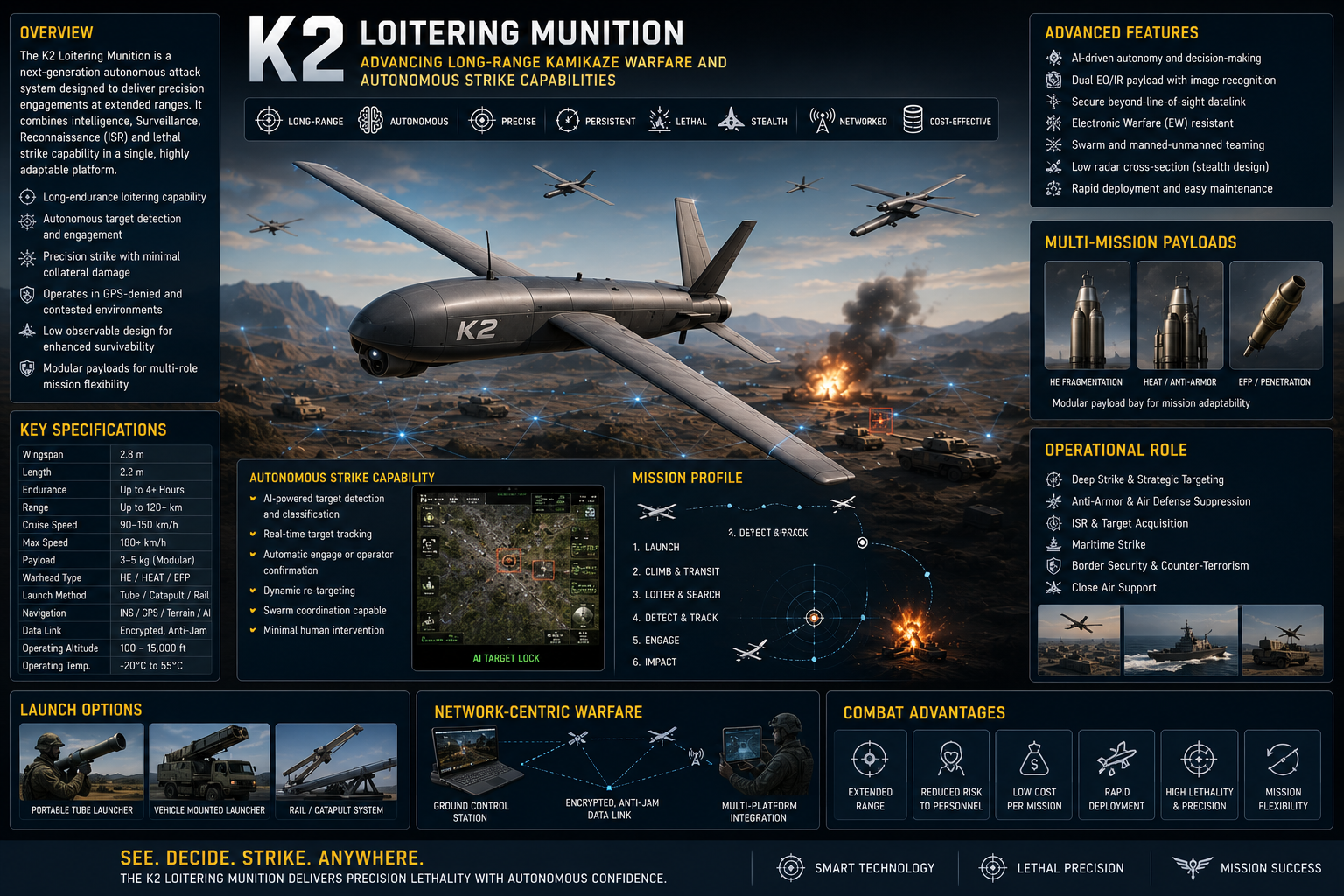
Growing Importance of Loitering Munitions in Modern Warfare
Loitering munitions occupy a unique operational space between traditional unmanned aerial systems (UAS) and guided missile platforms. Unlike conventional missiles that follow pre-programmed attack trajectories, loitering munitions can remain airborne for extended periods while searching for targets before executing a terminal strike.
This capability enables military forces to:
- Conduct persistent battlefield surveillance
- Track mobile targets in real time
- Perform rapid precision strikes
- Minimize collateral damage
- Operate in denied environments
- Support distributed combat operations
As modern conflicts increasingly demand rapid decision-making and decentralized operations, loitering munitions are becoming critical tools for tactical and operational-level warfare.
K2 Loitering Munition Expanding Autonomous Strike Capability
The K2 loitering munition concept reflects the next generation of smart autonomous combat systems designed for long-range precision strike missions. These systems are engineered to deliver high operational flexibility while maintaining affordability and deployment scalability.
Modern K2-class loitering systems typically emphasize:
- Extended endurance capability
- Autonomous navigation
- Precision strike accuracy
- AI-assisted targeting
- Network-centric communication
- Multi-role mission adaptability
- Reduced radar and thermal signatures
These features allow loitering munitions to engage high-value targets while operating across contested electromagnetic environments.
Long-Range Strike Missions Driving Demand
One of the primary drivers accelerating loitering munition adoption is the increasing importance of long-range precision strike operations.
Modern militaries require autonomous systems capable of:
- Engaging targets deep behind enemy lines
- Conducting beyond-line-of-sight operations
- Supporting anti-access/area denial (A2/AD) strategies
- Targeting mobile air defense systems
- Performing maritime strike operations
- Neutralizing command-and-control infrastructure
Long-range loitering munitions significantly improve battlefield reach while reducing dependence on manned strike aircraft operating in heavily defended airspace.
Their ability to remain airborne while awaiting optimal engagement opportunities also enhances tactical flexibility and mission success rates.
Artificial Intelligence Enhancing Autonomous Warfare
Artificial intelligence is becoming central to the evolution of advanced loitering munitions.
AI-enabled systems now support:
- Autonomous target detection
- Object recognition and classification
- Dynamic route optimization
- Threat prioritization
- Real-time battlefield adaptation
- Swarm coordination capability
Machine learning algorithms allow modern loitering munitions to process sensor data rapidly and respond dynamically to changing battlefield conditions.
AI-assisted autonomy also improves operational survivability by enabling drones to:
- Avoid enemy defenses
- Reconfigure flight paths
- Maintain mission continuity during communication disruption
- Operate with limited human intervention
As autonomous warfare technologies mature, AI integration will continue driving operational effectiveness and mission scalability.
ISR Integration Strengthening Battlefield Awareness
Modern loitering munitions increasingly function as integrated ISR and strike platforms rather than purely offensive systems.
Advanced sensor payloads now support:
- Electro-optical targeting
- Infrared surveillance
- Real-time video transmission
- Battlefield reconnaissance
- Target tracking
- Damage assessment
This integration allows operators to gather intelligence, confirm targets, and execute precision strikes using a single deployable platform.
The combination of ISR and strike functionality improves operational efficiency while reducing response time during dynamic combat scenarios.
Swarm Operations Expanding Tactical Flexibility
Swarm warfare is emerging as one of the most transformative applications of loitering munition technology.
Future K2-type systems may operate as coordinated autonomous swarms capable of:
- Saturation attacks
- Distributed reconnaissance
- Electronic warfare missions
- Air defense suppression
- Cooperative target engagement
- Dynamic mission adaptation
Swarm architectures significantly increase operational resilience because missions can continue even if individual drones are neutralized.
AI-enabled swarm coordination also complicates enemy defensive responses by overwhelming traditional air defense systems through mass deployment strategies.
Stealth and Survivability Becoming Critical
Modern air defense systems are becoming increasingly sophisticated, creating strong demand for low-observable loitering munitions capable of penetrating contested environments.
Advanced survivability features include:
Reduced Radar Cross-Section
Stealth airframe designs reduce detectability by radar systems.
Infrared Signature Suppression
Thermal management systems lower infrared visibility.
Low Probability of Intercept Communications
Secure communication systems reduce electronic detection risk.
Electronic Warfare Resistance
Anti-jamming technologies improve operational continuity under hostile interference.
These survivability enhancements allow loitering munitions to operate effectively against advanced integrated air defense systems.
Network-Centric Warfare Driving Connectivity Innovation
Modern combat operations increasingly rely on interconnected battlefield networks where autonomous systems share intelligence and coordinate operations in real time.
Advanced loitering munitions now integrate:
- Satellite communication (SATCOM)
- Mesh networking architectures
- Software-defined radios
- AI-assisted spectrum management
- Edge computing systems
These communication technologies support:
- Beyond-line-of-sight control
- Multi-domain coordination
- Swarm synchronization
- Real-time intelligence sharing
- Autonomous mission execution
Reliable communication infrastructure is becoming essential for future autonomous strike ecosystems.
Defense Modernization Programs Accelerating Adoption
Governments worldwide are expanding investments in autonomous strike technologies as part of broader defense modernization initiatives.
Key drivers include:
- Rising geopolitical tensions
- Increasing electronic warfare threats
- Demand for cost-effective combat systems
- Expansion of unmanned warfare doctrine
- Focus on distributed operations
- Need for rapid deployment capability
Loitering munitions provide militaries with scalable combat capability while reducing operational risks associated with traditional manned strike missions.
Explore In-Depth Industry Analysis: https://www.marketsandmarkets.com/Market-Reports/loitering-munition-market-139489979.html
Future Outlook
The future of autonomous warfare will be heavily shaped by advanced loitering munitions capable of combining long-range strike capability, AI-driven autonomy, ISR integration, and network-centric coordination into highly scalable combat systems.
K2 loitering munition systems represent the broader transformation occurring across modern military operations, where intelligent autonomous systems are becoming central to future battlefield strategy. As warfare continues evolving toward distributed, data-driven, and highly adaptive combat environments, long-range loitering munitions will play an increasingly decisive role in shaping next-generation precision strike and autonomous combat capabilities.
