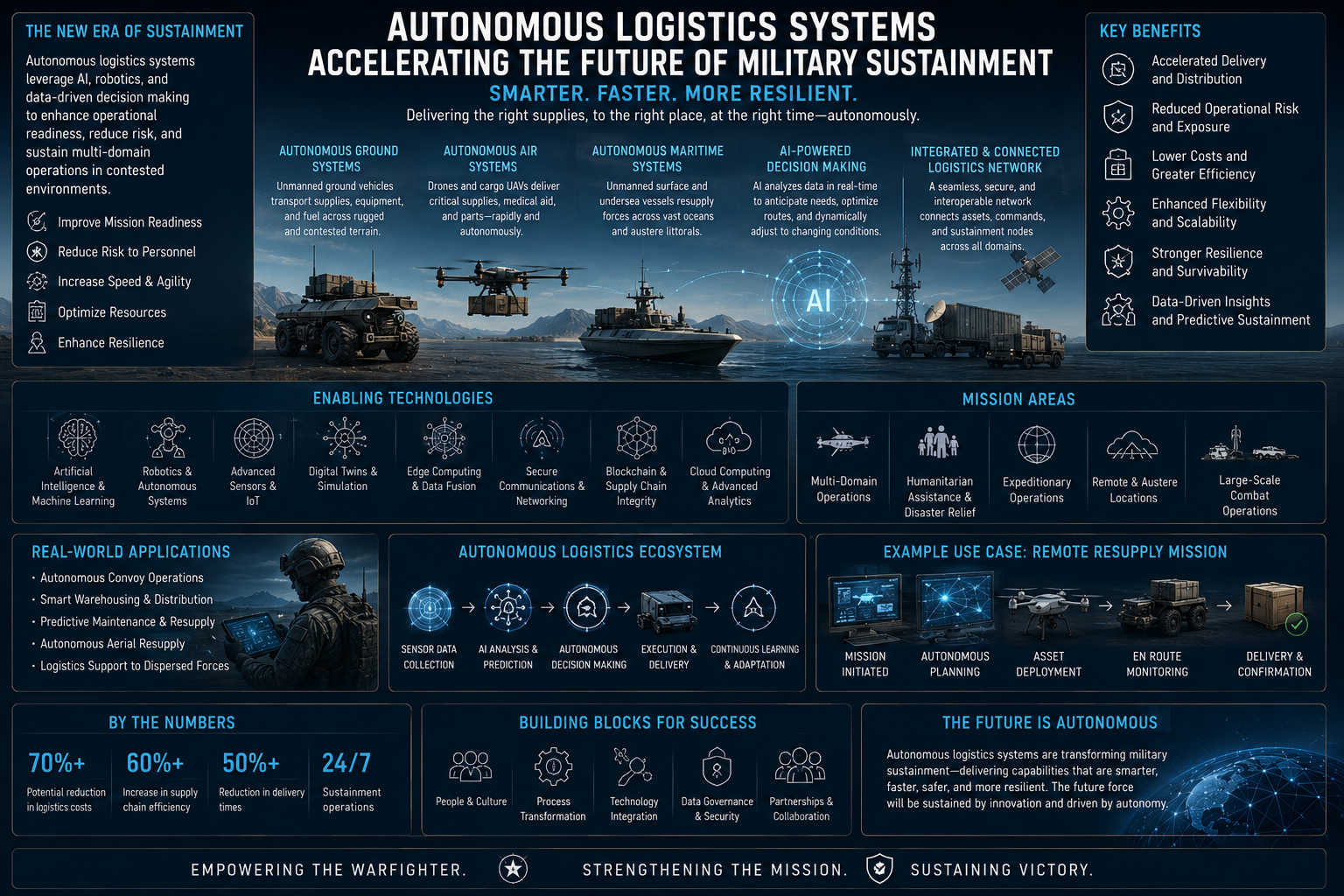
Autonomous logistics systems are rapidly transforming the future of military sustainment by enabling faster, safer, and more efficient movement of supplies, equipment, fuel, ammunition, and medical resources across complex operational environments. As modern warfare becomes increasingly data-driven, decentralized, and multi-domain, military organizations are investing heavily in autonomous technologies that can support sustained combat readiness while reducing risks to personnel and improving operational agility.
Traditional military logistics networks often face major challenges during high-intensity conflicts. Supply convoys are vulnerable to ambushes, communication disruptions, cyberattacks, and contested transportation routes. In modern battlefields where speed and survivability are critical, armed forces are shifting toward autonomous logistics platforms capable of operating with minimal human intervention. These systems are reshaping how militaries manage sustainment operations across land, air, sea, and space domains.
Download PDF Brochure : https://www.marketsandmarkets.com/pdfdownloadNew.asp?id=155479010
One of the most significant developments in this sector is the rise of autonomous ground resupply vehicles. Advanced unmanned transport vehicles can deliver ammunition, fuel, food, spare parts, and medical supplies directly to frontline units operating in dangerous or inaccessible areas. These vehicles use artificial intelligence, computer vision, LiDAR, GPS-denied navigation systems, and sensor fusion technologies to maneuver through complex terrains while avoiding obstacles and threats.
Defense organizations such as U.S. Department of Defense are actively testing robotic convoy systems that reduce the need for human drivers in combat zones. Autonomous convoy technologies improve operational efficiency while significantly lowering casualty risks associated with supply transportation missions. These capabilities are particularly valuable in contested environments where enemy forces target traditional logistics routes.
Autonomous aerial logistics systems are also becoming increasingly important for modern military sustainment. Unmanned aerial vehicles and cargo drones can rapidly transport critical supplies to remote forward operating bases, naval platforms, disaster zones, and special operations units. These systems provide rapid-response logistics capabilities during emergencies when conventional transport infrastructure is unavailable or under attack.
Heavy-lift military drones are evolving into key sustainment assets capable of carrying medical equipment, precision-guided munitions, batteries, communications systems, and humanitarian aid. Autonomous aerial resupply operations reduce delivery times and improve mission flexibility, especially during distributed warfare scenarios where forces operate across widely dispersed regions.
The growing adoption of artificial intelligence is further accelerating the evolution of autonomous military logistics. AI-powered predictive analytics systems can monitor supply chain performance, forecast maintenance needs, optimize inventory management, and identify potential disruptions before they affect operations. Predictive logistics enables militaries to maintain high readiness levels while reducing operational costs and minimizing equipment downtime.
Machine learning algorithms are increasingly integrated into military sustainment networks to analyze vast amounts of operational data in real time. These systems can dynamically reroute supplies, prioritize mission-critical deliveries, and optimize transportation schedules based on battlefield conditions. AI-driven logistics management enhances decision-making speed and enables more adaptive sustainment operations in rapidly changing combat environments.
Autonomous maritime logistics platforms are another emerging area of innovation. Unmanned surface vessels and autonomous underwater vehicles are being developed to support naval sustainment operations, cargo transport, surveillance, and fuel delivery missions. These systems can operate in high-risk maritime regions while reducing crew exposure to hostile threats. Future naval logistics architectures are expected to rely heavily on autonomous resupply capabilities to support distributed fleet operations.
Military sustainment is also being transformed by autonomous warehousing and robotic inventory systems. Smart military depots equipped with robotics, automated guided vehicles, and AI-driven inventory tracking technologies can significantly improve storage efficiency and supply distribution accuracy. Automated warehouses enable faster mobilization during crises while reducing manpower requirements and human error.
Additive manufacturing is increasingly integrated with autonomous logistics networks to support expeditionary operations. Mobile 3D printing systems allow deployed military units to manufacture spare parts, tools, and mission-critical components directly in operational theaters. This capability reduces dependency on vulnerable long-distance supply chains and improves battlefield sustainability.
Cybersecurity has become a critical priority as military logistics systems become more autonomous and interconnected. Autonomous sustainment platforms rely heavily on secure communications, cloud-based logistics networks, satellite systems, and AI-driven command infrastructures. Protecting these systems from cyberattacks, electronic warfare, and data manipulation is essential to maintaining operational reliability.
Advanced military communication networks, including resilient satellite constellations and secure tactical data links, are enabling real-time coordination between autonomous logistics assets. These technologies support synchronized multi-domain operations and enhance situational awareness across distributed supply networks.
Energy logistics is another area experiencing rapid transformation through autonomy. Future military forces will increasingly rely on autonomous fuel delivery systems, mobile energy storage platforms, and intelligent power management technologies to support electric vehicles, directed-energy weapons, sensors, and forward-deployed systems. Autonomous energy sustainment solutions will become critical for maintaining operational continuity in remote or contested environments.
The rise of multi-domain warfare is further increasing demand for highly flexible sustainment systems. Modern military operations often involve simultaneous activities across land, air, sea, cyber, and space domains. Autonomous logistics systems provide the scalability and adaptability needed to support these complex operations while maintaining rapid response capabilities.
Major defense contractors such as Lockheed Martin, Northrop Grumman, Raytheon, and BAE Systems are investing heavily in autonomous sustainment technologies, AI-enabled logistics software, robotic transport systems, and smart battlefield support networks. Growing defense modernization programs worldwide are expected to accelerate deployment of these technologies over the coming decade.
Explore In-Depth Industry Analysis: https://www.marketsandmarkets.com/Market-Reports/military-vehicle-sustainment-market-155479010.html
Future military sustainment operations will likely combine autonomous vehicles, intelligent logistics software, predictive maintenance platforms, unmanned cargo aircraft, robotic warehouses, and advanced communication networks into fully integrated digital sustainment ecosystems. These systems will enable armed forces to maintain operational readiness with greater speed, precision, resilience, and efficiency than ever before.
As global security environments become more unpredictable and technologically complex, autonomous logistics systems are emerging as foundational enablers of next-generation military power projection and battlefield endurance. The future of military sustainment will depend increasingly on intelligent autonomous systems capable of delivering continuous support across highly contested and rapidly evolving operational theaters.
