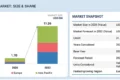
The global ADAS market size is projected to grow from 361.4 million units in 2026 to 582.6 million units by 2033, registering a CAGR of 7.1% during the forecast period. The increasing integration of advanced safety technologies, rising adoption of autonomous driving features, and growing regulatory focus on vehicle safety are major factors driving the growth of the ADAS market worldwide.
Advanced Driver Assistance Systems (ADAS) are transforming the automotive industry by improving vehicle safety, enhancing driving comfort, and supporting semi-autonomous driving capabilities. Automakers are increasingly integrating technologies such as adaptive cruise control (ACC), automatic emergency braking (AEB), lane keeping assist (LKA), blind spot detection, and driver monitoring systems across passenger and commercial vehicles.
AI and Sensor Fusion Technologies Accelerating ADAS Market Growth
The rapid advancement of artificial intelligence and sensor fusion platforms is significantly contributing to ADAS market growth. Modern ADAS solutions combine data from radar, LiDAR, cameras, and ultrasonic sensors to improve object detection, predictive safety, and real-time decision-making capabilities.
High-resolution camera systems now provide better visibility in low-light environments, while radar sensors deliver improved performance in adverse weather conditions. At the same time, LiDAR technology is becoming more affordable and compact, allowing wider deployment in mass-market vehicles.
AI-powered edge computing and over-the-air (OTA) software updates are also reshaping the ADAS industry. Automotive manufacturers can continuously improve vehicle safety features and introduce new functionalities without requiring hardware upgrades. This shift is supporting software-defined vehicle ecosystems and creating new revenue opportunities through subscription-based ADAS services.
Download PDF Brochure @ https://www.marketsandmarkets.com/pdfdownloadNew.asp?id=1201
China Leads Asia Pacific ADAS Market Share
China dominates the Asia Pacific ADAS market share due to its large automotive production capacity, strong government support, and increasing consumer demand for connected vehicles. Safety regulations and China NCAP standards are accelerating the deployment of advanced safety systems across both premium and mid-range vehicles.
Domestic automotive manufacturers are rapidly integrating ADAS features to remain competitive in the evolving mobility landscape. In addition, China benefits from a robust ecosystem of semiconductor manufacturers, AI companies, and sensor technology providers that help reduce costs and accelerate innovation.
Growing investments in smart mobility, electric vehicles, and autonomous driving technologies are further strengthening the country’s leadership position in the global ADAS market.
LiDAR Technology Emerging as Fastest-Growing Segment
Based on hardware offering type, LiDAR is expected to witness the fastest growth in the ADAS market during the forecast period. LiDAR sensors play a critical role in enabling Level 3 and higher autonomous driving capabilities through accurate 3D mapping and obstacle detection.
Technological advancements such as solid-state LiDAR, MEMS LiDAR, and electronically scanning LiDAR are improving durability, reducing system costs, and enhancing performance for automotive applications.
The growing demand for semi-autonomous vehicles, rising traffic congestion, and increasing focus on road safety are encouraging automotive manufacturers to adopt high-performance LiDAR systems in next-generation vehicles.
Level 3 Autonomous Vehicles Driving Future ADAS Market Trends
Level 3 autonomous vehicles are expected to grow at the fastest rate within the ADAS market as automakers move toward higher levels of vehicle automation. These systems allow drivers to disengage from active driving under certain controlled conditions, creating new opportunities for advanced driver assistance technologies.
Continuous improvements in sensors, AI algorithms, and high-performance computing platforms are supporting the commercialization of Level 3 autonomous driving systems. Regulatory approvals and real-world testing programs are also helping build consumer confidence in autonomous mobility solutions.
As automotive companies continue investing in software-defined vehicles and intelligent transportation systems, the demand for advanced ADAS technologies is expected to increase significantly over the coming years.
Future Opportunities in the ADAS Industry
The future of the ADAS industry will be shaped by stricter vehicle safety regulations, growing adoption of connected vehicles, and increasing investments in autonomous driving technologies. Sensor fusion platforms, cloud-based vehicle software, and cybersecurity solutions are expected to create new growth opportunities for automotive OEMs and technology providers.
The integration of predictive maintenance services, AI-based perception systems, and OTA-enabled feature upgrades is also opening new recurring revenue streams within the ADAS ecosystem. Companies developing scalable and cost-effective ADAS solutions are expected to gain a strong competitive advantage in the evolving automotive market.
Request Free Sample Report @ https://www.marketsandmarkets.com/requestsampleNew.asp?id=1201
Conclusion
The ADAS market is entering a new phase of growth driven by AI-powered safety technologies, connected mobility, and increasing adoption of autonomous driving systems. Advancements in LiDAR, radar, sensor fusion, and software-defined vehicle platforms are accelerating the transformation of the automotive industry.
With strong regulatory support, rapid technological innovation, and increasing consumer demand for safer vehicles, the global ADAS market share is expected to expand considerably through 2033.