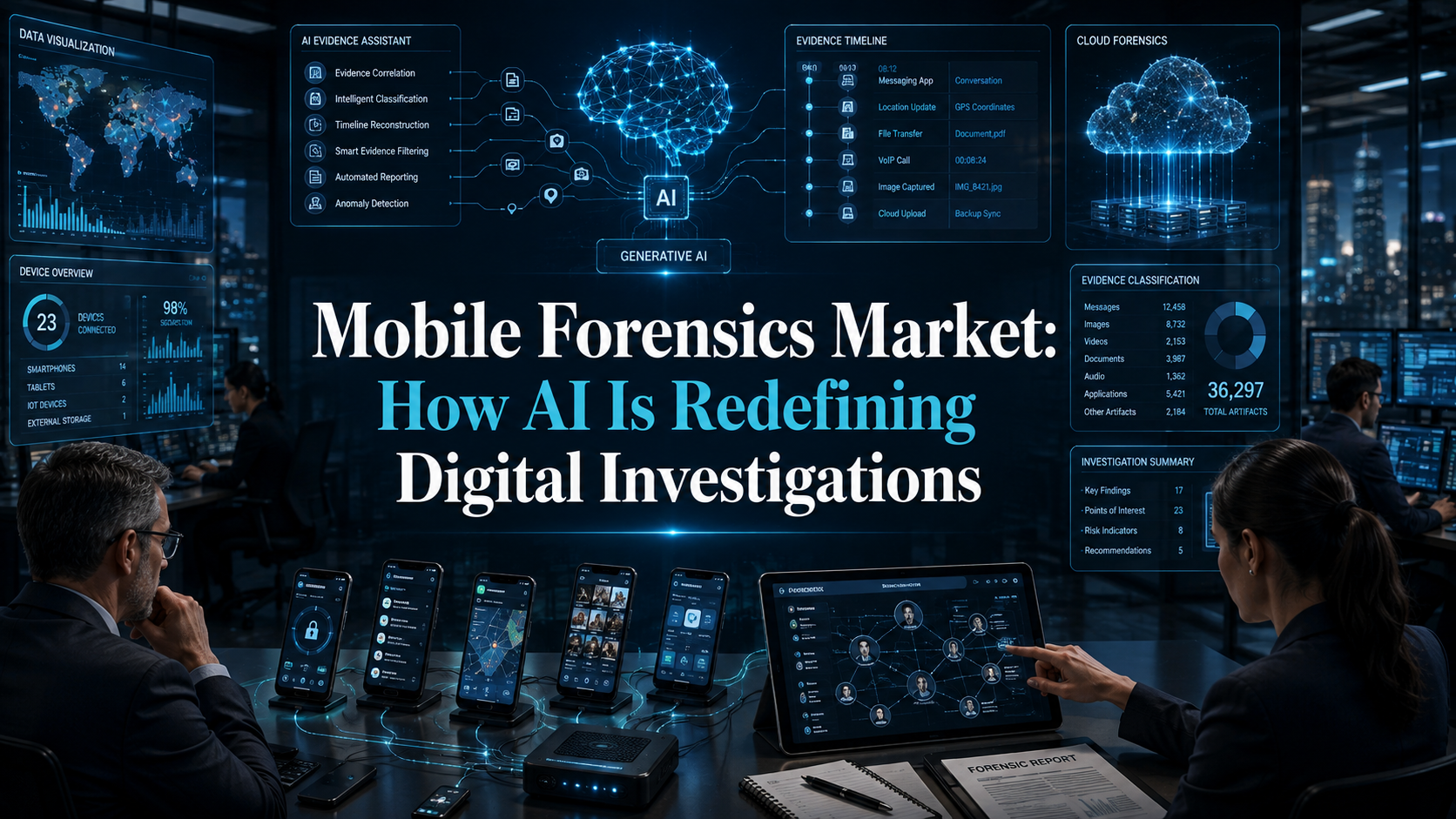
The Mobile Forensics Market is moving from traditional evidence collection toward AI-assisted analysis, intelligent prioritization, cloud forensics, and faster evidence-driven decisions.
Artificial intelligence, particularly generative AI, is emerging as a new layer for addressing the challenge of growing digital evidence. The bigger opportunity is not market size alone; it is the transformation from digital evidence collection to intelligent evidence interpretation.
The New Evidence Economy: Why Smartphones Have Become Critical
Smartphones have become concentrated sources of digital evidence, making mobile forensics increasingly important for cybersecurity, fraud, compliance, litigation, incident response, and financial-crime investigations.
Mobile evidence is increasingly relevant to:
- Cybersecurity and fraud investigations
- Insider-risk and employee misconduct investigations
- Corporate and regulatory investigations
- Intellectual-property protection
- Incident response and law enforcement
- Financial-crime investigations
MarketsandMarkets identifies rising mobile-centric cybercrime, increasing legal reliance on mobile-derived evidence, and widespread enterprise mobility as important drivers of Mobile Forensics Market growth.
Mobile Forensics Market: The Numbers Behind the AI Revolution
Research Industry forecasts the Mobile Forensics Market to grow from USD 5.72 billion in 2026 to USD 9.99 billion by 2031, representing an 11.8% CAGR.
Key signals include:
- North America held the largest regional share in 2026 at 43.1%.
- Asia Pacific is projected to be the fastest-growing region.
- BFSI is expected to record a 13.8% CAGR, reflecting rising demand for mobile evidence in financial investigations and fraud-related use cases.
According to market research, you can Download the PDF to explore detailed business opportunities.
Why Traditional Digital Investigations Are Falling Behind
Traditional forensic workflows struggle when evidence expands across smartphones, applications, cloud accounts, operating systems, multimedia, locations, and metadata.
Modern investigations can involve:
- Multiple smartphones and applications
- Encrypted communications
- Cloud-connected accounts
- Different operating systems and data formats
- Large multimedia collections
- Historical device information
- Location data and application metadata
The challenge is therefore not simply extraction. It is prioritization.
Investigators may encounter thousands or millions of data points while only a fraction directly matters to a case. This is where Mobile Forensics Market analysis increasingly intersects with AI.
AI can identify patterns, categorize information, correlate related data, and surface potentially relevant evidence for human review. Generative AI can create natural-language summaries and help investigators navigate complex evidence collections.
Accelerate your business growth by accessing our free Sample Report.
Generative AI: From Evidence Analysis to Investigation Intelligence
Generative AI can assist mobile investigations by summarizing evidence, correlating events, prioritizing relevant information, reconstructing timelines, classifying artifacts, and supporting structured reporting.
Key capabilities include:
- Summarization: Turn large evidence collections into concise investigative overviews.
- Correlation: Identify relationships among messages, events, applications, and timestamps.
- Prioritization: Surface potentially relevant evidence for human examination.
- Classification: Organize evidence into investigative categories.
- Timeline reconstruction: Help establish sequences from disparate records.
- Reporting: Assist with structured investigative documentation.
MarketsandMarkets identifies AI-driven analytics, smart data filtering, and automated reporting as capabilities that can streamline mobile forensic workflows.
Five Questions Executives Should Ask Before Investing
Enterprises should evaluate AI-powered mobile forensics through five lenses: investigation speed, cloud capability, encryption challenges, enterprise applicability, and trust in AI-assisted conclusions.
1. Can AI reduce investigation time?
Potentially. The greatest opportunity may be faster analysis and prioritization rather than faster evidence acquisition.
2. Can AI work with cloud-connected evidence?
Increasingly. Mobile Forensics Market trends point toward remote and cloud-based capabilities that support centralized, scalable investigations.
3. Can AI solve encrypted-device challenges?
No technology should be treated as a universal solution. Encryption and secure device architectures continue to create technical, legal, and access challenges.
4. Can enterprises use mobile forensics?
Yes. Enterprise mobility creates demand for investigation capabilities across employee devices, corporate applications, and digital communications.
5. Can investigators trust AI-generated conclusions?
Only with validation. AI should support investigative reasoning, while important conclusions remain traceable to underlying evidence.
Enterprise Applications: Turning Mobile Evidence Into Business Protection
Mobile forensics can support enterprise cybersecurity, fraud investigations, insider-risk management, litigation, compliance, and intellectual-property protection.
- Cyber incident investigation: Helps establish what happened, when it happened, and which artifacts may matter.
- Financial fraud: Supports investigations involving suspicious transactions, communications, and device activity. BFSI is expected to be the fastest-growing vertical, with a projected 13.8% CAGR.
- Insider risk: Mobile evidence may become relevant when sensitive information is suspected of leaving an organization.
- Corporate litigation: Mobile communications can support legal discovery and internal investigations.
- Compliance: Regulated organizations require defensible processes for handling sensitive evidence.
- Intellectual property protection: Devices may contain credentials, communications, and business information connected to valuable intellectual property.
The New Forensic Architecture: Device + Cloud + AI + Human Expertise
The emerging forensic architecture connects devices, evidence acquisition, cloud data, AI analytics, generative AI, human validation, and secure evidence management.
- Device: Smartphones, tablets, and emerging endpoints generate evidence.
- Acquisition: Appropriate forensic methods collect relevant evidence.
- Cloud: Connected applications and remote sources expand the investigation.
- Analytics: AI and machine learning process large evidence collections.
- Generative AI: Natural-language interfaces help investigators query, summarize, and organize evidence.
- Human validation: Investigators verify AI-assisted findings against source evidence.
- Evidence management: Evidence remains securely stored, traceable, and appropriately managed.
Trust, Privacy and Evidence Integrity in the GenAI Era
AI can accelerate evidence analysis, but privacy, provenance, chain of custody, traceability, and human oversight remain essential to trustworthy mobile investigations.
Generative AI creates a critical paradox: faster analysis also increases the importance of evidence authenticity.
Digital material cannot automatically be treated as trustworthy simply because it appears on a screen. AI-generated content and deepfakes make provenance, integrity, completeness, and contextual validation increasingly important.
Enterprises should combine:
- AI speed and forensic discipline
- Human oversight and evidence traceability
- Data minimization and legal authorization
- Privacy controls and secure storage
- Retention policies and auditability
Competitive Landscape: The Race Toward Intelligent Investigation
Competition is shifting from basic device extraction toward AI-powered analysis, cloud investigation, automation, remote workflows, data correlation, reporting, scalability, and evidence management.
Markets Research identifies Grayshift, Oxygen Forensics, and SalvationDATA among emerging innovators focused on areas such as encrypted-device access, advanced extraction, and scalable analysis.
2026 Technology Shift: From Forensic Tools to Investigation Intelligence
The strongest Mobile Forensics Market trends converge on one objective: reducing the distance between digital evidence and informed decisions.
Key developments include:
- AI-powered evidence analysis: Finds patterns across large collections.
- Generative AI assistants: Make complex evidence easier to query and summarize.
- Cloud-based forensics: Supports distributed investigations and centralized workflows.
- Automated reporting: Reduces repetitive documentation.
- Smart data filtering: Helps investigators focus on relevant evidence.
- Emerging device ecosystems: Require broader forensic coverage.
- Advanced encryption: Remains both a security necessity and forensic challenge.
- Anti-forensics: Increases demand for sophisticated detection and validation.
The Future: From Digital Evidence to Digital Intelligence
The Mobile Forensics Market is moving toward an evidence-intelligence model where AI, cloud technologies, automation, and human expertise work together to produce faster, scalable, and defensible investigations.
The organizations that lead will not necessarily collect the most information. They will answer critical questions quickly, accurately, and defensibly.
The real opportunity behind the Mobile Forensics Market is not simply extracting data. It is transforming evidence into intelligence.
The next generation of investigations will move beyond:
“What data is on this device?”
toward:
“What does the combined evidence tell us—and what should we do next?”
For enterprise leaders, this means treating forensic intelligence as a strategic capability, not software.
That is the transition from mobile forensics to investigation intelligence. As the market approaches USD 10 billion by 2031, AI-powered forensic technology is positioned to become increasingly important to enterprise security, fraud prevention, compliance, and digital resilience.
The future investigator will not be replaced by AI. The investigator who knows how to work with AI may simply be able to investigate more intelligently.