The Asia Pacific Collaborative Robot (Cobot) Market is witnessing robust growth as industries across the region increasingly adopt automation to enhance productivity, address labor shortages, and enable flexible manufacturing. Collaborative robots—designed to operate safely alongside humans—are gaining traction in automotive, electronics, logistics, manufacturing, and other sectors owing to advancements in robotics, AI, and Industry 4.0 initiatives.
The Asia Pacific collaborative robot market is expected to grow to USD 1.60 billion by 2030 from USD 0.59 billion in 2025, at a CAGR of 22.1% from 2025 to 2030.
Download PDF Sample: https://www.marketsandmarkets.com/pdfdownloadNew.asp?id=49403618
Asia Pacific Collaborative Robot Market Trends
- Rapid Adoption of Industry 4.0 Automation
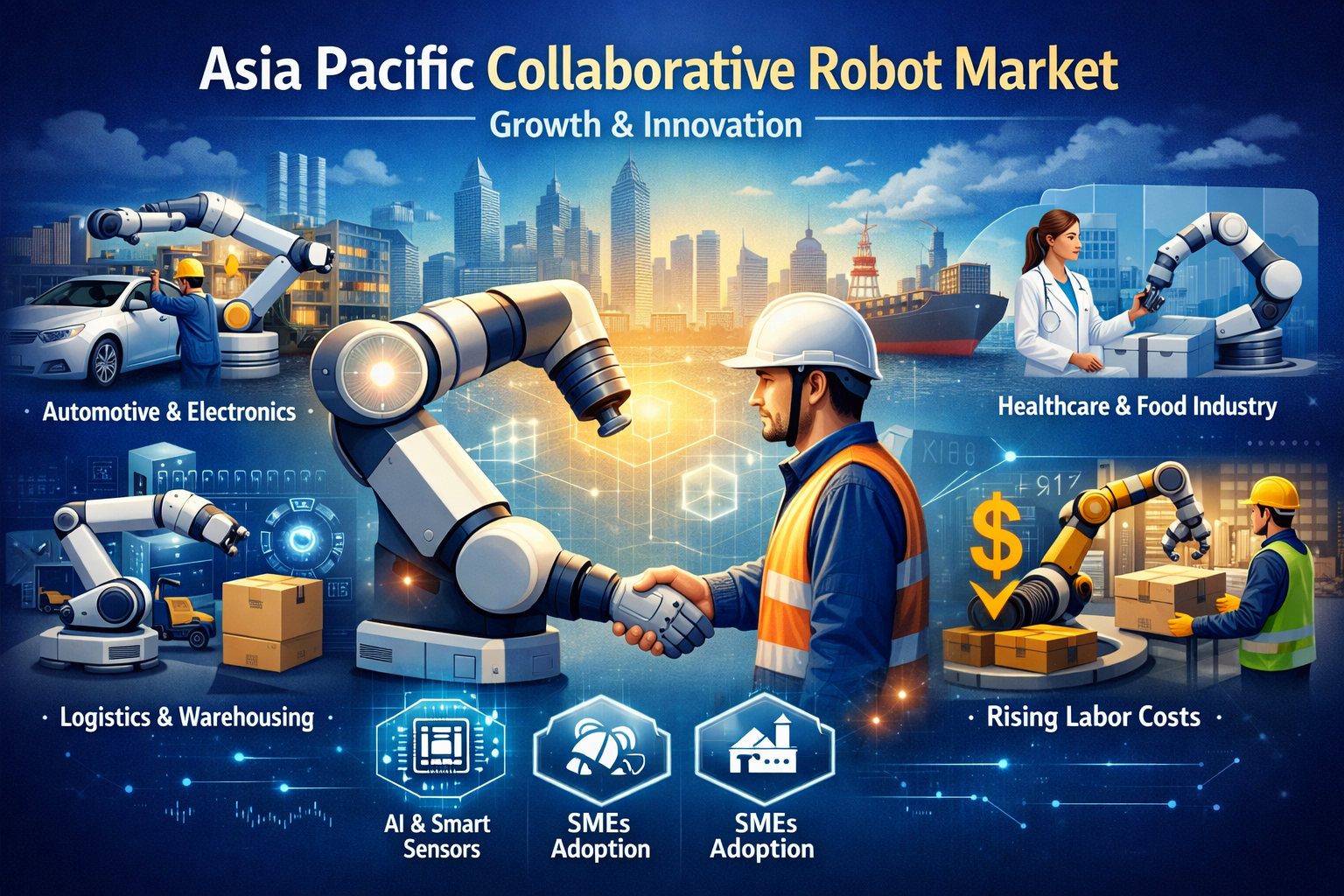
Increasing investments in smart manufacturing and digital transformation are driving collaborative robot deployment across key Asia Pacific industrial hubs. Cobots help manufacturers enhance efficiency, improve quality, and reduce time-to-market for complex products.
- Flexible, Human-Robot Collaboration
Cobots are designed to work safely alongside human operators without extensive safety barriers. Safety features such as power and force limiting (PFL) and monitored stop ensure effective human-robot interaction, making cobots suitable for SMEs and enterprise environments alike.
- Expansion into Logistics and Warehousing
Beyond traditional assembly lines, collaborative robots are now widely used in logistics for tasks such as picking, packing, sorting, and material handling, reducing dependence on manual labor and boosting operational throughput.
- AI and Sensor Integration
Integration of AI, vision systems, and advanced sensors increases cobot accuracy, adaptability, and automation capabilities. These technologies enable visual inspections, predictive maintenance, and intuitive task programming.
- Accessibility for SMEs
Cobots are becoming more cost-competitive and easier to integrate, helping small and medium-sized enterprises adopt automation without prohibitive costs or technical expertise barriers.
Make an Inquiry: https://www.marketsandmarkets.com/Enquiry_Before_BuyingNew.asp?id=49403618
Key Drivers of Asia Pacific Collaborative Robot Market Growth
Rising Manufacturing Automation
Asia Pacific is home to major electronics, automotive, and heavy-manufacturing sectors. The shift toward automated and flexible production lines is accelerating cobot adoption across these industries.
Labor Cost Pressures and Workforce Shortages
Countries such as China, Japan, South Korea, and Singapore are facing rising labor costs and demographic challenges. Cobots provide an efficient solution to maintain output while addressing workforce constraints.
Government Support and Industry Initiatives
Regional governments are supporting smart manufacturing through subsidies, tax incentives, and national robotics programs that encourage automation adoption at scale.
Expansion of Logistics and E-commerce
Rapid growth in e-commerce and modern supply chains is increasing the need for cobot deployments in warehousing and fulfillment centers, enhancing speed and accuracy of order processing.
Competitive Landscape
The Asia Pacific Collaborative Robot Market is highly competitive, with players emphasizing innovation, strategic partnerships, and regional expansions. Key strategies include:
Product Innovation: Launch of cobots with enhanced payload capacities, advanced sensing, and AI-enabled features.
Strategic Collaborations: Partnerships between robotics manufacturers, integrators, and industrial automation providers to expand solutions across end-use sectors.
Regional Focus: Increasing footprint of global robotics brands and strong local competitors targeting high-growth markets such as China and India.
Leading market players include:
- FANUC Corporation (Japan)
- Techman Robot Inc. (Taiwan)
- Universal Robots A/S (Denmark)
- AUBO Robotics (China)
- Doosan Robotics (South Korea)
- Yaskawa Electric Corporation (Japan)
- Siasun Robot & Automation Co., Ltd. (China)
Future Outlook
The Asia Pacific collaborative robot market is forecast to experience strong expansion through 2032. Continued technological advancements in robotics, AI integration, and flexible automation systems will sustain demand across manufacturing, logistics, and emerging sectors such as healthcare and food processing. Adoption is also expected to increase in small and medium enterprises as cobots become more affordable and easier to deploy.
Market growth is supported by:
- Increasing automation investments and restructuring of supply chains
- Continued government support and initiatives to promote Industry 4.0
- Expansion beyond traditional manufacturing into logistics and service applications
Ask for Sample Report: https://www.marketsandmarkets.com/requestsampleNew.asp?id=49403618
Asia Pacific Collaborative Robot Market: Investor-Focused FAQs
What is driving the Asia Pacific collaborative robot market growth?
The market is propelled by rising industrial automation, increasing labor costs, adoption of Industry 4.0 practices, and expanding use cases in logistics and manufacturing.
Which industry segments are leading adoption?
Automotive and electronics manufacturing represent the largest demand sectors, using cobots for assembly, welding, testing, and material handling.
What technologies are shaping the market?
AI integration, machine vision, advanced sensors, and safety features like power and force limiting are key technology drivers enhancing cobot performance.
Which countries show the strongest growth potential?
China dominates the region with substantial market share owing to its large manufacturing base, while India is poised to be the fastest-growing market due to rapid industrial expansion and automation adoption.