Introduction to Valve Positioners and Their Importance
Valve positioners are essential components in industrial automation, playing a crucial role in controlling the exact position of valve actuators. This precision is vital for processes that require accurate flow regulation of gases, liquids, or steam. Over time, valve positioners have evolved significantly, adapting to advancements in technology and the increasing complexity of industrial systems. Today, several types of valve positioners are available, each with unique mechanisms and features tailored to different operational needs and environments.
Pneumatic Valve Positioners: Reliability in Harsh Environments
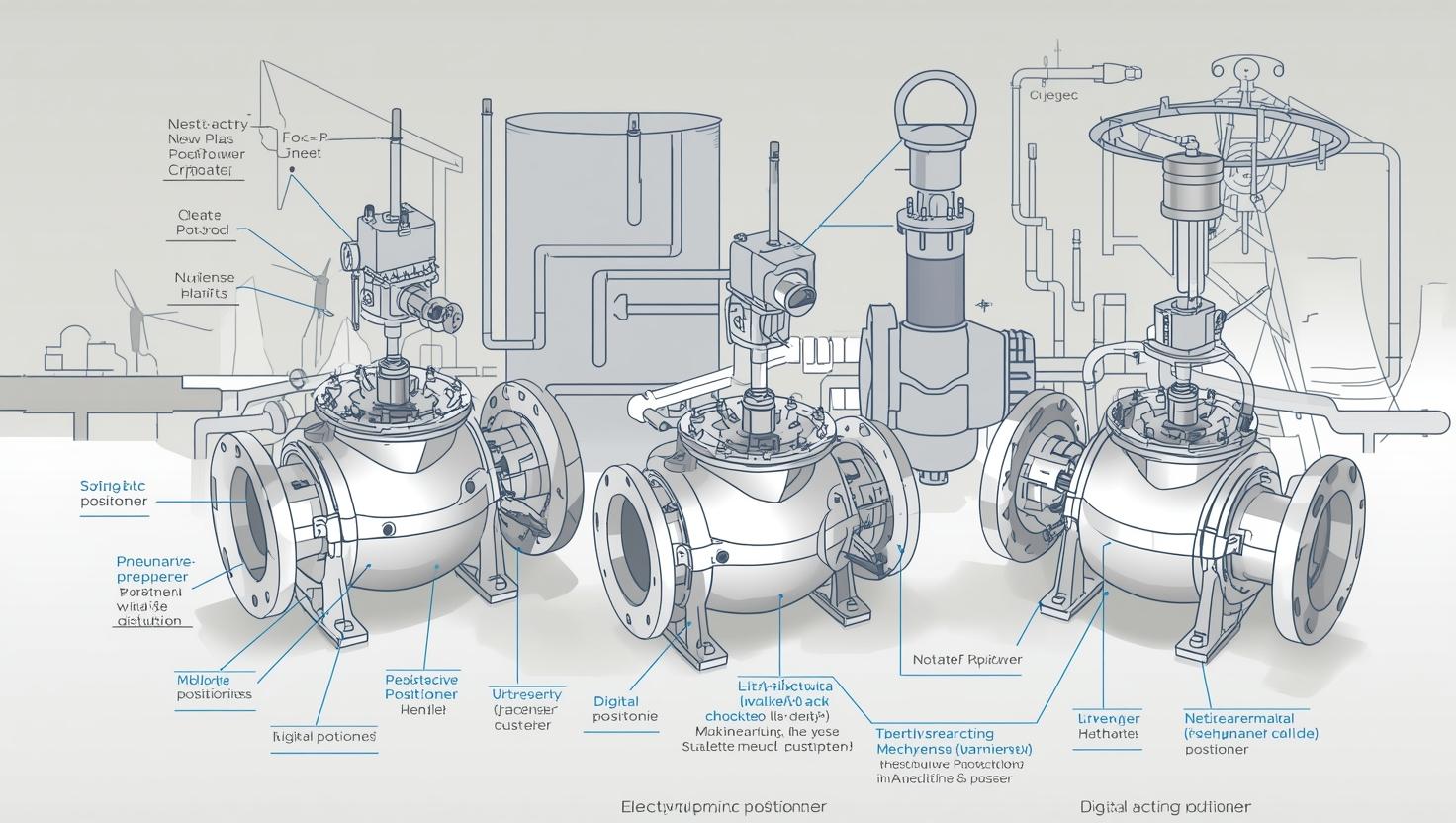
Pneumatic valve positioners are among the oldest and most widely used types. They operate using compressed air signals to adjust the valve actuator position. Their simple and robust design makes them highly reliable, especially in hazardous environments where electrical components might pose safety risks. Pneumatic positioners excel in industries like oil and gas or chemical plants where explosion-proof equipment is mandatory. Although they lack advanced diagnostic capabilities, their mechanical simplicity ensures low maintenance and high durability over extended periods. However, pneumatic positioners do not easily integrate with modern digital control systems, limiting their application in today’s smart industrial setups.
Electro-Pneumatic Valve Positioners: Bridging Analog and Digital Control
Electro-pneumatic valve positioners mark a transitional technology combining electrical control signals with pneumatic actuation. These devices accept standard 4–20 mA electrical signals, commonly used in process control systems, and convert them into proportional pneumatic outputs. This hybrid approach provides improved accuracy and quicker response times compared to purely pneumatic models. They also offer better compatibility with programmable logic controllers (PLCs) and other automation hardware. However, the inclusion of electrical components introduces potential vulnerability to electromagnetic interference and increases system complexity. Maintenance for these units tends to be more involved than for pneumatic-only types.
Download PDF Brochure @ https://www.marketsandmarkets.com/pdfdownloadNew.asp?id=138950854
Digital Valve Positioners: The Industry’s Modern Backbone
Digital valve positioners represent a significant leap forward by integrating microprocessors and software-based control. These positioners provide highly accurate valve positioning and come equipped with advanced features such as self-calibration, real-time diagnostics, and fault detection. The ability to communicate over fieldbus protocols like HART, Profibus, or Foundation Fieldbus allows seamless integration with distributed control systems and digital twins, facilitating predictive maintenance and reducing unplanned downtime. Digital valve positioners enable operators to monitor valve health remotely, optimizing performance and extending equipment lifespan. The increasing adoption of Industry 4.0 and IIoT (Industrial Internet of Things) frameworks further accelerates demand for digital solutions within the valve automation segment.
Wireless Valve Positioners: Flexibility and Cost Efficiency
Wireless valve positioners introduce the convenience of eliminating extensive wiring, thereby reducing installation costs and enabling easier retrofitting in existing plants. These devices use wireless communication technologies such as Wi-Fi, Bluetooth, or proprietary industrial protocols to transmit control and diagnostic data. Their flexibility allows deployment in hard-to-reach or rotating equipment where wiring would be impractical. Nonetheless, wireless systems face challenges related to signal reliability, interference, and battery life management. Despite these concerns, wireless valve positioners are gaining traction, especially in industries prioritizing cost-effective upgrades and streamlined maintenance procedures.
Smart Valve Positioners: The Future of Valve Automation
Smart valve positioners build upon digital technologies by incorporating sophisticated sensors, advanced analytics, and cloud connectivity. These devices offer comprehensive performance monitoring, enabling operators to predict failures before they occur and schedule maintenance proactively. Smart positioners integrate with IIoT platforms, feeding data into enterprise asset management systems and contributing to holistic plant optimization strategies. Their ability to dynamically adjust valve operations based on real-time process conditions enhances energy efficiency and throughput. As industries continue to prioritize sustainability and operational excellence, smart valve positioners are becoming indispensable components of next-generation automation ecosystems.
Industry Trends and Market Dynamics
The valve positioner industry is evolving rapidly, driven by trends such as increased industrial automation, demand for energy efficiency, and stricter environmental regulations. The Global valve positioner market is projected to grow from USD 2.07 billion in 2025 to USD 2.56 billion by 2030, registering a CAGR of 4.4 % during the forecast period. The growing complexity of process control systems necessitates positioners that provide not only precise control but also actionable insights into equipment health and performance. Digital and smart valve positioners dominate market growth due to their adaptability, advanced diagnostics, and compatibility with modern communication standards. Meanwhile, the ongoing digital transformation encourages the gradual phasing out of purely pneumatic systems in favor of more intelligent solutions. Nonetheless, pneumatic positioners retain a significant share in niche applications where simplicity and intrinsic safety are paramount.
Conclusion: Choosing the Right Valve Positioner
Selecting the appropriate valve positioner requires a careful balance between application requirements, environmental conditions, control system compatibility, and budget considerations. Pneumatic valve positioners remain valuable for environments demanding explosion-proof, low-maintenance solutions. Electro-pneumatic models offer a bridge to integrate with analog control systems, while digital and smart positioners are ideal for facilities seeking advanced automation, remote monitoring, and predictive maintenance capabilities. Wireless positioners offer new possibilities for flexible installations. Ultimately, understanding the specific strengths and limitations of each valve positioner type is essential for optimizing process control and achieving operational excellence in modern industrial settings.
Frequently Asked Questions (FAQ)
Q1: What is a valve positioner and why is it important?
A valve positioner is a device that controls the precise position of a valve actuator, ensuring accurate regulation of fluid flow in industrial processes. It is crucial for maintaining process stability, safety, and efficiency.
Q2: What are the main types of valve positioners?
The main types include pneumatic, electro-pneumatic, digital, wireless, and smart valve positioners. Each type offers different levels of control precision, communication capabilities, and integration with automation systems.
Q3: How do pneumatic valve positioners differ from digital ones?
Pneumatic valve positioners use compressed air to control valve movement and are valued for simplicity and reliability, especially in hazardous environments. Digital valve positioners use microprocessors and offer advanced diagnostics, remote control, and integration with digital control systems.
Q4: What advantages do electro-pneumatic valve positioners offer?
Electro-pneumatic positioners bridge electrical control signals and pneumatic actuation, offering better accuracy and faster response times compared to purely pneumatic models while supporting integration with analog control systems.
Q5: Are wireless valve positioners reliable?
Wireless valve positioners provide installation flexibility and reduced wiring costs. However, they can face challenges such as signal interference and battery life constraints, requiring careful planning for critical applications.
About MarketsandMarkets™
MarketsandMarkets™ has been recognized as one of America’s Best Management Consulting Firms by Forbes, as per their recent report.
MarketsandMarkets™ is a blue ocean alternative in growth consulting and program management, leveraging a man-machine offering to drive supernormal growth for progressive organizations in the B2B space. With the widest lens on emerging technologies, we are proficient in co-creating supernormal growth for clients across the globe.
Today, 80% of Fortune 2000 companies rely on MarketsandMarkets, and 90 of the top 100 companies in each sector trust us to accelerate their revenue growth. With a global clientele of over 13,000 organizations, we help businesses thrive in a disruptive ecosystem.
The B2B economy is witnessing the emergence of $25 trillion in new revenue streams that are replacing existing ones within this decade. We work with clients on growth programs, helping them monetize this $25 trillion opportunity through our service lines – TAM Expansion, Go-to-Market (GTM) Strategy to Execution, Market Share Gain, Account Enablement, and Thought Leadership Marketing.
Built on the ‘GIVE Growth’ principle, we collaborate with several Forbes Global 2000 B2B companies to keep them future-ready. Our insights and strategies are powered by industry experts, cutting-edge AI, and our Market Intelligence Cloud, KnowledgeStore™, which integrates research and provides ecosystem-wide visibility into revenue shifts.
To find out more, visit www.MarketsandMarkets™.com or follow us on Twitter , LinkedIn and Facebook .
Contact:
Mr. Rohan Salgarkar
MarketsandMarkets™ INC.
1615 South Congress Ave.
Suite 103, Delray Beach, FL 33445
USA: +1-888-600-6441
About MarketsandMarkets™
MarketsandMarkets™ has been recognized as one of America’s Best Management Consulting Firms by Forbes, as per their recent report.
MarketsandMarkets™ is a blue ocean alternative in growth consulting and program management, leveraging a man-machine offering to drive supernormal growth for progressive organizations in the B2B space. With the widest lens on emerging technologies, we are proficient in co-creating supernormal growth for clients across the globe.
Today, 80% of Fortune 2000 companies rely on MarketsandMarkets, and 90 of the top 100 companies in each sector trust us to accelerate their revenue growth. With a global clientele of over 13,000 organizations, we help businesses thrive in a disruptive ecosystem.
The B2B economy is witnessing the emergence of $25 trillion in new revenue streams that are replacing existing ones within this decade. We work with clients on growth programs, helping them monetize this $25 trillion opportunity through our service lines – TAM Expansion, Go-to-Market (GTM) Strategy to Execution, Market Share Gain, Account Enablement, and Thought Leadership Marketing.
Built on the ‘GIVE Growth’ principle, we collaborate with several Forbes Global 2000 B2B companies to keep them future-ready. Our insights and strategies are powered by industry experts, cutting-edge AI, and our Market Intelligence Cloud, KnowledgeStore™, which integrates research and provides ecosystem-wide visibility into revenue shifts.
To find out more, visit www.MarketsandMarkets™.com or follow us on Twitter , LinkedIn and Facebook .
Contact:
Mr. Rohan Salgarkar
MarketsandMarkets™ INC.
1615 South Congress Ave.
Suite 103, Delray Beach, FL 33445
USA: +1-888-600-6441
