The rapid expansion of cloud computing, artificial intelligence (AI), edge computing, and digital transformation has significantly increased demand for data centres worldwide. As these facilities consume substantial amounts of electricity, operators are under growing pressure to improve energy efficiency, reduce carbon emissions, and comply with evolving environmental regulations. Consequently, data centre certifications have become essential benchmarks for evaluating sustainability, operational efficiency, and infrastructure resilience. The data center certification market is projected to reach USD 3.05 billion by 2032 from an estimated USD 1.16 billion in 2026, growing at a CAGR of 17.4%.
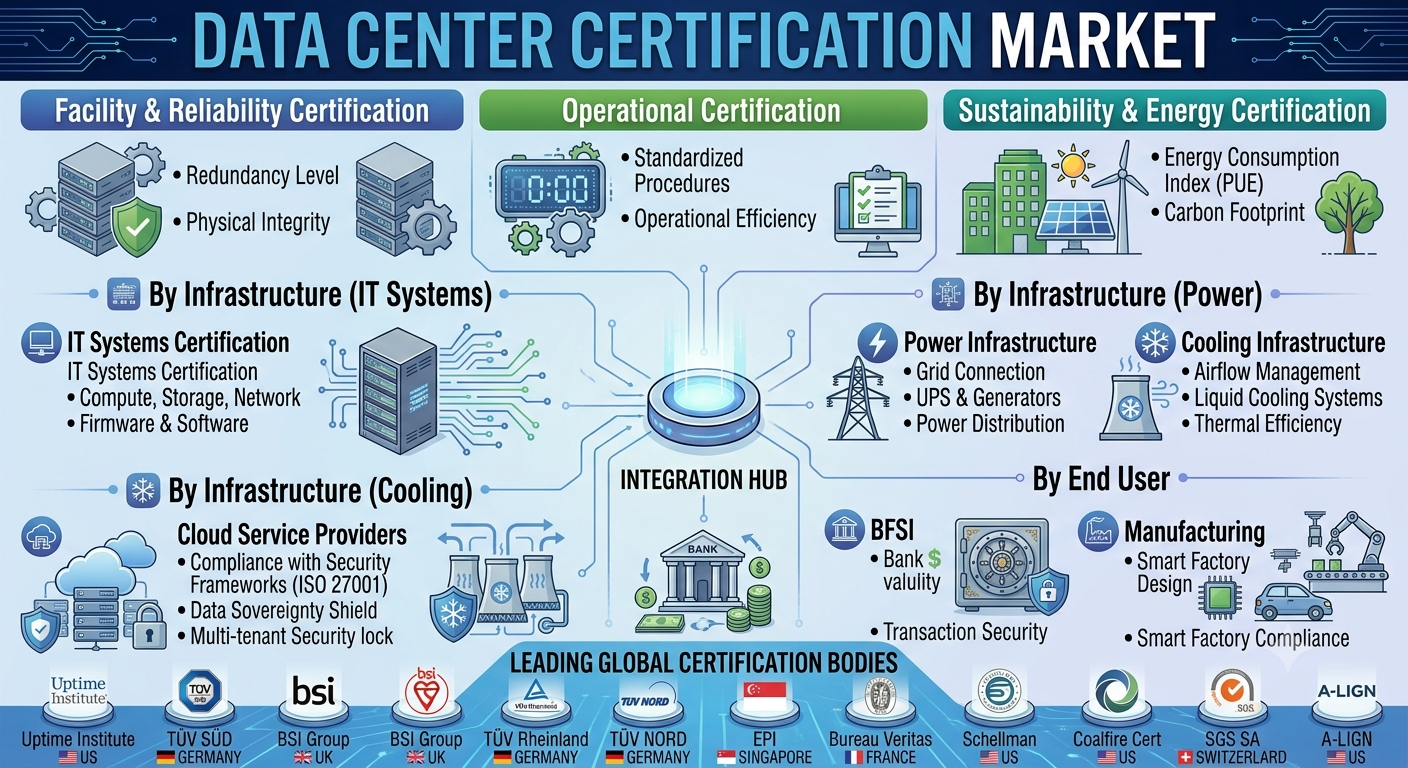
Certification programmes such as LEED, BREEAM, ENERGY STAR, Uptime Institute Tier Certification, TIA-942, and ISO 50001 are encouraging organisations to adopt best practices in energy management while improving operational performance. These certifications not only demonstrate environmental responsibility but also help operators reduce operational costs, attract environmentally conscious customers, and meet corporate ESG objectives.
Growing Focus on Green Building Certifications
Green building certifications have become a primary driver of sustainable data centre development. Operators are increasingly pursuing certifications such as LEED and BREEAM to demonstrate compliance with energy-efficient building practices. These certifications evaluate multiple sustainability parameters, including energy consumption, water conservation, material selection, waste management, indoor environmental quality, and carbon emissions.
Certified facilities often integrate energy-efficient HVAC systems, intelligent lighting controls, renewable energy sources, and sustainable construction materials to minimise their environmental impact throughout the facility’s lifecycle.
Rising Adoption of Renewable Energy
Renewable energy integration is becoming a defining trend in certified data centres. Major cloud service providers and colocation companies are investing in solar farms, wind power, hydroelectric energy, and power purchase agreements (PPAs) to reduce dependence on fossil fuels.
Certification frameworks increasingly recognise renewable energy utilisation as an important sustainability metric. Facilities powered by clean energy sources improve their environmental performance while strengthening long-term energy security and reducing exposure to electricity price fluctuations.
AI-Driven Energy Optimisation
Artificial intelligence is transforming energy management within certified data centres. AI-powered software continuously monitors equipment performance, cooling requirements, workload distribution, and electricity consumption to optimise operational efficiency.
Machine learning algorithms can dynamically adjust cooling systems, balance server workloads, and predict equipment failures before they occur. This intelligent optimisation significantly reduces unnecessary power consumption while maintaining maximum system availability.
Download PDF Brochure @ https://www.marketsandmarkets.com/pdfdownloadNew.asp?id=37943401
Advanced Cooling Technologies
Cooling infrastructure accounts for a significant portion of data centre energy consumption. Certification standards increasingly encourage the adoption of innovative cooling technologies that improve efficiency while reducing environmental impact.
Liquid cooling, immersion cooling, free-air cooling, evaporative cooling, and direct-to-chip cooling are replacing conventional air-conditioning systems in high-density computing environments. These technologies reduce electricity usage, improve heat dissipation, and support increasingly powerful AI workloads without excessive energy consumption.
Intelligent Power Management
Modern certified facilities are implementing advanced power management systems to improve electrical efficiency throughout their operations. Intelligent power distribution units (PDUs), high-efficiency uninterruptible power supplies (UPS), smart transformers, and real-time energy monitoring platforms enable operators to optimise electricity usage across the facility.
Continuous monitoring helps identify inefficiencies, reduce energy waste, and maintain optimal Power Usage Effectiveness (PUE), one of the industry’s most widely recognised energy efficiency metrics.
Increased Adoption of Modular Data Centres
Modular data centres are gaining popularity because they provide scalable, energy-efficient infrastructure that supports certification requirements. Prefabricated modules are designed using highly efficient cooling systems, optimised airflow management, and advanced power distribution technologies.
Their standardised construction also minimises material waste, shortens deployment times, and allows organisations to expand capacity without building entirely new facilities.
Digital Twins Enhancing Operational Efficiency
Digital twin technology is emerging as a valuable tool for certified data centres. Virtual replicas of physical facilities allow operators to simulate infrastructure performance, evaluate energy consumption, and identify opportunities for operational improvements before implementing physical changes.
By enabling predictive maintenance and real-time optimisation, digital twins help reduce downtime while supporting long-term sustainability objectives.
Water Conservation Becoming a Priority
Many certification programmes now place greater emphasis on water efficiency alongside energy management. Advanced cooling systems increasingly utilise recycled water, closed-loop cooling technologies, rainwater harvesting, and water-efficient heat exchange systems.
Reducing water consumption has become especially important in regions facing water scarcity, making sustainable water management an integral component of modern data centre certification.
Edge Data Centres Supporting Sustainable Expansion
The rapid growth of edge computing has increased demand for smaller, distributed data centres located closer to end users. Certification programmes are evolving to accommodate these facilities by promoting energy-efficient designs, renewable power integration, and intelligent infrastructure management.
Certified edge facilities reduce network latency while maintaining sustainability standards comparable to larger hyperscale data centres.
Strengthening ESG and Regulatory Compliance
Environmental, Social, and Governance (ESG) initiatives are becoming increasingly influential in shaping certification strategies. Governments, investors, and enterprise customers expect greater transparency regarding carbon emissions, energy efficiency, renewable energy adoption, and sustainable operations.
Certification provides independently verified evidence that organisations are meeting recognised sustainability standards, strengthening investor confidence while supporting regulatory compliance.
Future Outlook
The future of the data centre certification market will be shaped by continued investments in sustainable infrastructure, AI-driven facility management, renewable energy integration, advanced cooling technologies, and intelligent energy optimisation. As digital services continue expanding across cloud computing, AI, IoT, and edge computing, energy-efficient certified data centres will play an increasingly important role in supporting reliable and environmentally responsible digital infrastructure.
Certification programmes will continue evolving to incorporate stricter environmental performance criteria, helping operators achieve higher efficiency, lower operational costs, and improved resilience. Organisations that invest in certified, energy-efficient facilities will be better positioned to meet growing customer expectations, regulatory requirements, and global sustainability goals while supporting the next generation of digital transformation.
FAQ :
1 What are the key trends driving the data center certification market?
The major trends driving the data center certification market include increasing demand for energy-efficient facilities, adoption of green building standards, rising ESG commitments, renewable energy integration, AI-powered infrastructure optimisation, and stricter sustainability regulations.
2 Why are data center certifications important for energy-efficient facilities?
Data center certifications provide recognised standards to measure and improve energy performance, sustainability, reliability, and operational efficiency. They help organisations reduce energy costs, minimise carbon emissions, and demonstrate compliance with environmental goals.
3 Which certifications are commonly used for sustainable data centers?
Common data center certifications include LEED, BREEAM, ENERGY STAR, Uptime Institute Tier Certification, TIA-942, and ISO 50001. These certification
s evaluate factors such as energy efficiency, infrastructure reliability, environmental impact, and facility management practices.
4 How does AI support energy efficiency in certified data centers?
AI helps optimise data center operations by analysing real-time energy consumption, adjusting cooling systems, balancing workloads, predicting equipment failures, and improving overall resource utilisation. These capabilities help reduce power consumption and improve efficiency.
About MarketsandMarkets™
MarketsandMarkets™ has been recognized as one of America’s Best Management Consulting Firms by Forbes, as per their recent report.
MarketsandMarkets™ is a blue ocean alternative in growth consulting and program management, leveraging a man-machine offering to drive supernormal growth for progressive organizations in the B2B space. With the widest lens on emerging technologies, we are proficient in co-creating supernormal growth for clients across the globe.
Today, 80% of Fortune 2000 companies rely on MarketsandMarkets, and 90 of the top 100 companies in each sector trust us to accelerate their revenue growth. With a global clientele of over 13,000 organizations, we help businesses thrive in a disruptive ecosystem.
The B2B economy is witnessing the emergence of $25 trillion in new revenue streams that are replacing existing ones within this decade. We work with clients on growth programs, helping them monetize this $25 trillion opportunity through our service lines – TAM Expansion, Go-to-Market (GTM) Strategy to Execution, Market Share Gain, Account Enablement, and Thought Leadership Marketing.
Built on the ‘GIVE Growth’ principle, we collaborate with several Forbes Global 2000 B2B companies to keep them future-ready. Our insights and strategies are powered by industry experts, cutting-edge AI, and our Market Intelligence Cloud, KnowledgeStore™, which integrates research and provides ecosystem-wide visibility into revenue shifts.
To find out more, visit www.MarketsandMarkets™.com or follow us on Twitter , LinkedIn and Facebook .
Contact:
Mr. Rohan Salgarkar
MarketsandMarkets™ INC.
1615 South Congress Ave.
Suite 103, Delray Beach, FL 33445
USA: +1-888-600-6441
