The Fab Automation Market Key Trends are increasingly centered on artificial intelligence (AI), automated material handling systems (AMHS), robotics, advanced process control, digital twins, and smart manufacturing. As semiconductor fabs become more complex and production shifts toward advanced nodes, EUV lithography, 300 mm wafers, AI chips, high-performance computing, and heterogeneous integration, automation is becoming essential for maintaining productivity, precision, yield, and contamination control.
According to MarketsandMarkets, the global Fab Automation Market was valued at USD 25.24 billion in 2025 and is projected to reach USD 41.44 billion by 2032, registering a CAGR of 7.3% from 2025 to 2032. The market is being driven by rapid expansion of 300 mm fabs, increasing adoption of AMHS and robotics, AI-driven factory software, and the transition toward advanced-node and high-volume semiconductor manufacturing.
Automation is no longer simply an efficiency-enhancement tool for semiconductor manufacturers. It is becoming a fundamental infrastructure layer for next-generation fabs, enabling manufacturers to coordinate thousands of process steps, move wafers accurately, reduce contamination risks, monitor equipment performance, and optimize production in real time.
Why Fab Automation Is Essential for Next-Generation Semiconductor Manufacturing
Modern semiconductor manufacturing involves highly complex processes performed in tightly controlled cleanroom environments. As transistor geometries become smaller and wafer-processing requirements become more demanding, even minor variations in handling, temperature, vibration, contamination, or process timing can affect yield.
Automation addresses these challenges by creating controlled, repeatable, and highly coordinated manufacturing workflows. Automated systems can transport wafers between process tools, control equipment, monitor production conditions, detect abnormalities, and optimize manufacturing parameters.
The increasing complexity of advanced semiconductor manufacturing is therefore making automation a strategic requirement rather than an optional investment. Fabs producing AI processors, memory devices, automotive semiconductors, and high-performance computing chips require high levels of automation to maintain production consistency and respond to rapidly changing market demand.
Download PDF Brochure @ https://www.marketsandmarkets.com/pdfdownloadNew.asp?id=219676619
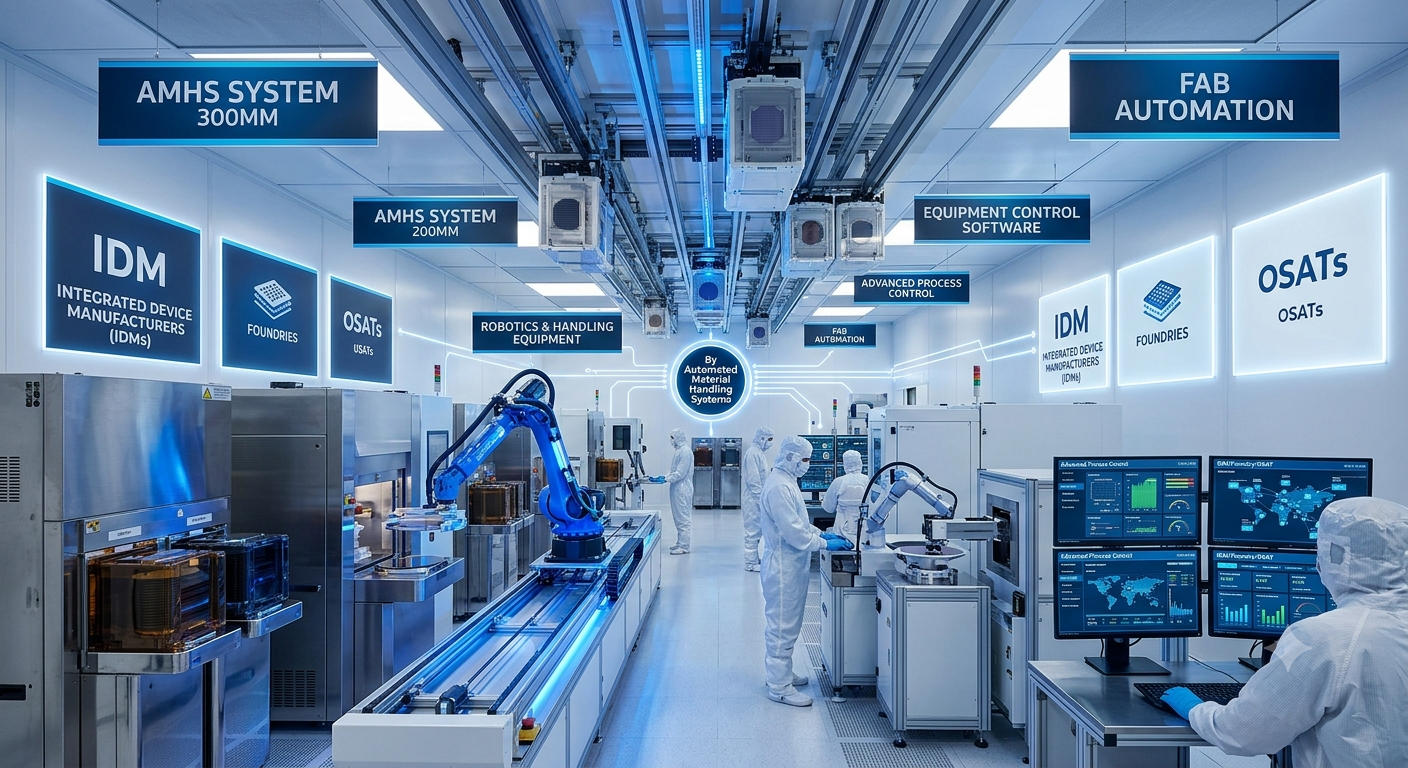
300 mm Fabs Drive Fab Automation Market Growth
One of the most important Fab Automation Market Key Trends is the rapid expansion of 300 mm semiconductor fabs. According to MarketsandMarkets, the 300 mm segment held the largest market share in 2024 and is expected to remain dominant through 2032.
The move toward 300 mm wafers enables manufacturers to produce more semiconductor dies per wafer, supporting higher production volumes and improved manufacturing economics. However, larger wafer sizes also require sophisticated material-handling and process-control systems.
Automated material handling systems, overhead hoist transport systems, precision robotics, and factory software are becoming critical components of 300 mm fabs. These technologies enable wafers to move efficiently between tools while reducing manual intervention and contamination risks.
The continued construction and expansion of 300 mm fabs across Asia Pacific, North America, and Europe will therefore remain a major catalyst for the Fab Automation Market.
AI and Machine Learning Transform Fab Automation
Artificial intelligence and machine learning are becoming important technologies across semiconductor manufacturing. AI-powered automation can analyze large volumes of production data to identify patterns, predict equipment failures, optimize processes, and improve manufacturing efficiency.
MarketsandMarkets identifies increasing adoption of AI/ML-driven predictive analytics and digital-twin platforms as a key driver of the market.
AI can support predictive maintenance by identifying early indicators of equipment degradation. Instead of waiting for a machine to fail, manufacturers can schedule maintenance based on equipment condition and predicted performance.
Machine learning can also support advanced process control by analyzing data from multiple manufacturing tools and identifying process deviations. This enables fabs to respond more quickly to abnormalities and maintain consistent production quality.
As semiconductor manufacturing becomes increasingly data-intensive, AI is expected to become a core component of next-generation fab automation architectures.
Digital Twins Enable Smarter Fab Operations
Digital twins are emerging as another important Fab Automation Market Key Trend. A digital twin creates a virtual representation of a manufacturing environment, equipment, or process that can be used to monitor, simulate, and optimize operations.
For semiconductor fabs, digital twins can help manufacturers simulate production workflows, identify bottlenecks, evaluate equipment utilization, and optimize material movement before implementing changes in the physical facility.
Digital twins can also support brownfield modernization. Existing fabs can use digital models to understand how new automation technologies will interact with legacy systems before deploying them.
The integration of digital twins with AI, predictive analytics, AMHS, manufacturing execution systems (MES), and advanced process control is creating more intelligent and responsive semiconductor manufacturing environments.
AMHS Becomes the Backbone of Automated Fabs
Automated Material Handling Systems are central to semiconductor fab automation. AMHS solutions enable automated transportation of wafers, reticles, and other materials between process tools.
In highly automated 300 mm fabs, overhead transport systems and other material-handling technologies can reduce manual movement, improve throughput, and minimize the risk of contamination.
MarketsandMarkets highlights AMHS adoption as one of the key factors supporting market expansion. The increasing complexity of semiconductor manufacturing is creating demand for flexible and scalable material-handling architectures capable of supporting high-volume production.
A major emerging opportunity is the adoption of modular AMHS. Modular architectures can provide greater flexibility than traditional fixed automation systems, allowing fabs to reconfigure production lines and expand capacity more efficiently.
Robotics Improve Precision and Reduce Manual Intervention
Robotics represents another major component of the Fab Automation Market. Semiconductor fabs use specialized robots for wafer handling, equipment loading and unloading, inspection, packaging, and other precision applications.
Cleanroom-compatible robots are designed to operate under strict contamination-control requirements. Vacuum and atmospheric robots can support wafer transfer in sensitive manufacturing environments where particle generation must be minimized.
The increasing adoption of advanced robotics is particularly important for sub-7 nm manufacturing. At these process nodes, small handling errors or contamination events can significantly affect yields.
Collaborative robotics also presents a growth opportunity. Cleanroom-compatible cobots can provide flexible handling capabilities and reduce manual intervention across wafer, reticle, and packaging workflows.
Advanced Process Control Supports Yield Improvement
Advanced Process Control (APC) is increasingly important as fabs move toward more complex semiconductor processes. APC technologies help manufacturers monitor process variables and make adjustments to maintain manufacturing consistency.
Automation systems can collect information from equipment and process sensors and use that data to identify deviations. When integrated with AI and machine learning, APC platforms can become more predictive and adaptive.
This is especially important for advanced-node production, where manufacturing tolerances are extremely tight. Improved process control can help manufacturers reduce variability, increase yield, and improve equipment utilization.
The combination of APC, AI analytics, sensors, MES, and factory automation software is therefore becoming a defining feature of smart semiconductor fabs.
Brownfield Automation Emerges as a Major Opportunity
While greenfield fabs dominated the market in 2024, MarketsandMarkets expects brownfield fabs to overtake greenfield deployments by 2032 as modernization and automation upgrades intensify.
Brownfield modernization allows semiconductor manufacturers to upgrade existing production facilities rather than build entirely new fabs. This approach can include installing new AMHS systems, robotics, predictive analytics platforms, digital twins, and factory automation software.
The modernization of legacy fabs is particularly important as semiconductor manufacturers seek to increase production capacity while managing capital expenditures.
Retrofitting existing infrastructure can be technically challenging because new automation systems must integrate with legacy equipment and software. However, advances in modular automation and interoperability are creating new opportunities for brownfield deployment.
Hardware Remains the Largest Offering Segment
By offering, the hardware segment held the largest share of the Fab Automation Market in 2024 and is expected to maintain its dominance through 2032.
Hardware includes AMHS, robotics, cleanroom material-handling systems, environmental control systems, and other automation infrastructure.
Demand for hardware is being supported by the expansion of 300 mm fabs and increasing adoption of EUV-enabled production. Semiconductor manufacturers require high-throughput automation systems capable of maintaining accurate wafer movement and stable production conditions.
At the same time, software is becoming increasingly important. MES, APC, equipment-control software, yield-management systems, AI analytics, and digital-twin platforms are helping manufacturers convert large volumes of production data into actionable insights.
The future of fab automation will therefore involve increasingly close integration between hardware and software.
Foundries Lead Adoption of Fab Automation
Among end users, foundries accounted for the largest share of the Fab Automation Market in 2024 and are expected to maintain their leadership through 2032.
Foundries manufacture chips for a broad range of customers and applications, including AI, 5G, automotive electronics, consumer electronics, and high-performance computing. Their diverse production requirements create strong demand for flexible and highly automated manufacturing systems.
Advanced foundries also operate increasingly complex processes involving advanced logic nodes, EUV lithography, and sophisticated packaging technologies. Automation is essential for maintaining production consistency and optimizing wafer flow.
Integrated device manufacturers (IDMs), OSAT providers, and research fabs also represent important customer groups, particularly as semiconductor manufacturing expands globally.
AI Chips and Advanced Electronics Increase Automation Demand
The rapid growth of AI computing is creating additional demand for advanced semiconductor manufacturing capacity. AI processors, GPUs, high-bandwidth memory, networking chips, and other advanced components require sophisticated manufacturing and packaging processes.
This trend is indirectly strengthening the Fab Automation Market because semiconductor manufacturers need automated systems capable of supporting high-volume and high-precision production.
Automotive electronics, 5G infrastructure, cloud computing, and consumer devices are also influencing automation requirements. MarketsandMarkets notes that these downstream trends are pushing semiconductor manufacturers toward advanced AMHS, robotics, APC, yield-management systems, and digital twins.
Asia Pacific Remains the Global Manufacturing Hub
Asia Pacific accounted for the largest share of the Fab Automation Market in 2024 and is expected to remain a leading region during the forecast period.
The region benefits from substantial semiconductor manufacturing capacity and major investments across China, Taiwan, South Korea, and Japan. Strong demand for AI chips, memory, automotive semiconductors, consumer electronics, and advanced processors is encouraging manufacturers to expand and modernize fabs.
Government initiatives supporting domestic semiconductor production are also encouraging new fab construction and technology upgrades.
As new 300 mm fabs are developed across the region, demand for AMHS, robotics, factory software, process-control systems, and cleanroom automation is expected to increase.
Modular Automation and 2.5D/3D Packaging Create New Opportunities
The semiconductor industry is increasingly moving toward advanced packaging approaches such as 2.5D and 3D integration. These technologies create new automation requirements across wafer handling, assembly, inspection, and process control.
MarketsandMarkets identifies the deployment of advanced automation for 2.5D/3D packaging and heterogeneous integration as a significant opportunity.
As chip architectures become more heterogeneous, manufacturing processes require greater coordination between different tools and production stages. Automation can help manufacturers manage complex material flows while maintaining precision and traceability.
This creates opportunities for automation vendors to develop specialized robotics, material-handling systems, inspection automation, and software platforms designed for advanced packaging environments.
Skilled Workforce Shortages Remain a Major Restraint
Despite strong growth prospects, the Fab Automation Market faces challenges related to the shortage of skilled automation and software specialists.
Modern fabs require engineers with expertise across robotics, MES, APC, AI/ML analytics, cleanroom automation, equipment control, and semiconductor manufacturing processes.
MarketsandMarkets identifies the shortage of skilled automation and software specialists as a key restraint. The talent gap can slow brownfield modernization, extend implementation timelines, and increase reliance on external integration partners.
Training and workforce development will therefore become increasingly important as automation systems become more software-intensive and interconnected.
Contamination Control and System Integration Remain Critical
Semiconductor fabs operate under exceptionally stringent contamination-control requirements. Even small particles, vibration, or handling errors can affect production yields, particularly at advanced process nodes.
Automation equipment must therefore operate with extremely high precision and reliability. Robots, transport systems, sensors, and other equipment must meet demanding cleanroom requirements.
Another challenge is integration complexity. Modern fabs often contain equipment and software from multiple vendors, creating interoperability challenges across MES, APC, YMS, AMHS, and equipment-control systems.
Successful automation strategies will require open architectures, standardized interfaces, strong system integration, and reliable data exchange between manufacturing systems.
Leading Companies Strengthen Their Automation Portfolios
The competitive landscape includes established automation, robotics, material-handling, and industrial technology companies. MarketsandMarkets identifies Daifuku, Murata Machinery, Atlas Copco, Rorze Corporation, Ebara Corporation, FANUC, Kawasaki Heavy Industries, Hirata Corporation, Yaskawa, and KUKA among the key companies in the market.
Competition is increasingly focused on automation performance, cleanroom compatibility, robotics precision, material-handling efficiency, software intelligence, and system integration.
Companies are also strengthening their capabilities through product launches, partnerships, factory software development, and investments in AI-driven automation and digital technologies.
The Future of Fab Automation Market
The future of the Fab Automation Market will be shaped by the convergence of semiconductor manufacturing and intelligent automation. AI, robotics, AMHS, digital twins, APC, IoT-enabled equipment, and factory software will increasingly operate as interconnected components of smart manufacturing ecosystems.
The market’s projected growth from USD 25.24 billion in 2025 to USD 41.44 billion by 2032, at a CAGR of 7.3%, reflects the increasing strategic importance of automation in semiconductor production.
The expansion of 300 mm fabs, growth of AI and advanced electronics, increasing adoption of EUV and advanced nodes, and modernization of existing facilities will continue to create demand for automation solutions.
Ultimately, next-generation fabs will need to be more than automated—they will need to be intelligent, predictive, flexible, connected, and highly autonomous. As semiconductor manufacturers compete to improve yield, reduce cycle times, control contamination, and meet growing global chip demand, fab automation will remain a foundational technology for the future of semiconductor manufacturing.
FAQ
1. What is the projected growth of the Fab Automation Market?
The Fab Automation Market is projected to grow from USD 25.24 billion in 2025 to USD 41.44 billion by 2032, at a CAGR of 7.3% during the forecast period.
2. What are the key trends driving the Fab Automation Market?
Key trends include the adoption of AI and machine learning, automated material handling systems (AMHS), robotics, digital twins, advanced process control, predictive analytics, and smart manufacturing technologies.
3. Why is automation essential for next-generation semiconductor fabs?
Automation enables semiconductor fabs to improve production efficiency, wafer handling, process precision, yield, contamination control, equipment utilization, and manufacturing consistency, particularly as fabs adopt advanced nodes and 300 mm wafers.
4. Which segment holds the largest share of the Fab Automation Market?
The hardware segment held the largest market share in 2024. Increasing deployment of AMHS, robotics, and other automation infrastructure in semiconductor fabs is supporting the segment’s growth.
5. Which region dominates the Fab Automation Market?
Asia Pacific accounted for the largest share of the Fab Automation Market in 2024 and is expected to maintain its leading position, supported by major semiconductor manufacturing hubs and continued investments in new and upgraded fabrication facilities.
About MarketsandMarkets™
MarketsandMarkets™ has been recognized as one of America’s Best Management Consulting Firms by Forbes, as per their recent report.
MarketsandMarkets™ is a blue ocean alternative in growth consulting and program management, leveraging a man-machine offering to drive supernormal growth for progressive organizations in the B2B space. With the widest lens on emerging technologies, we are proficient in co-creating supernormal growth for clients across the globe.
Today, 80% of Fortune 2000 companies rely on MarketsandMarkets, and 90 of the top 100 companies in each sector trust us to accelerate their revenue growth. With a global clientele of over 13,000 organizations, we help businesses thrive in a disruptive ecosystem.
The B2B economy is witnessing the emergence of $25 trillion in new revenue streams that are replacing existing ones within this decade. We work with clients on growth programs, helping them monetize this $25 trillion opportunity through our service lines – TAM Expansion, Go-to-Market (GTM) Strategy to Execution, Market Share Gain, Account Enablement, and Thought Leadership Marketing.
Built on the ‘GIVE Growth’ principle, we collaborate with several Forbes Global 2000 B2B companies to keep them future-ready. Our insights and strategies are powered by industry experts, cutting-edge AI, and our Market Intelligence Cloud, KnowledgeStore™, which integrates research and provides ecosystem-wide visibility into revenue shifts.
To find out more, visit www.MarketsandMarkets™.com or follow us on Twitter , LinkedIn and Facebook .
Contact:
Mr. Rohan Salgarkar
MarketsandMarkets™ INC.
1615 South Congress Ave.
Suite 103, Delray Beach, FL 33445
USA: +1-888-600-6441