The rapid adoption of generative artificial intelligence (AI) is transforming the global technology landscape, creating unprecedented demand for advanced computing infrastructure. Organizations across industries are increasingly deploying generative AI applications for content creation, data analysis, software development, customer service automation, predictive modeling, and business intelligence. These applications require powerful computing systems capable of processing massive datasets and supporting complex AI workloads. As a result, generative AI servers are becoming a critical component of modern data center infrastructure. Generative AI Server Market is expected to reach USD 448.60 billion by 2030 from USD 103.92 billion in 2025, registering a CAGR of 34.0% during the forecast period.
The Generative AI Server Market is experiencing significant growth as enterprises, cloud service providers, and hyperscale data center operators invest in high-performance computing systems. These servers are designed to support large language model (LLM) training, AI inference, deep learning, and other computationally intensive applications. Advanced graphics processing units (GPUs), application-specific integrated circuits (ASICs), field-programmable gate arrays (FPGAs), high-bandwidth memory (HBM), and high-speed networking technologies are improving server performance and scalability.
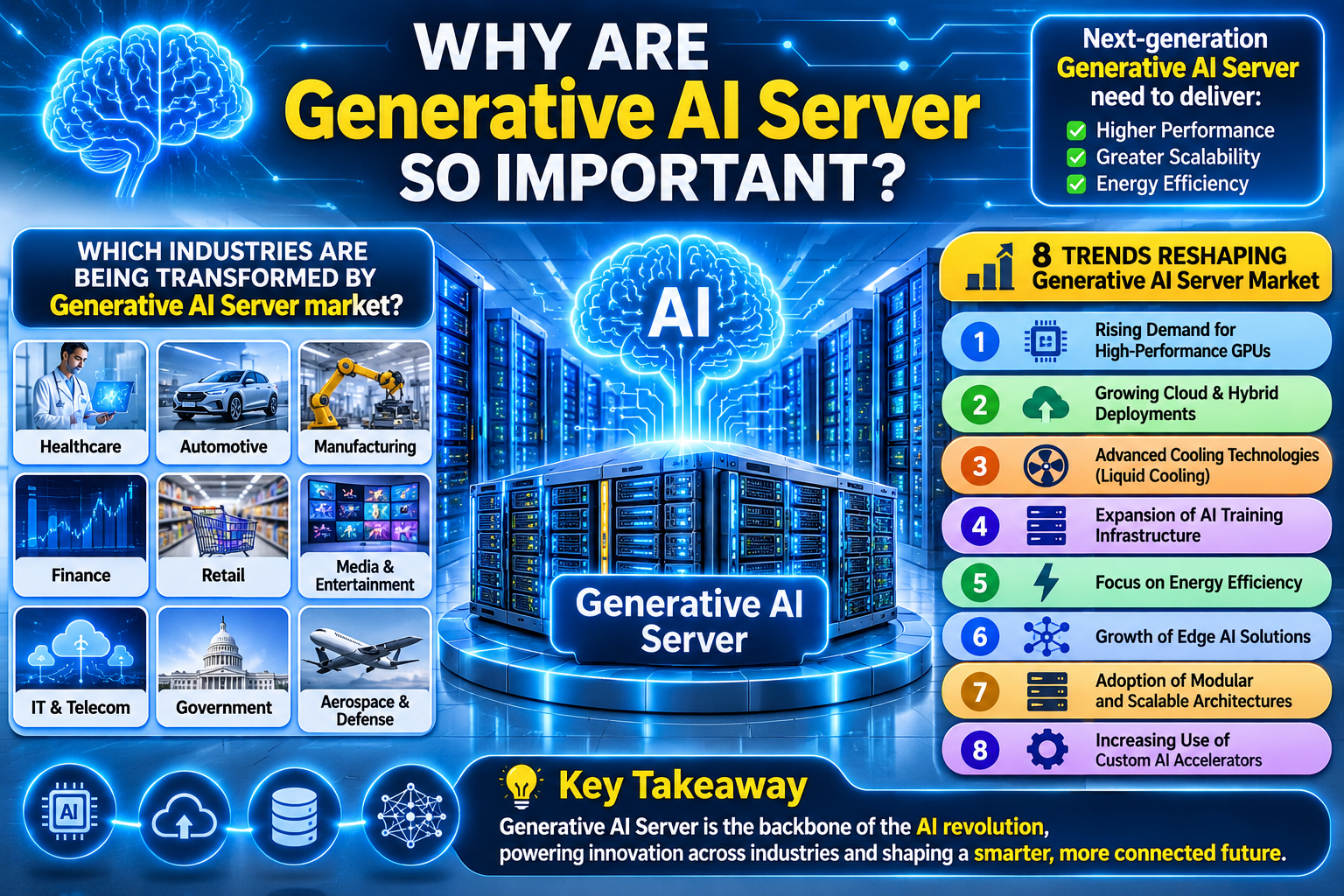
Technological advancements in AI accelerators, liquid cooling, high-speed interconnects, and energy-efficient server architectures are reshaping the industry. At the same time, increasing investments in AI infrastructure and enterprise automation are creating new opportunities for server manufacturers and semiconductor companies.
According to MarketsandMarkets, the global Generative AI Server Market was valued at USD 103.92 billion in 2025 and is projected to reach USD 448.60 billion by 2030, growing at a CAGR of 34.0% during 2025–2030. Increasing demand for LLM training and inference, hyperscale data center expansion, and GPU-accelerated computing infrastructure are among the major factors driving market growth.
1. Rising Adoption of Generative AI Applications
The growing adoption of generative AI applications across industries is one of the major factors driving demand for specialized AI server infrastructure. Businesses are increasingly using generative AI tools to automate workflows, generate digital content, improve customer interactions, and support complex decision-making processes.
Applications such as text generation, image synthesis, video creation, code generation, and conversational AI require significant computing resources. Generative AI servers provide the processing capabilities needed to train and operate large AI models efficiently.
Industries such as banking, healthcare, manufacturing, retail, automotive, and media are integrating generative AI into their operations. This increasing adoption is encouraging organizations to invest in dedicated AI infrastructure that can support high-volume workloads and real-time processing.
As generative AI becomes an integral part of enterprise operations, demand for advanced server architectures is expected to increase.
2. GPU-Based Servers Driving High-Performance AI Computing
Graphics processing units (GPUs) are playing a critical role in the development of generative AI infrastructure. Unlike traditional central processing units (CPUs), GPUs offer parallel processing capabilities that enable them to handle multiple complex computing operations simultaneously.
GPU-based servers are widely used for training large language models, deep learning networks, and generative AI applications. They support faster processing of large datasets and enable efficient execution of computationally intensive workloads.
According to MarketsandMarkets, GPU-based servers accounted for 70.7% of the processor-type segment in 2024, making them the dominant server architecture in the market.
Leading semiconductor companies are continuously developing advanced GPUs with higher processing performance, improved memory bandwidth, and better energy efficiency.
The growing adoption of AI accelerators and GPU clusters across hyperscale data centers and enterprise computing environments is expected to strengthen the position of GPU-based servers in the market.
Download PDF Brochure @ https://www.marketsandmarkets.com/pdfdownloadNew.asp?id=242200223
3. AI Inference Creating New Growth Opportunities
AI inference is emerging as an important growth area as generative AI applications move from development and experimentation toward large-scale commercial deployment.
Training involves developing AI models using large datasets, while inference refers to using trained models to generate responses, predictions, recommendations, and other outputs.
Applications such as AI chatbots, virtual assistants, automated customer support, recommendation engines, and real-time content generation require continuous inference processing.
As organizations deploy generative AI applications across multiple business functions, demand for low-latency and cost-efficient inference infrastructure is increasing.
According to MarketsandMarkets, the inference segment is expected to register the highest CAGR of 29.6% during the forecast period. This trend is encouraging manufacturers to develop specialized servers optimized for inference workloads, memory efficiency, and faster response times.
4. Liquid Cooling Transforming AI Data Center Infrastructure
The increasing computing density of generative AI servers is creating significant thermal management challenges. High-performance GPUs and AI accelerators generate substantial heat during intensive workloads, making traditional air-cooling systems less effective in certain high-density environments.
Liquid cooling is emerging as an important solution for managing heat in advanced AI servers. It transfers heat more efficiently than conventional air cooling and supports higher computing densities within data center facilities.
Direct-to-chip liquid cooling, immersion cooling, and hybrid cooling architectures are gaining attention among data center operators.
These technologies help maintain stable operating temperatures, improve energy efficiency, and support reliable server performance.
According to MarketsandMarkets, liquid cooling is expected to register the highest CAGR of 37.3% in the cooling technology segment during the forecast period. Growing investments in high-density AI infrastructure are expected to accelerate the adoption of advanced cooling solutions.
5. Hyperscale Data Center Expansion Accelerating Market Growth
The expansion of hyperscale data centers is creating substantial demand for generative AI servers. Cloud service providers and technology companies are investing in advanced computing infrastructure to support large-scale AI model training, inference, and enterprise applications.
Hyperscale data centers require high-performance servers equipped with powerful GPUs, high-bandwidth memory, advanced networking, and efficient cooling technologies.
The growing popularity of generative AI platforms is also increasing demand for scalable computing infrastructure capable of managing millions of AI requests.
Major cloud providers are expanding their AI infrastructure to support foundation models, enterprise AI applications, and generative AI services.
As investments in hyperscale computing continue, demand for high-density server configurations and advanced data center technologies is expected to increase.
6. High-Bandwidth Memory Improving AI Server Performance
High-bandwidth memory (HBM) is becoming an essential technology in generative AI server architectures. AI models require large amounts of data to be transferred between processors and memory systems during training and inference.
Traditional memory architectures can create bandwidth limitations when processing complex AI workloads. HBM addresses this challenge by providing higher data transfer rates and improved memory bandwidth within compact semiconductor packages.
The integration of HBM with GPUs and AI accelerators enables faster access to model parameters, datasets, and intermediate computing results.
This is particularly important for training large language models and executing complex neural network operations.
As AI models become more sophisticated, demand for advanced memory technologies and high-performance semiconductor integration is expected to increase.
7. Enterprise AI Adoption Creating Demand for Dedicated Servers
Enterprises are increasingly adopting generative AI to improve operational efficiency, automate business processes, and enhance customer experiences.
Organizations are using AI-powered applications for marketing content generation, software development, financial analysis, product design, customer support, and business intelligence.
Dedicated generative AI servers allow enterprises to customize computing infrastructure according to their specific workloads, security requirements, and performance expectations.
On-premises AI infrastructure is particularly attractive to organizations that require greater control over sensitive data, proprietary models, and internal business applications.
According to MarketsandMarkets, the enterprise end-user segment is expected to register the highest CAGR of 37.7% during the forecast period. Growing investments in private AI infrastructure and customized generative AI applications are supporting this trend.
8. Rack-Mounted Servers Supporting High-Density AI Infrastructure
Rack-mounted servers are becoming an important component of modern AI data centers because they support scalable computing infrastructure and efficient space utilization.
These servers can accommodate multiple GPUs, processors, memory modules, storage components, and high-speed networking interfaces within standardized rack configurations.
Generative AI workloads require significant computing capacity, making rack-mounted systems suitable for hyperscale data centers and enterprise AI infrastructure.
Manufacturers are developing advanced rack-scale server platforms that integrate high-performance accelerators, liquid cooling, and optimized power distribution.
According to MarketsandMarkets, rack-mounted servers are expected to hold the largest share of the form factor segment in 2030.
The growing deployment of GPU clusters and high-density AI computing systems is expected to support continued demand for rack-mounted server solutions.
9. Cloud and On-Premises Deployment Transforming AI Infrastructure
Deployment flexibility is becoming an important consideration for organizations investing in generative AI infrastructure. Businesses are evaluating cloud-based and on-premises server deployments based on computing requirements, data security, scalability, and operational costs.
Cloud deployment allows organizations to access high-performance AI computing resources without making substantial upfront investments in hardware and data center infrastructure.
Cloud service providers offer scalable GPU resources, AI development platforms, and infrastructure services that support model training and inference.
On-premises deployment, meanwhile, provides greater control over hardware configurations, sensitive information, and enterprise AI workloads. It is particularly relevant for organizations with strict data governance and regulatory requirements.
MarketsandMarkets identifies cloud deployment as the largest segment by market share, while on-premises deployment is projected to experience the highest growth rate during the forecast period.
The increasing adoption of hybrid infrastructure is also encouraging server manufacturers to develop flexible solutions that support both cloud and enterprise environments.
10. Asia Pacific Emerging as a High-Growth Market
Asia Pacific is becoming an important region in the global generative AI server industry due to increasing investments in AI infrastructure, semiconductor technologies, cloud computing, and digital transformation.
Countries such as China, Japan, South Korea, Singapore, and India are strengthening their AI ecosystems through government initiatives, research programs, and investments in data center infrastructure.
China is expanding its domestic AI computing capabilities, while Japan and South Korea are investing in advanced semiconductor technologies and enterprise AI applications.
India is also witnessing increasing demand for AI infrastructure, supported by its growing startup ecosystem, digital economy, and government-led AI initiatives.
The expansion of hyperscale data centers and cloud computing services across the region is creating opportunities for server manufacturers, semiconductor suppliers, and infrastructure providers.
11. Advanced AI Chips and Open Hardware Initiatives Driving Innovation
The growing complexity of generative AI workloads is encouraging semiconductor companies to develop specialized processors and advanced computing architectures.
GPUs remain important for large-scale AI training and inference, while ASICs and FPGAs provide opportunities to optimize specific computing operations.
Application-specific integrated circuits are designed for particular workloads and can offer improvements in processing efficiency and power consumption. FPGAs provide hardware configurability, allowing developers to adapt computing resources to different applications.
Open hardware initiatives are also gaining attention because they can encourage greater flexibility, interoperability, and innovation across the AI infrastructure ecosystem.
The development of advanced processors, high-speed interconnects, and optimized server architectures is expected to improve computing performance and support the next generation of generative AI applications.
12. Sustainability and Energy Efficiency Becoming Key Priorities
Power consumption is becoming a major concern as generative AI servers require increasingly powerful computing resources.
Large-scale AI data centers consume substantial electricity to operate GPUs, networking equipment, storage systems, and cooling infrastructure.
As a result, server manufacturers and data center operators are focusing on energy-efficient computing architectures and improved thermal management.
Innovations in liquid cooling, power management, processor efficiency, and server utilization are helping organizations optimize operational performance.
The adoption of renewable energy, efficient data center designs, and workload optimization strategies is also becoming important for reducing the environmental impact of AI infrastructure.
Energy efficiency will remain a critical consideration as enterprises and cloud providers expand their generative AI capabilities.
Generative AI Server Market Segmentation and Growth Opportunities
The Generative AI Server Market is segmented by processor type, function, cooling technology, form factor, deployment, and end user. Each segment addresses different computing requirements across enterprise and cloud infrastructure.
By Processor Type
- GPU-based Servers: Support parallel processing for large language model training, deep learning, and generative AI workloads.
- FPGA-based Servers: Provide configurable hardware architectures for specialized AI computing operations.
- ASIC-based Servers: Deliver application-specific processing capabilities for optimized AI workloads.
By Function
- Training: Used to develop and optimize AI models using large datasets and computational resources.
- Inference: Executes trained AI models to generate predictions, responses, images, and other outputs.
By Cooling Technology
- Air Cooling: Uses airflow and heat exchangers to maintain server operating temperatures.
- Liquid Cooling: Uses liquid-based thermal management to support high-density computing environments.
- Hybrid Cooling: Combines air and liquid cooling technologies to improve thermal efficiency.
By Form Factor
- Rack-Mounted Servers: Designed for scalable deployment in enterprise and hyperscale data centers.
- Blade Servers: Provide compact computing modules for high-density infrastructure.
- Tower Servers: Offer standalone configurations for smaller enterprise environments.
By Deployment
- On-Premises: Provides direct control over computing infrastructure, data, and security.
- Cloud: Enables scalable access to AI computing resources through cloud platforms.
By End User
- Cloud Service Providers
- Enterprises
- Government Organizations
These segments are creating opportunities for manufacturers to develop specialized AI server platforms that address different performance, scalability, and infrastructure requirements.
Challenges Facing the Generative AI Server Market
Despite strong growth opportunities, the Generative AI Server Market faces several challenges that can influence technology adoption and infrastructure expansion.
1. High Infrastructure Costs
Developing and deploying generative AI servers requires substantial investment in GPUs, AI accelerators, high-bandwidth memory, networking equipment, and advanced cooling systems. These costs can create barriers for small and medium-sized organizations.
2. Power Consumption and Sustainability Concerns
AI servers require significant electricity to support intensive computing workloads. Increasing power consumption is encouraging data center operators to invest in energy-efficient processors, liquid cooling, and optimized infrastructure.
3. Data Privacy and Regulatory Challenges
Generative AI applications often process sensitive enterprise and customer information. Organizations must address data privacy, data sovereignty, and regulatory requirements when deploying AI infrastructure across different regions.
4. Limited Availability of Advanced Hardware
Growing demand for GPUs, AI accelerators, and high-bandwidth memory can create supply chain challenges. Limited hardware availability may affect server production, infrastructure expansion, and deployment timelines.
5. Shortage of Skilled Professionals
Designing and managing advanced AI infrastructure requires expertise in server architecture, semiconductor technologies, networking, cooling systems, and AI workload optimization.
The Generative AI Server Market is becoming a critical part of the global AI infrastructure ecosystem. Increasing adoption of generative AI applications, rising demand for large language model training and inference, and investments in hyperscale data centers are accelerating market expansion.
Technological developments in GPU-based servers, AI accelerators, high-bandwidth memory, liquid cooling, and advanced networking are transforming server architectures and improving computing capabilities.
At the same time, enterprise AI adoption, cloud infrastructure expansion, and growing demand for customized AI solutions are creating significant opportunities for server manufacturers and semiconductor companies.
Although high infrastructure costs, power consumption, hardware availability, and data privacy concerns remain important challenges, continuous technological innovation is expected to support industry development.
With the global Generative AI Server Market projected to reach USD 448.60 billion by 2030, companies investing in advanced AI computing infrastructure are positioned to benefit from the growing demand for next-generation intelligent computing systems.
Frequently Asked Questions (FAQs)
1. What is the projected size of the Generative AI Server Market by 2030?
The global Generative AI Server Market is projected to grow from USD 103.92 billion in 2025 to USD 448.60 billion by 2030, registering a CAGR of 34.0%.
2. What are the major trends driving the Generative AI Server Market?
Major trends include GPU-based computing, AI inference expansion, liquid cooling, high-bandwidth memory, hyperscale data center investments, and enterprise AI adoption.
3. Which processor type dominates the Generative AI Server Market?
GPU-based servers dominate the processor-type segment because of their parallel processing capabilities and suitability for large language model training and generative AI workloads.
4. Which region is expected to grow fastest in the Generative AI Server Market?
Asia Pacific is anticipated to register the highest CAGR, supported by increasing AI infrastructure investments, government initiatives, cloud expansion, and AI research activities.
5. Who are the key players in the Generative AI Server Market?
Major companies include Dell Technologies, Hewlett Packard Enterprise, Lenovo, Huawei Technologies, IBM, Super Micro Computer, INSPUR, H3C Technologies, Cisco Systems, and Fujitsu.
About MarketsandMarkets™
MarketsandMarkets™ has been recognized as one of America’s Best Management Consulting Firms by Forbes, as per their recent report.
MarketsandMarkets™ is a blue ocean alternative in growth consulting and program management, leveraging a man-machine offering to drive supernormal growth for progressive organizations in the B2B space. With the widest lens on emerging technologies, we are proficient in co-creating supernormal growth for clients across the globe.
Today, 80% of Fortune 2000 companies rely on MarketsandMarkets, and 90 of the top 100 companies in each sector trust us to accelerate their revenue growth. With a global clientele of over 13,000 organizations, we help businesses thrive in a disruptive ecosystem.
The B2B economy is witnessing the emergence of $25 trillion in new revenue streams that are replacing existing ones within this decade. We work with clients on growth programs, helping them monetize this $25 trillion opportunity through our service lines – TAM Expansion, Go-to-Market (GTM) Strategy to Execution, Market Share Gain, Account Enablement, and Thought Leadership Marketing.
Built on the ‘GIVE Growth’ principle, we collaborate with several Forbes Global 2000 B2B companies to keep them future-ready. Our insights and strategies are powered by industry experts, cutting-edge AI, and our Market Intelligence Cloud, KnowledgeStore™, which integrates research and provides ecosystem-wide visibility into revenue shifts.
To find out more, visit www.MarketsandMarkets™.com or follow us on Twitter , LinkedIn and Facebook .
Contact:
Mr. Rohan Salgarkar
MarketsandMarkets™ INC.
1615 South Congress Ave.
Suite 103, Delray Beach, FL 33445
USA: +1-888-600-6441
