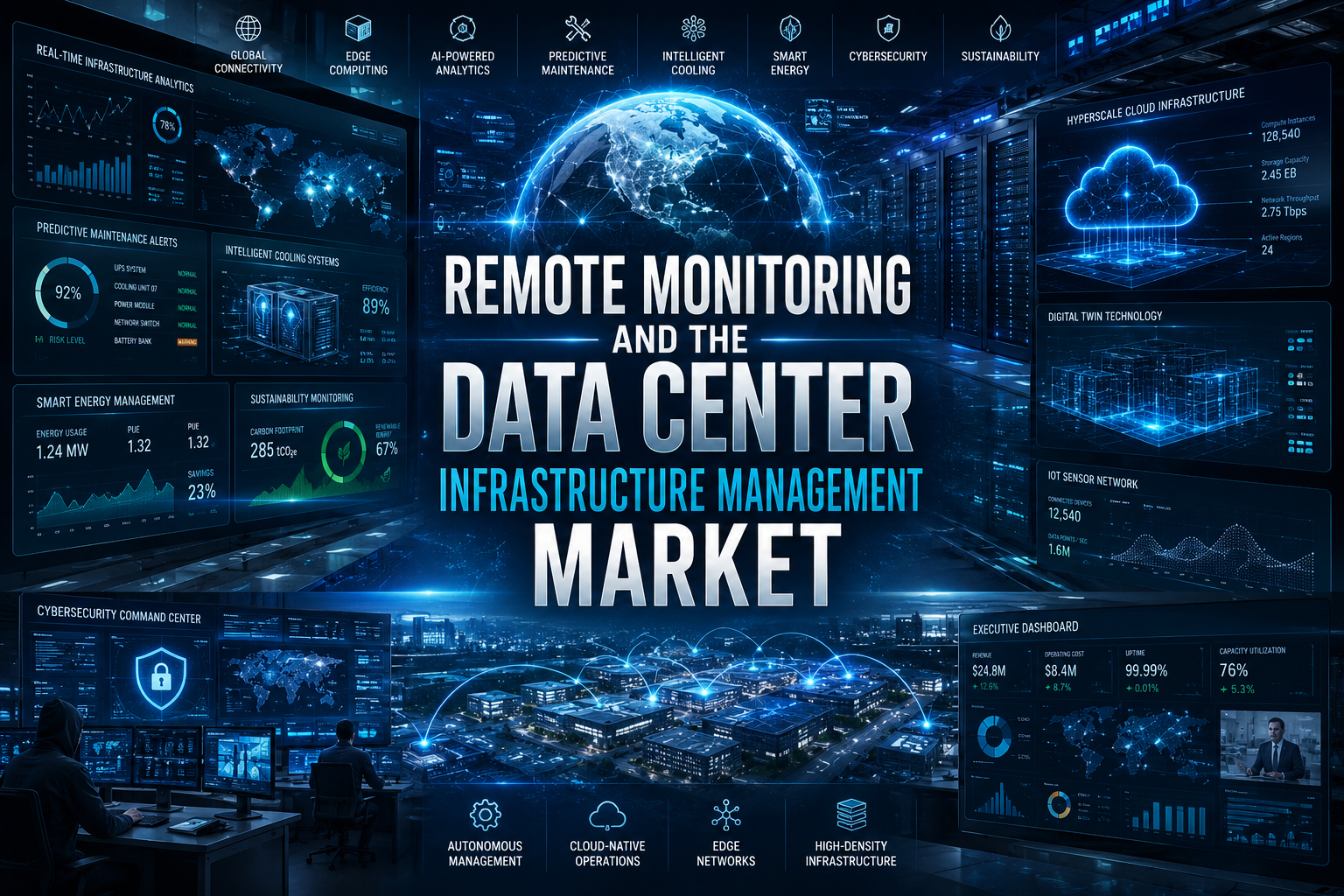
As organizations continue to accelerate digital transformation initiatives, the Data Center Infrastructure Management (DCIM) Market has emerged as a critical focus area for enterprises seeking to enhance operational efficiency, strengthen resilience, improve sustainability, and ensure uninterrupted business continuity. Central to this transformation is Remote Monitoring, a strategic technology capability that is fundamentally changing how enterprises manage data center operations, optimize infrastructure performance, minimize downtime, and enable data-driven decision-making.
From hyperscale cloud operators and telecommunications providers to financial institutions and healthcare organizations, businesses are increasingly investing in advanced remote monitoring solutions to achieve real-time visibility into mission-critical infrastructure assets. This growing adoption is influencing the Data Center Infrastructure Management Market share, accelerating technological innovation, enabling new operating models, and redefining the future of intelligent infrastructure management.
The Strategic Importance of Remote Monitoring
Across enterprise IT ecosystems, cloud environments, infrastructure communities, and digital transformation initiatives, one priority consistently stands out: the need for enhanced operational visibility.
Remote monitoring empowers organizations to monitor, analyze, and manage infrastructure assets from centralized locations regardless of geographic boundaries. Whether overseeing power systems, cooling infrastructure, networking equipment, servers, storage resources, or environmental conditions, enterprises gain access to actionable, real-time insights that support operational excellence and business agility.
In today’s highly connected digital economy, downtime represents more than an IT challenge—it poses significant financial, operational, and reputational risks. Remote monitoring enables organizations to identify and address potential issues proactively, reducing the likelihood of costly service disruptions.
Discover emerging business opportunities Download the PDF supported by extensive market research.
Why Modern Data Centers Require Intelligent Visibility
Today’s data centers are significantly more complex than traditional facilities. Organizations are now responsible for managing:
- Hybrid and multi-cloud environments
- Distributed and multi-site infrastructure
- Edge computing deployments
- AI-intensive workloads
- High-density computing resources
- Geographically dispersed assets
Conventional monitoring approaches often lack the scalability and intelligence required to manage these increasingly sophisticated environments effectively.
Remote monitoring addresses these challenges by delivering:
- Real-time infrastructure visibility
- Automated notifications and alerting
- Centralized management dashboards
- Predictive maintenance capabilities
- Advanced performance analytics
- Strategic capacity planning insights
These capabilities are becoming fundamental contributors to the expanding Data Center Infrastructure Management Market size globally.
Discover what’s fuelling successful companies download the Sample Report for your business growth.
The Evolution of the Data Center Infrastructure Management Market
Current Data Center Infrastructure Management Market analysis indicates a significant industry transition from reactive infrastructure management toward predictive, autonomous, and intelligence-driven operations.
Historically, DCIM platforms focused primarily on asset inventory and facility management functions. Modern solutions, however, integrate advanced technologies such as:
- Artificial Intelligence (AI)
- Machine Learning (ML)
- Digital Twin Technology
- Internet of Things (IoT) Sensors
- Predictive Analytics
- Energy Intelligence Platforms
- Sustainability Reporting Tools
Remote monitoring serves as the critical intelligence layer connecting these technologies, transforming infrastructure management into a strategic business function supported by real-time data and actionable insights.
This technological evolution continues to accelerate Data Center Infrastructure Management Market growth across both mature and emerging economies.
Global Remote Monitoring Trends Accelerating Market Adoption
Several technology-driven developments are fueling investment in remote monitoring solutions worldwide.
AI-Driven Infrastructure Management
Organizations are increasingly deploying AI-powered monitoring systems capable of detecting anomalies, identifying performance degradation, and predicting infrastructure failures before they occur.
Expansion of Edge Computing
As enterprises move workloads closer to end users, managing distributed infrastructure environments has become more complex. Remote monitoring provides centralized visibility across geographically dispersed assets.
Sustainability and ESG Priorities
Enterprises face growing pressure to reduce energy consumption and lower carbon emissions while maintaining operational performance and service reliability.
Distributed Workforce Models
Hybrid and remote work environments have increased demand for infrastructure solutions that provide continuous visibility and control without requiring on-site intervention.
Predictive Maintenance Strategies
Organizations are replacing traditional time-based maintenance models with predictive approaches that leverage real-time operational intelligence to maximize asset performance and lifespan.
These factors continue to shape emerging Data Center Infrastructure Management trends worldwide.
Core Applications of Remote Monitoring in Modern Data Centers
Remote monitoring plays a vital role across numerous operational functions within data center environments.
Power Infrastructure Monitoring
Organizations continuously monitor:
- Energy consumption
- Power distribution efficiency
- Load balancing performance
- Backup power systems
This visibility enhances operational reliability while reducing energy-related costs.
Cooling System Optimization
Cooling infrastructure represents one of the largest operational expenditures within data centers.
Remote monitoring supports:
- Temperature management
- Airflow optimization
- Energy efficiency improvements
- Predictive maintenance of cooling equipment
Environmental Monitoring
Advanced sensors provide continuous visibility into:
- Temperature conditions
- Humidity levels
- Air quality metrics
- Water leak detection
- Physical security status
Asset Utilization Analysis
Organizations gain valuable insights into infrastructure utilization rates, enabling better resource allocation, planning, and investment decisions.
AI, Automation, and Predictive Intelligence
One of the most significant advancements in remote monitoring is the integration of predictive intelligence.
AI-enabled platforms can:
- Detect operational anomalies
- Forecast equipment failures
- Recommend corrective actions
- Automate incident response workflows
- Optimize infrastructure utilization
Rather than responding to issues after they occur, enterprises can proactively mitigate risks and prevent service disruptions.
This capability has become a major differentiator highlighted in virtually every leading Data Center Infrastructure Management report published by industry analysts.
Enterprise Benefits of Data Center Infrastructure Management Applications
Organizations implementing modern DCIM solutions realize substantial operational and business benefits.
Enhanced Operational Efficiency
Remote monitoring reduces dependence on manual inspections and enables centralized infrastructure oversight.
Key benefits include:
- Faster issue resolution
- Reduced operational workloads
- Improved workforce productivity
Reduced Downtime and Service Disruptions
Real-time alerts facilitate immediate response to emerging infrastructure issues.
Benefits include:
- Increased system availability
- Enhanced customer satisfaction
- Reduced financial losses
Improved Capacity Planning
Advanced analytics provide visibility into infrastructure utilization patterns and future resource requirements.
Benefits include:
- Accurate forecasting
- Optimized capital investments
- Improved scalability
Lower Energy Expenditures
Continuous monitoring helps identify inefficiencies and opportunities for optimization.
Benefits include:
- Reduced power consumption
- Improved sustainability performance
- Lower operating costs
Stronger Compliance and Governance
Organizations can maintain comprehensive infrastructure records to support regulatory compliance, auditing, and reporting requirements.
Industry Applications and Business Impact
Banking and Financial Services
Financial institutions depend on uninterrupted infrastructure availability to support mission-critical transactions and regulatory compliance requirements.
Healthcare
Healthcare providers rely on resilient digital infrastructure to support patient care systems, medical records, and critical healthcare applications.
Telecommunications
Telecommunications companies manage extensive distributed infrastructure networks that require centralized monitoring and rapid issue resolution.
Manufacturing
Industrial organizations increasingly integrate operational technology with digital infrastructure, making remote monitoring essential for resilience and predictive maintenance.
Sustainability and Energy Optimization
Sustainability has become a board-level priority across industries.
Modern DCIM solutions support environmental objectives through:
- Power Usage Effectiveness (PUE) monitoring
- Carbon emissions tracking
- Renewable energy integration
- Energy optimization analytics
These capabilities are playing an increasingly important role in shaping global Data Center Infrastructure Management share among leading technology providers.
Today, infrastructure performance is evaluated not only by uptime and efficiency but also by sustainability outcomes and environmental impact.
Cybersecurity Benefits of Remote Monitoring
Infrastructure management and cybersecurity are becoming increasingly interconnected.
Remote monitoring solutions contribute to stronger security postures by providing:
- Real-time security event visibility
- Access control monitoring
- Environmental threat detection
- Infrastructure anomaly identification
- Compliance reporting capabilities
When combined with AI-driven analytics, these capabilities significantly enhance enterprise cyber resilience and risk management.
Future Innovations Shaping Infrastructure Operations
The future of remote monitoring will be defined by several transformative innovations.
Autonomous Data Centers
AI-powered facilities capable of self-monitoring, self-optimizing, and self-healing operations.
Digital Twin Technology
Virtual representations of physical infrastructure that support predictive modeling, simulation, and optimization.
Quantum-Ready Security Monitoring
Advanced monitoring frameworks designed to address emerging cybersecurity challenges in a post-quantum environment.
Advanced IoT Ecosystems
Billions of connected sensors generating real-time intelligence across increasingly distributed infrastructure networks.
These advancements are expected to significantly influence the future Data Center Infrastructure Management forecast over the coming decade.
Data Center Infrastructure Management Market Outlook
The long-term outlook for the market remains exceptionally strong.
Organizations continue increasing investments in:
- Intelligent infrastructure solutions
- AI-powered monitoring platforms
- Sustainability technologies
- Predictive maintenance capabilities
- Hybrid cloud management systems
- Edge infrastructure visibility tools
As digital ecosystems become increasingly complex, demand for real-time operational intelligence will continue to grow.
The overall Data Center Infrastructure Management outlook points toward sustained market expansion driven by digital transformation initiatives, growing data volumes, cybersecurity requirements, cloud adoption, and enterprise modernization strategies.
Remote monitoring will remain a foundational technology supporting this evolution.
Enterprise leaders can no longer view infrastructure management as a purely operational IT function. It has become a strategic business enabler directly impacting performance, resilience, sustainability, and competitiveness.
Remote monitoring delivers measurable value through:
✔ Improved operational efficiency
✔ Reduced downtime and business risk
✔ Enhanced cybersecurity posture
✔ Greater sustainability performance
✔ Optimized resource utilization
✔ Predictive operational intelligence
✔ Faster and more informed decision-making
✔ Improved scalability and business agility
Organizations that successfully integrate remote monitoring with advanced DCIM platforms will be better positioned to address future infrastructure challenges while unlocking new opportunities for innovation, growth, and long-term competitive advantage.
In an increasingly digital-first economy, the convergence of Remote Monitoring and the Data Center Infrastructure Management Market is becoming a critical foundation for enterprise success and sustainable business transformation.