The Humanoid Robot Market Growth is entering a pivotal phase in 2026, transitioning from experimental prototypes and pilot deployments to early-stage commercialization and scaled manufacturing. Driven by rapid advances in artificial intelligence (AI), embodied robotics, machine learning, and hardware miniaturization, humanoid robots are increasingly being positioned as general-purpose labor systems for industrial, commercial, and service environments.
According to industry research, the global humanoid robot market is projected to grow from The global humanoid robot market is expected to grow from USD 2.92 billion in 2025 to USD 15.26 billion in 2030, with a CAGR of 39.2%., highlighting the strong momentum behind Humanoid Robot Market Growth as companies accelerate real-world deployment across manufacturing, logistics, healthcare, and retail sectors.
At the same time, 2026 marks a critical inflection point where leading robotics companies, automotive manufacturers, and AI firms are shifting from R&D-heavy experimentation toward scalable production and commercial rollouts.
2026: A Breakthrough Year for Humanoid Robot Market Growth
The year 2026 is widely seen as a turning point in Humanoid Robot Market Growth, as several developments signal the transition from concept to commercialization.
Recent industry activity shows a clear shift:
- Companies are moving from prototypes to mass production planning
- Automotive firms are integrating humanoid robots into factories
- Robotics startups are securing large-scale funding rounds
- Governments and industrial players are investing in automation infrastructure
For example, leading Chinese EV maker Xpeng is accelerating its robotics division, aiming for mass production of its humanoid robots by the end of 2026, with early deployment expected in retail environments before broader rollout.
This reflects a broader trend where automotive and technology companies are converging into robotics ecosystems, strengthening Humanoid Robot Market Growth through cross-industry innovation.
Key Drivers Accelerating Humanoid Robot Market Growth in 2026
Several structural forces are fueling Humanoid Robot Market Growth globally:
2.1 Rising Labor Shortages
Industries such as manufacturing, logistics, and healthcare are facing persistent labor shortages. Humanoid robots are increasingly seen as a solution for repetitive, labor-intensive tasks.
2.2 Advancements in AI and Embodied Intelligence
Generative AI, computer vision, and real-time decision systems are enabling robots to understand, adapt, and operate in human-centric environments.
2.3 Industrial Automation Demand
Factories are rapidly evolving into smart production systems, increasing demand for humanoid robots capable of flexible task execution.
2.4 Investment Surge and Capital Inflows
The sector is attracting billions in funding as investors bet on long-term Humanoid Robot Market Growth, with startups scaling production capacity aggressively across Europe, the US, and Asia.
2.5 Shift Toward Physical AI
The industry is moving toward “physical AI”—systems that combine perception, reasoning, and physical interaction, enabling humanoid robots to function in real-world environments.
Download PDF Brochure @ https://www.marketsandmarkets.com/pdfdownloadNew.asp?id=99567653
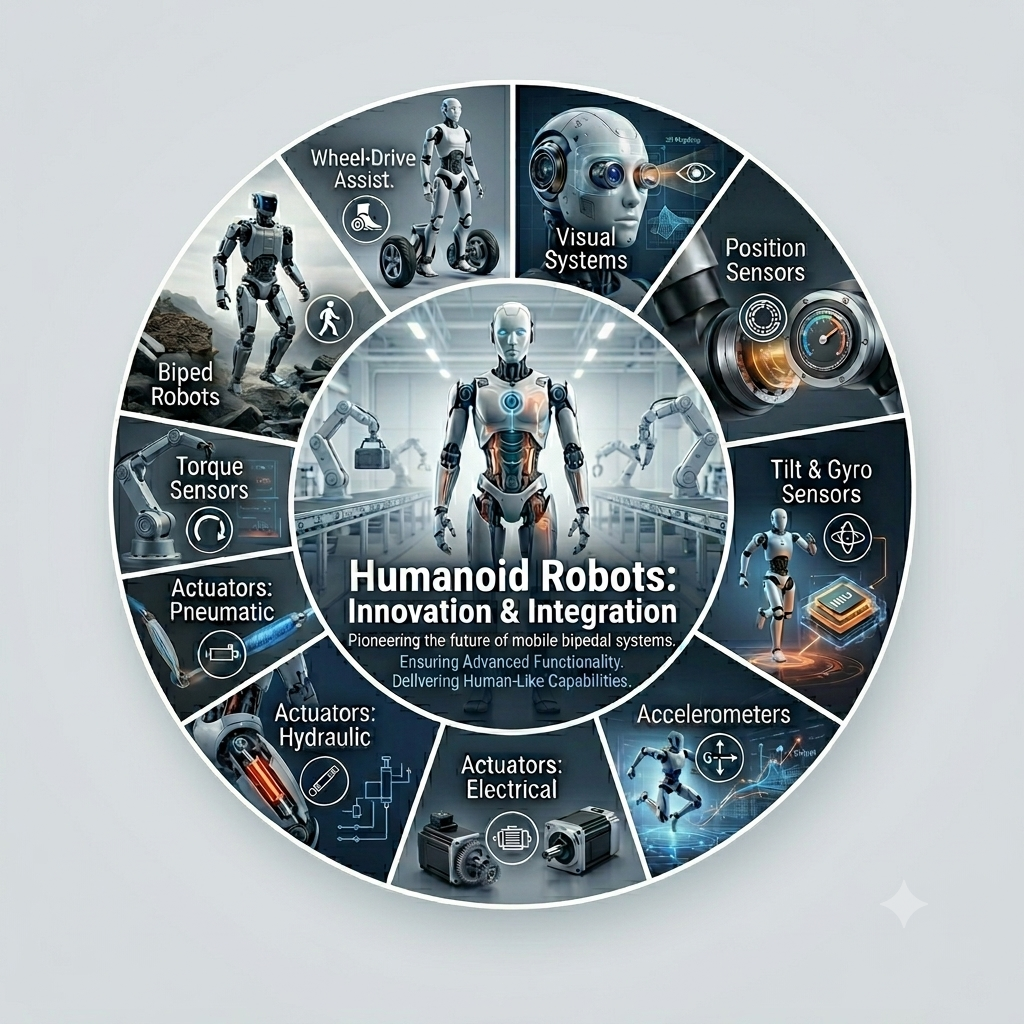
Key Players Driving Humanoid Robot Market Growth
The competitive landscape of Humanoid Robot Market Growth in 2026 is dominated by a mix of established technology leaders, automotive manufacturers, and specialized robotics startups.
Tesla (Optimus Program)
Tesla continues to develop its Optimus humanoid robot, focusing on industrial automation and factory integration. The company aims to deploy humanoid robots for repetitive manufacturing tasks within its production ecosystem.
NVIDIA
NVIDIA is positioning itself as a core enabler of robotics through AI platforms and simulation environments, supporting the development of scalable humanoid systems and accelerating Humanoid Robot Market Growth via compute infrastructure.
Hyundai & Boston Dynamics
Hyundai, through Boston Dynamics, is advancing robotics integration in automotive manufacturing, with strong backing from global technology leaders.
Neura Robotics (Europe)
Neura Robotics is one of Europe’s fastest-growing humanoid robotics firms, securing large-scale funding and planning to scale production from thousands to tens of thousands of units in the near term.
Unitree Robotics
Unitree is emerging as a high-volume manufacturer in China, contributing significantly to global shipment growth and cost reduction trends in humanoid robotics.
Agility Robotics & Figure AI
These companies are focused on warehouse automation, logistics, and industrial deployment, supporting early commercial adoption of humanoid systems.
Key 2026 Developments Shaping Humanoid Robot Market Growth
.1 Mass Production Planning
Companies are shifting from prototype development to scalable manufacturing. Several firms are targeting thousands to millions of units over the next decade.
2 Factory Integration
Humanoid robots are increasingly being deployed in automotive and electronics manufacturing environments for material handling, assembly support, and logistics operations.
3 AI Model Integration
Advanced AI models are being embedded into robotics systems, enabling better perception, mobility, and task execution.
4 Robotics-Cloud Ecosystems
Cloud platforms are becoming essential for training, simulation, and coordination of humanoid fleets, strengthening Humanoid Robot Market Growth.
.5 Robotics Funding Boom
Massive funding rounds across Europe, the US, and Asia are accelerating R&D and production scaling.
5. Application Areas Expanding Humanoid Robot Market Growth
The adoption of humanoid robots is expanding across multiple industries:
Manufacturing
Factories use humanoid robots for assembly, welding support, and material movement.
Logistics & Warehousing
Robots handle picking, packing, and transportation tasks in distribution centers.
Healthcare
Humanoid robots assist in patient care, monitoring, and hospital logistics.
Retail
Retail environments use robots for customer interaction and inventory management.
Service Industry
Hotels, airports, and public spaces are experimenting with humanoid robots for assistance roles.
These applications are directly reinforcing Humanoid Robot Market Growth by expanding real-world use cases.
6. Challenges in Humanoid Robot Market Growth
Despite strong momentum, several challenges remain:
- High production and development costs
- Limited dexterity compared to humans
- Energy efficiency constraints
- Safety and regulatory concerns
- Scaling manufacturing infrastructure
These barriers must be addressed before large-scale commercialization can fully unlock Humanoid Robot Market Growth potential.
7. Future Outlook: Where Humanoid Robot Market Growth Is Heading
The future of Humanoid Robot Market Growth is expected to be shaped by several key trends:
- Transition from pilot projects to large-scale deployment
- Cost reduction through mass manufacturing
- Integration with AI foundation models
- Expansion into consumer and home environments
- Development of global robotics supply chains
By 2030 and beyond, humanoid robots are expected to become a mainstream part of industrial ecosystems, significantly reshaping labor models and productivity structures across industries.
The Humanoid Robot Market Growth in 2026 represents a defining moment in the evolution of robotics and AI. With rapid advancements in physical AI, increasing industrial adoption, and strong investment momentum, humanoid robots are transitioning from experimental machines into scalable workforce solutions.
As leading companies such as Tesla, NVIDIA, Hyundai, Unitree, and Neura Robotics push toward commercialization, the humanoid robotics industry is set to become one of the most transformative technology markets of the next decade.
The coming years will determine how quickly humanoid robots move from factory pilots to everyday operational environments—marking the beginning of a new era in intelligent automation.
About MarketsandMarkets™
MarketsandMarkets™ has been recognized as one of America’s Best Management Consulting Firms by Forbes, as per their recent report.
MarketsandMarkets™ is a blue ocean alternative in growth consulting and program management, leveraging a man-machine offering to drive supernormal growth for progressive organizations in the B2B space. With the widest lens on emerging technologies, we are proficient in co-creating supernormal growth for clients across the globe.
Today, 80% of Fortune 2000 companies rely on MarketsandMarkets, and 90 of the top 100 companies in each sector trust us to accelerate their revenue growth. With a global clientele of over 13,000 organizations, we help businesses thrive in a disruptive ecosystem.
The B2B economy is witnessing the emergence of $25 trillion in new revenue streams that are replacing existing ones within this decade. We work with clients on growth programs, helping them monetize this $25 trillion opportunity through our service lines – TAM Expansion, Go-to-Market (GTM) Strategy to Execution, Market Share Gain, Account Enablement, and Thought Leadership Marketing.
Built on the ‘GIVE Growth’ principle, we collaborate with several Forbes Global 2000 B2B companies to keep them future-ready. Our insights and strategies are powered by industry experts, cutting-edge AI, and our Market Intelligence Cloud, KnowledgeStore™, which integrates research and provides ecosystem-wide visibility into revenue shifts.
To find out more, visit www.MarketsandMarkets™.com or follow us on Twitter , LinkedIn and Facebook .
Contact:
Mr. Rohan Salgarkar
MarketsandMarkets™ INC.
1615 South Congress Ave.
Suite 103, Delray Beach, FL 33445
USA: +1-888-600-6441
