The global Humanoid Robot Market is entering a transformative phase as emerging artificial intelligence technologies continue to reshape the capabilities, applications, and adoption of humanoid robots across industries. From advanced machine learning and computer vision to natural language processing and edge AI, next-generation technologies are enabling humanoid robots to become more intelligent, autonomous, and human-like than ever before. The global humanoid robot market is expected to grow from USD 2.92 billion in 2025 to USD 15.26 billion in 2030, with a CAGR of 39.2%. The global humanoid robot market is poised for major growth due to modern research that has evolved humanoid robot technology to the point where these robots can determine actions through sensor-based data processing
As industries increasingly embrace automation and human-machine collaboration, the latest Humanoid Robot Market Trends are driving significant innovation in healthcare, manufacturing, logistics, retail, defense, and customer service sectors. Humanoid robots are no longer limited to research laboratories or science fiction—they are rapidly becoming practical tools designed to support real-world operations.
The convergence of AI, robotics, sensors, and advanced computing is positioning humanoid robots as a critical component of the future digital economy.
Understanding Humanoid Robots
Humanoid robots are robots designed to resemble and mimic human behavior, movement, and interaction. These robots are equipped with advanced sensors, actuators, processors, and AI software that allow them to:
- Walk and balance
- Recognize objects and people
- Understand speech and language
- Perform tasks autonomously
- Interact naturally with humans
Modern humanoid robots combine mechanical engineering with sophisticated AI systems to create machines capable of learning, adapting, and making decisions in dynamic environments.
The growing integration of AI technologies is one of the most important factors shaping current Humanoid Robot Market Trends.
Key Takeaways
- Emerging AI technologies are transforming humanoid robot capabilities
- Machine learning and computer vision are driving autonomous behavior
- NLP and emotional AI are improving human-robot interaction
- Healthcare, manufacturing, and logistics are major application sectors
- Edge AI and cloud robotics are reshaping future market trends
- Human-robot collaboration is becoming a core industry focus
- Advanced mobility systems are expanding robotic functionality
- Retail and customer service applications are growing rapidly
- Challenges include cost, energy efficiency, and ethical concerns
- The future of humanoid robots is highly connected to AI innovation
Download PDF Brochure @ https://www.marketsandmarkets.com/pdfdownloadNew.asp?id=99567653
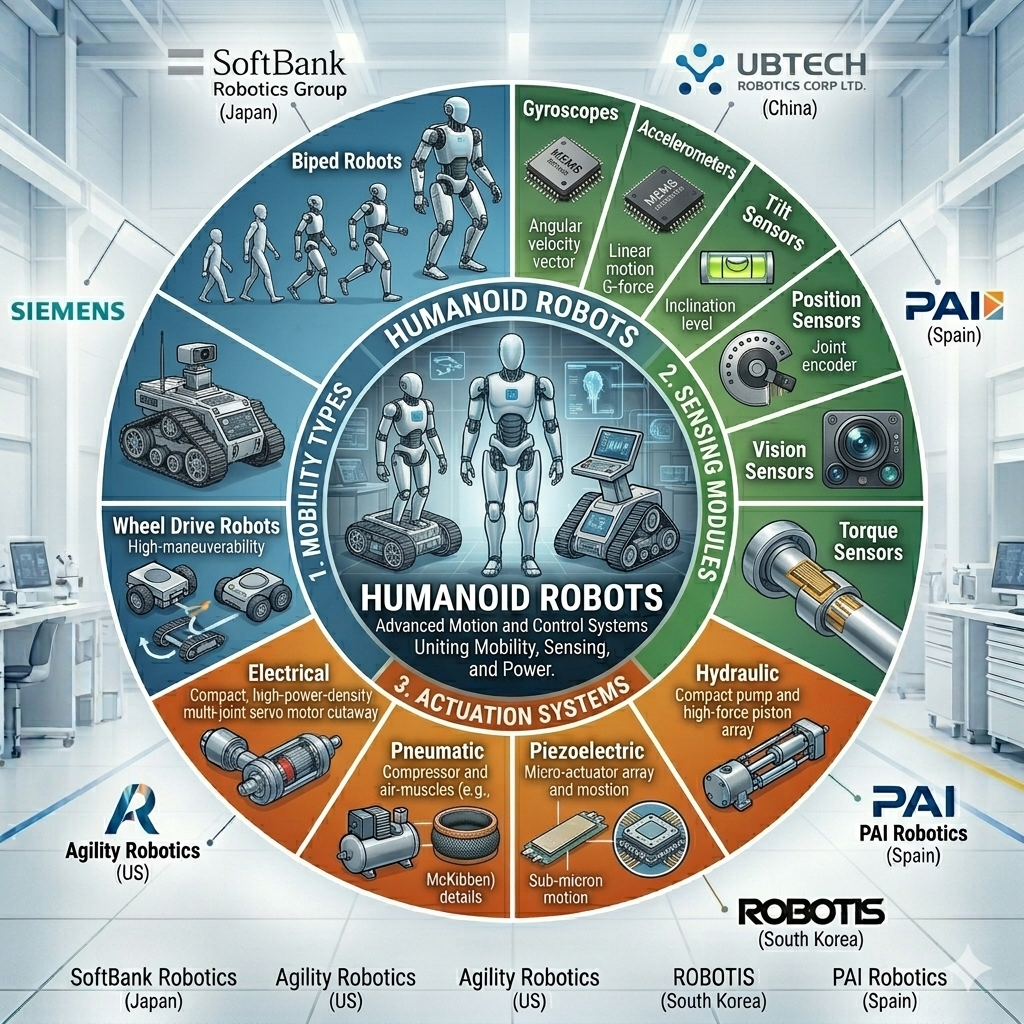
Key AI Technologies Driving Humanoid Robot Market Trends
1. Machine Learning and Deep Learning
Machine learning enables humanoid robots to learn from data, experiences, and environmental interactions.
Deep learning models help robots:
- Improve object recognition
- Enhance motion planning
- Adapt to changing environments
- Predict human behavior
As machine learning algorithms become more advanced, humanoid robots are becoming increasingly capable of autonomous decision-making.
This trend is significantly accelerating innovation in the Humanoid Robot Market.
2. Computer Vision Systems
Computer vision allows humanoid robots to interpret visual information from cameras and sensors.
Advanced vision systems enable robots to:
- Detect obstacles
- Recognize facial expressions
- Navigate complex environments
- Identify objects in real time
AI-powered computer vision is improving robot perception and interaction capabilities, making humanoid robots more effective in customer-facing and industrial environments.
3. Natural Language Processing (NLP)
Natural Language Processing enables robots to understand and respond to human speech.
Modern NLP technologies allow humanoid robots to:
- Conduct conversations
- Interpret voice commands
- Provide customer support
- Translate languages in real time
The rise of generative AI and conversational AI models is greatly enhancing the communication abilities of humanoid robots.
4. Edge AI and Real-Time Processing
Edge AI allows humanoid robots to process data locally without relying entirely on cloud infrastructure.
Benefits include:
- Faster response times
- Reduced latency
- Improved operational reliability
- Enhanced privacy and security
Real-time AI processing is becoming critical for humanoid robots operating in dynamic environments such as hospitals, factories, and public spaces.
5. Reinforcement Learning
Reinforcement learning allows robots to learn through trial and error.
This technology helps humanoid robots:
- Improve motor skills
- Optimize task execution
- Adapt to new environments
- Develop autonomous behaviors
Reinforcement learning is driving major breakthroughs in robotic mobility and dexterity.
Emerging Humanoid Robot Market Trends
Human-Robot Collaboration
One of the most significant Humanoid Robot Market Trends is the growing focus on collaborative robots that work alongside humans rather than replacing them entirely.
Humanoid robots are increasingly assisting workers in:
- Manufacturing facilities
- Warehouses
- Hospitals
- Retail stores
This collaborative approach improves productivity, safety, and operational efficiency.
AI-Powered Emotional Intelligence
Advanced AI models are enabling humanoid robots to recognize emotions and respond appropriately.
Emotional AI technologies support:
- Personalized customer interactions
- Elderly care assistance
- Mental health support applications
- Educational engagement
These capabilities are expanding the role of humanoid robots in service industries.
Advanced Mobility and Balance Systems
AI-driven motion control systems are significantly improving robotic movement and coordination.
Modern humanoid robots can:
- Walk on uneven surfaces
- Climb stairs
- Maintain dynamic balance
- Perform complex physical tasks
This advancement is broadening their industrial and commercial applications.
Integration with Cloud Robotics
Cloud robotics enables humanoid robots to share data and access centralized AI resources.
Benefits include:
- Continuous learning
- Remote updates
- Fleet coordination
- Improved computational efficiency
Cloud-connected robotic ecosystems are becoming an important trend in the global humanoid robot industry.
Major Application Areas
Healthcare and Elderly Care
Humanoid robots assist with:
- Patient monitoring
- Medication reminders
- Elderly companionship
- Rehabilitation support
Healthcare remains one of the fastest-growing application areas.
Manufacturing and Industrial Automation
Factories use humanoid robots for:
- Material handling
- Assembly line support
- Quality inspection
- Hazardous task execution
Automation demand is significantly driving market growth.
Retail and Customer Service
Retailers deploy humanoid robots for:
- Customer assistance
- Product recommendations
- Inventory management
- Interactive engagement
AI-powered customer interaction is becoming a major adoption driver.
Logistics and Warehousing
Humanoid robots improve:
Package handling
Warehouse automation
Inventory tracking
Autonomous transportation
The rapid growth of e-commerce is accelerating adoption in logistics.
Defense and Security
Defense organizations are exploring humanoid robots for:
Surveillance operations
Bomb disposal
Search and rescue missions
Remote hazardous inspections
Challenges Facing the Humanoid Robot Market
Despite rapid innovation, the Humanoid Robot Market faces several challenges:
- High development and manufacturing costs
- Limited battery life
- Complex motion control requirements
- Ethical and regulatory concerns
- Data privacy and cybersecurity risks
Addressing these challenges will be critical for large-scale commercialization.
Future Outlook
The future of the Humanoid Robot Market Trends appears highly promising as AI technologies continue advancing rapidly.
Future developments are expected to include:
- Fully autonomous humanoid robots
- More natural human-robot interaction
- AI-driven adaptive learning systems
- Improved energy efficiency
- Expansion into smart cities and homes
As AI, robotics, and sensor technologies continue converging, humanoid robots are expected to become increasingly integrated into everyday life and industrial operations.
Frequently Asked Questions (FAQs)
1. What is driving Humanoid Robot Market Trends?
The market is driven by advancements in AI, machine learning, robotics, sensors, and automation technologies.
2. What industries use humanoid robots?
Healthcare, manufacturing, retail, logistics, defense, and customer service industries are major users.
3. How does AI improve humanoid robots?
AI enables robots to learn, recognize objects, process language, make decisions, and interact naturally with humans.
4. What are the biggest challenges in the humanoid robot market?
High costs, battery limitations, motion complexity, and ethical concerns remain key challenges.
5. What is the future of humanoid robots?
The future includes fully autonomous robots with advanced emotional intelligence, real-time AI processing, and broader commercial adoption.
About MarketsandMarkets™
MarketsandMarkets™ has been recognized as one of America’s Best Management Consulting Firms by Forbes, as per their recent report.
MarketsandMarkets™ is a blue ocean alternative in growth consulting and program management, leveraging a man-machine offering to drive supernormal growth for progressive organizations in the B2B space. With the widest lens on emerging technologies, we are proficient in co-creating supernormal growth for clients across the globe.
Today, 80% of Fortune 2000 companies rely on MarketsandMarkets, and 90 of the top 100 companies in each sector trust us to accelerate their revenue growth. With a global clientele of over 13,000 organizations, we help businesses thrive in a disruptive ecosystem.
The B2B economy is witnessing the emergence of $25 trillion in new revenue streams that are replacing existing ones within this decade. We work with clients on growth programs, helping them monetize this $25 trillion opportunity through our service lines – TAM Expansion, Go-to-Market (GTM) Strategy to Execution, Market Share Gain, Account Enablement, and Thought Leadership Marketing.
Built on the ‘GIVE Growth’ principle, we collaborate with several Forbes Global 2000 B2B companies to keep them future-ready. Our insights and strategies are powered by industry experts, cutting-edge AI, and our Market Intelligence Cloud, KnowledgeStore™, which integrates research and provides ecosystem-wide visibility into revenue shifts.
To find out more, visit www.MarketsandMarkets™.com or follow us on Twitter , LinkedIn and Facebook .
Contact:
Mr. Rohan Salgarkar
MarketsandMarkets™ INC.
1615 South Congress Ave.
Suite 103, Delray Beach, FL 33445
USA: +1-888-600-6441
