The global lab on a chip technology Market is projected to grow from USD 14.01 billion in 2025 to USD 21.36 billion by 2030, registering a CAGR of 8.8% during the forecast period. Market growth is being driven by increasing demand for high-throughput and cost-effective diagnostic technologies, expanding genomics and proteomics research, growing adoption of personalized medicine, and advances in microfluidics, automation, and AI-enabled biochip platforms.
Download PDF Brochure:- https://www.marketsandmarkets.com/pdfdownloadNew.asp?id=54
Growing Demand for Precision Diagnostics Drives Biochip Adoption
The lab on a chip technology Market is experiencing strong growth as pharmaceutical companies, research institutions, clinical laboratories, and healthcare providers increasingly seek faster, more accurate, miniaturized, and cost-efficient analytical technologies.
lab on a chip technology are enabling high-throughput analysis across genomics, proteomics, molecular diagnostics, drug discovery, and personalized medicine. Their ability to process large volumes of biological information using compact platforms is supporting their adoption across both research and clinical environments.
The integration of artificial intelligence, automation, microfluidics, and connected data-management systems is further transforming biochip workflows by enabling faster analysis, improved precision, and more decentralized testing capabilities.
DNA Chips Segment Held the Largest Market Share
The DNA Chips segment accounted for the largest share of the lab on a chip technology Market by type in 2024.
DNA chips are widely used in genomics research, genetic testing, molecular diagnostics, and personalized medicine. Their ability to analyze gene expression, genetic variations, mutations, and other genomic characteristics makes them valuable tools for large-scale genetic analysis.
The growing adoption of genomic technologies for disease detection, drug development, biomarker discovery, and precision medicine is expected to sustain demand for DNA chip technologies.
Continued improvements in microarray design, assay performance, automation, and data analysis are also supporting the adoption of DNA chips across clinical and research applications.
Microfluidics to Register the Highest Growth Rate
The microfluidics segment is expected to register the highest CAGR during the forecast period.
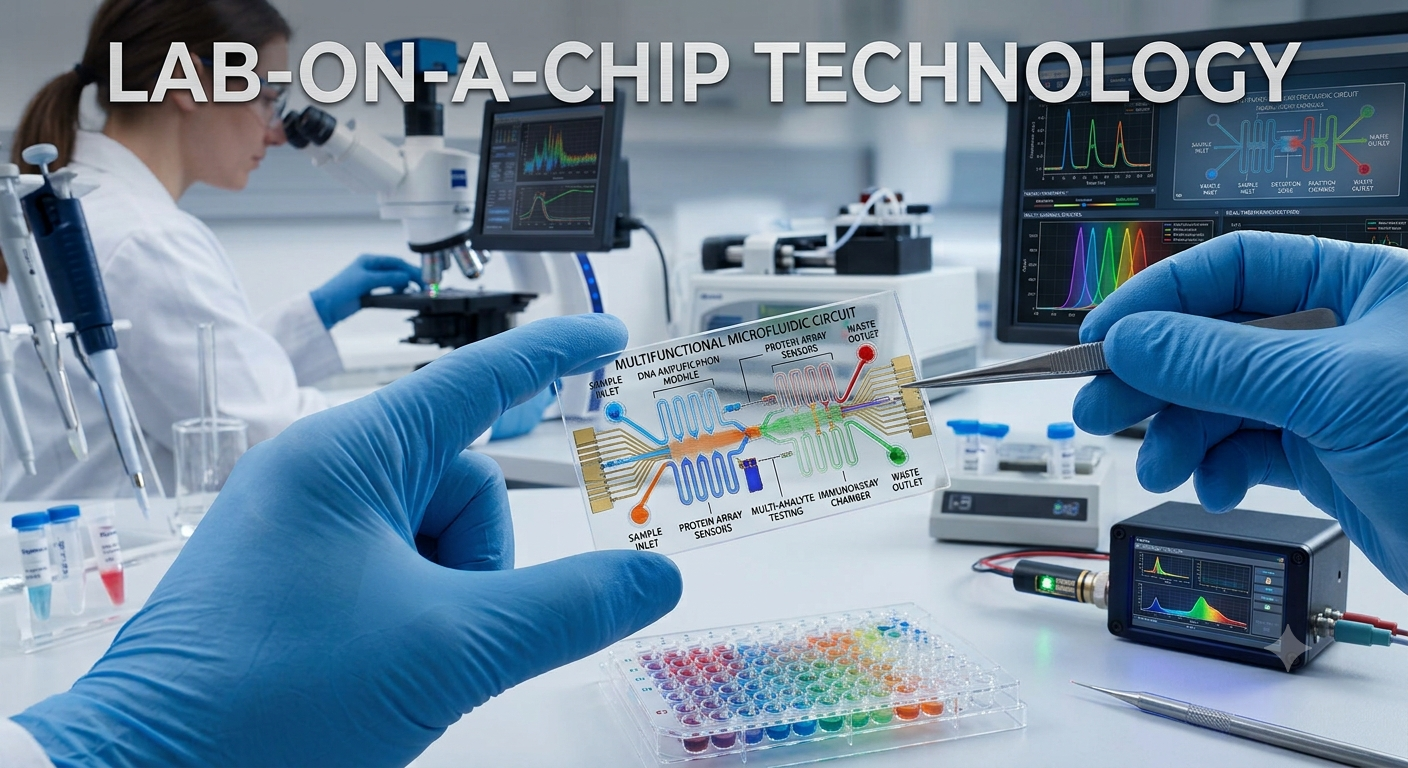
Microfluidic technologies enable the manipulation of extremely small volumes of biological fluids, supporting faster analysis, lower reagent consumption, and compact diagnostic platforms.
The ability to integrate multiple laboratory functions onto a single chip is creating significant opportunities for lab-on-a-chip, point-of-care diagnostics, molecular testing, and personalized medicine.
Advances in microfabrication and manufacturing technologies are improving the scalability, reliability, and affordability of microfluidic platforms.
The growing demand for decentralized testing and rapid diagnostic solutions is expected to further accelerate the adoption of microfluidic biochips.
lab on a chip technologySupport High-Throughput Screening and IVD Applications
lab on a chip technologyare increasingly being deployed across high-throughput screening, in vitro diagnostics (IVD), point-of-care testing, genomics, proteomics, and drug discovery.
In pharmaceutical R&D, biochip technologies can enable researchers to evaluate large numbers of biological samples and molecular interactions more efficiently.
In diagnostics, miniaturized platforms can support rapid testing and decentralized workflows, potentially improving access to diagnostic services in resource-limited and point-of-care environments.
The convergence of lab on a chip technology with AI-powered analytics and automation is expected to create further opportunities for data-driven biological analysis.
North America Maintains Market Leadership
North America accounted for the largest share of the lab on a chip technology Market in 2024.
The region’s leadership is supported by its advanced biotechnology and healthcare infrastructure, substantial R&D investments, established research institutions, and strong presence of biochip and life sciences technology providers.
The US remains a major contributor to regional growth, supported by demand for precision medicine, personalized diagnostics, genomics research, and point-of-care technologies.
The presence of leading industry participants and collaborations between pharmaceutical companies, biotechnology firms, universities, and clinical research organizations further strengthens the regional lab on a chip technology ecosystem.
Speak To Analyst:- https://www.marketsandmarkets.com/speaktoanalystNew.asp?id=54
AI and Automation Create New Growth Opportunities
The integration of AI and machine learning with biochip platforms is creating opportunities to automate image analysis, identify molecular patterns, interpret complex biological datasets, and improve diagnostic decision-making.
Automation can also improve laboratory throughput and reproducibility while reducing manual intervention.
At the same time, connected software platforms and cloud-based data management are enabling researchers and healthcare organizations to manage and analyze increasingly large volumes of biochip-generated data.
These developments are expected to accelerate the transition toward intelligent, automated, and data-driven biochip workflows.
Competitive Landscape
The global lab on a chip technology Market includes major life sciences, diagnostics, genomics, and biotechnology companies competing through technology innovation, product launches, strategic partnerships, R&D investments, and expansion of application portfolios.
Key players profiled in the report include Thermo Fisher Scientific Inc., Illumina, Inc., Agilent Technologies, Inc., F. Hoffmann-La Roche Ltd, QIAGEN, Bio-Rad Laboratories, Inc., Abbott, Standard BioTools Inc., 10x Genomics, and Cepheid, among others.
Market participants are increasingly focusing on microarray technologies, microfluidics, genomics platforms, integrated software, automated workflows, and solutions designed for high-throughput and decentralized applications.
