The global LiDAR Market Share is expanding rapidly as industries increasingly adopt advanced 3D sensing technologies for autonomous vehicles, mapping, surveying, smart infrastructure, environmental monitoring, robotics, and other applications. LiDAR, or Light Detection and Ranging, uses laser pulses to measure distances and generate highly accurate three-dimensional representations of objects and environments.
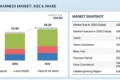
According to MarketsandMarkets, the global LiDAR market is projected to grow from USD 3.27 billion in 2025 to USD 12.79 billion by 2030, registering a strong 31.3% CAGR from 2025 to 2030. The rapid expansion reflects rising demand for accurate 3D data, autonomous navigation, digital mapping, and intelligent infrastructure.
Autonomous Vehicles Strengthen LiDAR Market Share
The growing development of autonomous and semi-autonomous vehicles is one of the most important factors influencing LiDAR Market Share. Automotive manufacturers and technology companies are integrating LiDAR sensors into advanced driver assistance systems (ADAS) to improve object detection, distance measurement, navigation, and vehicle safety.
LiDAR can provide detailed three-dimensional information about a vehicle’s surroundings, supporting applications ranging from driver assistance to higher levels of autonomous driving. MarketsandMarkets identifies the ADAS and driverless cars segment as a leading application area, supported by growing adoption of solid-state LiDAR and intelligent vehicle technologies. M
As automakers continue investing in automated driving platforms, demand for compact, accurate, and cost-effective sensing systems is expected to create additional opportunities for LiDAR manufacturers.
Downlaod PDF Brochure @ https://www.marketsandmarkets.com/pdfdownloadNew.asp?id=1261

Ground-Based Systems Hold a Larger Market Share
By installation, ground-based LiDAR holds the larger LiDAR Market Share and is also projected to grow at a faster rate than airborne LiDAR during the forecast period.
The segment benefits from relatively lower costs and less stringent approval requirements for many mapping and surveying applications. Ground-based systems are increasingly used in corridor mapping, environmental monitoring, meteorology, engineering, ADAS, and autonomous vehicles.
Ground-based LiDAR can provide highly detailed measurements of roads, buildings, infrastructure, terrain, and other physical environments. Its flexibility across multiple applications makes it an important component of the broader 3D sensing ecosystem.
Mechanical LiDAR Maintains a Strong Position
Mechanical LiDAR accounted for the larger market share by type in 2024, according to MarketsandMarkets. Its extensive use in corridor mapping, military applications, volumetric mapping, and engineering has supported its strong position.
One of the key advantages of mechanical LiDAR is its wide field of view. A single sensor can cover large areas and support long-range scanning, making the technology particularly suitable for large-scale mapping and surveying applications.
At the same time, solid-state LiDAR is gaining attention, particularly in automotive applications. Its potential for compact designs, improved integration, and suitability for mass-market vehicle platforms is creating opportunities for manufacturers seeking to reduce sensor size and cost.
Short-Range LiDAR Gains Momentum
The short-range segment is projected to lead the LiDAR market because of increasing adoption in automobiles, security systems, and robotics. These applications require accurate detection of nearby objects and environments.
Medium-range LiDAR is also expected to experience strong growth, particularly in engineering and construction applications. As industries demand more precise spatial information, LiDAR systems across different ranges are finding increasingly specialized applications
The diversity of range requirements is contributing to a broader LiDAR ecosystem in which manufacturers develop sensors optimized for specific applications rather than relying on a single technology configuration.
UAV LiDAR Creates New Opportunities
The growing adoption of UAV-based LiDAR systems is another important factor supporting LiDAR Market Share expansion. LiDAR-equipped drones can collect high-resolution information from areas that may be difficult, dangerous, or expensive to access using conventional surveying methods.
UAV LiDAR is being used for infrastructure inspection, environmental monitoring, corridor mapping, engineering projects, and remote-area surveys. These systems can generate digital elevation models and detailed 3D representations while reducing the time and resources required for field data collection.
As drone technology becomes more sophisticated, the integration of lightweight LiDAR sensors with unmanned platforms could create further opportunities across surveying and geospatial applications.
Smart Cities and 3D Mapping Drive Demand
The development of smart cities and digital infrastructure is contributing to rising demand for LiDAR-based mapping. Governments and infrastructure developers increasingly require accurate spatial data for urban planning, transportation networks, utilities, environmental management, and infrastructure development.
LiDAR can support detailed 3D mapping and digital elevation models, helping organizations understand the physical characteristics of urban and natural environments. MarketsandMarkets identifies smart infrastructure, urban planning, and 3D mapping as important contributors to market expansion.
The growing adoption of digital twins is also creating opportunities for LiDAR because high-quality spatial data can serve as an important foundation for developing accurate digital representations of physical environments.
Asia Pacific Expected to Record Fastest Growth
Regional developments are also reshaping LiDAR Market Share. Asia Pacific is projected to be the fastest-growing regional market during the forecast period.
MarketsandMarkets projects the Asia Pacific LiDAR market to increase from USD 0.92 billion in 2025 to USD 4.01 billion by 2030, representing a 34.1% CAGR. Infrastructure development, surveying and mapping activities, mining, forest management, smart-city initiatives, autonomous vehicles, robotics, and industrial automation are among the factors supporting regional expansion.
North America is also a major market, with its LiDAR market projected to reach USD 4.8 billion by 2030, up from USD 1.25 billion in 2025. The region benefits from investments in autonomous vehicles, ADAS technologies, and advanced mapping applications.
Europe Strengthens Its LiDAR Position
Europe is another important region for LiDAR adoption. MarketsandMarkets projects the European market to reach USD 3.16 billion by 2030, compared with USD 0.87 billion in 2025, representing a 29.6% CAGR.
Autonomous driving, smart mobility, environmental monitoring, agriculture, infrastructure planning, and mapping initiatives are contributing to regional demand. Government and regulatory support for advanced mobility technologies is also encouraging the development of new LiDAR applications.
Cost Remains a Market Challenge
Despite rapid growth, high costs remain a challenge for broader LiDAR adoption. LiDAR systems and post-processing software can require significant investment, particularly for smaller organizations and projects with limited budgets.
The availability of lower-cost photogrammetry systems is another competitive factor. Photogrammetry can provide visually rich 2D and 3D models at lower costs, making it an alternative for certain mapping applications
Manufacturers are therefore focusing on improving sensor performance while reducing size, complexity, and production costs. Greater affordability could help LiDAR penetrate additional applications and expand its market share.
AI and Software Enhance LiDAR Applications
The combination of LiDAR with artificial intelligence, cloud computing, and advanced data processing is opening new opportunities. LiDAR systems generate substantial amounts of spatial data, creating demand for software capable of processing and interpreting that information efficiently.
AI can help identify objects, classify environments, detect changes, and automate elements of mapping and inspection workflows. Cloud-enabled processing can also make LiDAR data more accessible to organizations operating across multiple locations.
These developments are helping transform LiDAR from a specialized sensing technology into a broader data-generation platform for intelligent applications.
Competitive Landscape
The global LiDAR market includes established sensing, surveying, geospatial, and automotive technology companies. MarketsandMarkets identifies Hesai Group, RoboSense Technology, SICK AG, Ouster, Luminar Technologies, Leica Geosystems, Trimble, Teledyne Optech, FARO Technologies, and RIEGL Laser Measurement Systems among the major companies operating in the market.
Companies are pursuing strategies such as product launches, partnerships, and acquisitions to strengthen their technology portfolios and expand their presence across automotive, mapping, surveying, robotics, and infrastructure applications.
Competition is increasingly focused on sensor accuracy, range, size, reliability, cost, software integration, and the ability to meet the requirements of emerging autonomous systems.
Future Outlook for LiDAR Market Share
The outlook for LiDAR Market Share remains highly positive as 3D sensing becomes increasingly important across transportation, infrastructure, robotics, environmental monitoring, and industrial applications.
The global market is expected to reach USD 12.79 billion by 2030, compared with USD 3.27 billion in 2025. This rapid expansion is being supported by autonomous vehicles, UAV-based surveying, smart infrastructure, 3D mapping, environmental applications, and technological improvements that enhance accuracy while reducing costs.
Future growth will likely depend on the industry’s ability to make LiDAR systems smaller, more affordable, energy-efficient, and easier to integrate. Solid-state technologies, AI-powered processing, cloud-based analytics, and improved sensor performance are expected to play increasingly important roles.
As industries continue shifting toward automated decision-making and digitally modeled environments, LiDAR Market Share is positioned to expand across both established and emerging applications. The convergence of 3D sensing with autonomous mobility, smart cities, robotics, and digital twins could make LiDAR an increasingly important technology in the next generation of intelligent systems.
Frequently Asked Questions
1. What is driving the growth of LiDAR Market Share?
The LiDAR Market Share is expanding due to rising adoption of 3D sensing technologies across autonomous vehicles, ADAS, robotics, surveying, mapping, smart infrastructure, and environmental monitoring.
2. How large is the global LiDAR market?
According to MarketsandMarkets, the global LiDAR market is projected to grow from USD 3.27 billion in 2025 to USD 12.79 billion by 2030, registering a 31.3% CAGR during the forecast period.
3. Which LiDAR segment holds the largest market share?
Ground-based LiDAR holds a larger market share, supported by applications in surveying, mapping, infrastructure, engineering, autonomous vehicles, and environmental monitoring.
4. Which region is expected to grow fastest in the LiDAR market?
Asia Pacific is projected to be the fastest-growing regional market, driven by infrastructure development, smart-city initiatives, autonomous vehicles, robotics, surveying, and industrial applications.
5. What are the major applications of LiDAR technology?
Major applications include autonomous driving and ADAS, corridor mapping, surveying, engineering, environmental monitoring, meteorology, urban planning, robotics, and 3D mapping.