The global defense landscape is undergoing a major transformation as loitering munitions emerge as one of the most disruptive technologies in modern warfare. Often referred to as “kamikaze drones” or “suicide drones,” loitering munitions combine the surveillance capabilities of unmanned aerial systems with the precision strike functionality of guided missiles. These systems are redefining tactical and strategic military operations by offering low-cost, high-precision strike capabilities against time-sensitive and mobile targets. As military modernization programs accelerate worldwide, loitering munitions are becoming central to the future of autonomous precision strike warfare.
Unlike traditional missiles that follow pre-programmed flight paths toward fixed targets, loitering munitions can remain airborne over a designated operational area for extended periods while searching for targets using onboard sensors and artificial intelligence-enabled guidance systems. This loitering capability provides military operators with real-time battlefield awareness and the flexibility to engage targets only when necessary. The result is a highly adaptable precision strike system capable of operating in dynamic combat environments where targets frequently change location.
Download PDF Brochure : https://www.marketsandmarkets.com/pdfdownloadNew.asp?id=139489979
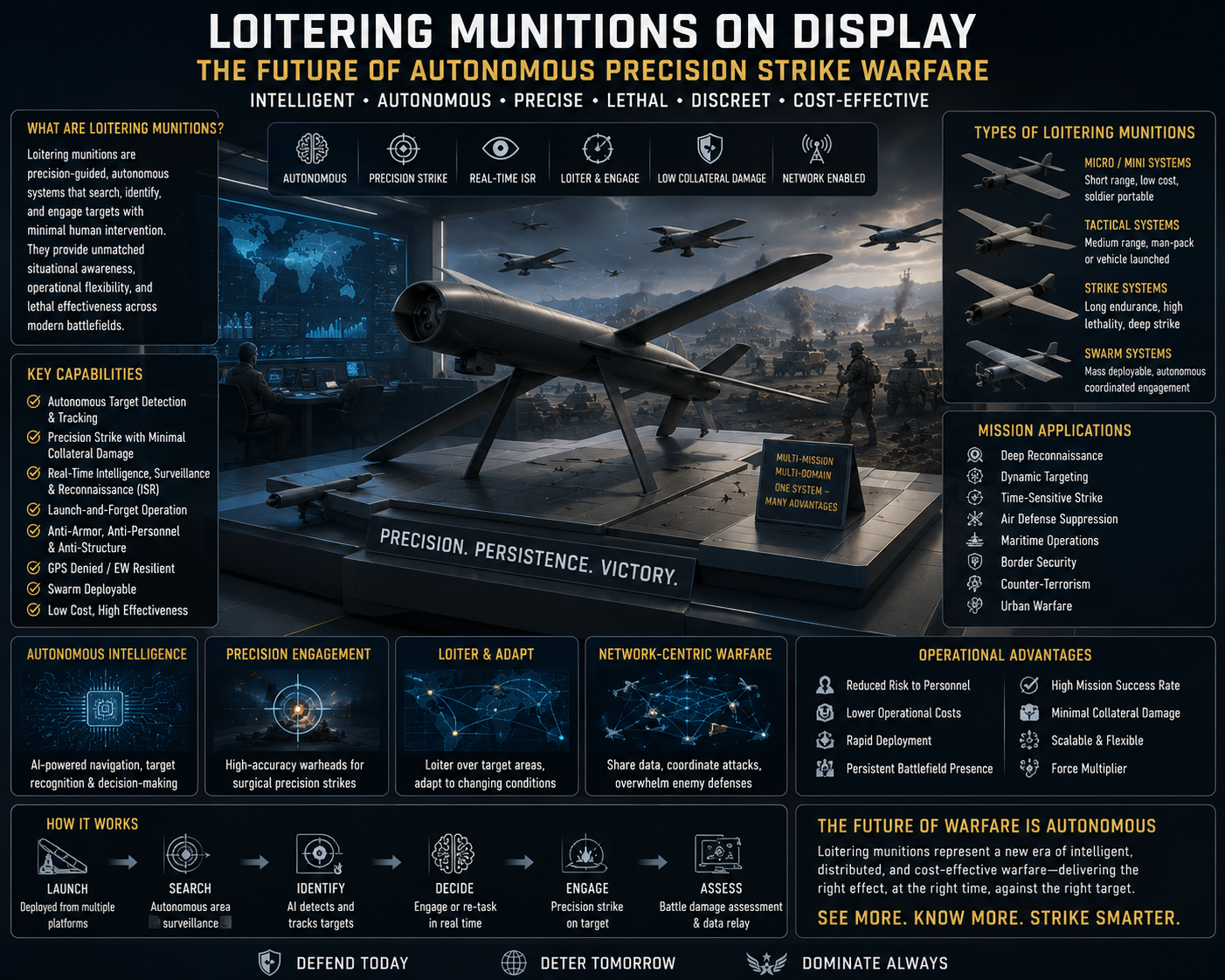
The growing popularity of loitering munitions is closely linked to the increasing importance of asymmetric warfare and distributed battlefield operations. Modern conflicts have demonstrated that traditional armored vehicles, artillery systems, and fixed military infrastructure are highly vulnerable to autonomous precision-guided systems. Loitering munitions allow relatively small military units to neutralize high-value targets without deploying expensive aircraft or risking pilot lives. Their affordability, mobility, and operational flexibility make them particularly attractive for both advanced militaries and smaller defense forces seeking cost-effective combat solutions.
Artificial intelligence is playing an increasingly important role in advancing loitering munition capabilities. Modern systems incorporate AI-enabled target recognition, autonomous navigation, computer vision, and sensor fusion technologies that improve operational accuracy and reduce response times. AI-driven systems can analyze battlefield conditions, identify threats, and optimize attack trajectories in real time. Some next-generation loitering munitions are also being designed with swarm capabilities, enabling multiple autonomous drones to coordinate attacks simultaneously against heavily defended targets.
Stealth and survivability are becoming major design priorities for future loitering munition platforms. Advanced radar-absorbing materials, reduced acoustic signatures, and compact airframe designs are improving the ability of these systems to penetrate contested airspace undetected. Military forces increasingly require autonomous strike systems capable of bypassing sophisticated air defense networks while maintaining high operational precision. Low-observable loitering munitions are therefore expected to play a critical role in suppression of enemy air defenses and deep-strike operations.
The battlefield effectiveness of loitering munitions has been clearly demonstrated in recent conflicts across Eastern Europe, the Middle East, and the Caucasus region. These systems have proven highly effective against tanks, artillery systems, radar installations, and command centers. Their ability to deliver precision strikes with minimal collateral damage has significantly altered traditional battlefield tactics. Military analysts increasingly view loitering munitions as essential force multipliers capable of reshaping future combat doctrines.
The integration of loitering munitions into multi-domain warfare strategies is also accelerating. Modern military operations increasingly emphasize coordination across air, land, sea, cyber, and space domains. Loitering munitions support this operational approach by providing persistent surveillance, electronic warfare support, and precision strike capabilities within interconnected battlefield networks. Advanced communication systems allow these platforms to share intelligence with command centers, ground forces, and other autonomous systems in real time.
One of the most important advantages of loitering munitions is their ability to engage time-sensitive targets rapidly. Traditional airstrike operations often require lengthy coordination processes involving reconnaissance, mission planning, and aircraft deployment. Loitering munitions dramatically shorten the kill chain by combining surveillance and strike functions within a single autonomous platform. This rapid response capability is especially valuable in high-intensity combat environments where battlefield conditions evolve quickly.
The defense industry is witnessing substantial investment in loitering munition research and development programs. Aerospace and defense companies are actively developing next-generation systems with extended endurance, higher payload capacity, improved AI functionality, and enhanced communication resilience. Governments are also increasing procurement budgets for autonomous precision strike systems as part of broader military modernization initiatives focused on unmanned warfare technologies.
Swarm-enabled loitering munitions represent one of the most significant future trends in autonomous warfare. Swarm technology allows multiple drones to operate collaboratively through decentralized AI-driven coordination. In future combat scenarios, swarms of loitering munitions could overwhelm enemy air defenses by attacking targets simultaneously from multiple directions. This saturation strategy creates significant challenges for traditional missile defense systems and increases operational success rates.
Electronic warfare integration is another area driving innovation in loitering munition systems. Advanced platforms are being equipped with jamming payloads, cyberattack capabilities, and electromagnetic disruption systems that allow them to interfere with enemy communications and radar infrastructure before conducting strikes. This combination of electronic attack and kinetic capability enhances mission effectiveness in contested electromagnetic environments.
Despite their operational advantages, loitering munitions also raise important ethical, legal, and cybersecurity concerns. The increasing use of autonomous targeting technologies has generated international debate regarding human oversight, accountability, and compliance with international humanitarian law. Ensuring reliable human control over lethal autonomous systems remains a key challenge for defense policymakers worldwide.
Counter-loitering munition technologies are also evolving rapidly. Military organizations are investing heavily in directed energy weapons, electronic countermeasures, AI-powered detection systems, and anti-drone defense networks to protect critical infrastructure and combat units from autonomous aerial threats. The competition between offensive autonomous strike systems and defensive counter-drone technologies is expected to become a defining feature of future military modernization efforts.
The future of autonomous precision strike warfare will likely be shaped by the continued convergence of artificial intelligence, swarm intelligence, advanced sensors, and stealth technologies. Loitering munitions represent a major shift in military strategy by enabling highly precise, scalable, and cost-effective strike capabilities across complex operational environments. As defense forces continue adapting to evolving security challenges, these systems are expected to become indispensable components of modern battlefield operations.
More In-Depth Industry Analysis @ https://www.marketsandmarkets.com/Market-Reports/loitering-munition-market-139489979.html
In the coming decade, loitering munitions will play a critical role in transforming how militaries project power, conduct surveillance, and execute precision strikes. Their combination of autonomy, adaptability, and affordability positions them as one of the most influential defense technologies of the twenty-first century. Autonomous precision strike warfare is no longer a future concept; it is rapidly becoming the operational reality of modern combat.
