The global defense sector is entering a new era of autonomous warfare driven by rapid advancements in artificial intelligence, swarm intelligence, stealth engineering, and distributed combat systems. Among the most transformative technologies shaping future military operations are next-generation attritable stealth swarm drones. These advanced unmanned systems are redefining battlefield strategy by combining affordability, low observability, and autonomous coordination into scalable combat ecosystems capable of operating in highly contested environments.
Get Detailed Market Size & Forecast Data: https://www.marketsandmarkets.com/pdfdownloadNew.asp?id=139489979
Attritable drones are specifically designed to be cost-effective enough for military commanders to accept operational losses without compromising overall mission objectives. Unlike traditional fighter aircraft or high-value unmanned combat platforms that require enormous procurement and maintenance investments, attritable systems emphasize mass deployment, rapid manufacturing, and mission adaptability. This shift reflects a broader transformation in modern warfare, where operational scalability and distributed intelligence are becoming more valuable than reliance on a limited number of expensive platforms.
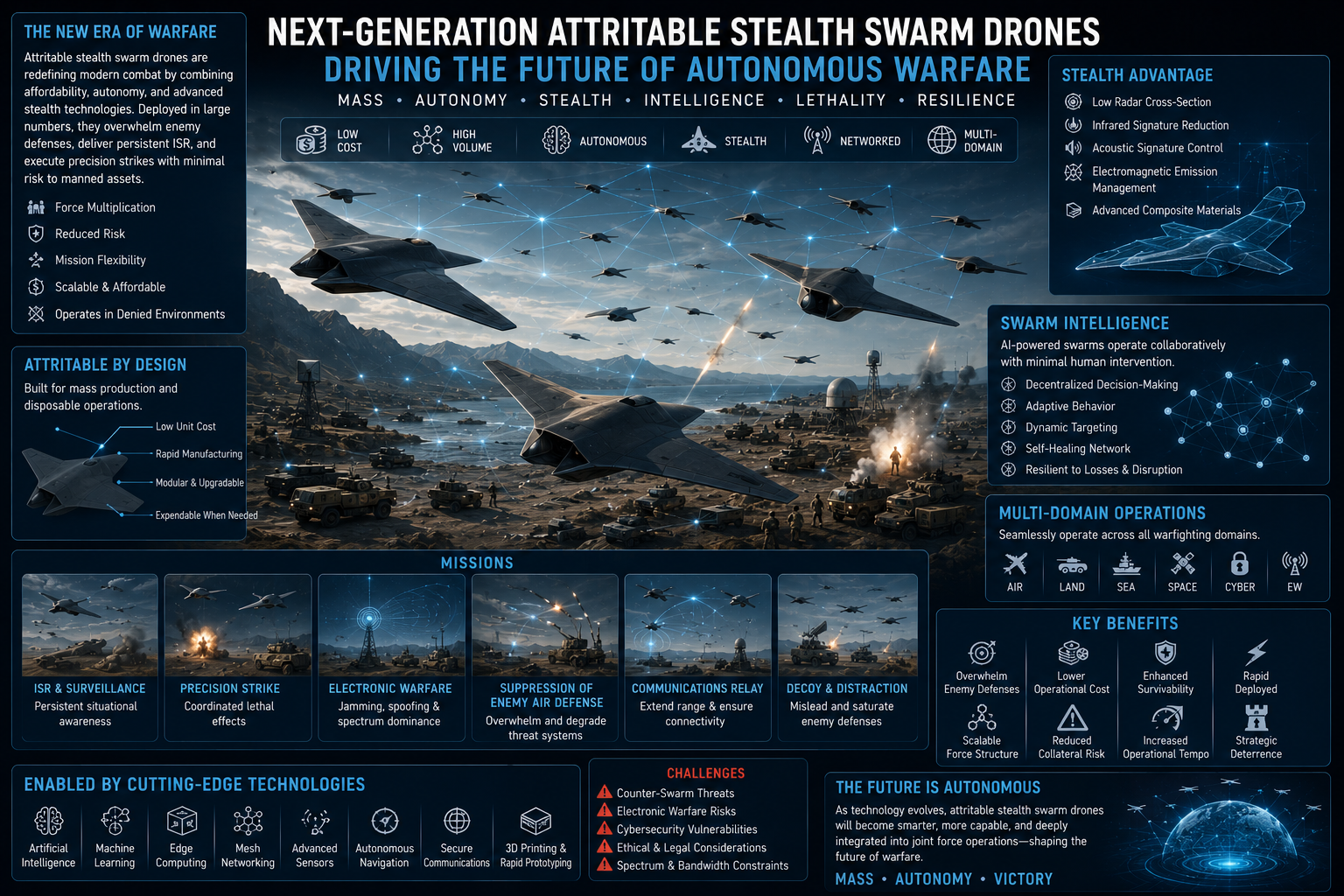
The integration of stealth technologies significantly enhances the operational effectiveness of swarm drones. Advanced radar-absorbing materials, reduced thermal signatures, optimized airframe geometry, and electronic countermeasure systems allow these drones to penetrate anti-access and area denial environments with minimal detection risk. Modern military forces increasingly require autonomous systems capable of infiltrating heavily defended airspace to conduct intelligence gathering, electronic warfare, reconnaissance, and precision strike operations. Stealth-enabled swarm drones provide a strategic advantage by reducing exposure to sophisticated enemy radar and missile defense networks.
Artificial intelligence forms the foundation of next-generation swarm warfare capabilities. AI-powered drones can autonomously analyze battlefield conditions, identify targets, navigate complex terrain, and coordinate operations with minimal human intervention. Swarm intelligence enables hundreds of drones to operate collectively through decentralized communication networks, allowing the swarm to adapt dynamically if individual drones are destroyed or communication links are disrupted. This distributed operational structure improves mission resilience and makes swarm formations extremely difficult for adversaries to neutralize completely.
Recent defense modernization initiatives across the United States, China, India, and Europe demonstrate growing strategic investment in autonomous swarm technologies. Programs focused on loyal wingman systems, AI-enabled combat drones, and distributed unmanned warfare platforms highlight the increasing importance of human-machine teaming in future military doctrine. In these operational concepts, stealth drones accompany manned aircraft to extend surveillance coverage, suppress enemy air defenses, conduct electronic attacks, and absorb battlefield risk.
The economic advantages of attritable swarm systems are equally significant. Traditional military procurement strategies focused heavily on technologically superior but extremely expensive platforms. Autonomous swarm doctrine instead prioritizes volume, rapid replacement capability, and operational persistence. Advances in additive manufacturing, modular payload architectures, lightweight composite materials, and commercial electronics integration are reducing production costs while accelerating deployment timelines. This enables defense organizations to sustain large-scale autonomous operations during prolonged conflicts.
Electronic warfare integration is another major factor driving the evolution of stealth swarm drones. Modern autonomous drones are increasingly equipped with electronic attack payloads capable of jamming radar systems, disrupting communications, and degrading enemy command-and-control networks. Distributed swarm formations create complex electronic warfare effects that are difficult to counter using traditional defensive systems. Combined with AI-enabled navigation and adaptive communication protocols, these capabilities strengthen operational survivability in electronically contested environments.
Despite their growing importance, autonomous swarm drones also raise significant ethical and cybersecurity concerns. AI-driven combat systems require robust safeguards to ensure reliable human oversight and prevent unintended escalation. At the same time, adversaries are developing advanced counter-swarm technologies, including directed energy weapons, electronic jamming systems, and AI-powered interception platforms designed to neutralize autonomous drone formations.
Access 100+ Data Tables & Charts: https://www.marketsandmarkets.com/Market-Reports/loitering-munition-market-139489979.html
The future battlefield will increasingly depend on intelligent, scalable, and networked autonomous systems capable of operating faster than traditional human decision cycles. Next-generation attritable stealth swarm drones represent a fundamental transformation in military strategy by combining affordability, survivability, and autonomous collaboration into a highly adaptable warfare framework. As geopolitical competition intensifies and defense modernization accelerates worldwide, these systems are expected to become central pillars of future autonomous warfare architectures.
