The Non-Destructive Testing Market is becoming increasingly important as industries prioritize safety, asset reliability, operational efficiency, and preventive maintenance. Non-destructive testing (NDT) enables manufacturers and infrastructure operators to identify defects, cracks, corrosion, weld failures, and material inconsistencies without damaging or destroying the tested component. As industries adopt automation, advanced sensors, digital inspection platforms, and predictive maintenance strategies, NDT is evolving from a conventional inspection activity into a technology-driven approach to asset management.
Understanding the Non-Destructive Testing Market
The Non-Destructive Testing Market includes technologies, equipment, software, and services used to evaluate the integrity and performance of materials, components, structures, and industrial assets without affecting their future usability. NDT methods are widely used across aerospace & defense, automotive, oil & gas, power generation, manufacturing, infrastructure, marine, and other industries where equipment failure can result in significant financial, operational, or safety consequences.
Traditional inspection methods remain important, but the industry is increasingly moving toward faster, more automated, accurate, and data-driven solutions. This transition is creating new opportunities for equipment manufacturers, inspection service providers, software companies, and technology developers.
Why the Non-Destructive Testing Market Is Growing
The increasing focus on industrial safety is one of the major factors supporting the Non-Destructive Testing Market. Industrial facilities operate expensive equipment and infrastructure that must remain reliable throughout their operating lifecycles. Detecting small defects before they develop into major failures can help organizations reduce downtime, improve maintenance planning, and extend asset life.
Aging infrastructure is another important factor. Pipelines, bridges, aircraft, pressure vessels, power-generation equipment, and industrial machinery require regular inspection as they age. NDT technologies allow operators to assess asset condition while minimizing disruption to operations.
The increasing adoption of predictive and preventive maintenance is also transforming demand. Instead of waiting for equipment to fail, companies are increasingly using inspection data to understand asset conditions and identify potential problems earlier.
Ultrasonic Testing Remains a Critical Technology
Ultrasonic testing continues to play an important role in the Non-Destructive Testing Market. The technology uses high-frequency sound waves to detect internal flaws, measure material thickness, and evaluate weld integrity.
Its ability to identify defects beneath surfaces makes ultrasonic testing valuable across industries such as aerospace, automotive, oil & gas, manufacturing, and power generation. Advances in phased-array ultrasonic testing and automated ultrasonic inspection are further expanding its capabilities.
Modern ultrasonic systems can generate detailed inspection data and support more efficient analysis, helping inspectors identify defects with greater accuracy.
Download PDF Brochure @ https://www.marketsandmarkets.com/pdfdownloadNew.asp?id=882
Radiographic Testing Advances Through Digitalization
Radiographic testing is another established NDT technique that is being transformed through digital technologies. Traditional film-based inspection is increasingly being complemented or replaced by digital radiography and computed radiography.
Digital approaches can accelerate image acquisition, storage, transmission, and analysis. They can also support remote inspection and integration with digital asset-management systems.
As industrial organizations pursue paperless workflows and centralized inspection databases, digital radiography is expected to remain an important part of the evolving Non-Destructive Testing Market.
AI Is Reshaping Industrial Inspection
Artificial intelligence is emerging as one of the most transformative trends in the Non-Destructive Testing Market.
AI and machine learning technologies can assist inspectors in analyzing large volumes of inspection data and identifying patterns associated with defects. Computer vision can support automated visual inspection, while machine learning algorithms can help classify anomalies and prioritize potential areas of concern.
The integration of AI does not necessarily eliminate the role of skilled inspectors. Instead, it can provide decision-support capabilities that help professionals process information faster and focus attention on critical findings.
As inspection datasets become larger and more digital, AI-powered analysis is expected to become increasingly valuable.
Robotics and Automation Enable Safer Inspection
Automation is becoming another major trend across the Non-Destructive Testing Market. Robots, drones, crawlers, and remotely operated systems can perform inspections in locations that may be difficult, hazardous, or expensive for human inspectors to access.
For example, robotic inspection systems can be deployed inside pipelines, storage tanks, industrial facilities, and other challenging environments. Drones can support visual inspections of infrastructure and large structures while reducing the need for personnel to work at height.
The combination of robotics, sensors, imaging technologies, and automated data analysis is creating a new generation of inspection systems focused on safety, speed, and repeatability.
Digital Transformation Creates New Opportunities
Digitalization is changing how inspection information is collected, analyzed, and managed. Modern NDT systems can generate significant volumes of data that can be stored in digital platforms and connected with broader enterprise systems.
This enables organizations to build historical records of asset conditions and compare inspection results over time. When combined with predictive analytics, inspection data can support more informed maintenance decisions.
The development of digital twins is another emerging opportunity. By connecting physical assets with digital representations, organizations can potentially integrate inspection information with operational and maintenance data to develop a more complete view of asset health.
Major Applications Across Critical Industries
The Non-Destructive Testing Market serves a wide range of industries where material integrity and operational reliability are essential.
In aerospace & defense, NDT is used to inspect aircraft structures, engines, components, and critical materials. The sector requires highly reliable inspection because even small defects can have serious consequences.
In oil & gas, NDT technologies are used to inspect pipelines, pressure vessels, storage tanks, welds, and other infrastructure. Corrosion, cracks, and material degradation must be identified before they cause leaks or failures.
The power generation industry uses NDT to assess turbines, boilers, pipes, welds, and other critical equipment. Inspection helps operators maintain reliability while reducing unplanned outages.
In automotive manufacturing, NDT supports quality control and production inspection by helping manufacturers evaluate welds, castings, components, and materials.
Infrastructure applications are also expanding as governments and asset owners focus on maintaining bridges, railways, buildings, and other structures.
The Shift Toward Remote Inspection
Remote inspection is becoming increasingly important within the Non-Destructive Testing Market. Industrial operators want to minimize downtime and reduce the risks associated with sending personnel into hazardous environments.
Drones, robotic crawlers, remotely operated vehicles, and portable inspection systems can allow operators to collect information from difficult-to-access locations. These technologies can improve worker safety while enabling more frequent inspections.
The growth of remote inspection is particularly relevant to industries such as oil & gas, energy, marine, aerospace, and infrastructure.
Portable NDT Solutions Expand Flexibility
Portability is another important trend. Compact and handheld inspection equipment enables technicians to conduct testing directly at manufacturing facilities, construction sites, maintenance locations, and remote industrial environments.
Portable ultrasonic devices, electromagnetic systems, thickness gauges, and imaging technologies can reduce the logistical challenges associated with transporting large equipment.
As industries demand faster inspection cycles and greater operational flexibility, portable solutions are likely to remain an important opportunity within the Non-Destructive Testing Market.
Challenges Facing the Market
Despite strong opportunities, several challenges can influence the development of the Non-Destructive Testing Market. Advanced inspection technologies can require significant investment, while sophisticated systems may require specialized training and experienced personnel.
The industry also faces challenges related to data management, technology integration, regulatory requirements, and standardization. As NDT systems become increasingly digital and connected, cybersecurity and data protection are becoming more relevant.
Another challenge is the availability of skilled professionals capable of operating advanced inspection equipment and accurately interpreting results. Training and certification will therefore remain essential as NDT technologies become more sophisticated.
Sustainability and Asset-Life Extension
Sustainability is creating another dimension of opportunity for the Non-Destructive Testing Market. By detecting defects early and supporting predictive maintenance, NDT can help organizations extend the operating life of industrial assets and reduce unnecessary replacement.
Longer asset lifecycles can contribute to more efficient use of materials and resources. NDT can also support the safe operation of existing infrastructure, allowing organizations to make informed decisions about repair, refurbishment, or replacement.
This makes NDT relevant not only to industrial safety but also to broader asset-efficiency and sustainability strategies.
What Does the Future Hold?
The future of the Non-Destructive Testing Market will be increasingly connected, automated, and data-driven. AI, robotics, advanced sensors, digital imaging, cloud platforms, and predictive analytics are expected to work together to create more intelligent inspection workflows.
Instead of simply identifying whether a component has a defect, next-generation NDT systems will increasingly help organizations understand where the defect is, how serious it may be, how it could affect asset performance, and when maintenance should be performed.
This evolution could significantly improve the relationship between inspection and maintenance. NDT data can become a critical input for predictive maintenance programs, enabling organizations to move from reactive repairs toward condition-based asset management.
The Non-Destructive Testing Market is evolving alongside the broader transformation of industrial operations. Rising safety requirements, aging infrastructure, predictive maintenance, automation, and digitalization are creating sustained demand for advanced inspection technologies.
The next stage of growth will be driven by the convergence of NDT with artificial intelligence, robotics, IoT, digital twins, cloud computing, and advanced analytics. These technologies can make inspection faster, safer, more accurate, and more actionable.
As industries continue to prioritize operational reliability and asset performance, non-destructive testing will remain a critical technology for detecting problems before they become costly failures. The future of industrial inspection is moving toward a model where data-driven NDT becomes an integral part of intelligent maintenance and smart manufacturing.
Frequently Asked Questions (FAQs) – Non-Destructive Testing Market
1. What is the Non-Destructive Testing Market?
The Non-Destructive Testing Market covers technologies, equipment, software, and services used to inspect materials, components, and structures without damaging their usability. NDT helps identify cracks, corrosion, weld defects, internal flaws, and other irregularities.
2. What is driving the growth of the Non-Destructive Testing Market?
Major growth drivers include increasing industrial safety requirements, aging infrastructure, growing adoption of predictive maintenance, stringent quality standards, and the need to reduce equipment failures and unplanned downtime.
3. Which industries use non-destructive testing?
NDT is widely used in aerospace & defense, automotive, oil & gas, power generation, manufacturing, marine, construction, infrastructure, and energy industries.
4. What are the major NDT methods?
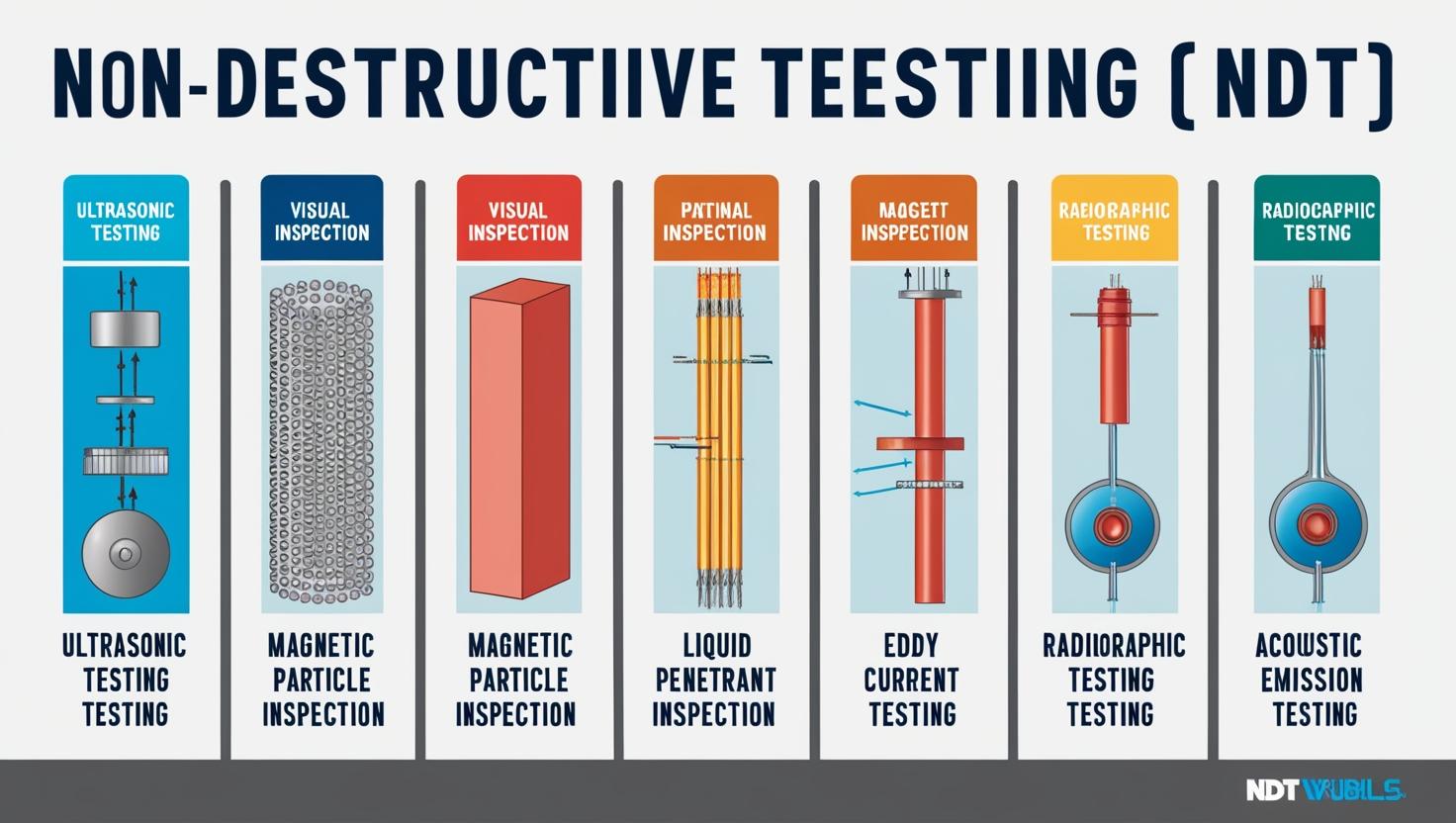
Common non-destructive testing methods include ultrasonic testing (UT), radiographic testing (RT), magnetic particle testing (MT), liquid penetrant testing (PT), eddy current testing (ET), and visual testing (VT).
5. How is AI transforming the Non-Destructive Testing Market?
AI and machine learning can analyze large volumes of inspection data, identify patterns, detect anomalies, classify defects, and support faster decision-making. AI-powered inspection can also improve consistency and reduce manual analysis time.
About MarketsandMarkets™
MarketsandMarkets™ has been recognized as one of America’s Best Management Consulting Firms by Forbes, as per their recent report.
MarketsandMarkets™ is a blue ocean alternative in growth consulting and program management, leveraging a man-machine offering to drive supernormal growth for progressive organizations in the B2B space. With the widest lens on emerging technologies, we are proficient in co-creating supernormal growth for clients across the globe.
Today, 80% of Fortune 2000 companies rely on MarketsandMarkets, and 90 of the top 100 companies in each sector trust us to accelerate their revenue growth. With a global clientele of over 13,000 organizations, we help businesses thrive in a disruptive ecosystem.
The B2B economy is witnessing the emergence of $25 trillion in new revenue streams that are replacing existing ones within this decade. We work with clients on growth programs, helping them monetize this $25 trillion opportunity through our service lines – TAM Expansion, Go-to-Market (GTM) Strategy to Execution, Market Share Gain, Account Enablement, and Thought Leadership Marketing.
Built on the ‘GIVE Growth’ principle, we collaborate with several Forbes Global 2000 B2B companies to keep them future-ready. Our insights and strategies are powered by industry experts, cutting-edge AI, and our Market Intelligence Cloud, KnowledgeStore™, which integrates research and provides ecosystem-wide visibility into revenue shifts.
To find out more, visit www.MarketsandMarkets™.com or follow us on Twitter , LinkedIn and Facebook .
Contact:
Mr. Rohan Salgarkar
MarketsandMarkets™ INC.
1615 South Congress Ave.
Suite 103, Delray Beach, FL 33445
USA: +1-888-600-6441
