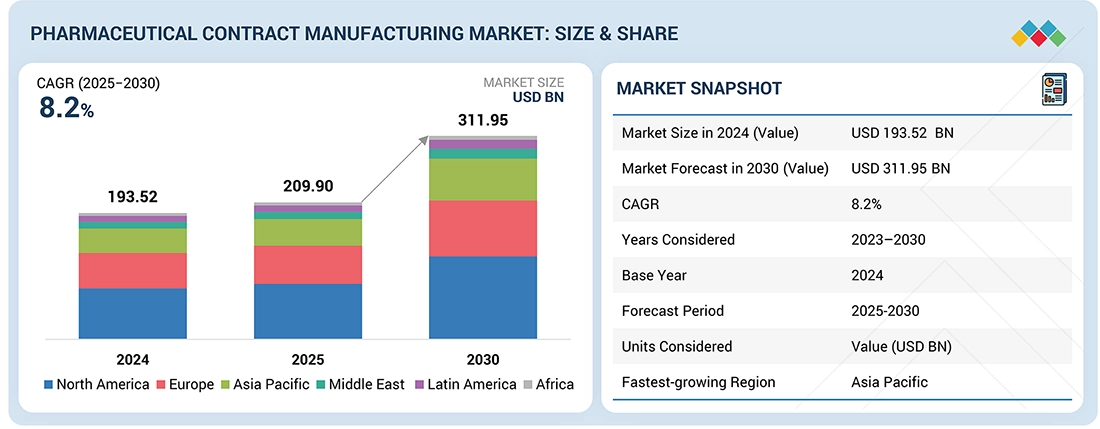
The global Pharmaceutical Contract Manufacturing Market is projected to grow from USD 209.90 billion in 2025 to USD 311.95 billion by 2030, registering a CAGR of 8.2% during the forecast period. Growth is being driven by the increasing outsourcing of pharmaceutical production, capacity constraints in high-demand therapeutic categories such as GLP-1 drugs, continued development of antibody-drug conjugates (ADCs), and the loss of exclusivity of several blockbuster biologics.
Download PDF Brochure:- https://www.marketsandmarkets.com/pdfdownloadNew.asp?id=201524381
Growing Demand for Specialized Manufacturing Drives CDMO Expansion
The pharmaceutical contract manufacturing market is expanding as pharmaceutical and biotechnology companies increasingly rely on contract development and manufacturing organizations (CDMOs) to access specialized expertise, advanced production technologies, and flexible manufacturing capacity.
The growing demand for GLP-1 therapies is creating a significant capacity requirement across the pharmaceutical supply chain. At the same time, continued approvals and development programs for complex modalities, including antibody-drug conjugates (ADCs), biologics, cell and gene therapies, highly potent APIs, peptides, and oligonucleotides, are increasing the need for specialized manufacturing infrastructure.
Loss of exclusivity for blockbuster biologics is also expected to support manufacturing activity as biosimilar development and commercialization continue to expand.
However, pharmaceutical manufacturers and CDMOs continue to face challenges associated with pricing pressure, high capital investment requirements, complex regulatory compliance, and cost constraints in major markets, including the US and Europe.
Pharmaceutical Manufacturing Services Held the Largest Market Share
The pharmaceutical manufacturing services segment accounted for the largest share of the pharmaceutical contract manufacturing market in 2024.
Pharmaceutical companies are increasingly outsourcing manufacturing operations to optimize costs, access specialized production capabilities, and improve speed to market.
The segment benefits from continued growth in both innovative and generic medicines, along with rising demand for complex formulations, including high-potency drugs, controlled-release dosage forms, and sterile injectables.
CDMOs provide pharmaceutical companies with access to specialized facilities, technical expertise, scalable production capacity, and established regulatory knowledge without requiring substantial investment in internal manufacturing infrastructure.
The growing need for flexible production models and resilient global supply chains is expected to further strengthen demand for outsourced pharmaceutical manufacturing services.
API Manufacturing Services Accounted for the Largest Share
Pharmaceutical API manufacturing services accounted for the largest share of the pharmaceutical manufacturing services segment in 2024.
Active pharmaceutical ingredients are critical components of medicines, and demand for specialized API manufacturing continues to increase with the rising prevalence of chronic and lifestyle-related diseases.
The expansion of the global generics market and the increasing complexity of modern APIs are encouraging pharmaceutical companies to partner with specialized CDMOs.
Growing demand for highly potent APIs (HPAPIs), peptides, oligonucleotides, and other complex molecules is further increasing the requirement for advanced manufacturing facilities with specialized containment, process development, and quality control capabilities.
As pharmaceutical companies focus on cost efficiency and regulatory compliance, API outsourcing is expected to remain a critical component of the global contract manufacturing ecosystem.
GLP-1, ADCs, and Advanced Modalities Create New Growth Opportunities
The rapid growth of GLP-1 therapies is creating substantial demand for pharmaceutical manufacturing capacity and supply chain support.
At the same time, continued investment in ADCs and other complex biologics is increasing the need for specialized capabilities across drug substance production, conjugation, fill-finish, packaging, and quality management.
Cell and gene therapies and other advanced therapeutic modalities are also contributing to the evolution of the CDMO landscape. These products require highly specialized facilities, technical expertise, and robust regulatory capabilities.
CDMOs are responding through capacity expansion, technology investments, automation, and the development of integrated services spanning drug development, clinical manufacturing, commercial-scale production, and packaging.
Asia Pacific Emerges as a Major Growth Hub
Asia Pacific accounted for the largest share of the pharmaceutical contract manufacturing market in 2024 and is expected to remain a major growth region.
Countries including China, India, South Korea, and Singapore have developed into important pharmaceutical and biologics manufacturing hubs.
The region benefits from a combination of skilled technical talent, competitive production costs, expanding infrastructure, supportive government policies, and growing investments in advanced manufacturing capabilities.
Rising demand for generics, biosimilars, biologics, and innovative therapies, combined with growing domestic pharmaceutical consumption, is further strengthening the region’s manufacturing ecosystem.
Regional companies such as WuXi Biologics, Samsung Biologics, Asymchem, Jubilant Pharmanova, Piramal Pharma Solutions, and Divi’s Laboratories are expanding their capabilities, while global CDMOs continue to invest in and strengthen their regional presence.
Strategic collaborations, capacity expansions, and investments in advanced technologies are expected to position Asia Pacific as a critical hub in the future global pharmaceutical CDMO landscape.
Speak To Analyst:- https://www.marketsandmarkets.com/speaktoanalystNew.asp?id=201524381
Competitive Landscape
The pharmaceutical contract manufacturing market is highly competitive, with companies focusing on capacity expansion, specialized manufacturing technologies, integrated service offerings, strategic acquisitions, and geographic expansion.
Key players profiled in the report include Thermo Fisher Scientific Inc., Catalent, Inc., Lonza, AbbVie Inc., WuXi AppTec, WuXi Biologics, Merck KGaA, Siegfried Holding AG, Evonik, Boehringer Ingelheim International GmbH, FUJIFILM Holding Corporation, Samsung Biologics, Almac Group, Vetter, Alcami Corporation, Asymchem Inc., and Charles River Laboratories, among others.
Companies are increasingly strengthening their capabilities in API manufacturing, FDF manufacturing, biologics production, ADC manufacturing, fill-finish services, packaging and labelling, and advanced therapeutic modalities.

