Introduction: Why Space Requires Hardened Electronics
Space is one of the most extreme environments known to humankind. Electronics operating in orbit or deep space are constantly exposed to intense radiation, temperature fluctuations, vacuum pressure, and cosmic particles. Conventional commercial electronics fail under such conditions, leading to potential system shutdowns, memory corruption, or even total mission failure. This is where radiation-hardened electronics for space environments become essential. These components are specially engineered to withstand high-radiation exposure and continue operating reliably throughout the lifespan of a mission — whether in Low Earth Orbit (LEO) or deep interplanetary space.
Components that Make Radiation-Hardened Systems Work
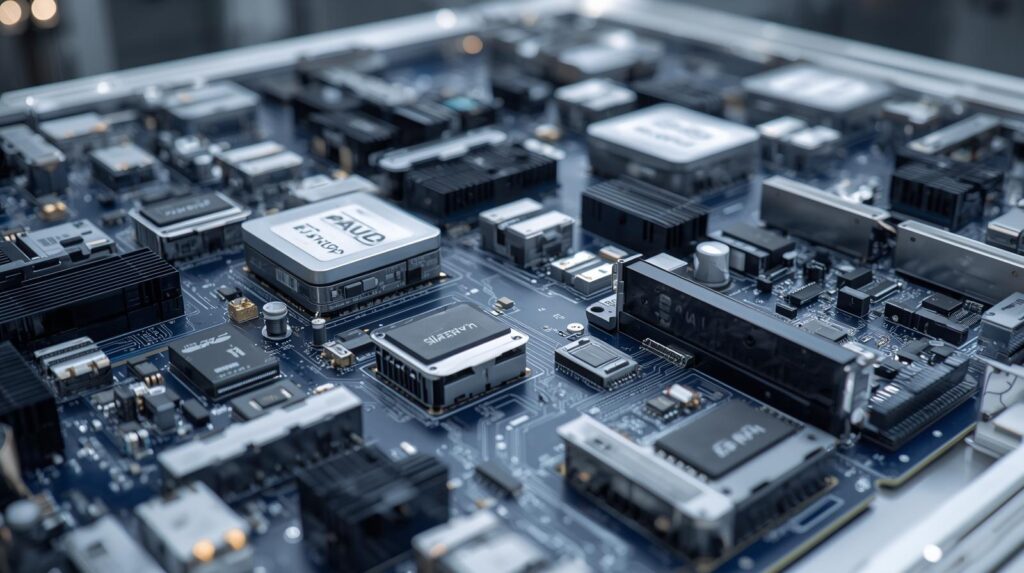
To function effectively in space, radiation-hardened electronics rely on a range of specialized components. Mixed signal integrated circuits (ICs) are often used to handle both analog and digital signals, making them essential in managing spacecraft communications, sensor inputs, and signal conversions. Processors and controllers act as the core computational engines of spacecraft systems, from onboard navigation to system health monitoring. These chips must operate flawlessly, even under radiation bombardment, to ensure mission success.
Memory components are another critical area. Spacecraft systems rely on both volatile and non-volatile memory for real-time operations, data storage, and system logging. In space environments, memory devices must be hardened against bit flips caused by high-energy particles — a common issue known as single-event upsets (SEUs). Lastly, power management integrated circuits ensure that energy from solar panels or onboard batteries is distributed safely and efficiently. In space, where energy is both precious and limited, these systems must perform flawlessly without succumbing to degradation from radiation exposure.
Techniques Behind Radiation Hardening
Two primary approaches dominate the design and manufacturing of radiation-hardened electronics for space environments. Radiation Hardening by Design (RHBD) focuses on circuit-level architecture improvements. This method employs fault-tolerant logic designs, redundant pathways, and error correction mechanisms to ensure that even if a radiation-induced error occurs, the system can recover or isolate the fault without total failure. RHBD is often preferred for its cost efficiency and design flexibility, especially when applied to commercial off-the-shelf (COTS) components being adapted for space use.
On the other hand, Radiation Hardening by Process (RHBP) involves modifying the actual semiconductor manufacturing process. This could include using silicon-on-insulator (SOI) substrates or specialized doping techniques that reduce the impact of radiation on semiconductor junctions. RHBP typically results in more robust, higher-tolerance electronics, but it comes at the expense of higher manufacturing costs and longer production timelines. RHBP is most often used in mission-critical applications such as deep space probes, defense systems, and interplanetary rovers.
Download PDF Brochure @ https://www.marketsandmarkets.com/pdfdownloadNew.asp?id=44047967
Commercial vs. Custom: Product Type Differentiation
Radiation-hardened electronics are commonly divided into two product types: commercial off-the-shelf (COTS) and custom-built systems. COTS components are standard commercial electronics adapted for space use, often through software-based error correction or limited shielding. These components are suitable for short-duration missions or lower-risk deployments, such as CubeSats in LEO. Their cost-effectiveness and availability make them attractive for commercial space startups and prototype missions.
Custom radiation-hardened systems, in contrast, are designed from the ground up to meet exacting space requirements. These systems undergo rigorous testing and validation to ensure survivability in high-radiation or long-duration environments. They are used extensively in defense, deep space exploration, and human spaceflight, where mission failure is not an option. While more expensive and complex, custom systems offer unmatched reliability and performance in extreme conditions.
Real-World Applications Across the Space Industry
Radiation-hardened electronics for space environments are used across a wide range of applications. In satellite communications, these components ensure that data transmission, signal processing, and onboard systems continue functioning despite the high radiation exposure common in geostationary and polar orbits. They are critical for weather satellites, GPS networks, and broadband constellations like Starlink and OneWeb.
Deep space missions rely heavily on radiation-hardened systems. Spacecraft like the Mars Perseverance rover or the James Webb Space Telescope operate far beyond Earth’s protective magnetosphere. Every sensor, actuator, and control unit must be engineered to endure long-term radiation exposure without degradation. Even minor faults could jeopardize multi-billion-dollar missions.
The defense and aerospace sectors also make significant use of radiation-hardened electronics. Surveillance satellites, missile guidance systems, and secure communications infrastructure all require fail-safe performance in the harshest conditions. Radiation resilience ensures national security assets remain operational in the event of solar storms or adversarial threats. Additionally, long-duration missions to the Moon and Mars—such as NASA’s Artemis program—require hardened electronics to support crew habitats, lunar rovers, and life support systems.
Market Trends and Future Outlook
The global radiation hardened electronics industry is projected to reach USD 2.30 billion by 2030 from USD 1.77 billion in 2025, growing at a CAGR of 5.4% during the forecast period. First, the increasing pace of satellite deployments is fueling demand for reliable space-grade electronics. With thousands of small satellites planned for launch in the coming years, there’s a growing need for cost-effective, radiation-tolerant systems. Second, the expansion of deep space exploration—by both government space agencies and commercial players—is accelerating investment in high-reliability components.
Another key trend is the miniaturization and modularization of electronics. As spacecraft become smaller and more agile, components must deliver more processing power in less space while maintaining radiation resilience. This is especially important for small satellite platforms, which have limited shielding capabilities and must rely on inherently robust electronics.
Artificial intelligence and edge computing are also making their way into space systems. As more spacecraft become autonomous, radiation-hardened processors capable of running machine learning models in orbit will become essential. These advancements are creating a new class of space-grade microelectronics that must be both intelligent and immune to radiation-induced failure.
Conclusion: The Backbone of Reliable Space Systems
As humanity reaches further into space, the need for reliable and resilient systems becomes more urgent. Radiation-hardened electronics for space environments are the unseen backbone of every successful mission — enabling satellites to transmit data, rovers to explore planets, and space stations to support human life. Through advancements in component design, manufacturing techniques like RHBD and RHBP, and tailored applications in commercial and custom systems, the industry is rising to meet the challenge of space’s harshest conditions.
Looking ahead, innovation in this field will not only power future space missions but also redefine what’s possible in Earth-based systems where reliability and resilience are critical — from aviation and nuclear power to autonomous vehicles and defense infrastructure. In the era of the new space race, radiation-hardened electronics for space environments are no longer optional — they are indispensable.
FAQ
Q1: What are radiation-hardened electronics?
A: Radiation-hardened electronics (often called “rad-hard” electronics) are electronic components and systems specifically designed to function reliably in environments with high levels of ionizing radiation — such as outer space. These electronics are engineered to withstand radiation effects like single event upsets (SEUs), total ionizing dose (TID), and displacement damage.
Q2: Why are radiation-hardened electronics essential in space environments?
A: In space, there is no atmospheric shielding like on Earth. High-energy particles from cosmic rays, solar flares, and trapped radiation belts can cause severe damage to standard electronics. Without radiation-hardening, systems can experience data corruption, component degradation, or complete failure — all of which are unacceptable in high-stakes missions.
Q3: What components are typically radiation-hardened in space systems?
A: The key components include mixed signal ICs, processors and controllers, memory (SRAM, DRAM, Flash, EEPROM), and power management ICs. These form the core of communication, control, computation, and energy distribution systems in spacecraft.
