SCADA in Renewable Market Growth
The global shift toward clean energy is accelerating the adoption of advanced digital technologies that improve the efficiency, reliability, and management of renewable power systems. Among these technologies, Supervisory Control and Data Acquisition (SCADA) systems have become a critical component in modern renewable energy infrastructure, enabling real-time monitoring, automated control, and data-driven optimization of solar and wind energy operations.
As renewable energy projects expand in scale and complexity, operators require intelligent solutions to manage fluctuating power generation, optimize asset performance, and ensure grid stability. SCADA systems provide centralized visibility and control over renewable assets, helping energy companies maximize productivity while reducing operational costs. The global SCADA in renewable energy market is estimated to reach USD 3.56 billion by 2030 from USD 1.96 billion in 2025, growing at a CAGR of 12.7% during the forecast period.
The growing deployment of solar farms, wind parks, distributed energy resources, and smart grids is driving significant demand for renewable energy SCADA solutions. Integration with artificial intelligence (AI), Internet of Things (IoT), cloud computing, and predictive analytics is further transforming SCADA from a monitoring platform into an intelligent energy management system.
Top 10 Key Takeaways
- SCADA systems are becoming essential for managing modern renewable energy assets.
- Solar and wind projects rely on SCADA for real-time monitoring and control.
- AI integration is transforming SCADA into an intelligent energy optimization platform.
- Predictive maintenance helps reduce downtime and operational costs.
- Cloud-based SCADA solutions improve scalability and remote accessibility.
- IoT connectivity is expanding renewable asset monitoring capabilities.
- Digital twins are enabling advanced simulation and performance optimization.
- Grid stability requirements are increasing demand for smart SCADA solutions.
- Cybersecurity is becoming a critical focus area for renewable SCADA networks.
- Future SCADA systems will support autonomous and data-driven renewable energy management.
Understanding SCADA in Renewable Energy
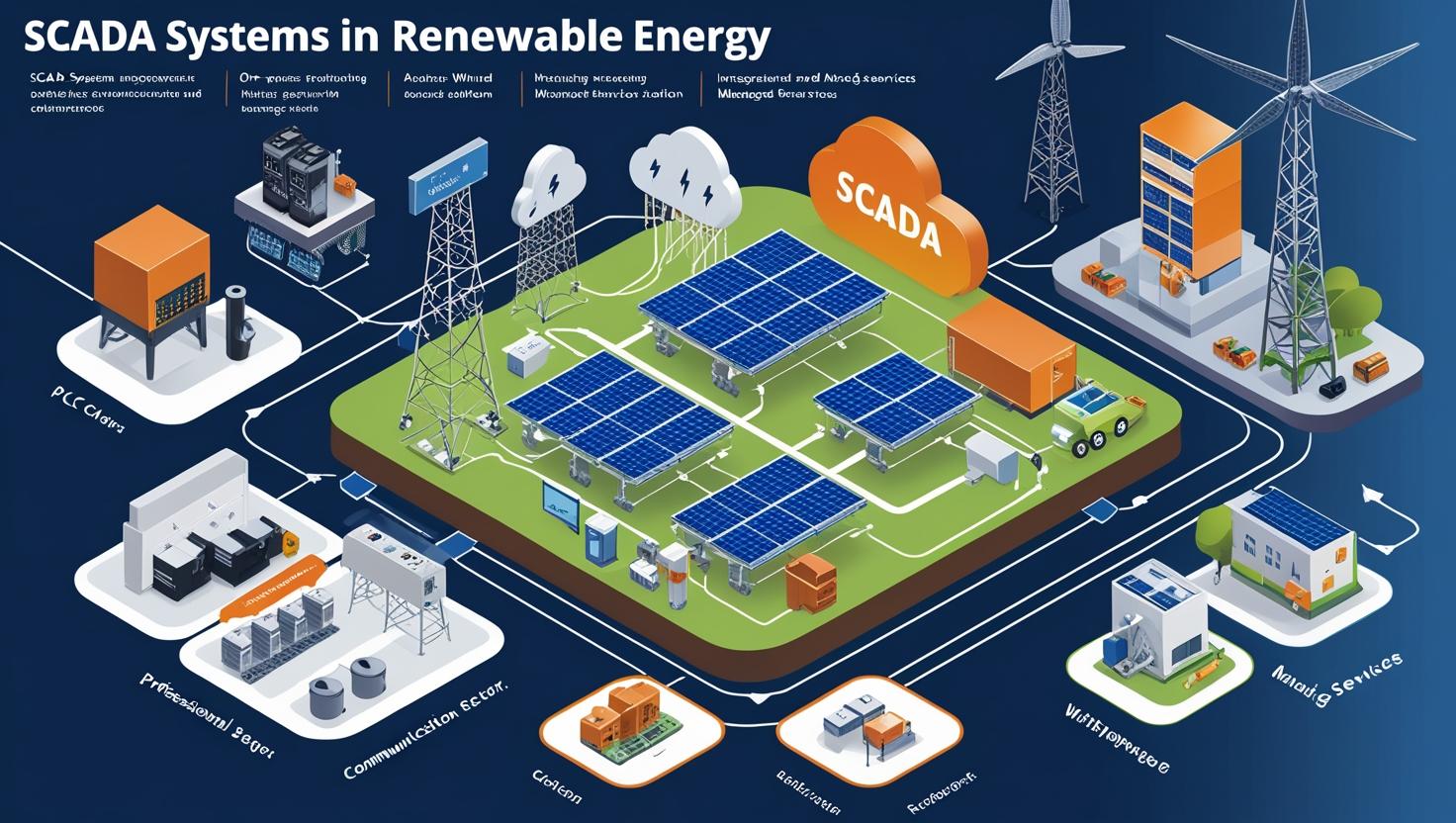
SCADA systems are industrial automation platforms designed to collect, process, analyze, and control operational data from energy assets. In renewable energy applications, SCADA connects field equipment with centralized control centers, allowing operators to monitor performance and respond quickly to changing conditions.
A typical renewable energy SCADA system includes:
- Sensors and measurement devices
- Remote terminal units (RTUs)
- Programmable logic controllers (PLCs)
- Communication networks
- Human-machine interfaces (HMIs)
- Data analytics platforms
- Central monitoring systems
These components work together to provide real-time information about energy generation, equipment health, environmental conditions, and system performance.
Role of SCADA in Solar Energy Operations
Solar photovoltaic (PV) plants require continuous monitoring to maintain efficiency and maximize electricity generation. SCADA systems enable operators to track critical parameters across solar installations.
SCADA applications in solar energy include:
Real-Time Performance Monitoring
SCADA platforms collect data from solar panels, inverters, weather stations, and electrical equipment. Operators can monitor:
- Power generation levels
- Voltage and current output
- Inverter performance
- Solar irradiance
- Temperature conditions
This visibility helps identify performance issues and maintain optimal energy production.
Predictive Maintenance for Solar Assets
Traditional maintenance approaches often rely on scheduled inspections. SCADA-enabled predictive maintenance uses operational data to identify early signs of equipment failure.
Benefits include:
- Reduced downtime
- Lower maintenance costs
- Improved equipment lifespan
- Faster fault detection
By analyzing historical performance trends, operators can schedule maintenance before failures occur.
Improving Solar Plant Efficiency
SCADA systems help optimize solar farm operations by identifying underperforming panels, inverter issues, and environmental impacts.
Advanced analytics can detect:
- Reduced energy output
- Panel degradation
- Electrical faults
- Abnormal operating conditions
This enables operators to improve overall plant performance.
Download PDF Brochure @ https://www.marketsandmarkets.com/pdfdownloadNew.asp?id=18400746
Role of SCADA in Wind Energy Operations
Wind farms operate in dynamic environments where weather conditions significantly influence power generation. SCADA systems are essential for monitoring turbine performance and optimizing energy output.
SCADA applications in wind energy include:
Turbine Monitoring and Control
SCADA systems collect data from wind turbines, including:
- Rotor speed
- Wind speed
- Blade position
- Generator performance
- Temperature levels
- Mechanical conditions
Operators can remotely monitor turbines and adjust operating parameters to maximize energy generation.
Wind Farm Optimization
Large wind farms consist of multiple turbines operating under different conditions. SCADA analytics help optimize turbine performance by evaluating:
- Wind direction
- Turbine efficiency
- Energy output variations
- Mechanical performance
This improves energy production and reduces unnecessary operational losses.
Fault Detection and Maintenance
Wind turbines require regular maintenance due to mechanical complexity and environmental exposure.
SCADA systems support:
- Early fault identification
- Condition monitoring
- Remote diagnostics
- Maintenance scheduling
Predictive maintenance helps reduce downtime and extends turbine operational life.
Key Drivers Fueling SCADA in Renewable Market Growth
Increasing Renewable Energy Capacity
The rapid expansion of renewable energy installations worldwide is a major factor driving SCADA adoption.
Solar and wind projects are becoming larger and more geographically distributed, increasing the need for centralized monitoring and control systems.
SCADA solutions help operators manage:
- Multiple renewable assets
- Remote installations
- Grid integration challenges
- Operational performance
As countries increase renewable energy investments, demand for advanced monitoring solutions continues to grow.
Growing Need for Grid Stability
Renewable energy generation is influenced by weather conditions, creating challenges for grid management.
SCADA systems support grid stability by providing:
- Real-time generation data
- Load monitoring
- Automated control
- Energy forecasting support
As renewable energy contributes a larger share of electricity generation, intelligent control systems are becoming increasingly important for reliable power networks.
Integration of AI and Machine Learning
Artificial intelligence is transforming SCADA systems by enabling advanced analytics and automation.
AI-powered SCADA solutions can provide:
- Predictive maintenance
- Automated fault detection
- Performance optimization
- Energy forecasting
- Anomaly detection
Machine learning algorithms analyze large volumes of operational data to identify patterns and improve decision-making.
The combination of AI and SCADA is helping renewable energy operators move from reactive management toward proactive asset optimization.
Cloud-Based SCADA Solutions
Cloud computing is changing how renewable energy operators manage infrastructure.
Cloud-based SCADA platforms provide:
- Remote accessibility
- Scalable data storage
- Advanced analytics
- Lower infrastructure costs
- Improved collaboration
These solutions are especially valuable for distributed renewable energy networks where assets are spread across multiple locations.
IoT Integration in Renewable SCADA Systems
The Internet of Things is expanding the capabilities of SCADA platforms by connecting more devices and sensors across renewable energy facilities.
IoT-enabled SCADA systems allow:
- Real-time equipment monitoring
- Automated data collection
- Remote asset management
- Improved operational visibility
The combination of IoT and SCADA supports smarter and more efficient renewable energy ecosystems.
Emerging Trends Shaping the SCADA Renewable Energy Market
Digital Twin Technology
Digital twins create virtual models of renewable energy assets, allowing operators to simulate performance and identify potential issues.
Applications include:
- Wind turbine modeling
- Solar plant optimization
- Equipment performance analysis
- Operational forecasting
Digital twins combined with SCADA data provide deeper insights into asset behavior.
Edge Computing Integration
Edge computing enables faster data processing by analyzing information closer to renewable assets.
Advantages include:
- Lower latency
- Faster decision-making
- Reduced network dependency
- Improved reliability
Edge-enabled SCADA systems are becoming increasingly important for large renewable installations.
Cybersecurity Improvements
As renewable energy systems become more connected, cybersecurity has become a major priority.
Modern SCADA solutions incorporate:
- Data encryption
- Access controls
- Network monitoring
- Threat detection systems
Protecting renewable infrastructure from cyber threats is essential for maintaining energy security.
Challenges Affecting SCADA Adoption
High Initial Investment
Implementing advanced SCADA infrastructure requires investment in:
- Hardware
- Software platforms
- Communication networks
- Integration services
Smaller renewable energy operators may face financial barriers when adopting advanced systems.
Complex System Integration
Renewable projects often include equipment from multiple manufacturers, creating interoperability challenges.
Successful SCADA deployment requires:
- Standardized communication protocols
- Compatible hardware
- Skilled technical expertise
Cybersecurity Risks
Increased connectivity creates additional cybersecurity challenges. Renewable operators must continuously improve security measures to protect critical infrastructure.
Regional Market Outlook
North America
North America is a major market for renewable energy SCADA solutions due to significant investments in solar and wind power, smart grids, and digital energy infrastructure.
Utilities and independent power producers are adopting advanced monitoring systems to improve operational efficiency.
Europe
Europe’s focus on renewable energy transition and grid modernization is supporting SCADA adoption.
Countries investing in offshore wind, solar farms, and smart energy networks are creating strong demand for advanced automation solutions.
Asia Pacific
Asia Pacific is expected to witness significant growth due to:
- Rapid renewable energy deployment
- Expanding solar and wind projects
- Government clean energy initiatives
- Increasing electricity demand
Large-scale renewable installations require advanced SCADA systems for efficient operation.
Future Outlook
The future of SCADA in renewable energy will be shaped by deeper integration with AI, IoT, cloud platforms, and automation technologies.
Next-generation SCADA systems will focus on:
- Autonomous energy management
- AI-based optimization
- Real-time predictive analytics
- Advanced cybersecurity
- Digital twin integration
- Smart grid compatibility
As renewable energy becomes a central component of global power systems, SCADA technology will play an increasingly important role in improving reliability, efficiency, and sustainability
Frequently Asked Questions (FAQs)
1. What is SCADA in renewable energy?
SCADA in renewable energy refers to monitoring and control systems used to collect data, manage equipment, and optimize operations in solar, wind, and other renewable power facilities.
2. How does SCADA improve solar and wind energy performance?
SCADA provides real-time monitoring, fault detection, predictive maintenance, and operational optimization, helping renewable energy operators improve efficiency and reliability.
3. Why is AI important for renewable energy SCADA systems?
AI enables predictive analytics, automated fault detection, energy forecasting, and intelligent decision-making, improving renewable asset management.
4. What renewable energy sectors use SCADA systems?
SCADA is widely used in solar farms, wind farms, hydroelectric facilities, battery storage systems, and smart grid applications.
5. What is the future of SCADA in renewable energy?
The future of SCADA will involve greater automation, AI integration, cloud connectivity, cybersecurity improvements, and intelligent energy management for next-generation renewable grids.
About MarketsandMarkets™
MarketsandMarkets™ has been recognized as one of America’s Best Management Consulting Firms by Forbes, as per their recent report.
MarketsandMarkets™ is a blue ocean alternative in growth consulting and program management, leveraging a man-machine offering to drive supernormal growth for progressive organizations in the B2B space. With the widest lens on emerging technologies, we are proficient in co-creating supernormal growth for clients across the globe.
Today, 80% of Fortune 2000 companies rely on MarketsandMarkets, and 90 of the top 100 companies in each sector trust us to accelerate their revenue growth. With a global clientele of over 13,000 organizations, we help businesses thrive in a disruptive ecosystem.
The B2B economy is witnessing the emergence of $25 trillion in new revenue streams that are replacing existing ones within this decade. We work with clients on growth programs, helping them monetize this $25 trillion opportunity through our service lines – TAM Expansion, Go-to-Market (GTM) Strategy to Execution, Market Share Gain, Account Enablement, and Thought Leadership Marketing.
Built on the ‘GIVE Growth’ principle, we collaborate with several Forbes Global 2000 B2B companies to keep them future-ready. Our insights and strategies are powered by industry experts, cutting-edge AI, and our Market Intelligence Cloud, KnowledgeStore™, which integrates research and provides ecosystem-wide visibility into revenue shifts.
To find out more, visit www.MarketsandMarkets™.com or follow us on Twitter , LinkedIn and Facebook .
Contact:
Mr. Rohan Salgarkar
MarketsandMarkets™ INC.
1615 South Congress Ave.
Suite 103, Delray Beach, FL 33445
USA: +1-888-600-6441
