The Smart Hospital Market is entering a period of strong expansion as healthcare providers increasingly adopt artificial intelligence (AI), the Internet of Medical Things (IoMT), cloud computing, advanced connectivity, automation, robotics, and data analytics. Hospitals are moving beyond conventional digital systems toward connected and intelligent environments designed to improve patient care, streamline clinical workflows, optimize resources, and support faster decision-making.
What Is a Smart Hospital?
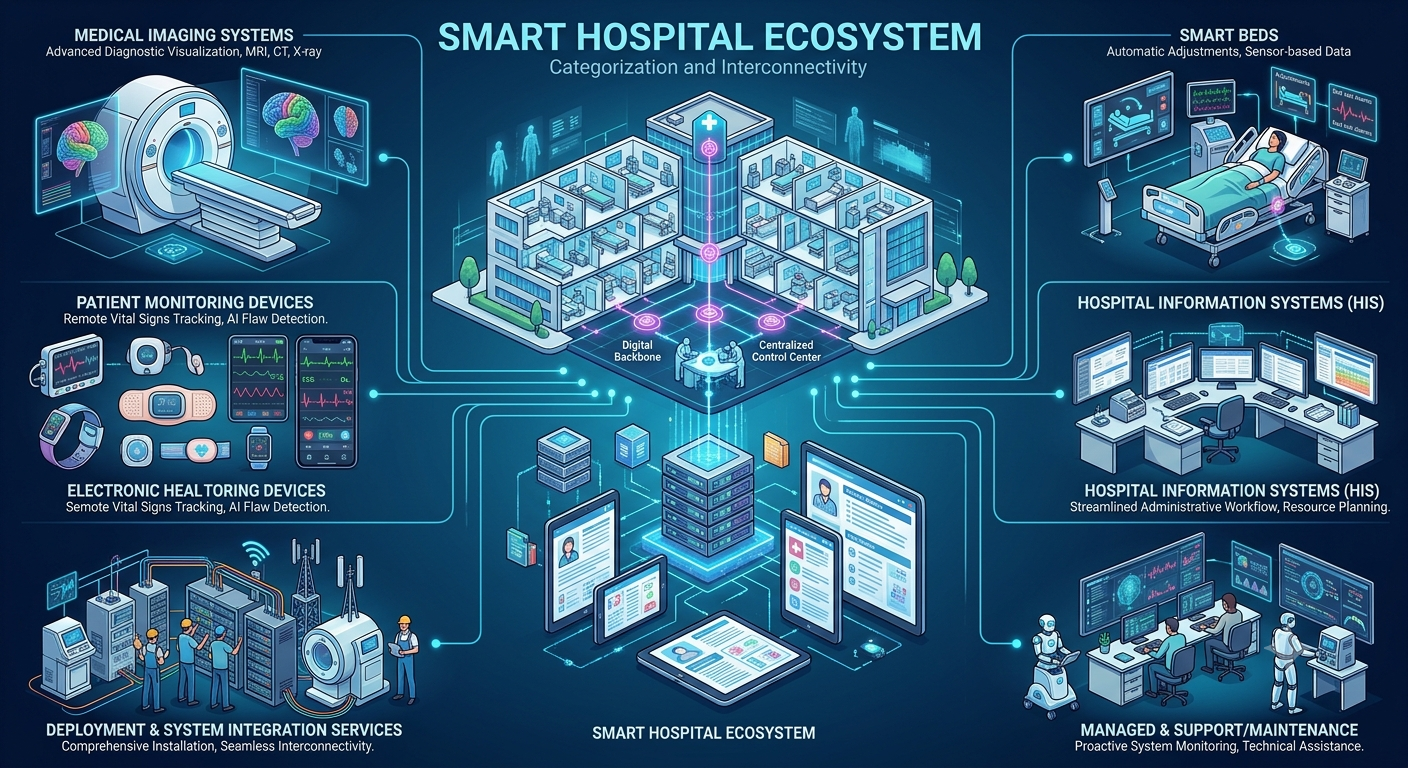
A smart hospital is a healthcare facility that integrates connected technologies, digital platforms, medical devices, analytics, and automation to create a more efficient and responsive healthcare environment.
Unlike traditional hospitals where systems may operate independently, smart hospitals aim to connect clinical, operational, and facility-management functions. IoMT devices can collect real-time patient data, AI systems can analyze information, cloud platforms can facilitate data access, and automated systems can help manage hospital resources.
This interconnected approach enables hospitals to improve patient monitoring, manage assets, optimize workflows, support clinical decisions, and enhance the overall patient experience.
Smart Hospital Market Growth Outlook
The market is projected to reach USD 246.17 billion by 2032, compared with USD 134.69 billion in 2026. This represents an increase of more than USD 111 billion over the forecast period.
The growth is being supported by increasing investments in hospital modernization and digital infrastructure. Healthcare organizations are seeking scalable technologies that can address rising patient volumes, workforce constraints, increasing healthcare costs, and the growing complexity of clinical operations.
MarketsandMarkets notes that the increasing demand for connected medical infrastructure, intelligent hospital technologies, real-time monitoring, and improved resource utilization is strengthening market growth.
Download PDF Brochure @ https://www.marketsandmarkets.com/pdfdownloadNew.asp?id=29319948
AI Becomes a Core Technology
Artificial intelligence and machine learning are among the most important technologies shaping the smart hospital market.
AI can support healthcare organizations in areas such as:
Clinical decision support
Medical imaging and diagnostics
Predictive analytics
Patient-risk assessment
Workflow optimization
Resource planning
Administrative automation
Predictive maintenance
MarketsandMarkets expects the AI & machine learning segment to register the highest CAGR among technology segments during the forecast period.
AI-enabled systems can analyze large quantities of clinical and operational data much faster than conventional approaches. This creates opportunities for hospitals to identify patterns, predict potential problems, and make more informed decisions.
The increasing integration of AI into hospital information systems and clinical workflows is therefore expected to remain a major growth driver.
IoMT Connects Patients, Devices, and Healthcare Systems
The Internet of Medical Things (IoMT) is another fundamental component of smart hospital transformation.
IoMT connects medical devices and sensors to healthcare networks, enabling the collection and exchange of real-time information. Connected patient monitors, smart beds, wearable devices, imaging systems, infusion equipment, and other medical technologies can contribute to a connected hospital ecosystem.
The increasing deployment of IoMT supports applications such as remote patient monitoring, asset tracking, patient care management, and clinical workflow optimization.
IoMT can also help healthcare providers improve visibility into equipment and patient status while reducing manual data collection.
Cloud-Based Deployment Gains Momentum
Cloud computing is playing an increasingly important role in smart hospital infrastructure. Cloud platforms offer scalability, centralized data management, flexible access, and support for data-intensive applications.
According to MarketsandMarkets, the cloud-based deployment segment is projected to register the highest CAGR of approximately 20.6% during the forecast period.
The growing adoption of electronic health records, AI analytics, IoMT, telemedicine, and remote patient monitoring is increasing demand for cloud-based infrastructure.
Cloud deployment can also help hospitals integrate data from different systems and locations. For healthcare networks operating multiple facilities, centralized cloud platforms can support more consistent access to information and analytics.
Remote Patient Monitoring Is a Major Growth Area
The shift toward connected and patient-centric healthcare is increasing demand for remote patient monitoring (RPM).
RPM technologies allow healthcare providers to collect patient information outside traditional hospital settings. Wearables, connected medical devices, mobile applications, and cloud platforms can transmit health data to healthcare professionals.
MarketsandMarkets expects the remote patient monitoring segment to record a CAGR of approximately 15.9%, making it one of the fastest-growing applications in the smart hospital market.
RPM can support chronic disease management, continuous health tracking, earlier intervention, and reduced dependence on unnecessary hospital visits.
The trend is particularly relevant as healthcare systems face aging populations, rising chronic disease prevalence, and workforce constraints.
Connectivity Is the Backbone of Smart Hospitals
Smart hospital technologies depend on reliable connectivity to exchange information between devices, healthcare professionals, and digital platforms.
The market includes connectivity technologies such as:
Wi-Fi
Bluetooth/BLE
RFID
Near Field Communication
Zigbee
Cellular 4G/5G
Ethernet/LAN
LoRaWAN/LPWAN
MarketsandMarkets projects the Wi-Fi segment to register the highest CAGR of approximately 18.7% during the forecast period.
Reliable wireless connectivity is particularly important for mobile clinical workflows, connected medical devices, patient monitoring, telemedicine, and hospital information access.
Hospital Command Centers Create New Opportunities
One of the emerging opportunities in the smart hospital market is the expansion of hospital command centers.
These centralized platforms bring together information from IoMT devices, real-time location systems, patient monitoring systems, electronic clinical platforms, and operational systems.
Command centers can provide real-time visibility into:
Patient flow
Bed occupancy
Staff allocation
Equipment utilization
Hospital capacity
Operational bottlenecks
MarketsandMarkets identifies hospital command centers as an important opportunity for intelligent hospital operations.
By combining data from multiple hospital systems, command centers can help administrators and clinical teams make faster, more informed operational decisions.
Digital Twins and Intelligent Hospital Optimization
Digital twins represent another emerging opportunity. A digital twin can create a virtual representation of a physical system, process, or environment.
In healthcare, this concept can potentially be applied to hospital operations, patient pathways, facilities, and clinical workflows.
MarketsandMarkets identifies the growing adoption of digital twins as an opportunity for smart hospital optimization.
Hospitals could use digital models to simulate operational scenarios, identify bottlenecks, evaluate capacity requirements, and improve resource planning before implementing changes in the physical environment.
Asia Pacific Leads Regional Growth
Asia Pacific is expected to be the fastest-growing region in the smart hospital market. MarketsandMarkets projects the region to account for approximately 32.3% of the global market by value in 2032.
Growth is being supported by healthcare digitalization, expanding hospital infrastructure, increasing adoption of AI and IoMT, and investments in connected healthcare technologies across countries including China, India, Japan, South Korea, Singapore, and Australia.
Government support for digital health initiatives and increasing demand for more efficient healthcare delivery are also encouraging investment in smart hospital technologies.
Key Market Drivers
Several factors are accelerating smart hospital adoption.
Increasing Connected Infrastructure
Hospitals are investing in IoMT devices, real-time location systems, intelligent building-management systems, automation platforms, and centralized monitoring solutions.
Growing AI Adoption
AI is increasingly being integrated into clinical and administrative workflows, enabling predictive analytics, automation, diagnostics, and decision support.
Demand for Operational Efficiency
Hospitals need to optimize beds, staff, medical equipment, energy, and other resources while maintaining high standards of patient care.
Growth of Digital Healthcare
Telemedicine, remote monitoring, electronic health records, digital health platforms, and connected devices are expanding the digital healthcare ecosystem.
Challenges to Market Growth
Despite its strong growth prospects, the smart hospital market faces several challenges.
High Upfront Costs
Smart hospital transformation requires investments in connected medical devices, networks, cybersecurity infrastructure, cloud or edge computing, data platforms, and integration services.
MarketsandMarkets identifies high upfront costs and integration complexity as important restraints on adoption.
Cybersecurity Risks
Greater connectivity also creates greater cybersecurity exposure. Hospitals need strong security architectures to protect patient information, medical devices, and critical infrastructure.
Workforce Readiness
Successful implementation requires healthcare professionals to adapt to new technologies and workflows. Training and change management are therefore critical components of digital transformation.
Data Governance and Regulation
Hospitals must balance innovation with privacy, regulatory compliance, interoperability, and responsible data management.
Competitive Landscape
The smart hospital market includes major healthcare technology and medical-device companies. MarketsandMarkets identifies Siemens Healthineers, GE HealthCare, Koninklijke Philips, FUJIFILM Holdings, and Canon among key players.
Other companies participating in the ecosystem include Stryker, Baxter, Medtronic, Becton, Dickinson and Company, and Abbott Laboratories.
Competition is increasingly focused on AI-enabled healthcare platforms, connected devices, cloud solutions, medical imaging, patient monitoring, workflow optimization, and integrated digital ecosystems.
Future Outlook
The future of the smart hospital market will be defined by integration and intelligence.
Hospitals are increasingly moving toward connected environments where AI, IoMT, cloud computing, advanced connectivity, robotics, analytics, and automation work together.
The next generation of smart hospitals will likely focus on predictive rather than reactive healthcare. Instead of simply recording patient or operational data, intelligent systems will increasingly analyze information in real time and identify potential issues before they become major problems.
The combination of remote monitoring, predictive analytics, AI-enabled diagnostics, automated workflows, and centralized command centers could significantly reshape how hospitals deliver and manage care.
The Smart Hospital Market is accelerating as healthcare organizations invest in AI, IoMT, cloud computing, automation, connected devices, and intelligent infrastructure. According to MarketsandMarkets, the market is expected to reach USD 246.17 billion by 2032, growing at a 10.6% CAGR from 2026 to 2032.
AI and machine learning, cloud-based deployment, Wi-Fi connectivity, and remote patient monitoring are expected to be among the strongest areas of growth. At the same time, hospital command centers and digital twins are creating new opportunities for operational optimization.
However, realizing the full potential of smart hospitals will require healthcare organizations to address implementation costs, cybersecurity, interoperability, workforce readiness, and data governance.
Ultimately, the smart hospital is evolving from a collection of connected technologies into a data-driven, AI-powered healthcare ecosystem. As hospitals continue their digital transformation journeys, intelligent connectivity will play an increasingly important role in improving patient outcomes, operational efficiency, and the overall quality of healthcare delivery.
The smart hospital market includes many major players, including Siemens Healthineers AG (Germany), Koninklijke Philips N.V. (Netherlands), GE HealthCare (US), Oracle (US), Epic Systems Corporation (US), Medtronic (Ireland), Cisco (US), Microsoft (US), Honeywell International Inc. (US), and Schneider Electric (France).
FAQs:
1. What is the Smart Hospital Market?
The Smart Hospital Market covers technologies and solutions that use AI, IoMT, cloud computing, connected medical devices, automation, robotics, and data analytics to improve patient care and hospital operations.
2. How fast is the Smart Hospital Market growing?
According to MarketsandMarkets, the global Smart Hospital Market is projected to grow from USD 134.69 billion in 2026 to USD 246.17 billion by 2032, at a 10.6% CAGR during 2026–2032.
3. What technologies are driving Smart Hospital Market growth?
Key technologies include artificial intelligence, machine learning, IoMT, cloud computing, advanced connectivity, robotics, automation, and data analytics.
4. Which applications are creating opportunities in the Smart Hospital Market?
Major applications include remote patient monitoring, clinical workflow optimization, patient monitoring, hospital command centers, electronic health records, asset management, and AI-powered clinical decision support.
5. What are the major challenges facing the Smart Hospital Market?
Key challenges include high implementation costs, cybersecurity risks, interoperability issues, data privacy requirements, regulatory compliance, and workforce readiness.
About MarketsandMarkets™
MarketsandMarkets™ has been recognized as one of America’s Best Management Consulting Firms by Forbes, as per their recent report.
MarketsandMarkets™ is a blue ocean alternative in growth consulting and program management, leveraging a man-machine offering to drive supernormal growth for progressive organizations in the B2B space. With the widest lens on emerging technologies, we are proficient in co-creating supernormal growth for clients across the globe.
Today, 80% of Fortune 2000 companies rely on MarketsandMarkets, and 90 of the top 100 companies in each sector trust us to accelerate their revenue growth. With a global clientele of over 13,000 organizations, we help businesses thrive in a disruptive ecosystem.
The B2B economy is witnessing the emergence of $25 trillion in new revenue streams that are replacing existing ones within this decade. We work with clients on growth programs, helping them monetize this $25 trillion opportunity through our service lines – TAM Expansion, Go-to-Market (GTM) Strategy to Execution, Market Share Gain, Account Enablement, and Thought Leadership Marketing.
Built on the ‘GIVE Growth’ principle, we collaborate with several Forbes Global 2000 B2B companies to keep them future-ready. Our insights and strategies are powered by industry experts, cutting-edge AI, and our Market Intelligence Cloud, KnowledgeStore™, which integrates research and provides ecosystem-wide visibility into revenue shifts.
To find out more, visit www.MarketsandMarkets™.com or follow us on Twitter , LinkedIn and Facebook .
Contact:
Mr. Rohan Salgarkar
MarketsandMarkets™ INC.
1615 South Congress Ave.
Suite 103, Delray Beach, FL 33445
USA: +1-888-600-6441
