The solar container market is witnessing notable growth as advancements in mobile solar technology continue to transform the way clean energy is generated, stored, and distributed. These containerized solar power systems offer a flexible, scalable, and efficient solution for delivering electricity across a wide range of applications, especially in areas with limited or no access to the grid. With rising global demand for renewable energy and energy independence, solar containers are becoming an increasingly important component of modern energy infrastructure. The solar container market is projected to reach USD 0.83 billion by 2030 from USD 0.29 billion in 2025, registering a CAGR of 23.8%
Growing Importance of Mobile Solar Technology
Mobile solar technology has significantly enhanced the capabilities of solar container systems. These containerized units integrate solar panels, batteries, and inverters into a compact and transportable structure, allowing for quick deployment in diverse environments. Their mobility makes them ideal for emergency power supply, temporary installations, and remote operations.
Advancements in battery storage, inverter efficiency, and solar panel performance are further improving the reliability and output of these systems. As a result, solar containers are now capable of delivering consistent and high-quality power in both urban and remote settings.
Market Segmentation by System Type
The solar container market can be categorized based on deployment type into on-grid, off-grid, portable, and fixed systems:
On-Grid Systems: These are connected to the main power grid and are used to supplement existing energy infrastructure. They help reduce dependency on conventional power sources and lower energy costs.
Off-Grid Systems: Widely used in remote locations, these systems operate independently of the grid and rely entirely on solar energy and battery storage.
Portable Systems: Designed for mobility, these containerized solutions can be easily transported and deployed for temporary or emergency use cases.
Fixed Systems: Installed in a permanent location, these systems are commonly used in industrial or large-scale applications requiring stable power supply.
Power Capacity Segmentation
Download PDF Brochure @ https://www.marketsandmarkets.com/pdfdownloadNew.asp?id=234680839
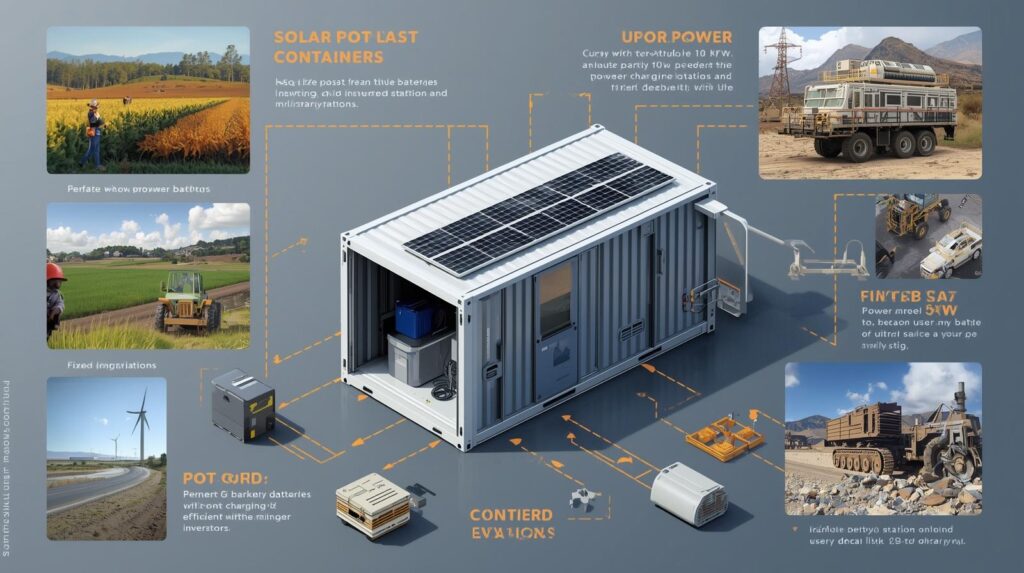
Based on power capacity, solar container systems are typically classified into:
Below 10 kW: Suitable for small-scale applications such as residential backup, small farms, and remote monitoring stations.
Above 50 kW: Designed for large-scale applications, including industrial operations, mining sites, military bases, and commercial facilities.
The increasing demand for high-capacity systems highlights the growing reliance on solar containers for powering energy-intensive operations.
Key Components Driving Performance
Solar container systems are composed of several key components:
Solar Panels: Capture and convert sunlight into electricity, forming the core of the system.
Batteries: Store excess energy for use during non-sunny periods, ensuring continuous power supply.
Inverters: Convert direct current (DC) into alternating current (AC), making the energy usable for standard electrical equipment.
Advancements in each of these components are contributing to improved efficiency, longer lifespan, and enhanced system performance.
Expanding Applications Across Industries
Solar container systems are finding applications across a diverse range of sectors:
Agriculture & Irrigation: Used to power irrigation pumps, lighting, and farm equipment in remote agricultural areas.
Remote Charging Stations: Provide off-grid charging solutions for electric vehicles and electronic devices in isolated locations.
Mining & Military: Deliver reliable and independent power in remote and harsh environments where grid access is limited or unavailable.
Energy Companies: Utilize solar containers as temporary or supplementary power sources for operations and maintenance activities.
These versatile applications are driving widespread adoption across both developed and developing regions.
Market Drivers and Opportunities
Several factors are fueling the growth of the solar container market:
- Rising demand for clean and renewable energy solutions
- Increasing need for portable and off-grid power systems
- Technological advancements in solar panels and energy storage
- Expansion of infrastructure in remote and underserved regions
- Growing focus on sustainability and carbon reduction
Opportunities also lie in government initiatives promoting renewable energy, as well as the growing adoption of hybrid energy systems combining solar with other power sources.
Challenges in the Market
Despite strong growth prospects, the solar container market faces certain challenges, including high initial investment costs, transportation and installation logistics, and dependence on weather conditions. Additionally, the need for efficient energy storage systems remains a key concern for maximizing performance.
Future solar container market Outlook
The solar container market is expected to continue its upward trajectory as mobile solar technology evolves and becomes more cost-effective. Increasing adoption across agriculture, defense, mining, and energy sectors will further drive demand.
As the world shifts toward sustainable and decentralized energy systems, solar containers are poised to play a crucial role in providing reliable, flexible, and environmentally friendly power solutions. With continuous innovation and expanding applications, the market is set for significant growth in the coming years.
FAQ
1. What is a solar container?
A solar container is a portable, self-contained solar power system housed within a shipping container. It typically includes solar panels, batteries, and inverters to generate, store, and supply electricity.
2. How does a solar container system work?
Solar panels capture sunlight and convert it into electricity, which is stored in batteries. The inverter then converts the stored DC power into AC power for use in various applications.
3. What are the main types of solar container systems?
On-grid systems
Off-grid systems
Portable systems
Fixed systems
4. What power capacities are available in solar containers?
Solar container systems are generally available in:
Below 10 kW for small-scale applications
Above 50 kW for large-scale industrial and commercial use
5. What are the key components of a solar container?
Solar panels
Batteries (energy storage)
Inverters
Charge controllers and monitoring systems
6. What industries use solar container systems?
Solar containers are widely used in:
Agriculture & irrigation
Mining & military operations
Energy companies
Remote charging stations
Construction and remote infrastructure projects
About MarketsandMarkets™
MarketsandMarkets™ has been recognized as one of America’s Best Management Consulting Firms by Forbes, as per their recent report.
MarketsandMarkets™ is a blue ocean alternative in growth consulting and program management, leveraging a man-machine offering to drive supernormal growth for progressive organizations in the B2B space. With the widest lens on emerging technologies, we are proficient in co-creating supernormal growth for clients across the globe.
Today, 80% of Fortune 2000 companies rely on MarketsandMarkets, and 90 of the top 100 companies in each sector trust us to accelerate their revenue growth. With a global clientele of over 13,000 organizations, we help businesses thrive in a disruptive ecosystem.
The B2B economy is witnessing the emergence of $25 trillion in new revenue streams that are replacing existing ones within this decade. We work with clients on growth programs, helping them monetize this $25 trillion opportunity through our service lines – TAM Expansion, Go-to-Market (GTM) Strategy to Execution, Market Share Gain, Account Enablement, and Thought Leadership Marketing.
Built on the ‘GIVE Growth’ principle, we collaborate with several Forbes Global 2000 B2B companies to keep them future-ready. Our insights and strategies are powered by industry experts, cutting-edge AI, and our Market Intelligence Cloud, KnowledgeStore™, which integrates research and provides ecosystem-wide visibility into revenue shifts.
To find out more, visit www.MarketsandMarkets™.com or follow us on Twitter , LinkedIn and Facebook .
Contact:
Mr. Rohan Salgarkar
MarketsandMarkets™ INC.
630 Dundee Road
Suite 430
Northbrook, IL 60062
USA : 1-888-600-6441
