Artificial intelligence has evolved from a niche technology into a strategic business enabler across industries. Enterprises are increasingly adopting generative AI to automate workflows, enhance customer experiences, accelerate software development, and improve business decision-making. As AI models become more sophisticated and data-intensive, organizations require specialized computing infrastructure capable of delivering exceptional performance, scalability, and reliability.
This demand is fueling rapid expansion in the Generative AI Server Market. is expected to reach USD 448.60 billion by 2030 from USD 103.92 billion in 2025, registering a CAGR of 34.0% during the forecast period. during the forecast period. The market’s growth is driven by the increasing need for real-time AI inference across applications such as virtual assistants, recommendation engines, content generation platforms, and intelligent automation systems.
Unlike conventional enterprise servers, generative AI servers are purpose-built to process enormous datasets and execute highly parallel AI workloads. Equipped with advanced processors such as GPUs, FPGAs, and ASICs, these servers provide the computational foundation necessary for training, fine-tuning, and deploying large language models (LLMs) and other deep learning applications.
Why Generative AI Servers Have Become Essential
Generative AI applications require enormous computational resources throughout their lifecycle. Training foundation models often involves billions or trillions of parameters and demands thousands of high-performance processors working together.
However, training is only one part of the AI lifecycle. Once deployed, AI models must perform inference continuously, responding instantly to millions of user requests. Whether generating text, recommending products, recognizing images, or answering customer questions, AI systems must deliver responses with minimal latency.
Traditional enterprise servers were never designed for these highly parallel workloads. Generative AI servers overcome these limitations by combining AI accelerators, high-speed networking, massive memory bandwidth, and optimized storage architectures.
As organizations integrate AI into mission-critical business operations, these servers are rapidly becoming the backbone of enterprise digital transformation.
Market Growth Drivers
Rising Demand for Real-Time AI Inference
One of the strongest growth drivers for the Generative AI Server Market is the increasing demand for real-time AI inference.
Today’s AI applications—including conversational AI, intelligent search, fraud detection, recommendation engines, autonomous systems, and personalized digital experiences—must process user requests instantly.
For example:
- AI chatbots must answer questions within seconds.
- Recommendation engines analyze customer behavior in real time.
- Content generation tools create text, images, videos, and code instantly.
- AI assistants continuously process voice commands.
Meeting these latency requirements requires specialized AI servers capable of handling continuous inference workloads at scale.
As businesses increasingly deploy AI-powered services, investments in inference-optimized infrastructure continue to accelerate.
Growing Adoption of Large Language Models
Large Language Models (LLMs) such as enterprise chatbots, virtual assistants, and knowledge management systems require significant computing power.
Training an LLM may take weeks or even months, involving thousands of GPUs operating simultaneously.
After deployment, enterprises continuously fine-tune these models using proprietary datasets to improve accuracy, industry-specific knowledge, and business performance.
This continuous AI lifecycle creates sustained demand for high-performance server infrastructure.
Enterprise AI Expansion Across Industries
Generative AI is no longer limited to technology companies.
Healthcare organizations use AI to assist with diagnostics and medical research.
Financial institutions deploy AI for fraud detection, credit analysis, and personalized banking.
Manufacturers leverage AI for predictive maintenance, quality inspection, and production optimization.
Retailers use AI to personalize shopping experiences and forecast demand.
Legal firms automate document review.
Marketing teams generate personalized campaigns using AI.
As AI adoption expands across virtually every industry, the demand for specialized server infrastructure continues to grow.
Download PDF Brochure @ https://www.marketsandmarkets.com/pdfdownloadNew.asp?id=242200223
Expansion of Hyperscale Data Centers
Cloud providers are investing billions of dollars to build AI-ready hyperscale data centers.
These facilities require thousands of AI servers interconnected through ultra-high-speed networking infrastructure.
Hyperscale operators are expanding capacity to support:
- AI model training
- Enterprise AI services
- Cloud-based inference
- Machine learning platforms
- AI-as-a-Service (AIaaS)
This rapid expansion is creating enormous demand for advanced server platforms optimized for AI workloads.
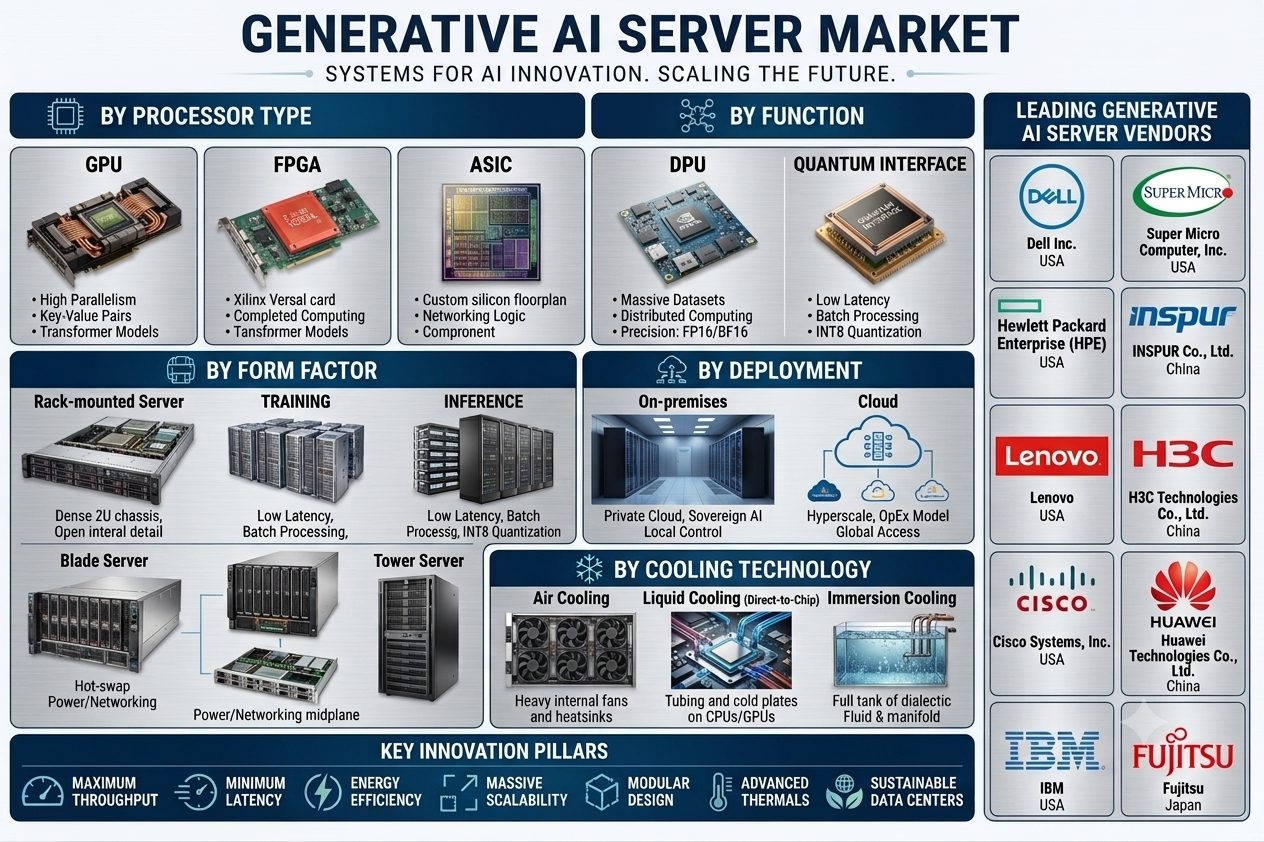
Processor Type Analysis
GPU-Based Servers
Graphics Processing Units (GPUs) currently dominate the Generative AI Server Market.
Unlike traditional CPUs, GPUs contain thousands of processing cores capable of executing multiple calculations simultaneously.
This massively parallel architecture makes GPUs ideal for:
- Large language model training
- Deep learning
- Computer vision
- Natural language processing
- Scientific computing
- Recommendation engines
GPU-based servers have become the preferred choice for hyperscale cloud providers and enterprises because they significantly reduce AI training time while improving inference performance.
As AI model complexity continues to increase, demand for GPU servers is expected to remain exceptionally strong.
FPGA-Based Servers
Field Programmable Gate Arrays (FPGAs) provide flexible hardware acceleration.
Unlike GPUs, FPGAs can be reconfigured after manufacturing, allowing organizations to optimize hardware for specific AI workloads.
Advantages include:
- Lower latency
- Improved energy efficiency
- Customized processing
- Reduced operating costs
- High-performance inference
FPGAs are increasingly used in industries requiring deterministic performance, including telecommunications, finance, and industrial automation.
ASIC-Based Servers
Application-Specific Integrated Circuits (ASICs) are purpose-built processors designed specifically for AI computation.
Since ASICs perform dedicated tasks, they offer:
- Higher processing efficiency
- Lower power consumption
- Reduced operational costs
- Superior inference performance
Major hyperscale providers continue investing heavily in custom AI chips to optimize both performance and energy efficiency.
Enterprise Applications
AI Model Training
Training generative AI models requires enormous computational resources.
AI servers distribute training workloads across multiple processors, enabling organizations to process massive datasets much faster than conventional infrastructure.
High-performance servers shorten development cycles and accelerate innovation.
Real-Time AI Inference
Inference is becoming one of the fastest-growing workloads in enterprise AI.
Businesses increasingly require AI systems capable of processing millions of requests simultaneously while maintaining low response times.
Applications include:
- Customer support chatbots
- Digital assistants
- Search engines
- Fraud detection
- Personalized recommendations
- Language translation
Optimized AI servers ensure consistent, low-latency performance even during peak demand.
Intelligent Automation
Organizations are deploying AI servers to automate repetitive business processes.
Examples include:
- Invoice processing
- Document summarization
- Software code generation
- Contract analysis
- Customer service
- Predictive maintenance
Automation improves productivity while reducing operational costs.
Scientific Research
Research institutions use AI servers for:
- Drug discovery
- Climate modeling
- Genomics
- Engineering simulations
- Materials research
These computationally intensive applications require advanced AI infrastructure capable of processing enormous scientific datasets.
Emerging Technology Trends
AI-Optimized Data Centers
Data centers are increasingly designed specifically for AI workloads.
Operators are deploying:
- High-density server racks
- Advanced networking
- AI accelerators
- Intelligent workload scheduling
These facilities maximize AI computing performance while improving scalability.
Liquid Cooling Technologies
As AI processors consume significantly more power than traditional CPUs, advanced cooling technologies have become essential.
Liquid cooling provides:
- Better heat dissipation
- Lower energy consumption
- Higher server density
- Improved system reliability
Many hyperscale AI data centers are rapidly adopting liquid cooling solutions.
High-Speed Networking
Modern AI clusters require extremely fast communication between thousands of processors.
Technologies such as InfiniBand and ultra-high-speed Ethernet reduce latency and improve distributed AI training efficiency.
Networking is becoming just as important as processor performance.
Sustainable AI Infrastructure
Energy efficiency has become a major focus for AI infrastructure providers.
Manufacturers continue developing:
- Efficient processors
- Intelligent power management
- Renewable-powered data centers
- Carbon-aware computing
Sustainable AI infrastructure is expected to become a competitive differentiator.
Challenges Facing the Market
Despite remarkable growth opportunities, several challenges remain.
Organizations face:
- High capital investment
- Significant energy consumption
- AI chip supply constraints
- Cooling infrastructure requirements
- Cybersecurity concerns
- Skills shortages
Addressing these challenges will require collaboration between hardware vendors, cloud providers, software developers, and enterprise customers
Future Outlook
The future of enterprise AI depends heavily on continued advances in server technology.
Next-generation AI servers will incorporate:
- More powerful GPUs
- Specialized AI accelerators
- Faster memory architectures
- Intelligent resource scheduling
- Advanced liquid cooling
- Automated infrastructure management
As generative AI becomes embedded across enterprise operations, organizations will increasingly invest in scalable, high-performance AI infrastructure capable of supporting continuous innovation.
The Generative AI Server Market is entering a period of unprecedented expansion as enterprises accelerate AI adoption across every major industry. Growing demand for real-time AI inference, large language models, intelligent automation, and cloud-based AI services is driving investments in specialized server infrastructure.
With the market expected to grow from USD 103.92 billion in 2025 to USD 448.60 billion by 2030 at a CAGR of 34.0%, AI servers are becoming the backbone of modern enterprise computing. Powered by GPU-, FPGA-, and ASIC-based architectures, these systems provide the speed, scalability, and intelligence required to support the next generation of AI innovation.
Organizations that invest in AI-ready infrastructure today will be better positioned to deliver faster insights, enhance operational efficiency, and maintain a competitive edge in the rapidly evolving digital economy.
Frequently Asked Questions (FAQs) – Generative AI Server Market
1. What is driving the growth of the Generative AI Server Market?
The growth of the Generative AI Server Market is driven by increasing demand for real-time AI inference, adoption of large language models (LLMs), expansion of generative AI applications, and rising investments in AI-ready data center infrastructure. Businesses are deploying AI servers to support applications such as virtual assistants, recommendation engines, content generation platforms, automation tools, and advanced analytics.
2. What processor types are used in Generative AI servers?
Generative AI servers primarily use three processor types: GPU (Graphics Processing Unit), FPGA (Field Programmable Gate Array), and ASIC (Application-Specific Integrated Circuit). GPUs are widely adopted for AI training and inference due to their parallel processing capabilities, while FPGAs offer flexibility and low-latency performance, and ASICs provide highly optimized processing for specific AI workloads.
3. Why are Generative AI servers important for enterprise AI adoption?
Generative AI servers provide the high-performance computing power required to train, fine-tune, and deploy advanced AI models. They enable enterprises to run AI applications with faster response times, improved scalability, and greater efficiency, supporting use cases such as customer service automation, predictive analytics, software development, and intelligent decision-making.
4. How is the increasing demand for AI inference impacting the Generative AI Server Market?
The growing need for real-time AI inference is significantly accelerating market growth. Applications such as AI assistants, search engines, recommendation systems, autonomous solutions, and content creation platforms require low-latency processing. This is encouraging organizations to invest in high-performance servers and edge computing infrastructure capable of handling continuous AI workloads.
5. What are the key trends shaping the future of the Generative AI Server Market?
Major trends shaping the market include the adoption of AI-optimized data centers, advanced cooling technologies, high-speed networking, custom AI processors, cloud-based AI infrastructure, and sustainable computing solutions. As generative AI adoption expands, enterprises are expected to increase investments in scalable and energy-efficient AI server platforms.
About MarketsandMarkets™
MarketsandMarkets™ has been recognized as one of America’s Best Management Consulting Firms by Forbes, as per their recent report.
MarketsandMarkets™ is a blue ocean alternative in growth consulting and program management, leveraging a man-machine offering to drive supernormal growth for progressive organizations in the B2B space. With the widest lens on emerging technologies, we are proficient in co-creating supernormal growth for clients across the globe.
Today, 80% of Fortune 2000 companies rely on MarketsandMarkets, and 90 of the top 100 companies in each sector trust us to accelerate their revenue growth. With a global clientele of over 13,000 organizations, we help businesses thrive in a disruptive ecosystem.
The B2B economy is witnessing the emergence of $25 trillion in new revenue streams that are replacing existing ones within this decade. We work with clients on growth programs, helping them monetize this $25 trillion opportunity through our service lines – TAM Expansion, Go-to-Market (GTM) Strategy to Execution, Market Share Gain, Account Enablement, and Thought Leadership Marketing.
Built on the ‘GIVE Growth’ principle, we collaborate with several Forbes Global 2000 B2B companies to keep them future-ready. Our insights and strategies are powered by industry experts, cutting-edge AI, and our Market Intelligence Cloud, KnowledgeStore™, which integrates research and provides ecosystem-wide visibility into revenue shifts.
To find out more, visit www.MarketsandMarkets™.com or follow us on Twitter , LinkedIn and Facebook .
Contact:
Mr. Rohan Salgarkar
MarketsandMarkets™ INC.
1615 South Congress Ave.
Suite 103, Delray Beach, FL 33445
USA: +1-888-600-6441
