The 4D Imaging Radar Industry is entering a high-growth phase as automakers increasingly adopt advanced sensing technologies to improve vehicle safety, enhance advanced driver-assistance systems (ADAS), and support higher levels of driving automation. Unlike conventional radar systems, 4D imaging radar can capture range, azimuth, elevation, and Doppler velocity, providing vehicles with richer information about their surroundings and enabling more precise object detection and tracking.
According to MarketsandMarkets, the global 4D imaging radar market is projected to grow from USD 392.8 million in 2025 to USD 1,206.9 million by 2030, registering a CAGR of 25.2% from 2025 to 2030. The growth is being driven primarily by rising demand for enhanced vehicle safety, increasing adoption of autonomous and semi-autonomous vehicles, expanding ADAS deployment, and advances in sensor-fusion technologies.
4D Imaging Radar Is Redefining Vehicle Perception
Modern vehicles increasingly require sensors capable of understanding complex environments rather than simply detecting objects. Cameras can provide rich visual information but can be affected by darkness, glare, fog, and adverse weather. Conventional radar provides strong range and velocity information but generally offers less detailed spatial information.
4D imaging radar addresses these limitations by adding elevation information to range, azimuth, and velocity measurements. This allows vehicles to generate a more detailed representation of their surroundings and distinguish between objects that may appear similar to conventional sensors.
This capability is particularly valuable for ADAS and autonomous driving applications, where vehicles need to identify, classify, and track objects in real time.
MarketsandMarkets highlights the ability of 4D imaging radar to deliver high-resolution environmental perception as a key factor supporting market growth.
ADAS Is the Major Growth Engine
The rapid adoption of advanced driver-assistance systems is one of the strongest growth drivers for the 4D Imaging Radar Industry. Features such as adaptive cruise control, automatic emergency braking, lane-keeping assistance, blind-spot detection, and collision avoidance increasingly depend on sophisticated environmental sensing.
MarketsandMarkets expects ADAS to remain the leading application segment, with the segment projected to register a CAGR of approximately 24.5% during the forecast period.
As automakers expand ADAS availability from premium vehicles into mass-market passenger cars, demand for cost-effective high-resolution radar sensors is increasing.
4D imaging radar can provide the perception required for these systems while complementing cameras, LiDAR, ultrasonic sensors, and other sensing technologies.
Autonomous Driving Is Accelerating Adoption
The transition toward higher levels of vehicle automation is another important factor influencing the market.
As vehicles move toward SAE Level 3 and above, perception systems must operate with greater accuracy and reliability. Autonomous vehicles need to detect objects at different distances, understand their position relative to the vehicle, track their movement, and respond appropriately.
4D imaging radar can provide critical environmental data for this process. Its ability to measure elevation and Doppler velocity makes it useful for identifying road users and objects in complex environments.
MarketsandMarkets identifies the shift toward autonomous driving as a pivotal driver of 4D imaging radar adoption.
Download PDF Brochure @ https://www.marketsandmarkets.com/pdfdownloadNew.asp?id=226035909
Sensor Fusion Is Creating New Opportunities
One of the most significant opportunities for the 4D Imaging Radar Industry is integration with multiple sensing technologies.
Rather than replacing cameras or LiDAR, 4D radar can complement them through sensor fusion. A vehicle can combine radar measurements with camera images, LiDAR point clouds, ultrasonic sensing, and other inputs to create a more comprehensive understanding of its surroundings.
This approach can improve perception reliability because individual sensors have different strengths and weaknesses.
MarketsandMarkets identifies the integration of 4D imaging radar into multi-sensor systems as a major market opportunity. Such integration can support more accurate object detection, classification, and tracking, particularly under poor visibility conditions.
The increasing focus on sensor fusion is therefore expected to create opportunities for radar manufacturers, semiconductor companies, automotive suppliers, and autonomous-driving technology developers.
Short-Range Radar Holds a Strong Market Position
By range, short-range 4D imaging radar is expected to hold the highest market share in 2030. Short-range systems are particularly useful for applications requiring precise object detection and spatial awareness around the vehicle.
These radar systems can support low-speed maneuvers, urban driving, parking, intersection monitoring, and other situations where accurate detection of nearby objects is critical.
Companies are developing compact, software-defined radar solutions that can be integrated into vehicle bumpers and other constrained locations.
At the same time, long-range radar is expected to experience strong growth as automakers require extended detection distances for highway driving and autonomous navigation. MarketsandMarkets identifies long-range radar as a high-growth segment during the forecast period.
Long-Range Radar Supports Highway Automation
Long-range 4D imaging radar can detect and track objects at significant distances, providing vehicles with more time to respond to potential hazards.
This capability is particularly important for highway driving, where vehicles travel at higher speeds and require longer detection ranges.
Advanced long-range radar can combine range, angular position, elevation, and Doppler velocity to create a detailed representation of objects ahead. This supports functions such as adaptive cruise control, forward collision warning, automatic emergency braking, and higher-level automated driving.
As automakers develop increasingly sophisticated highway-assistance systems, long-range 4D imaging radar is positioned to become an important component of next-generation vehicle perception architectures.
Automotive Is the Fastest-Growing End User
The automotive segment is projected to grow at the fastest rate from 2025 to 2030, reflecting the industry’s strong focus on ADAS and autonomous driving.
Automakers are investing heavily in sensing technologies as consumers increasingly expect advanced safety and automation features.
Regulatory requirements are also encouraging manufacturers to incorporate more sophisticated safety technologies. As safety ratings and government regulations increasingly emphasize driver assistance and collision avoidance, radar-based sensing can play an important role in meeting these requirements.
The growing electrification of vehicles is also creating opportunities for advanced electronic architectures in which radar, cameras, computing platforms, and connectivity systems can be integrated more efficiently.
AI Is Enhancing Radar Intelligence
Artificial intelligence is becoming increasingly important in radar perception. Modern 4D imaging radar generates substantial quantities of data that require advanced signal processing and computing capabilities.
AI and machine learning algorithms can help process radar information, identify objects, classify targets, recognize patterns, and improve perception performance.
The combination of AI with radar can transform raw sensor measurements into higher-level information that autonomous driving systems can use for decision-making.
Advancements in radar chipsets, signal processing, AI integration, and miniaturization are therefore contributing to improved performance and potentially lower system costs. MarketsandMarkets identifies these technological advances as important factors accelerating adoption.
Radar-on-Chip Technology Is Supporting Miniaturization
The development of increasingly integrated radar chipsets is another important trend. Integrating radar components into compact semiconductor solutions can reduce system size and simplify vehicle integration.
Smaller radar modules can be installed in vehicle bumpers, grilles, mirrors, and other locations without significantly affecting vehicle design.
Semiconductor companies are investing in radar system-on-chip technologies capable of supporting multiple transmit and receive channels, advanced signal processing, and high-resolution sensing.
This trend is important because automakers need sensors that deliver improved performance without significantly increasing vehicle complexity, weight, or energy consumption.
Regulatory Pressure Is Supporting Market Expansion
Governments and regulatory bodies are increasingly emphasizing vehicle safety. Stricter requirements for ADAS and automated driving features are encouraging automakers to invest in advanced sensing technologies.
Europe is particularly important in this context. MarketsandMarkets expects Europe to account for the largest share of the global 4D imaging radar market, supported by its strong automotive sector, advanced R&D ecosystem, and strict vehicle safety regulations.
The region’s regulatory environment and automotive innovation ecosystem create favorable conditions for adoption of advanced radar technologies.
Europe Remains a Key Innovation Hub
Europe’s automotive industry has been a major contributor to the development of advanced vehicle sensing and safety systems.
MarketsandMarkets estimates that Europe accounted for 46.6% of 4D imaging radar market revenue in 2024, highlighting the region’s strong position.
The presence of major automotive OEMs, technology suppliers, semiconductor companies, and research organizations creates a strong ecosystem for innovation.
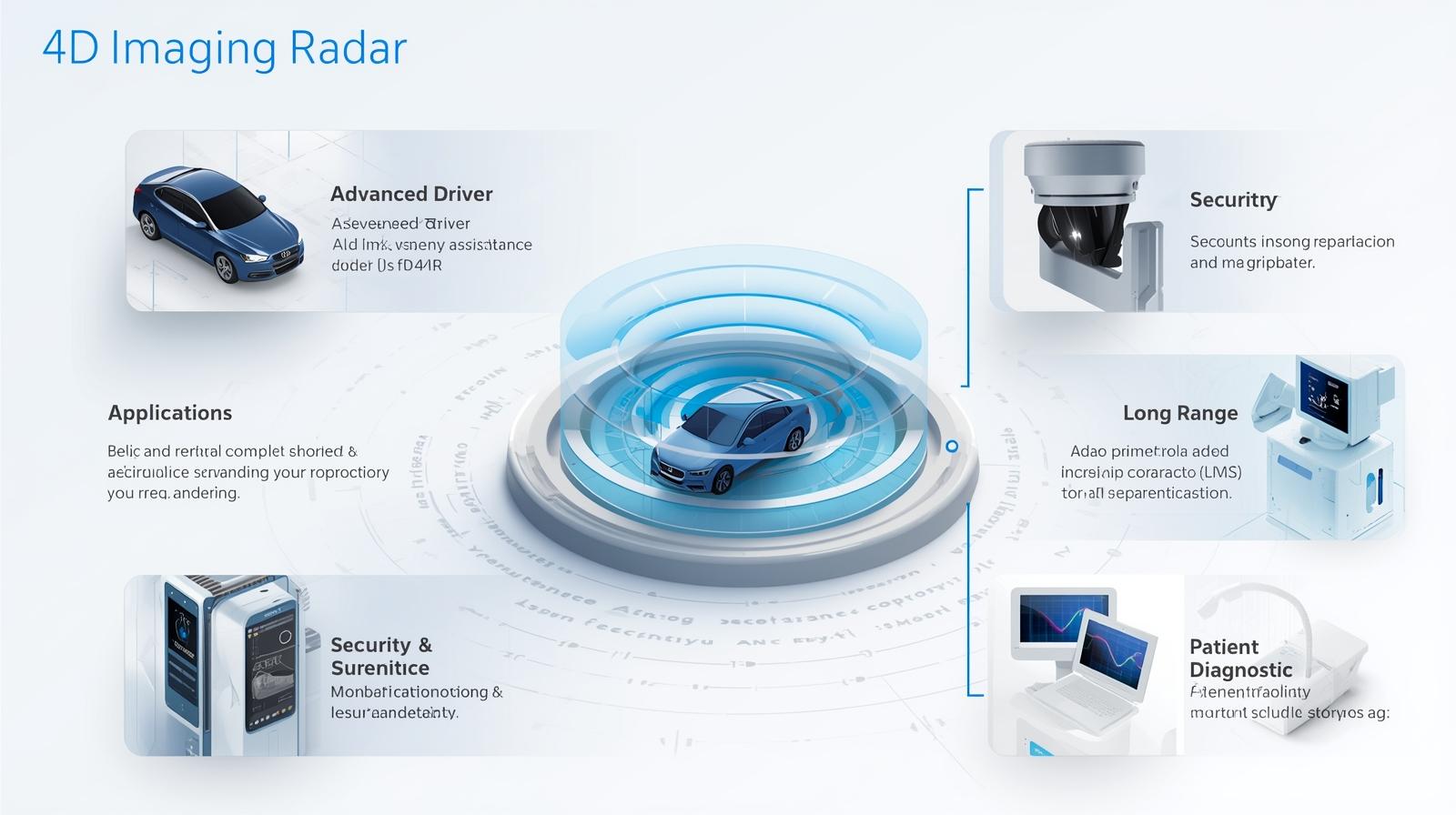
Beyond automotive applications, 4D imaging radar is also expanding into healthcare, security, industrial automation, and other areas, broadening the market opportunity.
Asia Pacific Is Growing Rapidly
Asia Pacific represents another major opportunity for the 4D Imaging Radar Industry. MarketsandMarkets reports that the regional market is projected to grow from USD 116.6 million in 2025 to USD 386.7 million by 2030, representing a 27.1% CAGR.
China, Japan, and South Korea are important contributors to regional adoption due to strong automotive industries, ADAS development, semiconductor capabilities, and government safety initiatives.
China’s 4D imaging radar market alone is projected to grow from USD 107.7 million in 2025 to USD 286 million by 2030, at a CAGR of 21.6%.
The expansion of electric vehicles and intelligent vehicle platforms across Asia Pacific is expected to provide additional opportunities for radar manufacturers.
Applications Are Expanding Beyond Automotive
Although automotive applications currently dominate the 4D Imaging Radar Industry, the technology is expanding into other sectors.
In security and surveillance, 4D radar can provide sensing capabilities in challenging visibility conditions and support perimeter monitoring.
In healthcare, radar can enable contactless patient monitoring, movement tracking, and fall detection without requiring wearable devices or cameras.
In industrial automation, radar can support machine perception, robotics, asset monitoring, and worker safety.
The expansion into these applications demonstrates that 4D imaging radar is evolving from a specialized automotive technology into a broader sensing platform.
Cost Remains a Key Restraint
Despite strong growth prospects, high system costs remain a challenge.
4D imaging radar requires sophisticated antenna configurations, multiple transmit and receive channels, advanced signal processing, and significant computing capabilities. These requirements can increase development, manufacturing, and integration costs compared with conventional radar technologies.
For mass-market automotive deployment, manufacturers need to balance sensor performance with affordability.
Continued semiconductor integration, manufacturing scale, software optimization, and component miniaturization will therefore be important for reducing costs and expanding adoption.
Power Consumption and Processing Complexity Create Challenges
4D radar systems can generate large volumes of data. Processing this information in real time requires substantial computational resources and can increase power consumption.
MarketsandMarkets identifies technical constraints and high power consumption as challenges, particularly for compact and energy-constrained platforms such as autonomous vehicles and drones.
Effective thermal management, optimized algorithms, efficient chip architectures, and low-power processing will be important for future system development.
Competitive Landscape Is Intensifying
The competitive landscape includes semiconductor manufacturers, automotive technology providers, radar specialists, and Tier 1 suppliers.
Key companies identified by MarketsandMarkets include Texas Instruments, NXP Semiconductors, Infineon Technologies, Robert Bosch, and Mobileye, along with Vayyar, Uhnder, Arbe, Thales, Continental, and Magna International.
Companies are competing through radar chip innovation, high-resolution sensing, extended detection range, sensor fusion, AI capabilities, miniaturization, and cost optimization.
Recent product developments illustrate this competition. Infineon introduced its RASIC CTRX8191F radar MMIC for next-generation 4D and HD imaging radar applications, while Uhnder launched its S81 4D imaging radar solution aimed at expanding access to advanced ADAS capabilities.
Key Trends Shaping the 4D Imaging Radar Industry
Several trends are expected to influence market development through 2030:
AI-powered radar perception: Machine learning is improving object detection, classification, and environmental interpretation.
Sensor fusion: Integration with cameras, LiDAR, and ultrasonic sensors is creating more robust perception systems.
Higher levels of autonomy: SAE Level 3 and higher driving automation is increasing demand for high-resolution environmental sensing.
Radar-on-chip: Semiconductor integration is enabling smaller, more efficient, and potentially lower-cost radar systems.
Long-range sensing: Extended detection distances are becoming increasingly important for highway automation.
ADAS expansion: Collision avoidance, adaptive cruise control, and lane-related functions are driving large-scale radar adoption.
All-weather perception: Radar’s ability to operate in darkness, rain, fog, and other challenging conditions provides an important advantage.
Non-automotive applications: Healthcare, industrial automation, security, and surveillance are creating additional revenue opportunities.
Future Outlook for Intelligent Radar Sensing
The global 4D Imaging Radar Industry is projected to grow from USD 392.8 million in 2025 to USD 1.21 billion by 2030, at a 25.2% CAGR.
This rapid growth reflects a broader transformation in automotive perception. Automakers are moving toward intelligent vehicles that can understand their surroundings with greater precision and reliability. 4D imaging radar is becoming an important component of this transformation because it provides detailed information about an object’s location, height, distance, and movement.
The future will increasingly involve AI-powered radar, multi-sensor fusion, advanced semiconductor architectures, and software-defined sensing. These technologies will enable vehicles to process complex environments more effectively while supporting increasingly sophisticated ADAS and autonomous-driving capabilities.
At the same time, manufacturers will need to overcome challenges related to cost, power consumption, processing complexity, integration, and regulatory standardization.
Ultimately, 4D imaging radar is evolving from an advanced sensing technology into a core component of intelligent mobility. As automakers embrace higher levels of automation and consumers demand safer vehicles, the technology is positioned to play a central role in building the next generation of connected, intelligent, and autonomous transportation systems.
5 Frequently Asked Questions (FAQs)
1. What is the projected growth of the 4D Imaging Radar Market?
The 4D Imaging Radar Market is projected to grow from USD 392.8 million in 2025 to USD 1.21 billion by 2030, registering a CAGR of 25.2% during 2025–2030.
2. What is driving the growth of the 4D Imaging Radar Industry?
Key growth drivers include increasing adoption of ADAS, rising demand for autonomous vehicles, growing focus on vehicle safety, advancements in radar-on-chip technology, and the integration of AI and sensor-fusion technologies.
3. Which application is expected to dominate the 4D Imaging Radar Market?
Advanced Driver-Assistance Systems (ADAS) are expected to remain a major application, as 4D imaging radar enables accurate detection, tracking, and classification of surrounding objects for safety and automated driving functions.
4. Which region is expected to hold a significant share of the 4D Imaging Radar Market?
Europe is expected to hold a significant market share, supported by its strong automotive industry, stringent vehicle safety regulations, and advanced research and development capabilities in automotive sensing technologies.
5. What are the key trends shaping the 4D Imaging Radar Industry?
Key trends include AI-powered radar perception, sensor fusion, radar-on-chip technology, long-range sensing, higher levels of vehicle automation, and integration of 4D radar with cameras and LiDAR to deliver more intelligent vehicle perception.
About MarketsandMarkets™
MarketsandMarkets™ has been recognized as one of America’s Best Management Consulting Firms by Forbes, as per their recent report.
MarketsandMarkets™ is a blue ocean alternative in growth consulting and program management, leveraging a man-machine offering to drive supernormal growth for progressive organizations in the B2B space. With the widest lens on emerging technologies, we are proficient in co-creating supernormal growth for clients across the globe.
Today, 80% of Fortune 2000 companies rely on MarketsandMarkets, and 90 of the top 100 companies in each sector trust us to accelerate their revenue growth. With a global clientele of over 13,000 organizations, we help businesses thrive in a disruptive ecosystem.
The B2B economy is witnessing the emergence of $25 trillion in new revenue streams that are replacing existing ones within this decade. We work with clients on growth programs, helping them monetize this $25 trillion opportunity through our service lines – TAM Expansion, Go-to-Market (GTM) Strategy to Execution, Market Share Gain, Account Enablement, and Thought Leadership Marketing.
Built on the ‘GIVE Growth’ principle, we collaborate with several Forbes Global 2000 B2B companies to keep them future-ready. Our insights and strategies are powered by industry experts, cutting-edge AI, and our Market Intelligence Cloud, KnowledgeStore™, which integrates research and provides ecosystem-wide visibility into revenue shifts.
To find out more, visit www.MarketsandMarkets™.com or follow us on Twitter , LinkedIn and Facebook .
Contact:
Mr. Rohan Salgarkar
MarketsandMarkets™ INC.
1615 South Congress Ave.
Suite 103, Delray Beach, FL 33445
USA: +1-888-600-6441