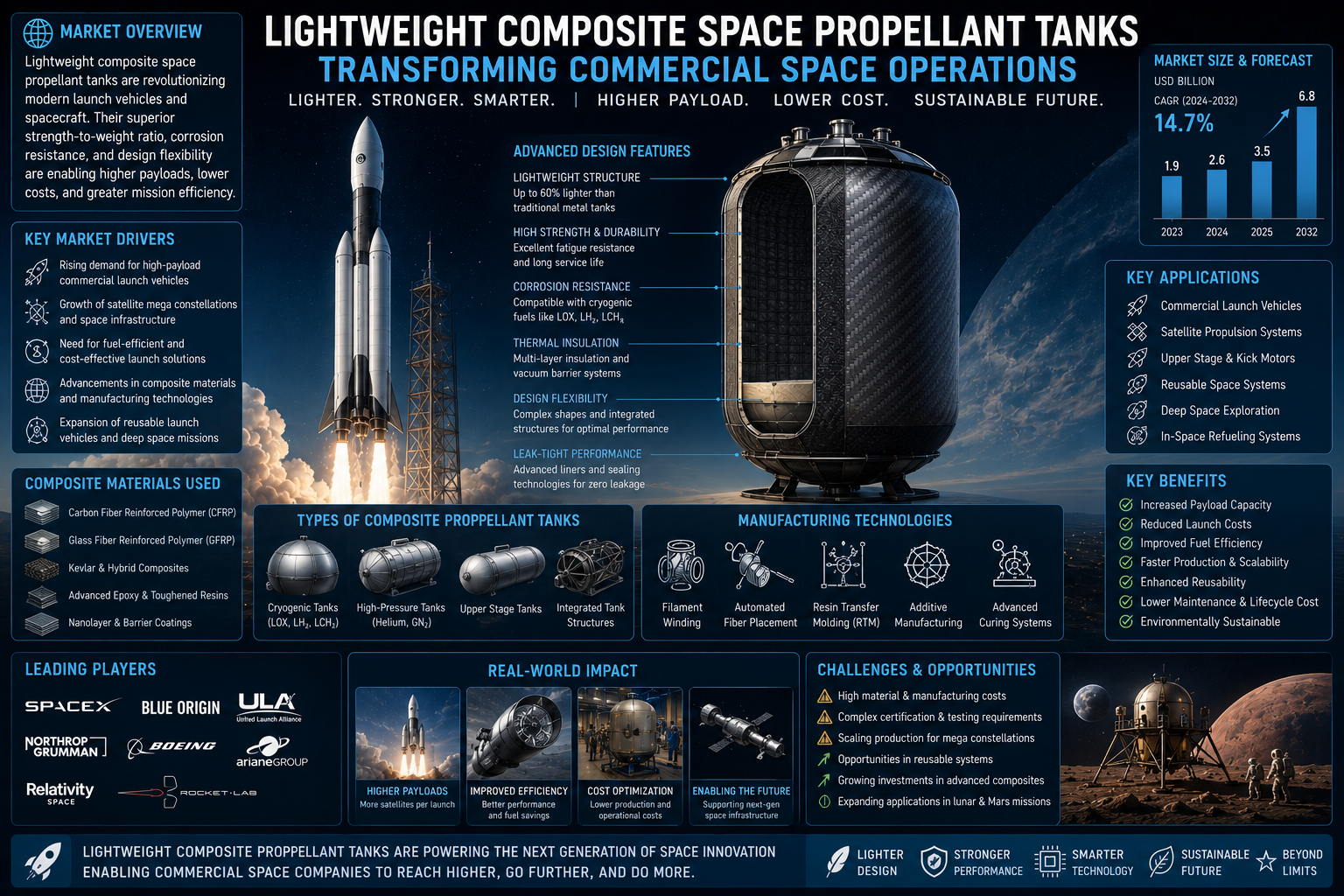
Lightweight composite space propellant tanks are rapidly transforming commercial space operations by enabling more efficient launch systems, reusable spacecraft architectures, and cost-effective satellite deployment strategies. As the global commercial space economy expands through satellite mega-constellations, private launch services, deep space exploration, and orbital logistics programs, aerospace manufacturers are increasingly adopting advanced composite propellant tanks to improve payload efficiency, reduce launch mass, and enhance mission reliability.
Traditional metallic propellant tanks, while structurally reliable, add substantial weight to launch vehicles and spacecraft. Composite-based propellant tanks offer a highly attractive alternative by combining reduced structural mass with exceptional strength, thermal resistance, and durability. The Lightweight Composite Space Propellant Tanks Market is estimated to reach approximately USD 0.73 billion in 2026 and is projected to exceed USD 1.27 billion by 2032, growing at a CAGR of 9.6% during the forecast period.
The rapid rise of reusable launch vehicles, commercial space transportation systems, autonomous satellites, and interplanetary exploration programs is accelerating adoption of lightweight composite tank technologies across the global aerospace sector. Artificial intelligence, IoT-enabled monitoring systems, automation, additive manufacturing, and digital engineering are further transforming the design, manufacturing, and operational capabilities of composite space propellant tanks.
Commercial Space Expansion Driving Demand
The commercialization of space has fundamentally changed the economics and operational requirements of modern aerospace systems. Commercial launch providers are increasingly prioritizing cost reduction, rapid reusability, and higher payload efficiency to remain competitive in a rapidly expanding market.
Lightweight composite propellant tanks play a critical role in these objectives by significantly reducing overall vehicle mass while maintaining structural integrity under extreme launch conditions. Reduced launch weight directly improves payload capacity, lowers fuel consumption, and enhances operational flexibility.The growing frequency of commercial launches is encouraging aerospace companies to invest heavily in scalable and durable composite tank technologies optimized for repeated operational cycles.
Reusable Launch Vehicles Accelerating Adoption
Reusable launch vehicles represent one of the largest growth drivers for lightweight composite propellant tanks. Modern reusable rocket systems require fuel storage systems capable of surviving repeated launch, re-entry, landing, and refueling cycles without significant structural degradation.
Reusable rocket programs increasingly rely on composite overwrapped pressure vessels (COPVs) and carbon fiber reinforced polymer (CFRP) structures to support liquid oxygen, methane, and hydrogen-based propulsion systems.
Methane-fueled reusable rockets, in particular, are accelerating demand for advanced composite cryogenic tanks designed to maintain thermal stability while supporting long-duration operations.
Download Free PDF Brochure @ https://www.marketsandmarkets.com/pdfdownloadNew.asp?id=195002624
Composite Materials Revolutionizing Tank Engineering
Advanced composite materials are fundamentally reshaping propellant tank engineering across commercial space applications. Carbon fiber composites have emerged as the dominant material category due to their high strength-to-weight ratio and excellent thermal characteristics.
Compared to traditional metallic tanks, composite tanks can reduce structural weight by up to 30%–40%, significantly improving overall launch efficiency and payload economics.
Composite materials also offer improved design flexibility, allowing engineers to develop more complex geometries and integrated structural architectures optimized for modern spacecraft systems.
Cryogenic Propulsion Systems Expanding Market Potential
The increasing adoption of cryogenic propulsion systems is creating substantial opportunities for lightweight composite tanks. Cryogenic fuels such as liquid hydrogen and liquid oxygen provide higher propulsion efficiency but require advanced storage systems capable of maintaining extremely low temperatures.
The combination of lightweight composites and advanced thermal management technologies is enabling more efficient long-duration space missions and reusable launch operations.
Deep space exploration initiatives, lunar programs, and orbital refueling concepts are also expanding long-term demand for advanced composite cryogenic storage systems.
Artificial Intelligence and Smart Tank Systems
Artificial intelligence is becoming increasingly important in the development and operation of lightweight composite propellant tanks. AI-driven systems can analyze real-time performance data, optimize thermal regulation, and predict structural fatigue before failures occur.
IoT-based telemetry platforms provide continuous monitoring of temperature, vibration, pressure, and structural integrity during launch and space operations. These capabilities significantly improve operational safety, mission reliability, and maintenance efficiency.
Digital twin technology is also becoming a major innovation area, allowing aerospace engineers to create real-time virtual replicas of tank systems for performance optimization and lifecycle management.
Automation and Additive Manufacturing Advancing Production
Automation technologies and additive manufacturing are revolutionizing the production of lightweight composite propellant tanks. Traditional aerospace manufacturing processes often involve long production cycles and complex assembly requirements. Automated manufacturing systems help improve scalability, consistency, and production speed.
Additive manufacturing enables rapid prototyping and lightweight structural optimization, helping manufacturers reduce material waste and accelerate product development cycles.
Automation also improves manufacturing precision and repeatability, which are critical for maintaining aerospace-grade reliability standards.
Satellite Mega-Constellations Creating Sustained Demand
The rapid deployment of satellite mega-constellations is creating continuous demand for lightweight launch systems and efficient onboard propulsion technologies. Communication, navigation, Earth observation, and IoT satellite networks require reliable and cost-efficient launch capabilities.
Small satellite and CubeSat markets are also driving innovation in compact composite propellant storage systems optimized for miniaturized space platforms.
Defense and National Security Applications
Military and defense organizations are increasingly adopting lightweight composite propellant tanks for advanced space and missile systems. National security programs require highly reliable propulsion infrastructures capable of supporting strategic communication satellites, missile defense systems, and ISR platforms.
Composite tanks provide important advantages in military applications due to their lightweight structure, operational durability, and enhanced survivability characteristics.
Regional Market Insights
North America currently dominates the Lightweight Composite Space Propellant Tanks Market due to strong commercial launch activity, advanced aerospace manufacturing capabilities, and substantial government investment in reusable launch systems and deep space exploration.
The United States leads global innovation through commercial launch providers, defense contractors, and space agencies focused on reusable spacecraft architectures and advanced propulsion technologies.
Europe is experiencing stable market growth driven by collaborative space programs, sustainable launch system initiatives, and increasing adoption of composite aerospace structures. European aerospace manufacturers are prioritizing lightweight propulsion infrastructure to improve launch efficiency and reduce operational costs.
Asia Pacific is projected to witness the fastest growth through 2035 due to expanding national space programs, satellite deployment activities, and indigenous launch vehicle development in China, India, Japan, and South Korea.
Competitive Landscape
The market is highly competitive, with aerospace companies focusing heavily on advanced materials, AI-driven monitoring systems, automation technologies, and reusable launch architectures.
Major companies operating in the market include SpaceX, Airbus Defence and Space, Lockheed Martin, Boeing, Northrop Grumman, ArianeGroup, Hexagon Purus, MT Aerospace, IHI Aerospace, Cobham Limited. These organizations are investing aggressively in composite material innovation, digital engineering, automated manufacturing systems, and next-generation propulsion infrastructure.
Future Outlook
The future of lightweight composite space propellant tanks is closely aligned with the broader evolution of commercial space transportation and reusable launch systems. As launch frequencies increase and deep space missions expand, aerospace companies will continue prioritizing lightweight, durable, and thermally efficient tank technologies.
Artificial intelligence, IoT-enabled monitoring, automation, digital twin technology, and advanced composite materials are expected to drive the next wave of innovation across the market. Composite propellant tanks will increasingly evolve into intelligent aerospace systems capable of autonomous diagnostics, predictive maintenance, and adaptive thermal management. With commercial space operations becoming more scalable and economically competitive, lightweight composite propellant tanks will remain a foundational technology supporting the future of reusable rockets, satellite deployment systems, orbital infrastructure, and deep space exploration missions.
