The global aerospace industry is witnessing a major transformation as cryogenic space propellant tanks become increasingly essential to next-generation satellite launch systems. The growing deployment of reusable launch vehicles, heavy-lift rockets, deep-space exploration missions, and advanced satellite constellations is driving significant demand for lightweight, high-performance cryogenic fuel storage technologies.
Cryogenic propellant tanks are specifically designed to store ultra-cold liquid fuels such as liquid hydrogen (LH₂), liquid oxygen (LOX), and liquid methane (LCH₄), which are widely used in modern launch propulsion systems due to their high energy efficiency and superior thrust performance. As launch providers focus on improving payload capacity, reducing mission costs, and enabling reusable space transportation, advanced cryogenic tank technologies are becoming critical to the future of the space economy.
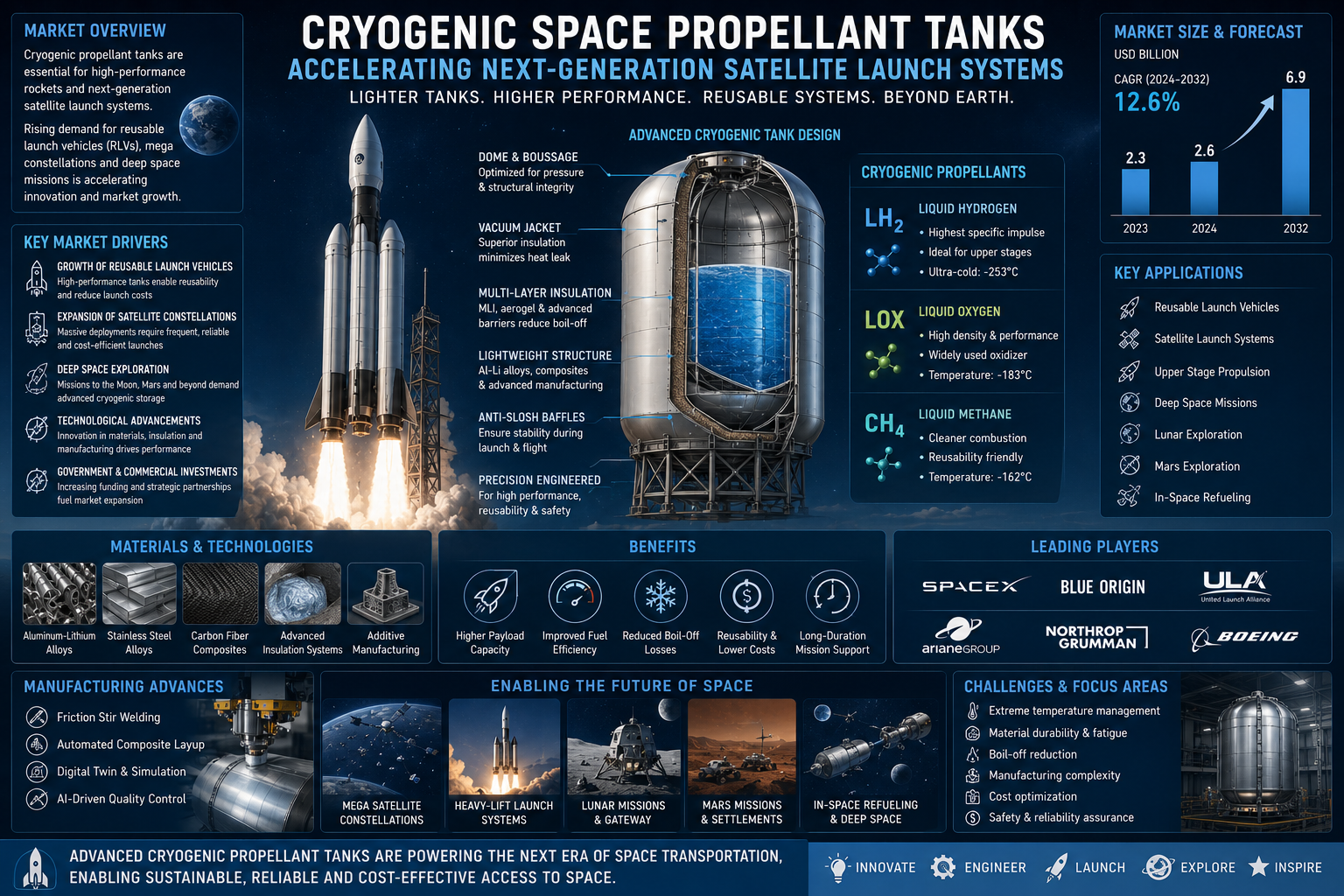
Rising Importance of Cryogenic Propellant Systems
Modern satellite launch systems increasingly depend on cryogenic propulsion because of its ability to deliver higher specific impulse and improved propulsion efficiency compared to conventional propellants.
Cryogenic tanks support several key aerospace applications, including:
- Reusable launch vehicles (RLVs)
- Heavy-lift orbital launch systems
- Satellite deployment missions
- Deep-space exploration programs
- Lunar and Mars transportation systems
- In-space refueling infrastructure
- Upper-stage propulsion systems
The rapid expansion of commercial satellite constellations and national space programs is accelerating investment in high-capacity cryogenic fuel storage technologies capable of supporting long-duration missions and frequent launch cycles.
Access 100+ Data Tables & Charts @ https://www.marketsandmarkets.com/pdfdownloadNew.asp?id=195002624
Reusable Launch Vehicles Driving Market Growth
The emergence of reusable launch systems has significantly increased the need for advanced cryogenic tank technologies. Modern reusable rockets require tanks capable of enduring repeated thermal cycling, high-pressure operations, and multiple launch and landing sequences without compromising structural integrity.
Cryogenic propellant tanks play a central role in improving:
- Launch vehicle reusability
- Payload capacity
- Fuel efficiency
- Operational turnaround times
- Cost reduction per launch
- Long-duration mission reliability
Space companies are increasingly focusing on lightweight tank structures that reduce overall launch mass while maintaining high durability under extreme aerospace operating conditions.
Liquid Hydrogen and Methane Fuel Adoption Expanding
The transition toward cleaner and more efficient rocket propulsion systems is driving increased adoption of liquid hydrogen and liquid methane fuels.
Liquid Hydrogen (LH₂)
Liquid hydrogen offers extremely high specific impulse and is widely used in upper-stage propulsion systems and deep-space missions. However, its extremely low storage temperature presents substantial engineering challenges.
Liquid Methane (LCH₄)
Methane-based propulsion is gaining popularity in reusable launch vehicles due to:
- Cleaner combustion characteristics
- Reduced engine maintenance
- Higher storage density
- Improved reusability performance
- Suitability for future Mars missions
This shift toward advanced cryogenic fuels is accelerating innovation in tank insulation systems, thermal management technologies, and lightweight composite materials.
Advanced Materials Revolutionizing Tank Design
Material innovation is becoming one of the most important drivers of next-generation cryogenic tank development. Modern aerospace manufacturers are increasingly using advanced materials to improve structural efficiency while minimizing tank weight.
Key materials include:
Aluminum-Lithium Alloys
These materials provide excellent strength-to-weight performance and high fracture resistance under cryogenic conditions.
Carbon Fiber Reinforced Polymers (CFRP)
Composite materials significantly reduce structural mass while enhancing durability and corrosion resistance.
Stainless Steel Alloys
Modern stainless-steel tank architectures offer improved thermal resilience and lower manufacturing costs for reusable systems.
Composite Overwrapped Pressure Vessels (COPVs)
COPVs are increasingly used for lightweight pressurized storage systems in modern launch platforms.
The integration of advanced materials enables aerospace manufacturers to achieve improved payload performance and lower operational costs.
Thermal Management and Insulation Technologies
Cryogenic propellants must be maintained at extremely low temperatures to remain in liquid form. Effective thermal management is therefore essential for ensuring fuel stability and minimizing boil-off losses during storage and launch operations.
Advanced cryogenic tanks increasingly incorporate:
- Multi-layer insulation systems
- Vacuum-jacketed structures
- Active thermal control systems
- Aerogel insulation materials
- Advanced vapor management technologies
- Zero-boil-off fuel systems
These innovations are particularly important for long-duration space missions and orbital refueling infrastructure where fuel preservation is critical.
Satellite Launch Industry Expanding Demand
The rapid growth of the global satellite industry is creating strong demand for high-performance launch systems supported by advanced cryogenic fuel storage.
Major market drivers include:
- Mega satellite constellation deployments
- Rising demand for Earth observation satellites
- Growth in defense and ISR satellites
- Expansion of broadband satellite networks
- Increased private sector space investment
- Deep-space scientific exploration missions
As launch frequency increases, aerospace companies are prioritizing scalable cryogenic tank manufacturing technologies capable of supporting higher production volumes and faster launch schedules.
Deep Space Missions Accelerating Innovation
Future lunar and interplanetary exploration programs are significantly influencing cryogenic propellant tank development strategies.
Deep-space missions require tanks capable of:
- Long-duration cryogenic storage
- Minimal propellant boil-off
- Radiation resistance
- Autonomous fuel management
- In-space refueling compatibility
- Extreme thermal cycling endurance
Space agencies and private companies are increasingly investing in technologies that support sustainable lunar infrastructure, Mars exploration systems, and orbital fuel depots.
The development of in-space cryogenic storage capability is expected to become one of the foundational technologies for future deep-space transportation architectures.
Manufacturing Advancements Supporting Scalability
Advanced manufacturing technologies are improving production efficiency and accelerating innovation in cryogenic tank development.
Key manufacturing trends include:
Additive Manufacturing
3D printing technologies enable production of lightweight, highly optimized tank components with reduced material waste.
Friction Stir Welding
This process improves structural integrity and reliability for large cryogenic tank assemblies.
Automated Composite Fabrication
Automation improves consistency and scalability for composite tank manufacturing.
Digital Twin and Simulation Technologies
Virtual engineering tools help optimize tank performance and reduce development cycles.
These innovations are reducing production costs while enabling faster commercialization of next-generation launch systems.
Challenges Facing Cryogenic Tank Development
Despite strong technological progress, several challenges continue to impact the market.
Extreme Temperature Requirements
Cryogenic fuels require storage temperatures as low as -253°C, creating significant thermal engineering complexity.
Material Fatigue and Structural Stress
Repeated thermal cycling can affect long-term tank durability.
Boil-Off Management
Minimizing fuel evaporation remains a major challenge for long-duration missions.
Manufacturing Complexity
Advanced composite and insulated structures require highly specialized production capabilities.
High Development Costs
Research, testing, and qualification processes for aerospace-grade cryogenic systems remain expensive and time-intensive.
Addressing these challenges will remain essential as the industry scales future launch and exploration programs.
Explore In-Depth Industry Analysis @ @ https://www.marketsandmarkets.com/Market-Reports/satellite-propellant-tanks-market-195002624.html
Future Outlook
The future of next-generation satellite launch systems will be closely tied to continued innovation in cryogenic space propellant tank technologies. As the global space economy expands, demand for lightweight, reusable, and thermally efficient cryogenic storage systems is expected to accelerate significantly.
Several trends are expected to shape the market over the coming decade:
- Expansion of reusable launch vehicle programs
- Growth of methane-fueled rocket systems
- Increased lunar and Mars mission activity
- Development of orbital refueling infrastructure
- Advancements in composite cryogenic tanks
- AI-assisted thermal management systems
- Sustainable space transportation initiatives
Cryogenic propellant tanks are becoming far more than structural fuel containers—they are emerging as mission-critical enablers of the next era of space transportation, reusable launch operations, and deep-space exploration. Their continued evolution will play a defining role in accelerating global satellite deployment capabilities and shaping the future of commercial and governmental space missions.
