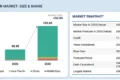
The automotive LiDAR market is projected to grow from USD 1.70 billion in 2026 to USD 11.26 billion by 2033 at a CAGR of 31.0%. The market is creating new revenue opportunities as automotive OEMs expand deployment of intelligent driving functions and increasingly position advanced sensing as a premium and software-enabled offering. Growing integration of LiDAR into software-defined vehicle architectures is enabling monetization through premium ADAS packages, OTA feature activation, and higher value vehicle trims. For instance, Mercedes-Benz Group AG (Germany) offers DRIVE PILOT as a paid Level 3 driving feature, while NIO Inc. (China) and XPENG Inc. (China) package advanced driving capabilities through premium intelligent driving configurations supported by LiDAR-based perception systems. over the air feature activation, and higher value vehicle trims. At the same time, advances in solid-state LiDAR, semiconductor integration, and sensor fusion are improving commercial viability across production vehicle platforms. Additional revenue generation is being created through the expansion of perception software, integrated sensing platforms, and automotive-grade LiDAR architectures that allow suppliers and OEMs to scale deployment across higher volume vehicle programs. Top of Form
Automotive LiDAR using near infrared (NIR) wavelengths, primarily 905 nm, is expected to grow due to its lower system cost, established technology ecosystem, and suitability for large-scale vehicle production, particularly across Level 2+ and Level 3 ADAS applications. Compared with 1550 nm architectures, 905 nm LiDAR benefits from wider semiconductor availability, established automotive supply chains, smaller optical packaging, and lower system cost, making it more suitable for large-scale passenger vehicle deployment. The segment is gaining commercial traction as OEMs increasingly integrate near-infrared LiDAR into Level 3 and higher automated driving systems, where scalable deployment and cost efficiency remain important. Growth of this segment is also supported by semiconductor maturity, as silicon-based detectors used in 905 nm architectures deliver strong performance and lower cost compared with InGaAs-based alternatives required at higher wavelengths. Several automotive LiDAR solutions are already based on this architecture, including AT Series from Hesai Group (China), M Series from RoboSense (China), and automotive LiDAR platforms from Huawei Technologies Co., Ltd. (China). For instance, in January 2026, Hesai Group (China) was selected as LiDAR partner for NVIDIA DRIVE Hyperion 10 and supplied its ETX automotive LiDAR platform to support Level 3 and Level 4 vehicle architectures, reinforcing continued industry preference for automotive scalable sensing solutions. As OEMs move toward higher volume intelligent vehicle production, 905 nm near infrared LiDAR is expected to maintain its position as the preferred wavelength architecture across the market.
Download PDF Brochure @ https://www.marketsandmarkets.com/pdfdownloadNew.asp?id=34875060
The Frequency Modulated Continuous Wave (FMCW) LiDAR segment is expected to register the fastest growth in the automotive LiDAR market during the forecast period due to its ability to measure both distance and object velocity simultaneously, giving vehicles better awareness of moving traffic conditions. Compared with conventional Time of Flight architecture, FMCW LiDAR offers stronger resistance to sunlight interference, improved performance in complex environments, and supports more accurate object tracking. Growth of the segment is increasingly supported by chip-scale integration, where lasers, detectors, and waveguides can be integrated into silicon photonics architectures to reduce system size and improve scalability. FMCW LiDAR also benefits from wider adoption of 1550 nm wavelengths, which enable higher laser power while maintaining automotive eye safety requirements and improving long-range sensing performance. Automotive OEMs and LiDAR companies are increasingly exploring FMCW technology to improve perception quality and support higher levels of vehicle automation. For instance, in November 2025, Mobileye (Israel) introduced its FMCW LiDAR on-chip architecture based on silicon photonics integration to support production deployment and target Level 4 autonomous driving applications. The platform combines sensing components onto a single chip to improve scalability, reduce system complexity, and strengthen long-range perception capability. As OEMs continue investing in higher-performance sensing architectures, FMCW LiDAR is expected to emerge as one of the fastest-growing technology segments in the market.
The semi-autonomous car segment is expected to account for the largest share of the automotive LiDAR market during the forecast period due to wider production deployment and faster consumer adoption compared with fully autonomous vehicles. Semi-autonomous vehicles, particularly Level 2+ and Level 3 passenger cars, are increasingly using LiDAR to support functions such as hands-free highway driving, automated lane changes, adaptive cruise control, and improved obstacle detection. OEMs are also integrating these capabilities into premium trims and paid ADAS packages, making semi-autonomous driving a key commercialization route for LiDAR adoption. Vehicle models such as Volvo EX90, Mercedes-Benz Class, NIO ET7, and XPENG G9 reflect this shift toward production-ready assisted driving systems. For instance, in September 2025, Mercedes-Benz (Germany) expanded the availability of Drive Pilot, its Level 3 automated driving system, into additional European markets, further strengthening the adoption of LiDAR-enabled semi-autonomous driving features in production vehicles. As OEMs continue prioritizing assisted driving deployment over full autonomy, semi-autonomous cars are expected to remain the largest revenue-generating segment for automotive LiDAR.
China is expected to dominate the Asia Pacific automotive LiDAR market during the forecast period due to its scale in intelligent vehicle production, concentration of domestic LiDAR suppliers, and faster commercialization of LiDAR-equipped passenger vehicles. Chinese OEMs such as NIO Inc., XPENG Inc., Zeekr Intelligent Technology, and Seres Group continue expanding LiDAR deployment across production vehicle portfolios, supported by suppliers like Hesai Group, RoboSense, and Huawei Technologies Co., Ltd. The country also benefits from a vertically integrated EV and sensing ecosystem that supports faster vehicle integration and commercialization. In April 2026, Huawei Technologies Co., Ltd. announced an investment of USD 2.63 billion in smart driving R&D to accelerate the deployment of intelligent driving platforms and expand LiDAR integration across OEM programs. At the same time, South Korea is expected to register the fastest growth in the region, supported by increasing investment in intelligent mobility and automated driving technologies, with Hyundai Motor Group (South Korea) strengthening the development of next-generation sensing and vehicle intelligence platforms. Supported by strong domestic demand in China and rising intelligent vehicle investments in South Korea, Asia Pacific is expected to remain the largest and fastest evolving regional market for automotive LiDAR.
Key Players
The major players in the automotive LiDAR market include Hesai Group (China), Huawei Technologies Co., Ltd. (China), RoboSense (China), Seyond (US), and Valeo (France).
Request Free Sample Report @ https://www.marketsandmarkets.com/requestsampleNew.asp?id=34875060