Over the past decade, public cloud platforms have transformed enterprise IT by delivering greater scalability, operational agility, and simplified infrastructure management. Organizations rapidly shifted workloads to cloud environments to accelerate digital transformation, support remote workforces, and reduce capital investments. However, with the growing adoption of AI workloads, data-intensive applications, evolving regulatory requirements, and rising operational expenses, many enterprises are reassessing their long-term infrastructure strategies.
Today, the US Data Center Colocation Market is gaining renewed momentum as organizations seek greater control over their IT infrastructure while preserving the flexibility of cloud connectivity. Instead of replacing public cloud services, enterprises are increasingly adopting hybrid IT strategies that combine the scalability of the cloud with the performance, security, and predictable cost structure offered by colocation facilities.
According to the latest US Data Center Colocation Market report, enterprises across the financial services, healthcare, manufacturing, telecommunications, retail, and government sectors are increasingly relocating mission-critical workloads to carrier-neutral colocation facilities. This transition is fueling substantial US Data Center Colocation Market growth as organizations modernize their digital infrastructure to support Artificial Intelligence (AI), high-performance computing (HPC), edge computing, and multi-cloud environments.
Understanding the US Data Center Colocation Market
The US Data Center Colocation Market comprises purpose-built facilities where enterprises lease secure space, power, cooling, and network connectivity to host their servers and critical IT infrastructure. Unlike public cloud environments, colocation enables organizations to maintain ownership and direct control of their hardware while benefiting from enterprise-grade infrastructure and seamless connectivity to multiple cloud providers.
Modern colocation providers offer:
- High-density rack deployments
- AI-ready infrastructure
- Carrier-neutral connectivity
- Disaster recovery solutions
- Edge computing capabilities
- Hybrid cloud integration
- Physical and cybersecurity protection
- Sustainable, energy-efficient operations
The expanding US Data Center Colocation Market size reflects growing enterprise investments in resilient digital infrastructure capable of supporting next-generation AI workloads, mission-critical applications, and long-term business continuity.
History of Enterprise Infrastructure: From On-Premises to Public Cloud
Enterprise IT infrastructure has undergone significant transformation over the past three decades, evolving alongside advancements in computing, networking, and cloud technologies.
Traditional On-Premises Era
Initially, organizations operated private data centers within corporate campuses or dedicated facilities. These environments provided complete control over IT infrastructure but required substantial investments in servers, networking equipment, power systems, cooling infrastructure, and highly skilled IT personnel to ensure reliable operations.
Rise of Public Cloud
Beginning in the late 2000s, hyperscale cloud providers introduced highly scalable Infrastructure-as-a-Service (IaaS) platforms that transformed enterprise IT deployment models. Organizations rapidly embraced public cloud solutions to reduce capital expenditures, accelerate application deployment, improve business agility, and support global digital transformation initiatives.
The Return to Colocation
As cloud adoption matured, enterprises began encountering challenges such as rising operational costs, vendor lock-in, data sovereignty concerns, and the increasing infrastructure demands of latency-sensitive AI workloads. In response, many organizations turned to colocation as a strategic component of hybrid IT, combining dedicated private infrastructure with the scalability and flexibility of public cloud services to achieve greater performance, security, and cost efficiency.
Market research indicates strong trends Download the PDF to uncover business insights.
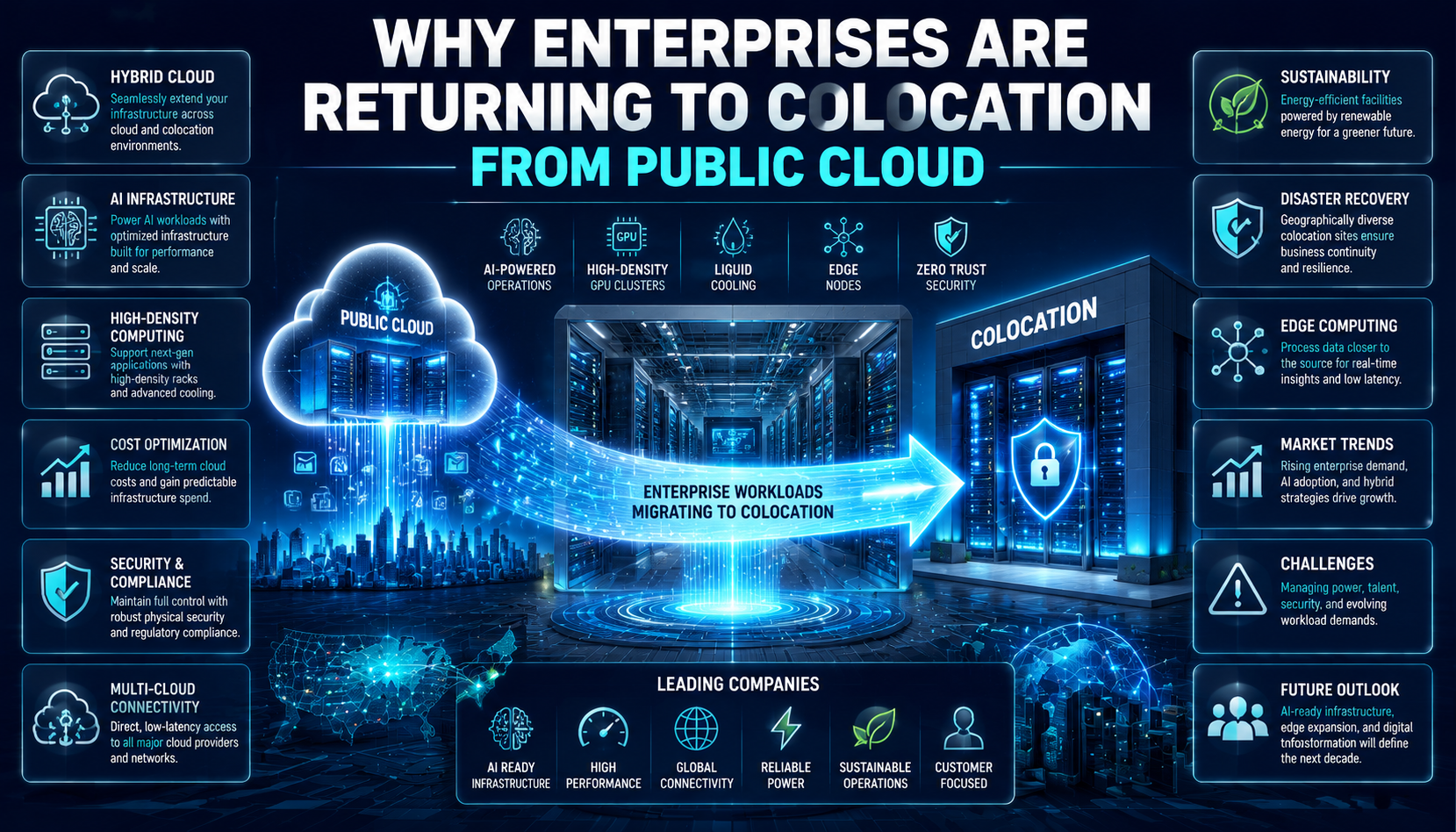
Why Enterprises Are Returning to Colocation
Several strategic factors are accelerating enterprise migration toward colocation facilities as organizations seek greater control, performance, and long-term value from their IT infrastructure.
Cost Optimization
Many enterprises have recognized that the predictable cost structure of colocation provides greater long-term financial value than the rising operational expenses associated with public cloud environments, particularly for stable workloads, AI applications, and high-performance computing infrastructure.
AI and High-Performance Computing
Artificial Intelligence (AI) training models, GPU clusters, and machine learning workloads require high-density power, advanced cooling technologies, and low-latency networking capabilities. Modern colocation providers are increasingly delivering the specialized infrastructure needed to support these compute-intensive environments.
Enhanced Security
Colocation enables enterprises to maintain complete ownership and control of their physical infrastructure while benefiting from enterprise-grade security measures, including multi-layer physical protection, biometric access controls, 24/7 monitoring, and Zero Trust security frameworks.
Regulatory Compliance
Industries such as healthcare, financial services, government, and defense operate under stringent regulatory requirements for data security and privacy. Colocation facilities help organizations meet compliance obligations while providing the flexibility required to support evolving business operations.
Multi-Cloud Connectivity
Carrier-neutral colocation facilities offer direct connectivity to multiple cloud providers, allowing enterprises to develop resilient hybrid and multi-cloud architectures that enhance performance, improve redundancy, and reduce vendor dependency.
Business Continuity
Geographically distributed colocation facilities strengthen disaster recovery and business continuity strategies by ensuring uninterrupted operations during natural disasters, cyberattacks, and unexpected infrastructure failures.
This Sample Report is designed to fuel your business growth download it today.
Current US Data Center Colocation Market Analysis
The latest US Data Center Colocation Market analysis highlights sustained demand driven by the rapid adoption of Artificial Intelligence, enterprise digital transformation initiatives, and the exponential growth of data generation across industries.
Key investment areas include:
- AI infrastructure
- GPU-ready data centers
- High-density racks
- Liquid cooling systems
- Edge computing facilities
- Hybrid cloud connectivity
- Renewable energy integration
- Automated infrastructure management
The continued expansion of enterprise digital infrastructure is driving significant Data Center Colocation Market share, particularly across regions with reliable power availability, high-capacity fiber connectivity, and mature cloud ecosystems. Organizations are increasingly prioritizing colocation facilities capable of supporting AI-ready environments while delivering scalability, operational resilience, and high-performance connectivity.
Key US Data Center Colocation Market Trends
Several emerging technologies and evolving enterprise requirements continue shaping US Data Center Colocation Market trends, driving innovation across the digital infrastructure landscape.
AI Infrastructure Expansion
Artificial Intelligence applications demand significantly higher compute densities than traditional enterprise workloads, accelerating investments in AI-ready colocation facilities equipped with advanced cooling systems, GPU clusters, and high-capacity power distribution.
Hybrid Cloud Strategies
Organizations are increasingly adopting hybrid cloud models that integrate private infrastructure with public cloud platforms, enabling them to optimize workload placement, improve operational flexibility, and control infrastructure costs.
Sustainability
Sustainability has become a key competitive differentiator as colocation providers invest in renewable energy, energy-efficient cooling technologies, carbon reduction initiatives, and environmentally responsible facility operations.
Edge Computing
The rapid adoption of autonomous vehicles, Industrial IoT, smart manufacturing, and smart city applications is driving demand for distributed colocation facilities positioned closer to end users, reducing latency and improving application performance.
Automation
Artificial Intelligence is transforming modern data center operations through predictive maintenance, intelligent infrastructure monitoring, workload optimization, automated resource allocation, and enhanced energy management, enabling greater operational efficiency and long-term infrastructure reliability.
Industry Applications Driving Colocation Adoption
Colocation facilities have become the foundation of modern digital infrastructure, supporting a wide range of enterprise workloads across multiple industries that require secure, scalable, and high-performance computing environments.
Major industry adopters include:
- Banking and Financial Services
- Healthcare
- Government
- Telecommunications
- Manufacturing
- Retail
- Artificial Intelligence
- Cloud Service Providers
- Media and Entertainment
- Research Institutions
These industries depend on resilient, secure, and highly available infrastructure to accelerate digital transformation, support mission-critical applications, ensure regulatory compliance, and meet growing performance requirements. As enterprise workloads continue to expand, colocation facilities are becoming an essential component of long-term IT modernization strategies.
Challenges Facing Enterprise Infrastructure
Despite the strong adoption of colocation services, enterprises continue to face several infrastructure challenges that influence deployment strategies and long-term investment decisions.
Key challenges include:
- Rising power costs
- Limited utility availability
- AI infrastructure complexity
- Cooling requirements
- Cybersecurity threats
- Regulatory compliance
- Skilled workforce shortages
- Supply chain disruptions
Addressing these challenges requires sustained investments in resilient infrastructure, intelligent automation, advanced cooling technologies, and sustainable facility design. Organizations must also strengthen cybersecurity frameworks, improve operational efficiency, and enhance workforce capabilities to support increasingly complex digital infrastructure environments.
Leading US Data Center Colocation Market Companies
Leading US Data Center Colocation Market companies continue to expand infrastructure capacity and invest in next-generation technologies to address the growing demand for AI-ready digital infrastructure.
Strategic investment priorities include:
- AI-ready campuses
- GPU infrastructure
- High-density power distribution
- Liquid cooling deployment
- Renewable energy adoption
- Multi-cloud interconnection
- Security modernization
- Global expansion
Strategic collaborations between hyperscale cloud providers, telecommunications companies, infrastructure developers, and enterprise customers continue to accelerate innovation across the industry. These partnerships are enabling the deployment of scalable, energy-efficient, and highly connected colocation facilities that support Artificial Intelligence, hybrid cloud environments, edge computing, and mission-critical enterprise workloads while strengthening the overall US Data Center Colocation Market.
Future US Data Center Colocation Market Outlook
The US Data Center Colocation Market outlook remains exceptionally promising as enterprises continue accelerating investments in Artificial Intelligence, hybrid cloud infrastructure, and next-generation digital transformation initiatives. Growing demand for high-performance computing, edge applications, and sustainable infrastructure is expected to further strengthen the market over the coming years.
According to the latest US Data Center Colocation Market forecast, future innovation will focus on:
- AI factories
- Autonomous data center operations
- Digital twins
- Quantum-ready infrastructure
- Edge AI deployments
- Software-defined facilities
- Advanced immersion cooling
- Sustainable energy ecosystems
These emerging technologies are expected to redefine enterprise infrastructure by improving operational efficiency, enhancing scalability, reducing energy consumption, and supporting increasingly sophisticated AI workloads. As organizations continue modernizing their digital ecosystems, colocation providers will play a critical role in delivering secure, intelligent, and resilient infrastructure capable of meeting future business demands.
Continued investments in AI-ready facilities, cloud interconnection, advanced networking, and energy-efficient infrastructure are projected to accelerate US Data Center Colocation Market growth through 2032. The market will remain a key enabler of enterprise innovation, supporting mission-critical applications across diverse industry verticals.
The renewed adoption of colocation reflects a broader shift toward balanced hybrid infrastructure strategies that emphasize performance, operational efficiency, security, and long-term cost optimization. While public cloud platforms continue to play a vital role in enterprise IT, organizations increasingly recognize the strategic value of hosting mission-critical workloads within carrier-neutral colocation facilities that provide greater control, flexibility, and infrastructure resilience.
The expanding US Data Center Colocation Market size, coupled with rapid advancements in Artificial Intelligence, edge computing, high-performance networking, and hybrid cloud adoption, positions colocation as a fundamental pillar of tomorrow’s digital infrastructure. As highlighted in every leading US Data Center Colocation Market report, organizations that invest in scalable, AI-ready, secure, and sustainable colocation environments will be better equipped to accelerate innovation, strengthen cybersecurity, optimize operational costs, and improve overall business resilience.
Looking ahead, the US Data Center Colocation Market analysis indicates that increasing enterprise investments, expanding hyperscale deployments, and growing AI infrastructure requirements will continue reshaping the competitive landscape. Evolving US Data Center Colocation Market trends point toward greater adoption of autonomous operations, liquid cooling technologies, renewable energy integration, and software-defined infrastructure. Supported by a positive US Data Center Colocation Market outlook, the industry is expected to maintain steady momentum, while the latest US Data Center Colocation Market forecast suggests sustained opportunities for infrastructure providers, enterprises, and technology innovators. As leading US Data Center Colocation Market companies continue expanding AI-ready capacity and strengthening hybrid cloud ecosystems, the industry will play a central role in powering the next generation of intelligent, connected, and data-driven enterprises.