The Smart Hospital Industry is entering a new phase of transformation as healthcare providers increasingly integrate artificial intelligence (AI), the Internet of Medical Things (IoMT), cloud computing, automation, robotics, advanced connectivity, and data analytics into hospital environments. These technologies are changing how hospitals monitor patients, manage clinical workflows, utilize resources, and make healthcare decisions.
According to MarketsandMarkets, the smart hospital market is projected to grow from USD 134.69 billion in 2026 to USD 246.17 billion by 2032, registering a CAGR of 10.6% during 2026–2032. This growth is being supported by rising investments in digital healthcare infrastructure, connected medical devices, real-time patient monitoring, hospital automation, and data-driven healthcare delivery.
AI Is Becoming the Intelligence Layer of Smart Hospitals
Artificial intelligence is emerging as one of the most important technologies transforming the Smart Hospital Industry. Hospitals are increasingly using AI and machine learning to analyze large volumes of clinical and operational data, identify patterns, support decision-making, and automate routine activities.
AI-enabled systems can support medical imaging, clinical decision support, predictive analytics, patient monitoring, workflow optimization, and administrative processes. By integrating AI with electronic health records, medical imaging systems, patient-monitoring devices, and hospital information systems, healthcare providers can create more connected and responsive care environments.
MarketsandMarkets identifies artificial intelligence and machine learning as the technology segment expected to register the highest CAGR in the smart hospital market during the forecast period.
The growing use of AI also addresses an important challenge for hospitals: reducing administrative workloads while enabling healthcare professionals to focus more on patient care. AI-powered tools can help automate documentation, analyze medical information, support clinical workflows, and provide actionable insights.
IoT and Connected Healthcare Are Reshaping Hospital Operations
The Internet of Medical Things is another major force accelerating the Smart Hospital Industry. Connected medical devices enable hospitals to collect and exchange real-time information across clinical and operational environments.
Patient monitoring devices, smart beds, wearable medical devices, connected imaging systems, RFID technologies, and real-time location systems can provide continuous visibility into patients, equipment, and hospital resources.
This connected infrastructure allows healthcare providers to monitor patients remotely, track medical assets, improve staff coordination, and optimize resource utilization. It also enables hospitals to move from reactive operations toward more predictive and proactive models.
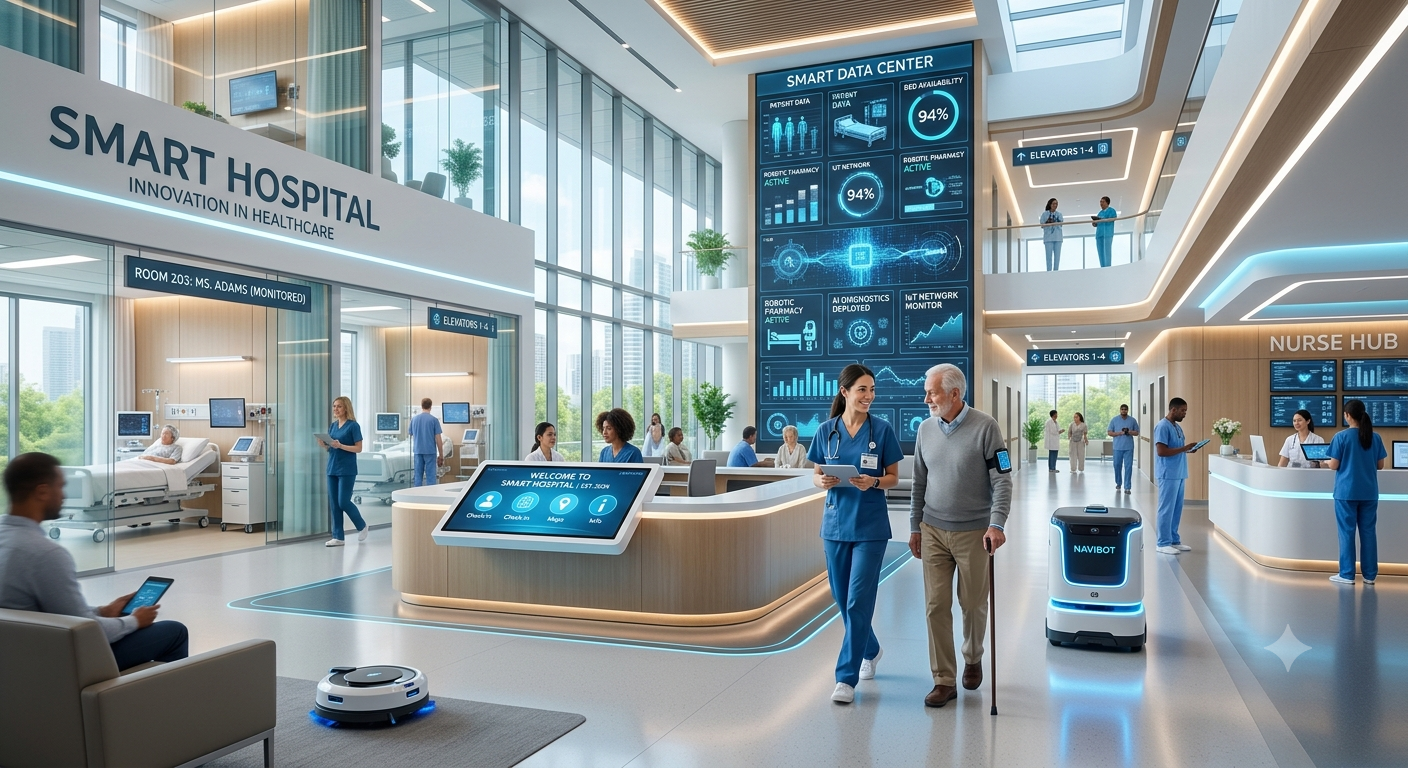
According to MarketsandMarkets, increasing deployment of connected smart hospital infrastructure and automation is a key market driver. Smart hospitals integrate IoMT devices, intelligent building management systems, RTLS, automation platforms, and centralized monitoring solutions to improve operational visibility and data exchange.
Automation Is Improving Clinical and Operational Efficiency
Automation is becoming increasingly important as hospitals face growing patient volumes, workforce constraints, and pressure to improve operational efficiency.
Automated workflows can support areas such as patient registration, asset tracking, medication management, facility management, diagnostics, inventory management, and clinical documentation. Robotics can also assist with logistics, surgery, rehabilitation, and other hospital activities.
The combination of automation with AI and IoMT creates an intelligent operating environment in which hospitals can respond to events more quickly. For example, connected systems can identify changes in patient conditions, trigger alerts, coordinate resources, and support healthcare professionals with relevant information.
This shift is moving hospitals beyond basic digitization toward intelligent, connected, and automated healthcare ecosystems.
Download PDF Brochure @ https://www.marketsandmarkets.com/pdfdownloadNew.asp?id=29319948
Cloud Computing Enables Scalable Smart Hospital Infrastructure
Cloud-based technologies are becoming a critical component of modern smart hospitals. Healthcare organizations need infrastructure capable of managing large amounts of information generated by EHRs, connected devices, imaging systems, remote patient monitoring, and AI applications.
Cloud deployment provides scalability, centralized data management, flexible access, and support for data-intensive healthcare applications. It can also facilitate interoperability across hospital departments and healthcare networks.
MarketsandMarkets expects the cloud-based deployment segment to record a CAGR of approximately 20.6%, highlighting the increasing importance of cloud infrastructure in smart hospital transformation.
Cloud platforms are particularly valuable when combined with AI analytics and IoMT because they allow healthcare organizations to bring information from multiple sources into connected digital environments.
Remote Patient Monitoring Creates New Growth Opportunities
Remote patient monitoring is becoming an important application within the Smart Hospital Industry. Wearable devices, connected sensors, mobile platforms, and cloud-based systems enable healthcare providers to monitor patients beyond traditional hospital settings.
MarketsandMarkets projects the remote patient monitoring segment to register a CAGR of approximately 15.9% during the forecast period.
The growth of remote monitoring is supported by increasing demand for continuous patient observation, chronic disease management, aging populations, and the need to reduce unnecessary hospital visits.
Connected monitoring can also support earlier intervention by providing healthcare professionals with real-time information. This creates opportunities for hospitals to develop more patient-centric and continuous models of care.
Hospital Command Centers Are Emerging as a Strategic Opportunity
One of the most significant opportunities in the Smart Hospital Industry is the expansion of hospital command centers.
Modern command centers bring information from multiple hospital systems into centralized platforms. Data from IoMT devices, patient monitoring systems, RTLS, electronic clinical platforms, and operational systems can be analyzed to provide real-time visibility into hospital activities.
Command centers can help healthcare organizations monitor:
- Patient flow
- Bed occupancy
- Staff allocation
- Equipment utilization
- Clinical capacity
- Operational bottlenecks
- Resource availability
MarketsandMarkets identifies the expansion of hospital command centers for intelligent operations as a major opportunity in the smart hospital market.
As hospitals become increasingly data-driven, command centers could become an important interface between AI analytics and real-world hospital operations.
Digital Twins Could Transform Hospital Optimization
Digital twin technology is another emerging opportunity for the Smart Hospital Industry. Digital twins can create virtual representations of hospital operations, infrastructure, workflows, or facilities and allow healthcare organizations to simulate different scenarios.
Hospitals could use these technologies to evaluate patient flows, capacity requirements, resource allocation, facility operations, and workflow changes before implementing them in real environments.
MarketsandMarkets highlights the growing adoption of digital twins as an opportunity for smart hospital optimization.
The combination of digital twins, AI, and real-time hospital data could enable healthcare organizations to move toward more predictive operational planning.
Smart Hospital Hardware Remains a Key Market Segment
Although software and services are increasingly important, hardware remains a major component of the Smart Hospital Industry.
MarketsandMarkets expects the hardware segment to account for the largest share of the smart hospital market. Growth is being supported by demand for patient monitoring devices, smart beds, medical imaging systems, connected medical devices, networking infrastructure, wearables, and robotics.
These technologies provide the physical infrastructure needed to collect, transmit, and act on healthcare data.
As hospitals modernize their facilities, demand for connected hardware is expected to increase alongside investments in IoMT and intelligent hospital infrastructure.
Connectivity Is Becoming Critical for Smart Healthcare
Reliable connectivity is essential for smart hospital environments because healthcare systems increasingly depend on continuous communication between devices, clinicians, patients, and digital platforms.
Wi-Fi is expected to remain an important connectivity technology, with MarketsandMarkets projecting approximately 18.7% CAGR for the Wi-Fi segment during the forecast period.
High-quality connectivity supports mobile clinical workflows, connected medical devices, EHR access, telemedicine, patient monitoring, and real-time data exchange.
As hospitals deploy more connected devices, the importance of reliable and secure connectivity will continue to increase.
Asia Pacific Is Emerging as a Major Smart Hospital Growth Region
Asia Pacific is expected to be one of the strongest growth regions for the Smart Hospital Industry. MarketsandMarkets expects Asia Pacific to account for approximately 32.3% of the global smart hospital market by value in 2032.
Healthcare digitalization, expanding hospital infrastructure, government-led digital health initiatives, and increasing adoption of AI, IoMT, cloud computing, and connected healthcare technologies are supporting regional growth.
Countries including China, India, Japan, South Korea, Singapore, and Australia are investing in digital healthcare infrastructure. Growing healthcare demand, workforce constraints, and the need to improve operational efficiency are also encouraging healthcare organizations to adopt intelligent hospital technologies.
Cybersecurity and Integration Remain Critical Challenges
Despite strong growth prospects, smart hospital transformation also introduces challenges. Hospitals must integrate multiple devices, platforms, networks, and legacy systems while maintaining data security and regulatory compliance.
MarketsandMarkets identifies high upfront costs, integration complexity, and persistent cybersecurity risks as important restraints. Workforce readiness and the need to balance technological innovation with regulatory compliance and data governance are also key challenges.
As hospitals become increasingly connected, cybersecurity will become an essential component of smart hospital infrastructure rather than an additional layer added after deployment.
Healthcare organizations will need to protect sensitive patient information while ensuring that connected devices, cloud platforms, EHR systems, and AI applications can operate securely.
Competitive Landscape Is Expanding
The competitive environment in the Smart Hospital Industry includes healthcare technology companies, medical device manufacturers, healthcare IT providers, cloud companies, system integrators, and cybersecurity providers.
MarketsandMarkets identifies Siemens Healthineers, GE HealthCare, Koninklijke Philips, FUJIFILM Holdings, and Canon among the key players with strong market positions. Zebra Technologies and Schneider Electric are also highlighted among companies developing specialized capabilities in this ecosystem.
Recent developments demonstrate how competition is increasingly focused on AI-enabled workflows, connected medical devices, cloud platforms, operational intelligence, and predictive analytics.
For example, Siemens Healthineers has introduced AI-enabled radiology services and an operational twin designed to support imaging workflows and simulate hospital scenarios.
Key Trends Shaping the Smart Hospital Industry
Several trends are expected to influence the next phase of smart hospital development:
AI-powered clinical decision-making: AI is increasingly being integrated into diagnostics, medical imaging, patient monitoring, and clinical workflows.
IoMT expansion: Connected medical devices are enabling continuous data collection and real-time monitoring.
Cloud-first healthcare infrastructure: Cloud platforms are supporting scalable data management, AI analytics, and interoperability.
Hospital automation: Automation is helping streamline clinical and administrative workflows while improving resource utilization.
Remote patient monitoring: Connected devices are extending healthcare beyond traditional hospital environments.
Intelligent command centers: Centralized operational platforms are enabling real-time visibility into hospital performance.
Digital twins: Virtual hospital models are creating opportunities for simulation, capacity planning, and operational optimization.
Advanced connectivity: Reliable wireless connectivity is becoming increasingly important as connected devices proliferate.
AI-enabled robotics: Robotics is creating opportunities across logistics, surgery, rehabilitation, and hospital operations.
Cybersecurity and data governance: As digital ecosystems expand, protecting patient data and connected infrastructure is becoming a strategic priority.
The Future of the Smart Hospital Industry
The future of the Smart Hospital Industry will be defined by the convergence of AI, IoMT, cloud computing, automation, robotics, advanced connectivity, analytics, and digital twins.
The market is projected to reach USD 246.17 billion by 2032 from USD 134.69 billion in 2026, at a CAGR of 10.6%, according to MarketsandMarkets.
The transformation will extend beyond simply installing connected medical devices. The next generation of smart hospitals will increasingly operate as integrated digital ecosystems in which clinical systems, patients, healthcare professionals, facilities, equipment, and operational platforms continuously exchange information.
Hospitals that successfully combine intelligent technologies with interoperable infrastructure, cybersecurity, workforce training, and effective data governance will be better positioned to improve patient outcomes and operational efficiency.
Ultimately, AI, IoT, and automation are transforming hospitals from digitally enabled facilities into intelligent healthcare ecosystems. As healthcare providers continue investing in connected infrastructure and data-driven technologies, smart hospitals are positioned to play a central role in the future of healthcare delivery.
5 Frequently Asked Questions (FAQs)
1. What is the Smart Hospital Industry?
The Smart Hospital Industry focuses on integrating AI, IoT, cloud computing, automation, robotics, connected medical devices, and data analytics to improve patient care, operational efficiency, and hospital management.
2. What is driving the growth of the Smart Hospital Industry?
The major growth drivers include increasing adoption of AI and IoMT, demand for remote patient monitoring, hospital automation, digital healthcare infrastructure, cloud-based solutions, and the need to improve healthcare delivery and operational efficiency.
3. How is AI transforming smart hospitals?
AI is transforming smart hospitals through medical imaging, clinical decision support, predictive analytics, patient monitoring, workflow optimization, and automation of routine administrative and clinical processes.
4. Which region is expected to witness significant growth in the Smart Hospital Industry?
Asia Pacific is expected to witness significant growth, supported by healthcare digitalization, increasing investments in smart healthcare infrastructure, government initiatives, and rising adoption of AI, IoT, cloud, and connected medical technologies.
5. What are the key opportunities in the Smart Hospital Industry?
Key opportunities include AI-powered healthcare, remote patient monitoring, hospital command centers, digital twins, connected medical devices, cloud-based hospital infrastructure, robotics, advanced connectivity, and intelligent hospital automation.