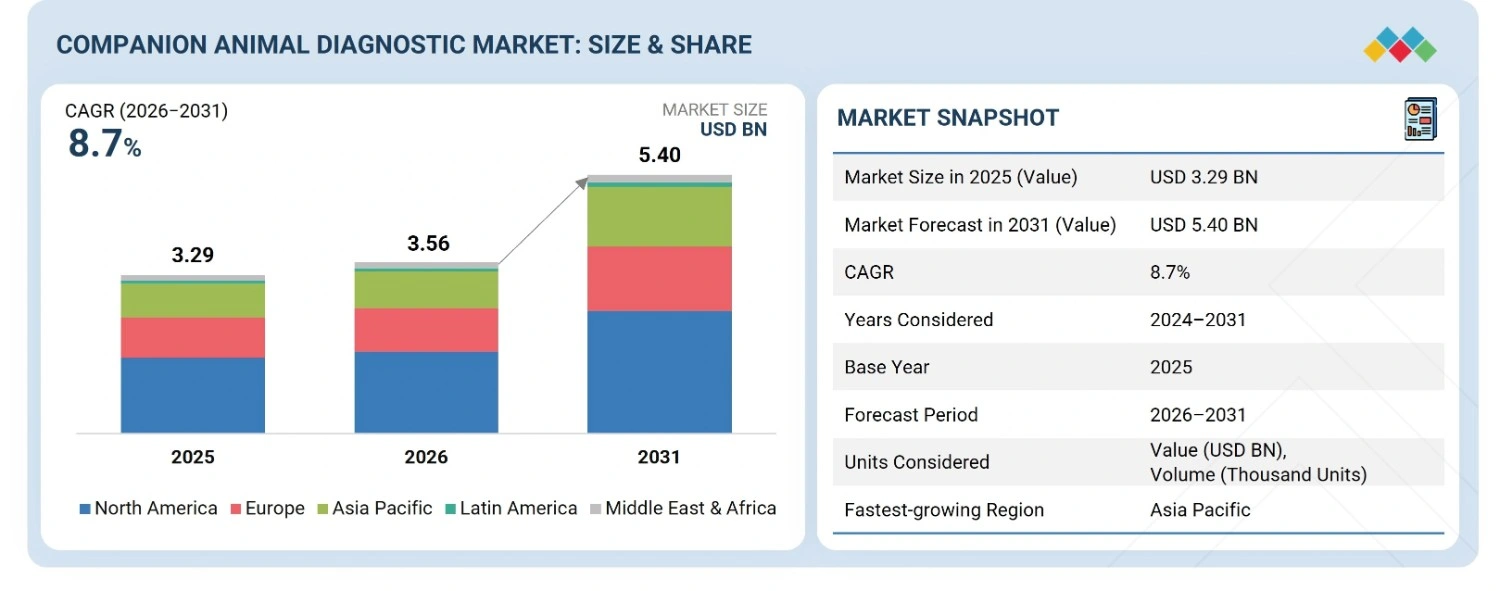
The global Companion Animal Diagnostics Market is projected to grow from USD 3.56 billion in 2026 to USD 5.40 billion by 2031, registering a CAGR of 8.7% during the forecast period, according to a new market research report. Rising pet ownership, increasing expenditure on veterinary healthcare, growing awareness of preventive animal care, and rapid adoption of advanced diagnostic technologies are driving the expansion of the companion animal diagnostics industry.
Download PDF Brochure:- https://www.marketsandmarkets.com/pdfdownloadNew.asp?id=173823870
Rising Pet Ownership and Veterinary Healthcare Spending Drive Market Growth
The increasing humanization of pets is encouraging owners to spend more on preventive healthcare, routine screening, disease diagnosis, and chronic disease management for companion animals.
Dogs and cats are increasingly being treated as family members, leading to greater willingness among pet owners to invest in advanced veterinary services. Veterinary practices and diagnostic laboratories are responding by adopting faster, more accurate, and cost-effective diagnostic technologies.
The increasing prevalence of infectious diseases, metabolic disorders, cancer, and age-related conditions among companion animals is further supporting demand for diagnostic testing.
Technological advancements in molecular diagnostics, immunodiagnostics, automated analyzers, AI-powered image analysis, liquid biopsy, and cloud-connected diagnostic platforms are also transforming veterinary diagnostic workflows.
Clinical Pathology Segment Held Largest Market Share in 2025
The clinical pathology segment accounted for the largest share of the companion animal diagnostics market in 2025.
Clinical pathology forms the foundation of routine veterinary diagnosis and includes hematology, clinical chemistry, urinalysis, cytology, and electrolyte testing.
These tests are widely used to identify infections, metabolic abnormalities, organ dysfunction, chronic diseases, and other health conditions in companion animals.
The increasing availability of in-house diagnostic analyzers is supporting adoption by veterinary practices by enabling faster turnaround times and facilitating immediate clinical decision-making.
Growing demand for preventive screening and routine health monitoring, particularly among aging dogs and cats, is expected to sustain high testing volumes throughout the forecast period.
Homecare Settings to Register Fastest Growth
The homecare settings segment is expected to register the highest CAGR during the forecast period.
The growing adoption of home-based veterinary care and remote monitoring is creating demand for diagnostic solutions that can support decentralized testing and continuous health management.
Advances in portable diagnostic devices, connected monitoring technologies, digital veterinary platforms, and at-home testing are making it easier for pet owners and veterinary professionals to monitor animal health outside traditional clinical settings.
The expansion of tele-veterinary services is also creating opportunities for diagnostic companies to integrate testing data with digital platforms, enabling veterinarians to monitor patients remotely and support timely intervention.
AI and Molecular Diagnostics Create New Opportunities
The integration of artificial intelligence and advanced molecular technologies is emerging as an important opportunity in companion animal diagnostics.
AI-enabled image analysis can support the interpretation of diagnostic images, while molecular technologies such as PCR can enable rapid detection of infectious diseases and genetic conditions.
Other emerging technologies, including liquid biopsy, automated analyzers, digital pathology, and cloud-based diagnostic ecosystems, are helping veterinary practices improve testing efficiency and data accessibility.
These technologies are expected to support the transition toward more preventive, personalized, and data-driven veterinary care.
Speak To Analyst:- https://www.marketsandmarkets.com/speaktoanalystNew.asp?id=173823870
North America Dominated the Market in 2025
North America accounted for the largest share of the companion animal diagnostics market in 2025.
The region’s leadership is supported by high pet ownership, well-developed veterinary healthcare infrastructure, increasing veterinary healthcare expenditure, and strong adoption of advanced diagnostic technologies.
The widespread availability of veterinary hospitals, specialty clinics, reference laboratories, and in-house diagnostic systems is supporting market development across the region.
Growing awareness of preventive pet healthcare and increasing adoption of pet insurance are also encouraging pet owners to pursue routine diagnostic testing.
The presence of major veterinary diagnostics companies further strengthens North America’s position in the global market.
Competitive Landscape
The companion animal diagnostics market includes established veterinary healthcare companies, diagnostic technology providers, and specialized laboratory organizations competing through product innovation, automation, strategic partnerships, and geographic expansion.
Key players profiled in the report include IDEXX Laboratories, Antech Diagnostics, Zoetis Services, FUJIFILM, Thermo Fisher Scientific, bioMérieux, BioNote, Virbac, Randox Laboratories, INDICAL BIOSCIENCE, Shenzhen Mindray Animal Medical Technology, Boule, Innovative Diagnostics, MEGACOR Diagnostik, and Biogal, among others.
Market participants are increasingly investing in molecular diagnostics, immunodiagnostics, automated analyzers, AI-enabled diagnostic technologies, digital platforms, and point-of-care testing solutions to strengthen their positions in the rapidly evolving veterinary diagnostics market.