The rapid expansion of digital infrastructure, cloud computing, artificial intelligence (AI), and hyperscale data centers is creating significant growth opportunities for the global data center certification market. As organizations increasingly depend on data centers to support mission-critical applications, the need for reliable, secure, energy-efficient, and compliant infrastructure is becoming more important. Data center certification helps operators validate facility performance, operational reliability, cybersecurity, sustainability, and adherence to industry standards.
The growing deployment of AI-ready data centers, high-performance computing infrastructure, and colocation facilities is further increasing demand for specialized certification services. Enterprises and cloud service providers are prioritizing independent assessments to minimize operational risks, improve infrastructure resilience, and strengthen customer confidence. Certification providers are also expanding their service portfolios to address evolving requirements across facility design, construction, commissioning, and operations.
According to MarketsandMarkets, The data center certification market is projected to reach USD 3.05 billion by 2032 from an estimated USD 1.16 billion in 2026, growing at a CAGR of 17.4%. This growth reflects increasing investments in hyperscale infrastructure, AI-enabled computing environments, cybersecurity compliance, and sustainable data center operations.
Growing Investments in Hyperscale and Colocation Data Centers Create New Revenue Opportunities
The increasing deployment of hyperscale and colocation data centers is one of the major factors driving the growth of the data center certification market. Cloud service providers, technology companies, and enterprises are investing in large-scale facilities to accommodate growing data traffic, digital services, and computing requirements.
These facilities require extensive infrastructure, including power distribution systems, cooling equipment, IT hardware, networking components, and backup systems. Certification plays an important role in validating the performance, reliability, and resilience of these interconnected systems.
Hyperscale operators require standardized certification frameworks to maintain consistent infrastructure performance across geographically distributed facilities. Similarly, colocation providers use certifications to demonstrate operational reliability and compliance with customer requirements. Certified facilities can strengthen customer confidence, improve competitive positioning, and support business development.
For certification providers, this expansion creates opportunities to generate revenue through facility assessments, design reviews, construction certification, commissioning validation, and recurring operational audits. Companies offering integrated certification services across multiple facility locations can also benefit from long-term relationships with hyperscale and colocation operators.
Download PDF Brochure @ https://www.marketsandmarkets.com/pdfdownloadNew.asp?id=37943401
AI-Ready Data Centers Increase Demand for Specialized Certification Services
The rapid adoption of generative AI, machine learning, and high-performance computing is transforming data center infrastructure requirements. AI workloads require high-density computing environments supported by advanced processors, high-speed networking, reliable power infrastructure, and sophisticated cooling technologies.
Traditional data center infrastructure may require significant upgrades to support these demanding workloads. Consequently, operators are increasingly focusing on validating power capacity, cooling efficiency, infrastructure availability, and operational resilience before deploying AI infrastructure at scale.
This creates opportunities for certification companies to develop specialized assessment programs for AI-ready data centers. Certification services can evaluate whether facilities meet the requirements of high-density computing environments and maintain reliable performance under intensive workloads.
The increasing use of liquid cooling, advanced power distribution, and high-performance IT infrastructure also creates demand for more comprehensive technical assessments. Certification providers that develop expertise in AI infrastructure requirements can strengthen their market positioning and capture opportunities from growing investments in AI data centers.
Sustainability and Energy Efficiency Drive Certification Adoption
Sustainability has become an important consideration for data center operators because facilities consume substantial amounts of electricity and require continuous cooling. Increasing energy demand, environmental regulations, and corporate sustainability commitments are encouraging operators to improve energy efficiency and reduce environmental impact.
Sustainability and energy certifications help organizations assess energy consumption, environmental management practices, cooling efficiency, and resource utilization. These certifications also support organizations in demonstrating progress toward environmental, social, and governance (ESG) objectives.
The growing adoption of renewable energy, efficient cooling technologies, and advanced power management systems is creating opportunities for certification providers. Organizations require independent assessments to validate sustainability performance and demonstrate compliance with applicable standards.
Certification companies can expand revenue opportunities by offering energy efficiency assessments, environmental management certification, sustainability audits, and ongoing performance verification. Integrated sustainability services can also help providers build long-term relationships with data center operators seeking to improve environmental performance.
Cybersecurity and Regulatory Compliance Strengthen Market Demand
Data centers store and process sensitive business information, financial records, customer information, and mission-critical digital assets. Increasing cyber threats, data privacy concerns, and regulatory requirements are driving demand for stronger information security and cybersecurity certification services.
Organizations operating in sectors such as banking, financial services and insurance (BFSI), healthcare, telecommunications, and government require robust security frameworks to protect critical infrastructure and maintain business continuity.
Information security and cybersecurity certifications help organizations demonstrate that appropriate security controls, risk management practices, and governance processes are in place. Independent assessments also improve stakeholder confidence and support compliance with industry-specific requirements.
As cloud adoption and AI-enabled infrastructure expand, cybersecurity certification is becoming increasingly important. Certification providers can capitalize on this opportunity by expanding their portfolios to include information security assessments, cybersecurity compliance, business continuity certification, and operational risk evaluation.
Continuous Monitoring and Recertification Create Recurring Revenue Streams
The data center certification market is gradually moving beyond one-time assessments toward continuous monitoring and recurring certification models. Data center infrastructure changes frequently as operators upgrade servers, expand power capacity, introduce advanced cooling systems, and deploy new security technologies.
Periodic certification helps organizations maintain compliance and validate infrastructure performance as operational requirements evolve. Continuous monitoring and recertification also enable operators to identify potential gaps and address issues before they affect service availability.
This trend creates an attractive revenue opportunity for certification providers. Instead of depending exclusively on initial certification projects, companies can generate recurring revenue through surveillance audits, periodic reassessments, compliance monitoring, and certification renewal services.
MarketsandMarkets identifies continuous monitoring and recertification as the fastest-growing certification delivery model during the forecast period. Providers that combine traditional auditing expertise with digital monitoring capabilities can strengthen customer retention and establish more predictable revenue streams.
IT and Power Infrastructure Offer Significant Growth Potential
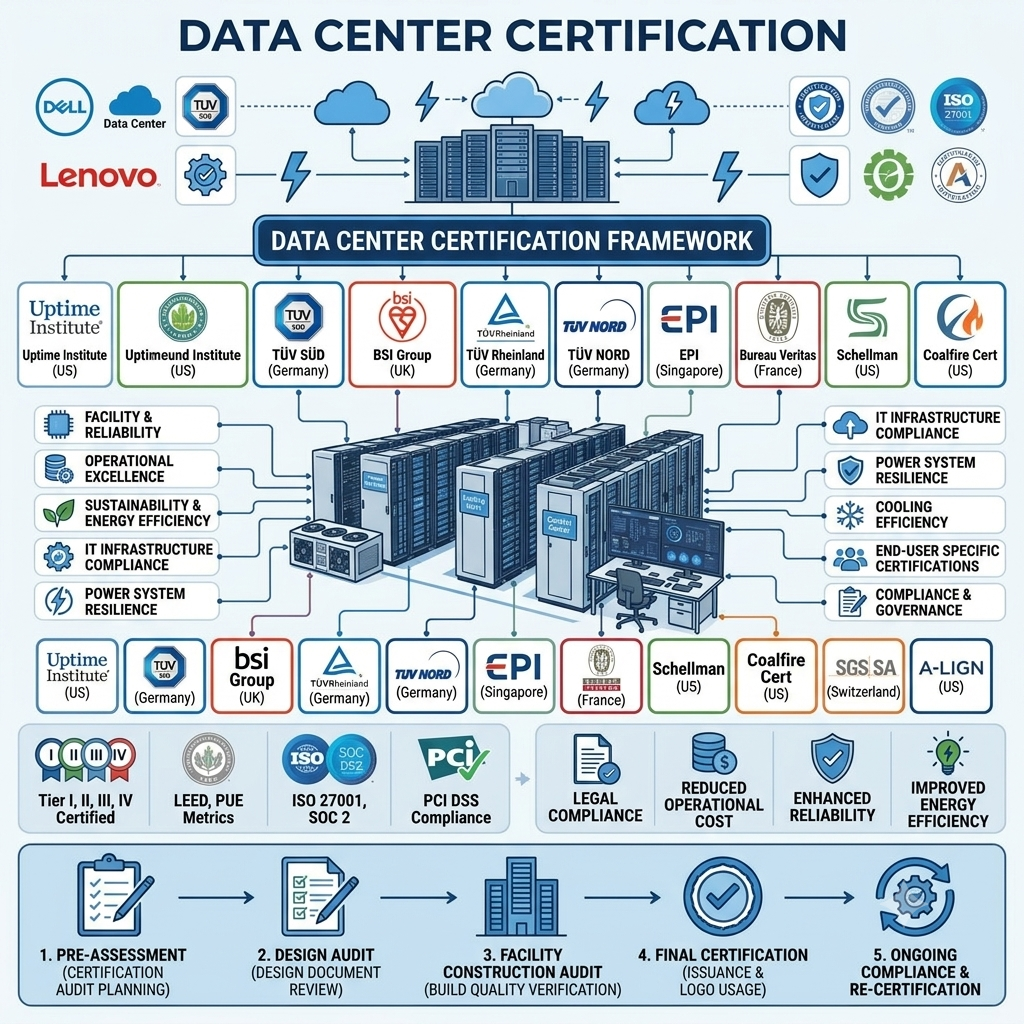
Data center certification requirements cover multiple infrastructure categories, including IT, power, cooling, and racks and enclosures. Each category plays an important role in maintaining facility performance and operational reliability.
The IT infrastructure segment is expected to register the highest CAGR during the forecast period. Increasing investments in AI-ready data centers, cloud computing, and digital transformation are driving demand for certification of servers, storage systems, networking equipment, and cybersecurity infrastructure.
Meanwhile, the power infrastructure segment is projected to account for the largest market share by 2032. The growing deployment of high-density computing environments is increasing requirements for reliable electrical infrastructure, backup power systems, redundancy, and uninterrupted power supply.
These developments create opportunities for certification providers to offer specialized assessments covering IT infrastructure performance, electrical systems, cooling operations, and integrated facility reliability.
Asia Pacific Emerges as a High-Growth Regional Market
Asia Pacific is expected to register the highest growth in the data center certification market during the forecast period. Rapid digital transformation, expanding cloud infrastructure, increasing AI investments, and growing hyperscale and colocation deployments are driving demand across the region.
Countries such as China, India, Japan, Singapore, and Australia are strengthening their digital infrastructure capabilities. Global cloud service providers and regional technology companies are investing in data center facilities to support enterprise applications, digital services, and AI workloads.
India represents an important growth opportunity because of increasing cloud adoption, digitalization across industries, and investments in data center infrastructure. The expansion of enterprise computing, financial services, telecommunications, and e-commerce is increasing the need for reliable and compliant facilities.
Certification providers can expand their regional presence through partnerships, local accreditation capabilities, technical expertise, and customized certification programs. Companies that understand regional regulatory requirements while maintaining alignment with international standards can improve their competitive positioning.
Competitive Landscape and Strategic Market Expansion
The data center certification market includes established certification bodies, testing and inspection companies, cybersecurity assurance providers, and specialized data center certification organizations. Competition is shaped by global recognition, technical expertise, accreditation, service portfolio, and geographic presence.
Key players operating in the market include Uptime Institute (US), TÜV SÜD (Germany), BSI Group (UK), TÜV Rheinland (Germany), TÜV NORD (Germany), Bureau Veritas (France), Schellman (US), Coalfire Systems (US), SGS SA (Switzerland), and A-LIGN (US).
These companies are strengthening their market positions through portfolio expansion, specialized certification services, industry partnerships, and geographic expansion. The growing importance of cybersecurity, sustainability, operational resilience, and AI-ready infrastructure is encouraging providers to develop more comprehensive certification offerings.
Strategic partnerships with data center operators, infrastructure vendors, engineering companies, and cloud service providers can help certification companies expand customer reach. Investments in technical training and specialized auditing capabilities can also improve service delivery and support entry into emerging regional markets.
Key Challenges Affecting Market Expansion
Despite strong growth potential, the data center certification market faces several challenges. High certification, audit, infrastructure upgrade, and recurring surveillance costs can discourage smaller data center operators from adopting comprehensive certification programs.
The presence of multiple certification frameworks and regional regulatory requirements also increases operational complexity. Global operators may need to comply with different standards across facilities, making certification management more resource-intensive.
Additionally, the shortage of skilled auditors and technical experts can affect certification timelines and service delivery. Rapid developments in AI computing, liquid cooling, cybersecurity, and power infrastructure require certification providers to continuously update their technical capabilities.
Companies that invest in skilled professionals, standardized assessment processes, and digital compliance solutions will be better positioned to address these challenges and capture emerging opportunities.
Future Outlook: Strategic Opportunities for Revenue Growth
The future of the data center certification market will be shaped by increasing investments in AI infrastructure, hyperscale computing, cloud services, cybersecurity, and sustainable digital infrastructure. As data center facilities become more complex, operators will increasingly depend on independent certification to validate reliability, performance, security, and compliance.
For certification providers, the strongest revenue opportunities will emerge from AI-ready infrastructure assessments, cybersecurity certification, sustainability verification, and continuous monitoring services. Expanding integrated certification programs across the design, construction, commissioning, and operational stages can create additional business opportunities.
Regional expansion, strategic partnerships, digital assessment capabilities, and specialized technical expertise will remain important competitive differentiators. Companies that align their services with evolving infrastructure requirements and customer expectations can strengthen their market presence and build sustainable revenue streams.
With the market projected to reach USD 3.05 billion by 2032, the data center certification industry offers attractive opportunities for established certification bodies, emerging service providers, infrastructure companies, and investors seeking growth in the expanding digital infrastructure ecosystem.
Frequently Asked Questions (FAQs)
1. What is the projected size of the data center certification market by 2032?
The data center certification market is projected to reach USD 3.05 billion by 2032, growing from USD 1.16 billion in 2026 at a CAGR of 17.4%.
2. What are the major factors driving the data center certification market?
Key growth drivers include increasing hyperscale and colocation deployments, AI-ready data center investments, cloud computing expansion, cybersecurity requirements, operational resilience, and sustainability initiatives.
3. Which certification segment is expected to hold the largest market share?
The facility and reliability certifications segment is expected to account for the largest market share by 2032, supported by growing demand for infrastructure availability, fault tolerance, and operational resilience.
4. Which region is expected to experience the fastest growth?
Asia Pacific is expected to register the highest growth during the forecast period, driven by expanding hyperscale infrastructure, cloud investments, AI adoption, and digital transformation.
5. Who are the key players in the data center certification market?
Major companies include Uptime Institute, TÜV SÜD, BSI Group, TÜV Rheinland, TÜV NORD, Bureau Veritas, Schellman, Coalfire Systems, SGS SA, and A-LIGN.
About MarketsandMarkets™
MarketsandMarkets™ has been recognized as one of America’s Best Management Consulting Firms by Forbes, as per their recent report.
MarketsandMarkets™ is a blue ocean alternative in growth consulting and program management, leveraging a man-machine offering to drive supernormal growth for progressive organizations in the B2B space. With the widest lens on emerging technologies, we are proficient in co-creating supernormal growth for clients across the globe.
Today, 80% of Fortune 2000 companies rely on MarketsandMarkets, and 90 of the top 100 companies in each sector trust us to accelerate their revenue growth. With a global clientele of over 13,000 organizations, we help businesses thrive in a disruptive ecosystem.
The B2B economy is witnessing the emergence of $25 trillion in new revenue streams that are replacing existing ones within this decade. We work with clients on growth programs, helping them monetize this $25 trillion opportunity through our service lines – TAM Expansion, Go-to-Market (GTM) Strategy to Execution, Market Share Gain, Account Enablement, and Thought Leadership Marketing.
Built on the ‘GIVE Growth’ principle, we collaborate with several Forbes Global 2000 B2B companies to keep them future-ready. Our insights and strategies are powered by industry experts, cutting-edge AI, and our Market Intelligence Cloud, KnowledgeStore™, which integrates research and provides ecosystem-wide visibility into revenue shifts.
To find out more, visit www.MarketsandMarkets™.com or follow us on Twitter , LinkedIn and Facebook .
Contact:
Mr. Rohan Salgarkar
MarketsandMarkets™ INC.
630 Dundee Road
Suite 430
Northbrook, IL 60062
USA : 1-888-600-6441