The Edge Computing in Video Surveillance Market is gaining momentum as organizations increasingly adopt intelligent security systems, real-time video analytics, and AI-powered surveillance technologies. The growing need for faster threat detection, reduced network latency, improved data security, and efficient video processing is accelerating the integration of edge computing into video surveillance infrastructure. By processing video data closer to the source rather than relying entirely on centralized cloud servers, edge computing enables faster decision-making, lower bandwidth consumption, and improved system reliability.
The increasing deployment of smart city infrastructure, connected security cameras, industrial monitoring systems, and intelligent transportation networks is creating new growth opportunities. Additionally, advancements in artificial intelligence (AI), machine learning (ML), computer vision, and Internet of Things (IoT) technologies are transforming traditional video surveillance into intelligent and automated security ecosystems.
Top 10 Key Takeaways
- Edge computing is transforming traditional video surveillance through real-time data processing.
- AI-based video analytics is improving threat detection and automated monitoring.
- Smart city investments are creating new opportunities for edge-enabled surveillance.
- On-premises deployment is important for organizations requiring local data control.
- Hybrid edge-cloud infrastructure is supporting scalable surveillance management.
- Computer vision is advancing object tracking, facial recognition, and intelligent monitoring.
- Traffic monitoring and intrusion detection are important application areas.
- Asia Pacific offers significant growth opportunities through smart infrastructure investments.
- Cybersecurity, privacy, and integration complexity remain key market challenges.
- AI innovation and edge computing hardware will shape the market’s future through 2032.
Download PDF Brochure @ https://www.marketsandmarkets.com/pdfdownloadNew.asp?id=257491057
Edge Computing in Video Surveillance Market Size and Growth Outlook
The Edge Computing in Video Surveillance Market is estimated at approximately USD 8.0 billion in 2025 and is projected to reach USD 20.0 billion by 2032, registering a compound annual growth rate (CAGR) of approximately 14.0% from 2026 to 2032
Increasing investments in intelligent security infrastructure and the growing adoption of AI-enabled surveillance cameras are supporting market expansion. Traditional video surveillance systems often depend on centralized servers or cloud platforms to process and analyze video footage. However, these systems can experience network delays, bandwidth limitations, and higher data transmission costs when handling large volumes of high-resolution video.
Edge computing addresses these challenges by enabling local processing through cameras, gateways, and edge servers. This approach supports real-time monitoring, faster incident detection, and more efficient video data management.
The growing demand for automated security systems across transportation, retail, manufacturing, government facilities, and commercial buildings is expected to create additional opportunities for market participants.
Key Growth Drivers of the Edge Computing in Video Surveillance Market
Increasing Adoption of AI-Powered Video Analytics
Artificial intelligence is transforming video surveillance by enabling automated monitoring, object recognition, facial recognition, and suspicious activity detection. AI-powered video analytics can process large volumes of visual information and identify unusual events without requiring continuous human supervision.
When combined with edge computing, AI algorithms can analyze video footage directly on cameras or nearby computing devices. This reduces processing delays and enables security teams to respond quickly to potential incidents.
Applications such as intrusion detection, vehicle identification, crowd monitoring, and perimeter security are benefiting from these capabilities. As organizations prioritize intelligent security infrastructure, demand for AI-enabled edge surveillance solutions is expected to increase.
Growing Investments in Smart City Infrastructure
Smart city development is creating significant opportunities for edge computing in video surveillance. Governments are investing in connected traffic management systems, public safety infrastructure, intelligent transportation networks, and urban monitoring platforms.
Edge-enabled surveillance cameras can analyze traffic conditions, detect accidents, identify congestion, and monitor public spaces in real time. Local processing helps reduce the volume of video data transmitted to centralized systems while supporting faster responses to incidents.
The integration of surveillance infrastructure with IoT sensors, traffic signals, emergency response systems, and city management platforms is further strengthening demand.
Rising Demand for Real-Time Security and Threat Detection
Organizations across industries are increasingly prioritizing real-time security monitoring to protect people, assets, and critical infrastructure. Conventional surveillance systems may require video data to travel to centralized servers before analysis, creating delays in identifying security threats.
Edge computing enables video analytics closer to the point of data generation, allowing systems to detect unauthorized access, suspicious movement, and potential security incidents more quickly.
This capability is particularly valuable in airports, railway stations, manufacturing plants, warehouses, financial institutions, and government facilities.
Increasing Need for Bandwidth Optimization and Data Privacy
High-resolution surveillance cameras generate substantial volumes of video data. Transmitting continuous footage to cloud platforms can increase bandwidth requirements, storage expenses, and network infrastructure costs.
Edge computing helps address these challenges by processing video locally and transmitting only relevant alerts, metadata, or selected video clips to centralized platforms.
Local processing can also reduce unnecessary exposure of sensitive footage during transmission. However, organizations must still implement appropriate cybersecurity measures, access controls, encryption, and data-retention policies to maintain privacy and regulatory compliance.
Emerging Technology Trends Transforming Video Surveillance
AI-Based Video Analytics and Computer Vision
AI-based video analytics and computer vision are among the most important technologies shaping the market. These technologies enable surveillance systems to identify objects, recognize activities, track movements, and detect unusual patterns.
Computer vision algorithms can analyze video frames to identify people, vehicles, and other objects. When integrated with edge processors, these capabilities support real-time event detection without depending entirely on centralized computing infrastructure.
The growing availability of advanced AI processors and optimized machine learning models is improving the performance of edge-based surveillance solutions.
Integration of Edge AI and IoT
The integration of Edge AI and IoT is creating connected surveillance ecosystems. Intelligent cameras, sensors, gateways, and computing devices can exchange information to support automated monitoring and security operations.
For example, when an edge-enabled camera detects unauthorized entry into a restricted area, the system can automatically trigger an alarm, notify security personnel, and activate connected access-control systems.
This integration is improving operational efficiency and creating opportunities for automated security management across industrial and commercial environments.
Growth of Hybrid Edge-Cloud Architectures
Hybrid edge-cloud infrastructure is gaining importance as organizations seek to combine local processing with centralized monitoring and storage.
Edge devices can process video streams locally, while cloud platforms support centralized analytics, remote monitoring, reporting, and long-term data management.
This architecture offers flexibility for organizations operating multiple facilities or geographically distributed surveillance networks. It also allows businesses to scale their security infrastructure without transferring every video stream continuously to cloud environments.
Development of Advanced Edge Computing Hardware
The development of specialized processors, GPUs, neural processing units (NPUs), and edge AI accelerators is improving the ability of surveillance devices to perform complex analytics.
Manufacturers are focusing on compact, energy-efficient hardware capable of processing multiple high-resolution video streams. These technologies are supporting more sophisticated applications, including real-time object tracking, facial recognition, and automated incident classification.
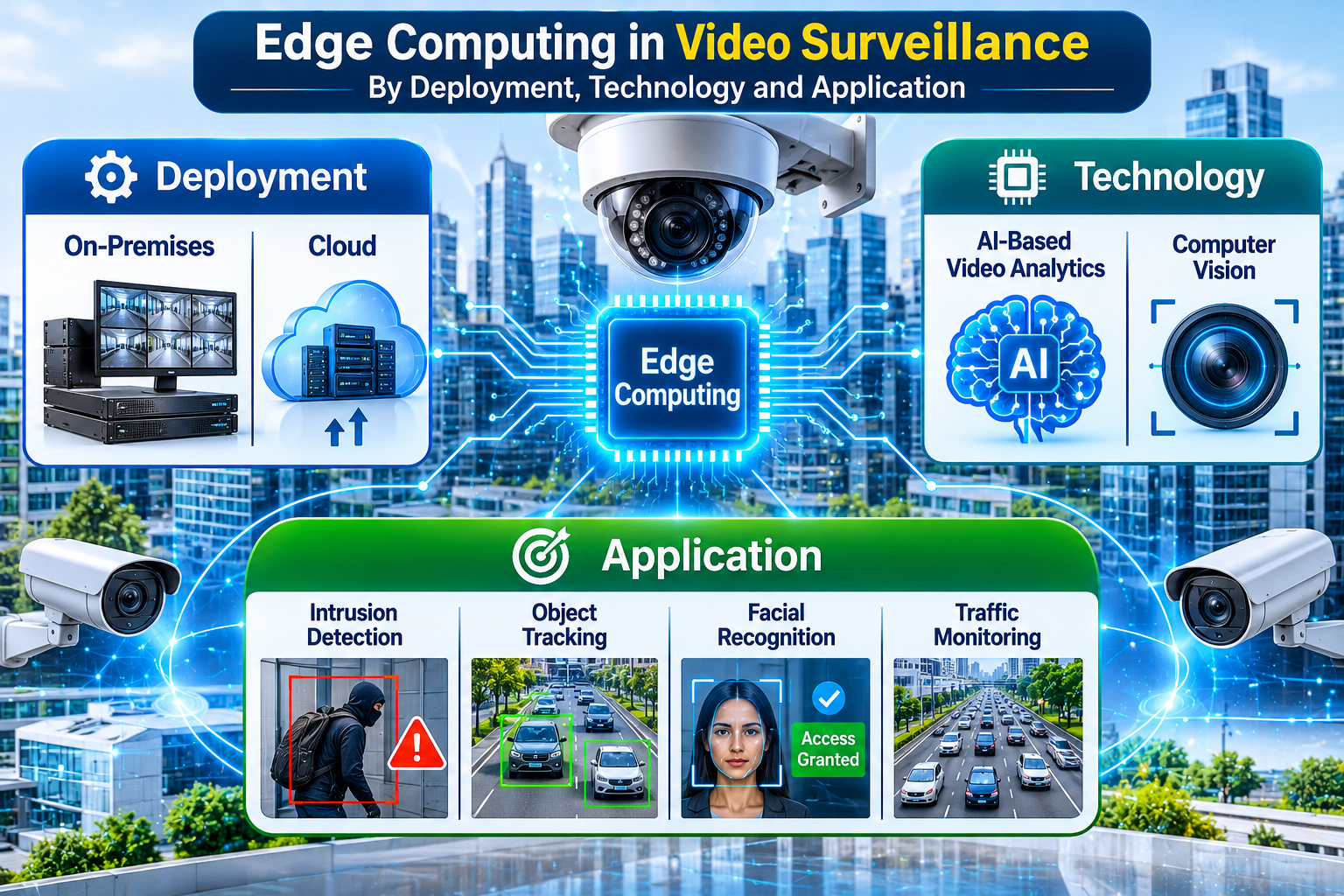
Market Segmentation: Deployment, Technology, and Application
The Edge Computing in Video Surveillance Market is segmented by deployment, technology, and application. Each segment addresses specific infrastructure and security requirements.
By Deployment
On-premises: On-premises deployment remains important for organizations requiring direct control over video footage, local processing, low latency, and greater control over sensitive surveillance data. Government facilities, industrial plants, airports, and financial institutions are important application areas.
Cloud: Cloud deployment supports centralized surveillance management, remote accessibility, scalable storage, and advanced analytics. Organizations can combine edge-based processing with cloud infrastructure to manage surveillance networks across multiple locations.
By Technology
AI-Based Video Analytics: AI-based video analytics enables automated object detection, event classification, behavioral analysis, and suspicious activity identification. It helps reduce manual monitoring requirements and improves security response capabilities.
Computer Vision: Computer vision supports image recognition, object tracking, facial recognition, and scene analysis. Its integration with edge computing enables faster visual intelligence and automated decision-making.
By Application
Intrusion Detection: Edge computing enables surveillance systems to identify unauthorized access and suspicious activities in real time. It is particularly valuable for industrial facilities, warehouses, commercial buildings, and restricted areas.
Object Tracking: Intelligent video systems can track the movement of people, vehicles, and objects across monitored environments. This supports security monitoring, logistics management, and operational visibility.
Facial Recognition: Edge-enabled facial recognition supports identity verification and access management. It can be deployed in airports, commercial facilities, and controlled-access environments, subject to applicable privacy and legal requirements.
Traffic Monitoring: Edge computing supports real-time traffic analysis, vehicle counting, congestion detection, and incident identification. These applications are becoming increasingly important in smart city and intelligent transportation projects.
Regional Opportunities in the Edge Computing in Video Surveillance Market
North America is expected to remain a major market due to established security infrastructure, enterprise investments, and increasing adoption of AI-powered surveillance technologies. The presence of technology providers, data center infrastructure, and smart city initiatives is supporting regional demand.
Asia Pacific offers strong growth potential as countries such as China, India, Japan, and South Korea expand smart city infrastructure, transportation networks, and industrial automation. Increasing urbanization and investments in connected security systems are creating opportunities for edge computing providers.
Europe is also an important market, supported by investments in intelligent transportation, industrial digitalization, and connected infrastructure. Growing emphasis on data protection and secure surveillance architecture is influencing technology adoption.
For technology providers, regional expansion, strategic partnerships, and customized solutions will be important to capturing emerging market opportunities.
Competitive Landscape and Strategic Opportunities
Competition in the Edge Computing in Video Surveillance Market involves companies operating across video surveillance hardware, AI software, networking infrastructure, semiconductor technologies, and edge computing platforms.
Companies such as Axis Communications, Motorola Solutions, Hikvision, Dahua Technology, Hanwha Vision, Bosch Security Systems, NVIDIA, Intel, and Cisco participate in different parts of the broader surveillance and edge computing ecosystem.
Market participants are focusing on product innovation, AI integration, strategic collaborations, and advanced hardware development to strengthen their competitive positions.
Key competitive strategies include:
- AI Integration: Developing intelligent surveillance cameras and video analytics platforms with advanced detection capabilities.
- Hardware Innovation: Introducing energy-efficient edge processors, AI accelerators, and high-performance computing devices.
- Technology Partnerships: Collaborating with software developers, semiconductor manufacturers, and system integrators.
- Cloud Integration: Developing hybrid edge-cloud solutions for centralized monitoring and scalable video management.
- Cybersecurity Enhancement: Improving device authentication, encryption, secure updates, and network protection.
- Application Expansion: Targeting smart cities, transportation, retail, manufacturing, logistics, and critical infrastructure.
Companies that combine reliable surveillance hardware with advanced analytics and secure edge computing capabilities are likely to strengthen their competitive positions.
Challenges in the Edge Computing in Video Surveillance Market
Despite strong growth opportunities, the market faces several challenges that may influence adoption.
High Initial Infrastructure Costs: Deploying edge computing infrastructure requires investments in intelligent cameras, edge servers, processors, networking equipment, and software platforms. These expenses can create barriers for small and medium-sized organizations.
Cybersecurity Risks: Connected surveillance devices can become potential targets for cyberattacks. Protecting video feeds, access credentials, and sensitive information requires robust cybersecurity frameworks.
Integration Complexity: Integrating edge computing solutions with legacy surveillance cameras, video management systems, and existing IT infrastructure can increase deployment complexity.
Data Privacy and Regulatory Compliance: Facial recognition and video analytics involve sensitive information. Organizations must comply with applicable data protection regulations and implement responsible data management practices.
Addressing these challenges through cost-effective hardware, secure architectures, and interoperable platforms will be important for long-term market development.
Future Outlook: Edge Computing Will Transform Intelligent Video Surveillance
The future of the Edge Computing in Video Surveillance Market will be shaped by advancements in AI, computer vision, IoT, and intelligent computing infrastructure. As organizations increasingly prioritize real-time monitoring and automated security, edge computing will become an important technology for next-generation surveillance systems.
The growing adoption of AI-enabled cameras, edge AI processors, and advanced video analytics software will create opportunities across commercial buildings, transportation infrastructure, manufacturing facilities, and smart cities.
Hybrid edge-cloud architectures will also gain importance by combining local video processing with centralized data management and analytics. Meanwhile, improvements in cybersecurity, hardware efficiency, and AI model accuracy will support wider adoption.
Through 2032, companies that prioritize technological innovation, strategic partnerships, scalable infrastructure, and customer-focused solutions are expected to benefit from emerging opportunities. The transition from traditional video monitoring to intelligent, real-time surveillance will remain a major factor influencing the industry’s development.
With increasing investments in connected infrastructure and AI-powered security, edge computing is positioned to play an important role in the future of global video surveillance.
Frequently Asked Questions (FAQs)
1. What is the projected size of the Edge Computing in Video Surveillance Market by 2032?
The market overview provides an illustrative estimate of USD 20.0 billion by 2032, compared with approximately USD 8.0 billion in 2025. These figures require independent validation.
2. What is driving the growth of the Edge Computing in Video Surveillance Market?
Increasing adoption of AI-powered video analytics, smart city infrastructure, real-time threat detection, IoT connectivity, and demand for efficient video processing are driving market growth.
3. Which technologies are shaping the Edge Computing in Video Surveillance Market?
AI-based video analytics, computer vision, edge AI processors, machine learning, and IoT connectivity are among the key technologies transforming the market.
4. Which are the major applications of edge computing in video surveillance?
Major applications include intrusion detection, object tracking, facial recognition, and traffic monitoring.
5. Which companies are active in the Edge Computing in Video Surveillance Market?
Important participants across the broader ecosystem include Axis Communications, Motorola Solutions, Hikvision, Dahua Technology, Hanwha Vision, Bosch Security Systems, NVIDIA, Intel, and Cisco.
About MarketsandMarkets™
MarketsandMarkets™ has been recognized as one of America’s Best Management Consulting Firms by Forbes, as per their recent report.
MarketsandMarkets™ is a blue ocean alternative in growth consulting and program management, leveraging a man-machine offering to drive supernormal growth for progressive organizations in the B2B space. With the widest lens on emerging technologies, we are proficient in co-creating supernormal growth for clients across the globe.
Today, 80% of Fortune 2000 companies rely on MarketsandMarkets, and 90 of the top 100 companies in each sector trust us to accelerate their revenue growth. With a global clientele of over 13,000 organizations, we help businesses thrive in a disruptive ecosystem.
The B2B economy is witnessing the emergence of $25 trillion in new revenue streams that are replacing existing ones within this decade. We work with clients on growth programs, helping them monetize this $25 trillion opportunity through our service lines – TAM Expansion, Go-to-Market (GTM) Strategy to Execution, Market Share Gain, Account Enablement, and Thought Leadership Marketing.
Built on the ‘GIVE Growth’ principle, we collaborate with several Forbes Global 2000 B2B companies to keep them future-ready. Our insights and strategies are powered by industry experts, cutting-edge AI, and our Market Intelligence Cloud, KnowledgeStore™, which integrates research and provides ecosystem-wide visibility into revenue shifts.
To find out more, visit www.MarketsandMarkets™.com or follow us on Twitter , LinkedIn and Facebook .
Contact:
Mr. Rohan Salgarkar
MarketsandMarkets™ INC.
630 Dundee Road
Suite 430
Northbrook, IL 60062
USA : 1-888-600-6441