The growing demand for artificial intelligence (AI), cloud computing, high-performance computing, and advanced digital services is transforming the global data center industry. As organizations generate and process increasing volumes of data, data centers require powerful, scalable, and energy-efficient semiconductor solutions. Data center chips are becoming essential components of modern digital infrastructure, enabling faster data processing, improved connectivity, efficient power management, and intelligent computing operations.
The Data Center Chip Market is witnessing significant growth as hyperscale data center operators, cloud service providers, and enterprises invest in advanced computing infrastructure. The increasing adoption of generative AI, machine learning, and data-intensive applications is creating demand for specialized processors, high-bandwidth memory, networking chips, and power management solutions.
According to MarketsandMarkets, the global data center chip market is projected to grow from USD 283.16 billion in 2026 to USD 687.65 billion by 2032, registering a compound annual growth rate (CAGR) of 15.9% during 2026–2032. This growth highlights the increasing importance of semiconductor innovation in supporting next-generation data center infrastructure.
Rising AI Adoption Creates New Growth Opportunities
Artificial intelligence is one of the major factors accelerating the demand for advanced data center chips. AI applications require enormous computing power to process complex algorithms, train machine learning models, and generate real-time insights. Traditional computing infrastructure is often insufficient to handle these demanding workloads efficiently.
As a result, data center operators are increasingly deploying graphics processing units (GPUs), AI accelerators, application-specific integrated circuits (ASICs), and other specialized processors. These chips help improve parallel processing capabilities, reduce computational delays, and support large-scale AI operations.
The expansion of generative AI applications, including large language models, intelligent automation, and AI-powered enterprise platforms, is further increasing demand for high-performance computing infrastructure.
This creates opportunities for semiconductor manufacturers to develop specialized chips that deliver higher processing performance while reducing energy consumption. Companies investing in AI-optimized processors and advanced semiconductor architectures are well-positioned to benefit from the growing requirements of intelligent data centers.
Cloud Computing Expansion Accelerates Market Growth
The increasing adoption of cloud computing is another important factor supporting the growth of the data center chip market. Businesses across industries are shifting their workloads from traditional IT infrastructure to cloud-based platforms to improve operational flexibility, scalability, and cost efficiency.
Cloud service providers are expanding their data center infrastructure to support enterprise applications, digital services, data storage, and AI workloads. These facilities require advanced processors, memory components, networking chips, and power management integrated circuits to maintain reliable operations.
Hyperscale data centers are also investing in customized computing infrastructure to improve performance and optimize operational costs. The growing demand for public, private, and hybrid cloud services is therefore creating opportunities for chip manufacturers to supply high-performance semiconductor solutions.
Cloud service providers represent an important end-user segment because of their extensive investments in data center infrastructure and continuous requirements for advanced computing technologies.
Advanced Processors Transform Data Center Infrastructure
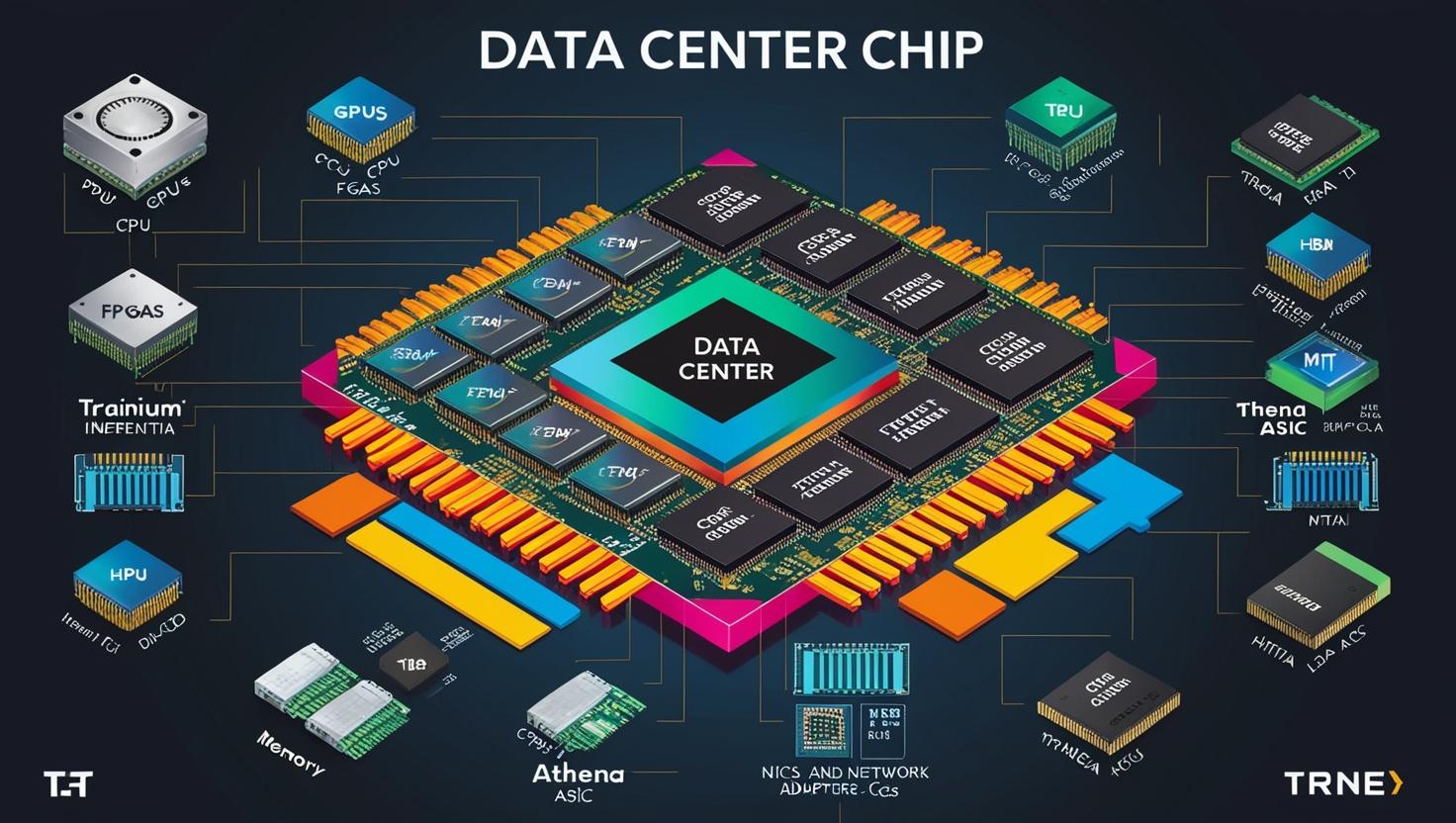
Processors play a critical role in determining the performance and efficiency of data centers. Central processing units (CPUs), graphics processing units (GPUs), field-programmable gate arrays (FPGAs), and AI-specific processors support different computing requirements across modern facilities.
The growing complexity of AI and data analytics workloads is encouraging manufacturers to develop processors with higher computational capabilities, improved memory bandwidth, and optimized power efficiency.
GPUs are particularly important for parallel processing and AI model training, while CPUs continue to support general-purpose computing, enterprise applications, and data management operations. FPGAs and ASICs offer specialized processing capabilities for applications that require customized performance and lower latency.
The increasing adoption of heterogeneous computing architectures, which combine different processing technologies, is also creating opportunities for semiconductor companies. These architectures allow data centers to allocate workloads to the most suitable processing units, improving resource utilization and overall system performance.
Download PDF Brochure @ https://www.marketsandmarkets.com/pdfdownloadNew.asp?id=39999570
High-Bandwidth Memory Creates New Opportunities
Memory is becoming increasingly important as data centers handle larger datasets and more demanding computing workloads. AI training, real-time analytics, cloud applications, and high-performance computing require fast access to large volumes of information.
High-bandwidth memory (HBM), dynamic random-access memory (DRAM), and other advanced memory technologies are helping address these requirements by improving data transfer speeds and supporting intensive computing operations.
According to MarketsandMarkets, the memory segment is expected to register the highest CAGR of 16.7% during the forecast period. The increasing need for faster data access and improved processing efficiency is supporting investment in advanced memory technologies.
The growing use of AI accelerators is also increasing the importance of memory bandwidth. Insufficient memory performance can limit processor utilization and reduce the efficiency of AI workloads. Consequently, semiconductor manufacturers are focusing on advanced memory architectures and improved integration between processors and memory components.
This trend creates attractive growth opportunities for companies developing high-performance memory solutions for next-generation data centers.
Networking Chips Enable Faster Data Connectivity
Modern data centers require high-speed communication between processors, memory systems, storage infrastructure, and networking equipment. As computing workloads become more complex, efficient data movement is essential for maintaining overall system performance.
Networking chips, network interface cards, adapters, and interconnect technologies help facilitate communication across data center infrastructure. These components support faster data transmission, lower latency, and improved connectivity between computing resources.
The expansion of distributed computing, cloud platforms, and AI clusters is increasing demand for advanced networking solutions. High-speed Ethernet, advanced interconnect technologies, and optical networking are becoming increasingly important for supporting large-scale computing environments.
Manufacturers are developing networking semiconductor solutions that improve bandwidth, reduce communication bottlenecks, and support scalable infrastructure. These developments are creating new opportunities in the data center chip market.
Energy Efficiency and Power Management Drive Innovation
Rising energy consumption is a major challenge for modern data centers. AI workloads, high-density computing systems, and large-scale cloud infrastructure require substantial electricity to operate processors, memory, and networking equipment.
As data center operators focus on reducing operational expenses and improving sustainability, energy-efficient semiconductor technologies are becoming increasingly important.
Power management chips help regulate voltage, manage current, improve power delivery, and maintain stable operations across computing systems. Sensors also support temperature monitoring, equipment management, and environmental control.
Innovations in power management integrated circuits, voltage regulators, power controllers, and thermal monitoring solutions are helping improve data center efficiency.
Semiconductor manufacturers have opportunities to develop solutions that reduce power losses, improve energy utilization, and support high-performance computing without significantly increasing electricity requirements.
Custom Silicon and Chiplet Architectures Create Emerging Opportunities
The growing diversity of data center workloads is encouraging technology companies to explore customized semiconductor solutions. Standardized processors may not provide the optimal balance of performance, power consumption, and cost for every application.
Custom silicon enables cloud service providers and large technology companies to develop chips designed for specific workloads, including AI inference, cloud-native applications, and large-scale data analytics.
This approach supports better hardware-software integration, improved processing efficiency, and greater control over computing infrastructure.
Chiplet architectures are also gaining attention as an approach to developing advanced semiconductor systems. Instead of manufacturing an entire processor as a single large chip, chiplet-based designs combine multiple smaller semiconductor components into a unified package.
This approach can improve design flexibility, support advanced integration, and help manufacturers develop scalable computing solutions. The adoption of chiplets and heterogeneous computing is expected to create additional opportunities across the data center semiconductor ecosystem.
Regional Growth Opportunities in the Data Center Chip Market
North America represents a major market for data center chips because of its established cloud computing ecosystem, hyperscale data center infrastructure, and strong presence of leading semiconductor and technology companies.
The region benefits from significant investments in AI infrastructure, advanced computing systems, and cloud services. The growing deployment of generative AI platforms is further increasing demand for specialized processors, memory, and networking solutions.
Asia Pacific is expected to register the highest growth rate during the forecast period. Rapid digitalization, increasing cloud adoption, semiconductor manufacturing investments, and expanding data center infrastructure are supporting regional market growth.
Countries such as China, Japan, South Korea, and India are strengthening their digital infrastructure and semiconductor ecosystems. Growing investments in AI applications, enterprise computing, and cloud platforms are creating new opportunities for data center chip manufacturers.
Europe is also witnessing increasing demand for advanced semiconductor solutions as organizations invest in cloud infrastructure, digital transformation, and energy-efficient computing technologies.
Competitive Landscape and Key Market Participants
The data center chip market is characterized by continuous technological innovation, product development, strategic investments, and competition among established semiconductor manufacturers and technology companies.
Market participants are focusing on developing advanced processors, AI accelerators, high-performance memory, networking components, and power management solutions to address evolving data center requirements.
Key companies operating in the market include NVIDIA Corporation, Advanced Micro Devices, Inc., Intel Corporation, Samsung, SK hynix, Google, Amazon Web Services, Micron Technology, Texas Instruments, and Analog Devices.
These companies are investing in semiconductor research, customized chip development, advanced memory technologies, and AI-focused computing solutions.
The growing demand for workload-specific processors and energy-efficient infrastructure is expected to intensify competition. Companies capable of delivering high-performance, scalable, and cost-effective semiconductor technologies will have opportunities to strengthen their market positions.
Future Outlook: Intelligent Data Centers Will Shape Market Demand
The future of the data center chip market will be closely connected to the evolution of artificial intelligence, cloud computing, high-performance computing, and advanced semiconductor technologies.
As intelligent data centers become more sophisticated, demand for specialized processors, high-bandwidth memory, advanced networking chips, sensors, and power management solutions is expected to increase.
AI-driven workloads will encourage greater adoption of GPUs, ASICs, and customized processors, while advanced memory and networking technologies will help address growing data transfer requirements. At the same time, energy-efficient chip designs will become increasingly important as operators seek to manage infrastructure costs and improve sustainability.
Custom silicon, chiplet architectures, heterogeneous computing, and advanced semiconductor integration are also expected to influence the next phase of market development.
With the global data center chip market projected to reach USD 687.65 billion by 2032, the industry presents significant opportunities for semiconductor manufacturers, technology providers, and data center operators. Continuous innovation and investments in intelligent computing infrastructure will remain important factors shaping the industry’s long-term growth.
Frequently Asked Questions (FAQs)
Q1. What is the projected size of the data center chip market?
The global data center chip market is projected to grow from USD 283.16 billion in 2026 to USD 687.65 billion by 2032, at a CAGR of 15.9%.
Q2. What are the major factors driving the growth of the data center chip market?
The market is driven by increasing AI adoption, cloud computing expansion, rising demand for high-performance computing, hyperscale data center investments, and the need for energy-efficient semiconductor solutions.
Q3. Which component segment is expected to grow fastest in the data center chip market?
The memory segment is expected to register the highest CAGR of 16.7% during the forecast period, driven by increasing demand for high-bandwidth memory and faster data processing.
Q4. Which region is expected to witness the highest growth in the data center chip market?
Asia Pacific is expected to register the highest growth during the forecast period due to rapid digitalization, expanding cloud infrastructure, semiconductor investments, and increasing AI adoption.
Q5. Who are the key players in the data center chip market?
Major companies operating in the market include NVIDIA Corporation, Intel Corporation, Advanced Micro Devices (AMD), Samsung, SK hynix, Micron Technology, Google, Amazon Web Services, Texas Instruments, and Analog Devices.
About MarketsandMarkets™
MarketsandMarkets™ has been recognized as one of America’s Best Management Consulting Firms by Forbes, as per their recent report.
MarketsandMarkets™ is a blue ocean alternative in growth consulting and program management, leveraging a man-machine offering to drive supernormal growth for progressive organizations in the B2B space. With the widest lens on emerging technologies, we are proficient in co-creating supernormal growth for clients across the globe.
Today, 80% of Fortune 2000 companies rely on MarketsandMarkets, and 90 of the top 100 companies in each sector trust us to accelerate their revenue growth. With a global clientele of over 13,000 organizations, we help businesses thrive in a disruptive ecosystem.
The B2B economy is witnessing the emergence of $25 trillion in new revenue streams that are replacing existing ones within this decade. We work with clients on growth programs, helping them monetize this $25 trillion opportunity through our service lines – TAM Expansion, Go-to-Market (GTM) Strategy to Execution, Market Share Gain, Account Enablement, and Thought Leadership Marketing.
Built on the ‘GIVE Growth’ principle, we collaborate with several Forbes Global 2000 B2B companies to keep them future-ready. Our insights and strategies are powered by industry experts, cutting-edge AI, and our Market Intelligence Cloud, KnowledgeStore™, which integrates research and provides ecosystem-wide visibility into revenue shifts.
To find out more, visit www.MarketsandMarkets™.com or follow us on Twitter , LinkedIn and Facebook .
Contact:
Mr. Rohan Salgarkar
MarketsandMarkets™ INC.
1615 South Congress Ave.
Suite 103, Delray Beach, FL 33445
USA: +1-888-600-6441