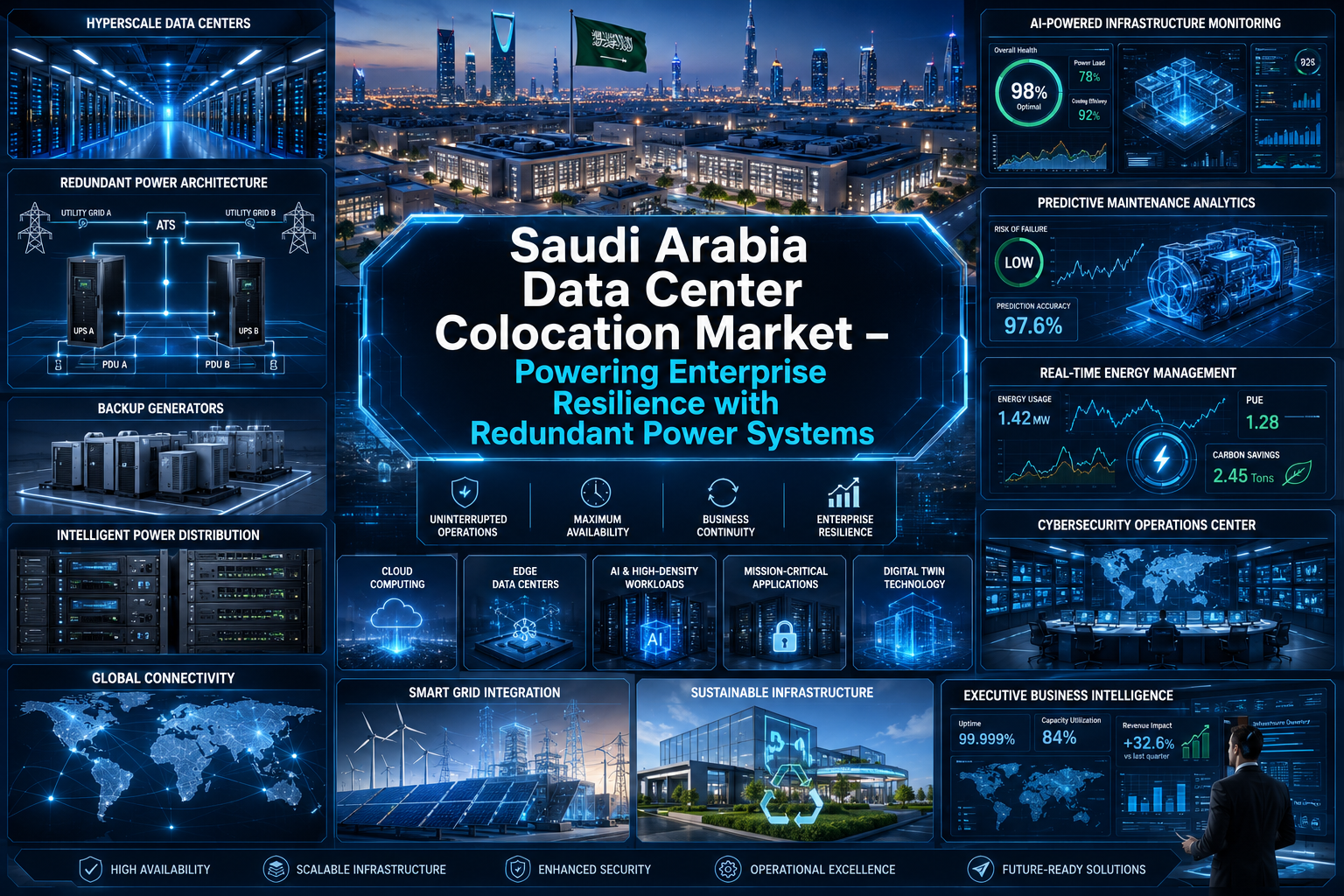
In today’s increasingly interconnected digital landscape, the Saudi Arabia Data Center Colocation Market is undergoing significant transformation as organizations accelerate investments in cloud computing, artificial intelligence (AI), digital transformation initiatives, edge infrastructure, and mission-critical business applications. Amid these advancements, Redundant Power Systems have emerged as a strategically vital component of modern data center operations. As enterprises become more dependent on uninterrupted digital services, power resilience is evolving into a critical determinant of infrastructure reliability, operational continuity, and long-term business performance.
Across global technology ecosystems, enterprise infrastructure strategies, and industry discussions, redundant power architectures continue to rank among the highest priorities for CIOs, CTOs, data center operators, and IT decision-makers. The growing focus on service availability, cybersecurity resilience, AI-driven workloads, and seamless digital experiences has elevated power redundancy from a technical requirement to a strategic business imperative.
The New Standard for Digital Infrastructure Reliability
Modern enterprises operate in an environment where even brief service interruptions can lead to substantial financial losses, reputational challenges, regulatory concerns, and diminished customer trust.
As organizations increasingly adopt AI-powered applications, hybrid cloud environments, digital platforms, and real-time analytics solutions, infrastructure reliability has become a cornerstone of business success. Redundant power systems play a pivotal role in ensuring operational continuity by maintaining the availability of critical equipment and services during power disruptions or infrastructure failures.
Consequently, enterprises worldwide are significantly increasing investments in hyperscale facilities, colocation environments, and next-generation data center infrastructure designed to deliver superior levels of resilience and uptime.
Discover emerging business opportunities Download the PDF supported by extensive market research.
Why Redundant Power Systems Are Gaining Global Attention
Several key technology and business trends are accelerating the demand for advanced power redundancy solutions across global markets.
Accelerating Artificial Intelligence Adoption
AI infrastructure requires substantial computing capacity and continuous power availability. Organizations deploying advanced AI models and analytics platforms must ensure uninterrupted operations to prevent costly disruptions and performance bottlenecks.
Expansion of Cloud Services
Cloud service providers operate under stringent service-level agreements (SLAs) that demand exceptional levels of availability and reliability. Redundant power systems are fundamental to maintaining these performance standards.
Growth of Edge Computing
As edge computing deployments expand, distributed infrastructure environments require highly resilient power architectures capable of supporting continuous operations across geographically dispersed locations.
Enterprise Digital Transformation
Organizations are increasingly dependent on digital platforms and connected services, making power resilience a critical component of business continuity and operational excellence.
Enhanced Cybersecurity Preparedness
Power redundancy supports organizational resilience by helping maintain operations during cybersecurity incidents, infrastructure failures, and disaster recovery events.
Collectively, these factors continue to shape investment priorities across the global digital infrastructure sector.
Discover what’s fuelling successful companies download the Sample Report for your business growth.
Understanding Modern Redundant Power Architectures
Today’s data centers deploy sophisticated power redundancy frameworks specifically designed to eliminate single points of failure and ensure continuous service availability.
Commonly adopted configurations include:
- N+1 Redundancy
- N+N Redundancy
- 2N Architecture
- 2N+1 Architecture
- Dual Power Feed Systems
- Intelligent UPS Solutions
- Backup Generator Infrastructure
- Advanced Power Distribution Units (PDUs)
- Automated Transfer Switching Technologies
Together, these solutions create highly resilient environments capable of supporting mission-critical workloads under demanding operating conditions.
Why Downtime Has Become a Strategic Business Concern
Downtime is no longer viewed solely as an IT challenge. It has become a significant business risk that directly impacts organizational performance and competitiveness.
Industries including financial services, healthcare, telecommunications, e-commerce, manufacturing, and government increasingly rely on continuous digital operations to deliver products, services, and customer experiences.
Business leaders recognize that infrastructure resilience directly influences:
- Revenue generation
- Customer satisfaction and experience
- Regulatory compliance
- Corporate reputation
- Competitive differentiation
- Operational efficiency
As a result, investments in redundant power systems are increasingly regarded as strategic initiatives that support long-term business objectives.
The Growing Impact of AI, Cloud, and Mission-Critical Applications
Artificial intelligence and cloud computing continue to redefine enterprise infrastructure requirements.
AI training environments and advanced analytics platforms demand sustained computational performance over extended periods. Any interruption can negatively affect productivity, increase operational costs, and delay innovation initiatives.
Similarly, cloud-based business applications support millions of users globally and require highly reliable infrastructure to maintain service continuity and customer confidence.
Redundant power systems provide the foundational reliability necessary to support these increasingly complex and resource-intensive workloads.
Saudi Arabia Data Center Colocation Market: A Strategic Growth Opportunity
The ongoing expansion of the Saudi Arabia Data Center Colocation Market growth is closely aligned with the Kingdom’s digital transformation agenda, smart city initiatives, cloud adoption strategies, and growing enterprise demand for scalable digital infrastructure.
Organizations seeking secure, resilient, and cost-efficient IT environments are increasingly leveraging colocation facilities to support evolving business requirements and accelerate digital transformation efforts.
According to ongoing Saudi Arabia Data Center Colocation analysis, enterprises are prioritizing facilities that offer advanced redundancy capabilities, carrier-neutral ecosystems, robust security frameworks, and high-availability infrastructure designs.
Consequently, power resilience is becoming one of the most significant differentiators within the market.
The increasing Saudi Arabia Data Center Colocation size reflects strong demand from multiple sectors, including:
- Banking and Financial Services
- Healthcare
- Telecommunications
- Government and Public Sector
- Retail and E-Commerce
- Energy and Utilities
- Manufacturing
- Logistics and Transportation
Industry Applications of Redundant Power Systems
Financial Services
Financial institutions depend on uninterrupted transaction processing, digital banking platforms, and fraud detection systems to maintain operational integrity and customer confidence.
Healthcare
Healthcare providers require continuous access to patient records, diagnostic applications, telemedicine platforms, and critical care systems.
Telecommunications
Network operators rely on highly available infrastructure to support communication networks and deliver uninterrupted connectivity.
Manufacturing
Smart manufacturing environments utilize automated production systems that depend on reliable power and continuous connectivity.
Government Services
Public sector organizations require resilient infrastructure to support essential citizen services and national digital transformation initiatives.
Enterprise Benefits of Colocation Solutions
Organizations leveraging colocation facilities gain access to several strategic advantages:
Enhanced Availability
Redundant power architectures significantly reduce operational risks and improve service reliability.
Lower Capital Investment
Colocation enables organizations to avoid the substantial costs associated with building and maintaining private data center facilities.
Scalability and Flexibility
Businesses can expand infrastructure capacity efficiently without major capital-intensive upgrades.
Advanced Security
Modern colocation facilities provide enterprise-grade physical security, cybersecurity controls, and compliance capabilities.
Regulatory Readiness
Organizations can more effectively meet evolving industry regulations and compliance requirements.
Strengthened Disaster Recovery
Redundant infrastructure improves resilience and ensures faster recovery during unexpected disruptions.
These advantages continue to support a positive Saudi Arabia Data Center Colocation outlook across diverse industry verticals.
Emerging Saudi Arabia Data Center Colocation Trends
Several notable developments are shaping the future of the market:
AI-Optimized Data Centers
Facilities are increasingly designed to support high-density AI and machine learning workloads.
Sustainable Infrastructure Investments
Operators continue investing in energy-efficient technologies, renewable energy integration, and carbon reduction initiatives.
Expansion of Edge Infrastructure
Edge data centers are enabling low-latency services and supporting the growth of digital applications.
Intelligent Infrastructure Monitoring
AI-powered monitoring and predictive analytics solutions are enhancing operational visibility and performance management.
Advanced Power Management Systems
Smart power distribution and energy optimization technologies are improving reliability and efficiency across facilities.
These evolving Saudi Arabia Data Center Colocation trends are expected to accelerate enterprise adoption in the years ahead.
Sustainability and Energy Efficiency Priorities
Modern redundant power systems increasingly align with corporate sustainability objectives through innovations such as:
- Intelligent energy management platforms
- High-efficiency UPS technologies
- Renewable energy integration
- Predictive maintenance capabilities
- Advanced cooling optimization
- Carbon footprint reduction initiatives
These advancements enable organizations to achieve both operational excellence and environmental sustainability goals.
Strengthening Business Continuity and Disaster Recovery
Enterprise resilience requires comprehensive continuity strategies that extend beyond traditional backup solutions.
Organizations must be prepared to maintain operations during:
- Utility power interruptions
- Equipment failures
- Cybersecurity incidents
- Natural disasters
- Infrastructure-related disruptions
Redundant power architectures serve as a critical foundation for ensuring business continuity and disaster recovery readiness.
Future Outlook
The Saudi Arabia Data Center Colocation forecast remains highly favorable as enterprises continue to invest in cloud adoption, AI infrastructure, digital transformation, and resilient technology ecosystems.
Industry stakeholders anticipate sustained growth across:
- Colocation infrastructure capacity
- AI-ready facilities
- Hyperscale data centers
- Edge computing deployments
- Intelligent power management systems
- Renewable energy adoption
Recent Saudi Arabia Data Center Colocation report findings consistently identify reliability, scalability, security, and power resilience as primary decision-making factors for enterprise customers.
Furthermore, the increasing Saudi Arabia Data Center Colocation share of regional digital infrastructure investments underscores growing confidence in the Kingdom’s expanding technology ecosystem.
As organizations navigate an increasingly digital and data-driven future, infrastructure resilience has become a strategic necessity rather than an operational consideration. Redundant power systems provide the essential foundation required to support AI innovation, cloud transformation, cybersecurity preparedness, and business continuity objectives.
The continued evolution of the Saudi Arabia Data Center Colocation Market highlights the growing interdependence between power resilience, operational excellence, and digital infrastructure modernization. Enterprises that prioritize advanced redundant power architectures today will be better positioned to achieve sustainable growth, enhanced operational stability, and long-term competitive advantage in the digital economy.