The rapid evolution of autonomous mobility, advanced driver-assistance systems (ADAS), and intelligent transportation technologies is creating significant growth opportunities for the 4D Imaging Radar Market. As automotive manufacturers increasingly focus on vehicle safety, automation, and real-time environmental perception, 4D imaging radar is emerging as a critical sensing technology for next-generation mobility solutions.
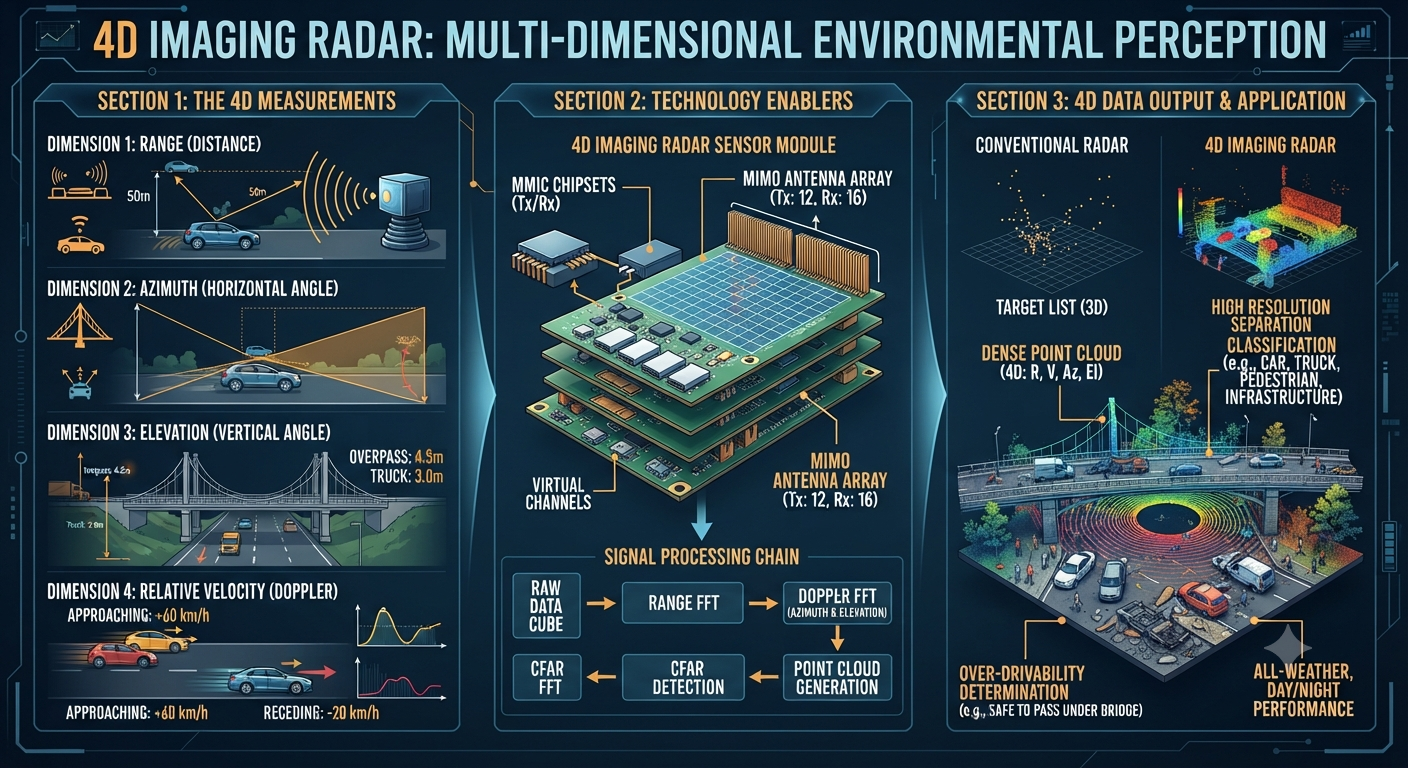
Unlike conventional radar systems, 4D imaging radar captures four essential dimensions: range, azimuth, elevation, and Doppler velocity. This capability enables vehicles to identify objects, measure their distance, determine their position, and track their movement with greater accuracy. It also improves environmental perception under challenging conditions, including rain, fog, darkness, and low visibility.
According to MarketsandMarkets, the global 4D imaging radar market is projected to grow from USD 0.39 billion in 2025 to USD 1.21 billion by 2030, registering a compound annual growth rate (CAGR) of 25.2% during the forecast period. Increasing investments in autonomous driving, growing ADAS adoption, and continuous advancements in radar technologies are expected to accelerate market expansion.
As the automotive industry transitions toward higher levels of driving automation, the 4D Imaging Radar Market presents substantial revenue opportunities for semiconductor manufacturers, radar technology providers, automotive suppliers, and mobility technology companies.
Rising Demand for Autonomous Vehicles Creates New Revenue Opportunities
The growing development of autonomous and semi-autonomous vehicles is one of the primary factors driving the 4D Imaging Radar Market. Automakers are investing in advanced perception technologies to improve vehicle intelligence, reduce accidents, and support higher levels of driving automation.
Autonomous vehicles require reliable sensing systems to continuously monitor their surroundings, recognize obstacles, detect pedestrians, and make real-time driving decisions. Traditional radar systems offer distance and velocity information but have limitations in accurately identifying the spatial positioning of objects.
4D imaging radar addresses these limitations by delivering high-resolution environmental information. Its ability to detect objects across multiple dimensions makes it suitable for applications such as adaptive cruise control, automatic emergency braking, collision avoidance, lane-change assistance, and autonomous navigation.
The transition toward SAE Level 3 and higher automation is creating additional demand for sophisticated radar solutions. Automotive OEMs and Tier 1 suppliers are increasingly exploring advanced radar architectures to strengthen vehicle perception and improve system redundancy.
For technology providers, this transition creates opportunities to develop high-performance radar sensors, automotive radar chipsets, signal-processing solutions, and integrated perception platforms.
ADAS Integration Strengthens Market Growth Potential
Advanced driver-assistance systems are becoming increasingly important in modern vehicles as consumers and regulatory authorities prioritize road safety. Features such as blind-spot detection, forward collision warning, adaptive cruise control, and automatic emergency braking are encouraging automakers to integrate advanced sensing technologies.
The 4D Imaging Radar Market is benefiting from this trend because radar technology provides reliable object detection and velocity measurement across different environmental conditions.
The ADAS application segment is expected to register the highest CAGR of 24.5%, according to MarketsandMarkets. This growth highlights the increasing importance of 4D radar technology in automotive safety systems.
The integration of 4D imaging radar into ADAS platforms also creates revenue opportunities beyond individual radar sensor sales. Companies can generate additional business through radar software, signal-processing technologies, system integration, and customized sensing solutions.
Furthermore, the increasing availability of advanced safety features in mid-range and mass-market vehicles could expand the addressable market for radar manufacturers. As production volumes increase and manufacturing costs decline, suppliers may gain opportunities to establish long-term partnerships with global automotive manufacturers.
Download PDF Brochure @ https://www.marketsandmarkets.com/pdfdownloadNew.asp?id=226035909
Multi-Sensor Fusion Creates Significant Commercial Opportunities
One of the most promising opportunities in the 4D Imaging Radar Market is the integration of radar technology with LiDAR, cameras, and ultrasonic sensors.
Autonomous vehicles depend on multiple sensing technologies to develop an accurate understanding of their surroundings. Cameras provide visual information, LiDAR delivers detailed spatial measurements, and ultrasonic sensors support short-range obstacle detection. However, each technology has limitations under specific operating conditions.
4D imaging radar complements these technologies by providing reliable distance, elevation, and velocity information, including in challenging weather and lighting conditions.
Multi-sensor fusion enables autonomous driving platforms to combine information from different sensors, improving object classification, tracking, and environmental awareness.
This creates attractive business opportunities for companies developing integrated perception systems, automotive computing platforms, radar software, and artificial intelligence-based sensor-fusion solutions.
Technology providers can also collaborate with automotive OEMs and Tier 1 suppliers to develop customized radar platforms for passenger vehicles, commercial vehicles, and autonomous mobility applications.
Companies investing in advanced radar algorithms and AI-powered perception software are particularly well positioned to benefit from the increasing demand for intelligent vehicle technologies.
Short-Range Radar Emerges as an Important Market Segment
Based on range, the 4D Imaging Radar Market is segmented into short-range, medium-range, and long-range radar.
Short-range 4D imaging radar is expected to account for the largest market share in 2030. Its capabilities make it particularly suitable for applications requiring precise object detection and spatial awareness around vehicles.
Short-range radar systems support parking assistance, blind-spot monitoring, pedestrian detection, cross-traffic alerts, and low-speed collision avoidance. These applications are becoming increasingly relevant as urban traffic density increases and automakers introduce more sophisticated safety features.
The growing adoption of advanced parking assistance and automated driving functions is creating opportunities for manufacturers to develop compact, cost-effective radar modules.
Companies such as Arbe Robotics, Uhnder, Vayyar Imaging, Aptiv, and CUBTEK are contributing to technological developments in high-resolution radar solutions.
For manufacturers, short-range radar offers opportunities to expand product portfolios and target high-volume automotive applications. The development of smaller radar modules with improved resolution and lower power consumption could further support commercialization.
Technological Advancements Improve Revenue Potential
Continuous innovation in radar hardware, semiconductor technologies, artificial intelligence, and signal processing is strengthening the commercial potential of the 4D Imaging Radar Market.
Modern radar platforms increasingly use multiple-input multiple-output (MIMO) architectures to improve angular resolution and object detection capabilities. Millimeter-wave technology, advanced antenna configurations, and sophisticated signal-processing algorithms are also enhancing radar performance.
These advancements are helping manufacturers develop systems capable of identifying smaller objects, distinguishing between closely positioned targets, and tracking multiple moving objects simultaneously.
Artificial intelligence and edge computing are creating additional opportunities by enabling faster processing of radar data. AI-powered algorithms can improve object classification, environmental interpretation, and real-time decision-making.
Semiconductor manufacturers also have opportunities to develop specialized radar integrated circuits, system-on-chips (SoCs), and high-performance processing components.
Companies such as Texas Instruments, NXP Semiconductors, and Infineon Technologies are important participants in the radar semiconductor ecosystem.
As radar technology becomes more sophisticated, revenue opportunities will extend across hardware manufacturing, software development, semiconductor design, and integrated automotive sensing platforms.
Expanding Applications Beyond Automotive Mobility
Although automotive applications represent the primary growth opportunity, the 4D Imaging Radar Market is also expanding into aerospace and defense, industrial automation, security, and healthcare.
In aerospace and defense, radar systems can support surveillance, object tracking, situational awareness, and unmanned aerial vehicle detection. The ability to operate in challenging environmental conditions makes advanced radar technologies valuable for monitoring and detection applications.
Industrial automation represents another emerging opportunity. Radar-based sensing can support equipment monitoring, object detection, robotics, and smart infrastructure applications.
In healthcare and assisted living, privacy-preserving radar sensing offers opportunities for contactless monitoring. Unlike camera-based systems, radar can detect movement and certain physiological patterns without capturing conventional visual images.
These applications create opportunities for radar manufacturers to diversify their customer base and reduce dependence on automotive demand.
Companies developing compact, low-power, and application-specific radar solutions could benefit from the expansion of these adjacent markets.
Regional Opportunities: Europe Maintains a Strong Market Position
Regional growth opportunities in the 4D Imaging Radar Market are influenced by automotive manufacturing capabilities, technology investments, vehicle safety regulations, and the adoption of advanced mobility solutions.
Europe accounted for 46.6% of the global market revenue in 2024, according to MarketsandMarkets. The region benefits from its established automotive manufacturing ecosystem, strong automotive engineering capabilities, and emphasis on vehicle safety.
The increasing adoption of advanced driver-assistance technologies and stringent vehicle safety requirements are supporting demand for sophisticated automotive sensing systems.
North America also represents an important market, supported by autonomous vehicle development, investments in mobility technologies, and the presence of established semiconductor and automotive technology companies.
Meanwhile, Asia Pacific offers significant growth opportunities due to its large automotive manufacturing base, expanding electric vehicle industry, and increasing investments in intelligent transportation systems. Countries such as China, Japan, and South Korea are important contributors to automotive electronics and radar technology development.
For market participants, regional expansion, strategic partnerships, and localized manufacturing capabilities can help strengthen competitiveness and capture emerging demand.
Competitive Landscape and Strategic Industry Positioning
The 4D Imaging Radar Market is characterized by technological innovation, product development, semiconductor advancements, and strategic collaborations between automotive manufacturers and technology providers.
Leading companies are focusing on improving radar resolution, reducing system costs, enhancing processing capabilities, and expanding the range of automotive applications.
Key companies operating in the market include:
- Texas Instruments Incorporated
- NXP Semiconductors
- Infineon Technologies AG
- Robert Bosch GmbH
- Mobileye
These companies are strengthening their market positions through advancements in radar chipsets, automotive sensing technologies, and integrated perception solutions.
Emerging companies such as Echodyne and bitsensing are also developing specialized radar technologies for automotive, security, and infrastructure applications.
Strategic partnerships between radar developers, semiconductor manufacturers, automotive OEMs, and Tier 1 suppliers will remain important for accelerating product commercialization.
Companies that can deliver high-resolution sensing, cost-efficient hardware, reliable software, and scalable production capabilities are likely to gain competitive advantages.
Challenges That Could Influence Market Expansion
Despite its strong growth potential, the 4D Imaging Radar Market faces several challenges that could influence adoption.
High system costs remain an important restraint. Advanced radar systems require sophisticated antenna configurations, multiple transmitting and receiving channels, and high-performance digital signal-processing capabilities. These requirements can increase manufacturing and integration expenses.
Data processing complexity is another challenge. 4D imaging radar generates substantial volumes of information that must be processed accurately and quickly. Integrating radar systems with existing vehicle architectures and other sensors also requires significant engineering investments.
Power consumption and thermal management can create additional limitations, particularly in compact and battery-powered platforms.
Furthermore, regulatory requirements and standardization challenges may influence the speed of commercialization across different regions.
Addressing these challenges through semiconductor innovation, system miniaturization, advanced algorithms, and manufacturing efficiencies will be important for achieving wider market penetration.
Future Outlook: Unlocking Long-Term Revenue Opportunities
The future of the 4D Imaging Radar Market will be shaped by the convergence of autonomous mobility, artificial intelligence, semiconductor innovation, and advanced vehicle safety technologies.
As automakers move toward higher levels of driving automation, demand for accurate and reliable environmental perception will continue to increase. 4D imaging radar is positioned to play an important role in this transition by providing detailed spatial and velocity information across challenging operating environments.
The market’s projected growth from USD 0.39 billion in 2025 to USD 1.21 billion by 2030 reflects the expanding commercial potential of this technology.
For investors and industry participants, the most attractive opportunities are likely to emerge across radar semiconductor development, AI-powered perception software, multi-sensor integration, short-range radar systems, and automotive safety platforms.
Manufacturers that prioritize cost optimization, technological differentiation, strategic partnerships, and scalable production will be better positioned to capture future revenue opportunities.
Overall, the 4D Imaging Radar Market is evolving from an advanced automotive sensing category into an important component of intelligent mobility infrastructure. Its growing role in autonomous driving, ADAS, and connected transportation is expected to create new business opportunities and reshape the future of vehicle perception.
Frequently Asked Questions (FAQs)
1. What is the projected size of the 4D Imaging Radar Market by 2030?
The global 4D Imaging Radar Market is projected to reach USD 1.21 billion by 2030, growing from USD 0.39 billion in 2025 at a CAGR of 25.2%.
2. What are the major growth drivers of the 4D Imaging Radar Market?
Major growth drivers include increasing adoption of autonomous vehicles, rising demand for ADAS, stricter vehicle safety requirements, advancements in radar technology, and growing investments in sensor-fusion systems.
3. Which application segment is expected to grow fastest in the 4D Imaging Radar Market?
The ADAS application segment is expected to register the highest CAGR of 24.5%, driven by increasing demand for collision avoidance, adaptive cruise control, and advanced vehicle safety technologies.
4. Which region holds the largest share of the 4D Imaging Radar Market?
Europe accounted for 46.6% of the global market revenue in 2024, supported by its established automotive industry, advanced safety regulations, and increasing adoption of ADAS technologies.
5. Who are the key players in the 4D Imaging Radar Market?
Major companies include Texas Instruments Incorporated, NXP Semiconductors, Infineon Technologies AG, Robert Bosch GmbH, and Mobileye.
About MarketsandMarkets™
MarketsandMarkets™ has been recognized as one of America’s Best Management Consulting Firms by Forbes, as per their recent report.
MarketsandMarkets™ is a blue ocean alternative in growth consulting and program management, leveraging a man-machine offering to drive supernormal growth for progressive organizations in the B2B space. With the widest lens on emerging technologies, we are proficient in co-creating supernormal growth for clients across the globe.
Today, 80% of Fortune 2000 companies rely on MarketsandMarkets, and 90 of the top 100 companies in each sector trust us to accelerate their revenue growth. With a global clientele of over 13,000 organizations, we help businesses thrive in a disruptive ecosystem.
The B2B economy is witnessing the emergence of $25 trillion in new revenue streams that are replacing existing ones within this decade. We work with clients on growth programs, helping them monetize this $25 trillion opportunity through our service lines – TAM Expansion, Go-to-Market (GTM) Strategy to Execution, Market Share Gain, Account Enablement, and Thought Leadership Marketing.
Built on the ‘GIVE Growth’ principle, we collaborate with several Forbes Global 2000 B2B companies to keep them future-ready. Our insights and strategies are powered by industry experts, cutting-edge AI, and our Market Intelligence Cloud, KnowledgeStore™, which integrates research and provides ecosystem-wide visibility into revenue shifts.
To find out more, visit www.MarketsandMarkets™.com or follow us on Twitter , LinkedIn and Facebook .
Contact:
Mr. Rohan Salgarkar
MarketsandMarkets™ INC.
630 Dundee Road
Suite 430
Northbrook, IL 60062
USA : 1-888-600-6441