The global GaN Substrate Market is gaining momentum as semiconductor manufacturers increasingly adopt gallium nitride (GaN) technology for high-performance, energy-efficient, and high-frequency electronic applications. GaN substrates are becoming essential materials for next-generation power electronics, radio frequency (RF) devices, telecommunications infrastructure, electric vehicles (EVs), renewable energy systems, and advanced optoelectronic applications.
The growing demand for compact electronic devices, efficient power conversion, and high-speed communication systems is transforming the competitive landscape of the GaN substrate industry. Semiconductor manufacturers are investing in advanced substrate manufacturing technologies, larger wafer sizes, crystal growth processes, and strategic partnerships to strengthen their market positions.
Unlike conventional silicon-based materials, GaN offers high breakdown voltage, superior electron mobility, high switching frequency, and improved power efficiency. These characteristics make GaN substrates attractive for applications requiring high power density, thermal stability, and reliable performance.
According to MarketsandMarkets, the GaN Substrate Market is projected to grow from USD 0.62 billion in 2026 to USD 1.25 billion by 2032, registering a CAGR of 12.5% during the 2026–2032 forecast period.
Market expansion is supported by increasing adoption of GaN-based power devices, growing demand for 5G and next-generation telecommunications, and rising investments in semiconductor manufacturing.
The development of AI data centers, electric vehicle powertrains, renewable energy infrastructure, and high-frequency communication systems is further increasing demand for advanced GaN substrates.
Manufacturers are also investing in larger wafer diameters and improved crystal growth technologies to increase production capacity, enhance substrate quality, and reduce manufacturing costs.
Download PDF Brochure @ https://www.marketsandmarkets.com/pdfdownloadNew.asp?id=115699534
Competitive Landscape of the GaN Substrate Market
The GaN substrate industry features established semiconductor material manufacturers, specialized wafer producers, and emerging technology companies. Competition is primarily influenced by substrate quality, crystal growth capabilities, wafer diameter, manufacturing yields, pricing, and the ability to meet customer requirements across different applications.
According to MarketsandMarkets, the market is moderately consolidated, with leading companies including Sumitomo Chemical, Mitsubishi Chemical, Shin-Etsu Chemical, SOITEC, and IQE. These companies collectively hold a significant share of the global market.
1. Sumitomo Chemical Co., Ltd.
Sumitomo Chemical is one of the leading companies in the GaN substrate market. The company focuses on advanced semiconductor materials and substrate technologies for high-performance electronic applications.
Its competitive positioning is supported by manufacturing expertise, research and development capabilities, and investments in advanced GaN substrate technologies.
The company’s focus on crystal growth and substrate quality positions it to benefit from increasing demand for RF devices, power electronics, and next-generation semiconductor applications.
2. Mitsubishi Chemical Corporation
Mitsubishi Chemical Group is strengthening its position through investments in advanced materials and semiconductor substrate technologies.
The company is focusing on manufacturing capabilities that support high-performance GaN applications, including power semiconductors and advanced electronic systems.
Its technology development and manufacturing expansion initiatives are important competitive factors as demand for GaN substrates increases across EVs, inverters, and data center power systems.
3. Shin-Etsu Chemical Co., Ltd.
Shin-Etsu Chemical is a significant participant in the semiconductor materials industry.
The company’s expertise in high-quality semiconductor materials and wafer manufacturing supports its competitive position in advanced substrate technologies.
Increasing demand for high-performance semiconductor devices creates opportunities for its GaN-related material portfolio.
4. IQE plc
IQE is an important supplier of compound semiconductor wafers and epitaxial materials.
The company focuses on GaN epitaxial wafer technologies for RF, power electronics, and optoelectronic applications.
Its manufacturing expertise and collaborations with semiconductor technology partners support the development of scalable GaN solutions for automotive, industrial, and telecommunications markets.
5. SOITEC
Soitec is strengthening its competitive position through engineered substrate technologies, including GaN-on-silicon solutions.
The company focuses on advanced semiconductor materials for RF, photonics, and power electronics applications.
Its research collaborations and substrate engineering capabilities support the development of next-generation semiconductor technologies.
Other Important Players in the GaN Substrate Industry
Apart from the leading manufacturers, several companies are contributing to competitive developments through specialized materials, advanced wafer technologies, and semiconductor innovation.
- Wolfspeed – Focuses on wide-bandgap semiconductor materials and advanced power technologies.
- Infineon Technologies – Develops semiconductor technologies for automotive, industrial, and energy applications.
- Xiamen Powerway Advanced Material – Participates in advanced substrate and semiconductor materials development.
- NGK Corporation – Focuses on advanced materials and electronic components.
- Kyma Technologies – Specializes in compound semiconductor substrate technologies.
These companies contribute to market competition through technology development, product innovation, manufacturing improvements, and partnerships.
Key Competitive Strategies Shaping the GaN Substrate Market
Companies operating in the GaN substrate industry are adopting multiple strategies to strengthen their market positions and improve competitiveness.
1. Strategic Partnerships and Collaborations
Partnerships between substrate manufacturers, semiconductor foundries, and device manufacturers are becoming increasingly important.
These collaborations help companies accelerate product development, improve wafer quality, and commercialize advanced GaN technologies.
For example, IQE and X-FAB entered a joint development agreement in April 2025 to accelerate the commercialization of 200 mm GaN power technology. The collaboration combines IQE’s epitaxial wafer expertise with X-FAB’s semiconductor manufacturing capabilities.
2. Manufacturing Capacity Expansion
Increasing demand for GaN substrates is encouraging manufacturers to expand production capabilities.
Companies are investing in advanced manufacturing equipment, crystal growth processes, and larger wafer production facilities to improve scalability and meet growing customer requirements.
In July 2026, Mitsubishi Chemical and Japan Steel Works were reported to be preparing a capacity expansion for GaN substrates to address increasing demand from next-generation power semiconductor applications.
3. Product Innovation and Technology Development
Innovation is a major competitive differentiator in the GaN substrate market.
Manufacturers are focusing on:
- Improving crystal quality and reducing substrate defects.
- Developing larger-diameter GaN wafers.
- Enhancing thermal conductivity and electrical performance.
- Improving epitaxial layer uniformity.
- Developing advanced GaN-on-Si and GaN-on-SiC technologies.
- Reducing manufacturing costs and improving production yields.
These developments are expected to improve the commercial viability of GaN substrates across multiple semiconductor applications.
4. Geographic Expansion
Companies are strengthening their global presence by expanding manufacturing operations, developing regional partnerships, and targeting high-growth semiconductor markets.
Asia Pacific is particularly important because of its established semiconductor manufacturing ecosystem and increasing investments in telecommunications, EVs, and advanced electronics.
Expanding regional manufacturing capabilities can also help companies improve supply chain resilience and serve customers more efficiently.
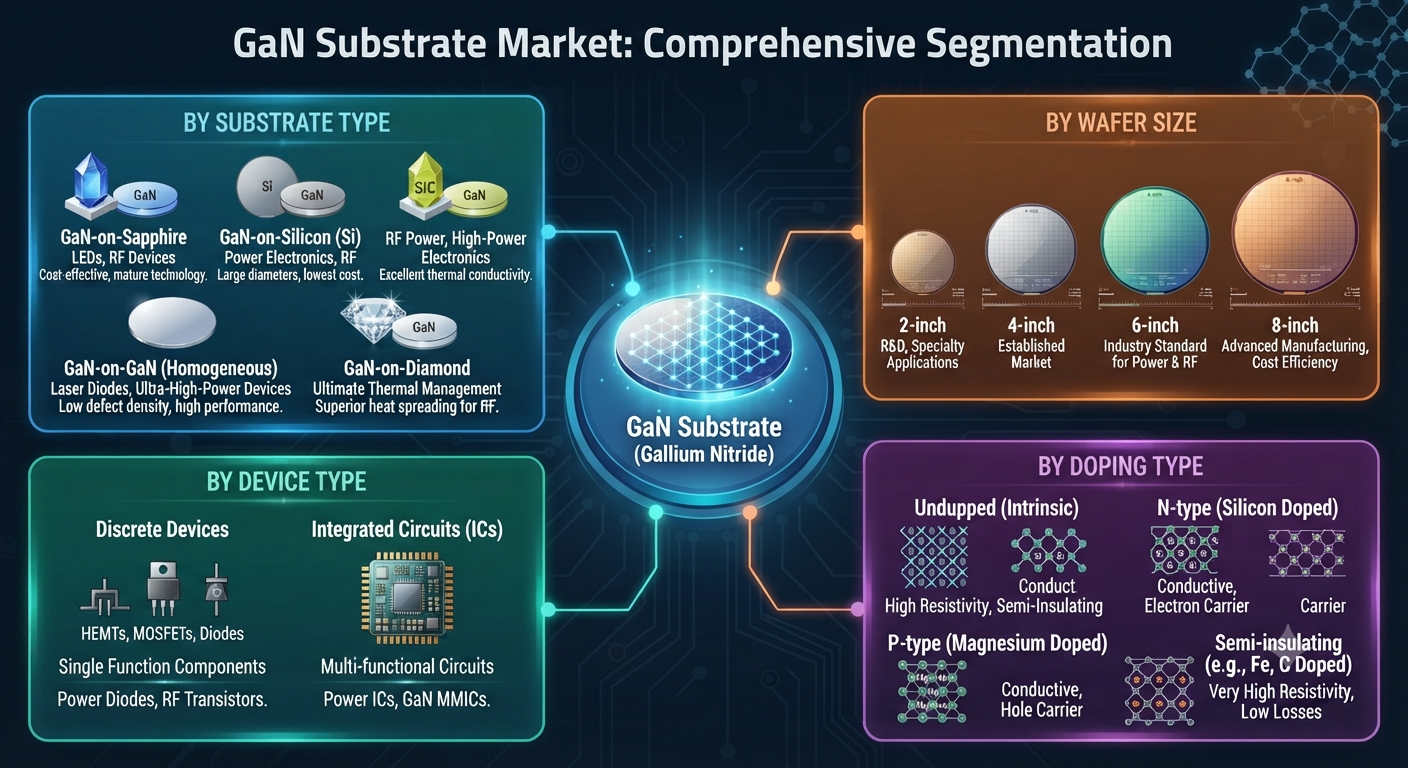
GaN Substrate Market Segmentation Analysis
The competitive environment varies across substrate technologies, wafer sizes, device types, applications, and end-use industries.
By Substrate Type
The market includes GaN-on-Sapphire, GaN-on-Silicon, GaN-on-SiC, GaN-on-GaN, and GaN-on-Diamond.
GaN-on-SiC held the largest market share of 43.9% in 2025. Its excellent thermal conductivity, high power density, and electrical performance make it suitable for RF and high-power applications.
GaN-on-Silicon is gaining attention because of its potential for scalable manufacturing and compatibility with established semiconductor manufacturing processes.
GaN-on-Sapphire continues to support optoelectronic applications, including LED technologies.
By Wafer Size
The market is segmented into 2-inch, 4-inch, 6-inch, and 8-inch wafers.
The 8-inch wafer segment is expected to register the highest CAGR of 44.2% during the forecast period. Larger wafer sizes offer opportunities to improve manufacturing efficiency, increase production volumes, and reduce costs per device.
By Device Type
The market covers discrete devices and integrated circuits (ICs).
The IC segment is projected to experience the highest growth rate during the forecast period, supported by increasing demand for integrated GaN technologies in power management, RF communication, and advanced electronic systems.
By Application
The market includes optoelectronic devices, power devices, and RF devices.
RF applications held the largest share in 2025, supported by increasing demand for high-frequency communication systems, radar technologies, satellite communication, and 5G infrastructure.
Power devices are expected to register a CAGR of 24.2%, driven by increasing adoption in electric vehicles, renewable energy systems, industrial power supplies, and data centers.
By End Use
Major end-use industries include:
- Consumer Electronics
- Telecommunications
- Automotive
- Aerospace & Defense
- Energy & Power
- Healthcare
- Industrial
Telecommunications is projected to account for the largest market share in 2032, supported by investments in 5G infrastructure, RF power amplifiers, and next-generation wireless communication systems.
Regional Competitive Landscape: Asia Pacific Leads Growth
Asia Pacific is expected to register the highest CAGR in the GaN Substrate Market during the forecast period.
China, Japan, South Korea, and Taiwan are important markets because of their semiconductor manufacturing capabilities, advanced electronics industries, and investments in next-generation semiconductor technologies.
Japan has a strong competitive position due to the presence of established materials manufacturers such as Sumitomo Chemical, Mitsubishi Chemical, and Shin-Etsu Chemical.
China is expanding its domestic semiconductor ecosystem and investing in advanced materials and compound semiconductor manufacturing.
South Korea and Taiwan are also strengthening their semiconductor capabilities through investments in advanced wafer manufacturing, electronics, and telecommunications infrastructure.
North America remains an important market due to investments in power semiconductors, aerospace and defense electronics, EV technologies, and advanced semiconductor research.
Europe is witnessing opportunities through investments in automotive electrification, industrial power electronics, and semiconductor manufacturing.
Challenges Affecting Competitive Positioning
Despite strong growth opportunities, manufacturers face several challenges that influence their competitive strategies.
1. High Manufacturing Costs
GaN substrate production requires specialized crystal growth technologies, advanced equipment, and stringent quality control. These factors increase production costs and create barriers for new market participants.
2. Technical Manufacturing Challenges
Producing large-diameter substrates with low defect density remains technically complex. Wafer cracking, dislocations, and manufacturing yield limitations can affect product quality and scalability.
3. Competition from Alternative Technologies
Silicon and silicon carbide remain established materials in semiconductor manufacturing. Their mature manufacturing ecosystems and cost advantages create competitive pressure for GaN substrate manufacturers.
4. Supply Chain Complexity
Limited availability of specialized materials, manufacturing equipment, and standardized production processes can affect supply chain efficiency.
Manufacturers must address these challenges through process innovation, capacity expansion, quality improvements, and strategic supplier relationships.
Future Outlook: Strategic Opportunities in the GaN Substrate Market
The future competitive landscape will be shaped by increasing demand for energy-efficient semiconductor technologies, advanced power electronics, and high-frequency communication systems.
Electric vehicle manufacturers are adopting GaN-based technologies to improve power conversion efficiency and reduce system size. Similarly, renewable energy installations and AI data centers are creating demand for advanced power semiconductor devices.
The development of larger wafer sizes, improved crystal growth technologies, and advanced epitaxial manufacturing processes will further influence competition.
Companies that successfully improve substrate quality, manufacturing yields, production scalability, and cost competitiveness will have opportunities to strengthen their market positions.
Strategic partnerships, technology investments, and manufacturing expansion will remain important approaches for capturing emerging demand.
With the global GaN Substrate Market projected to reach USD 1.25 billion by 2032, the industry offers significant opportunities for semiconductor material manufacturers, wafer suppliers, foundries, and technology developers.
Top 10 Takeaways: GaN Substrate Market Competitive Landscape
- The GaN Substrate Market is projected to reach USD 1.25 billion by 2032.
- The market is expected to grow at a CAGR of 12.5% during 2026–2032.
- Sumitomo Chemical, Mitsubishi Chemical, Shin-Etsu Chemical, SOITEC, and IQE are leading market participants.
- GaN-on-SiC accounted for 43.9% of the market in 2025.
- The 8-inch wafer segment is expected to register the highest CAGR of 44.2%.
- Power devices are projected to grow at a CAGR of 24.2%.
- Telecommunications is expected to account for the largest end-use market share by 2032.
- Asia Pacific is expected to register the fastest regional growth.
- Strategic partnerships, capacity expansion, and product innovation are major competitive strategies.
- EVs, 5G, AI data centers, and renewable energy are creating new growth opportunities.
Frequently Asked Questions (FAQs)
Q1. What is the projected size of the GaN Substrate Market by 2032?
The global GaN Substrate Market is projected to reach USD 1.25 billion by 2032, growing from USD 0.62 billion in 2026.
Q2. What is the expected CAGR of the GaN Substrate Market?
The market is expected to register a CAGR of 12.5% during the 2026–2032 forecast period.
Q3. Which region is expected to witness the fastest growth in the GaN Substrate Market?
Asia Pacific is expected to register the highest CAGR during the forecast period, driven by semiconductor manufacturing, 5G infrastructure, and growing demand for advanced electronics.
Q4. Which substrate type holds the largest market share?
GaN-on-SiC held the largest share of the market in 2025, accounting for 43.9%.
Q5. Who are the key players in the GaN Substrate Market?
Major players include Sumitomo Chemical, Mitsubishi Chemical, Shin-Etsu Chemical, IQE, SOITEC, Wolfspeed, Infineon Technologies, Xiamen Powerway Advanced Material, NGK Corporation, and Kyma Technologies.
About MarketsandMarkets™
MarketsandMarkets™ has been recognized as one of America’s Best Management Consulting Firms by Forbes, as per their recent report.
MarketsandMarkets™ is a blue ocean alternative in growth consulting and program management, leveraging a man-machine offering to drive supernormal growth for progressive organizations in the B2B space. With the widest lens on emerging technologies, we are proficient in co-creating supernormal growth for clients across the globe.
Today, 80% of Fortune 2000 companies rely on MarketsandMarkets, and 90 of the top 100 companies in each sector trust us to accelerate their revenue growth. With a global clientele of over 13,000 organizations, we help businesses thrive in a disruptive ecosystem.
The B2B economy is witnessing the emergence of $25 trillion in new revenue streams that are replacing existing ones within this decade. We work with clients on growth programs, helping them monetize this $25 trillion opportunity through our service lines – TAM Expansion, Go-to-Market (GTM) Strategy to Execution, Market Share Gain, Account Enablement, and Thought Leadership Marketing.
Built on the ‘GIVE Growth’ principle, we collaborate with several Forbes Global 2000 B2B companies to keep them future-ready. Our insights and strategies are powered by industry experts, cutting-edge AI, and our Market Intelligence Cloud, KnowledgeStore™, which integrates research and provides ecosystem-wide visibility into revenue shifts.
To find out more, visit www.MarketsandMarkets™.com or follow us on Twitter , LinkedIn and Facebook .
Contact:
Mr. Rohan Salgarkar
MarketsandMarkets™ INC.
630 Dundee Road
Suite 430
Northbrook, IL 60062
USA : 1-888-600-6441