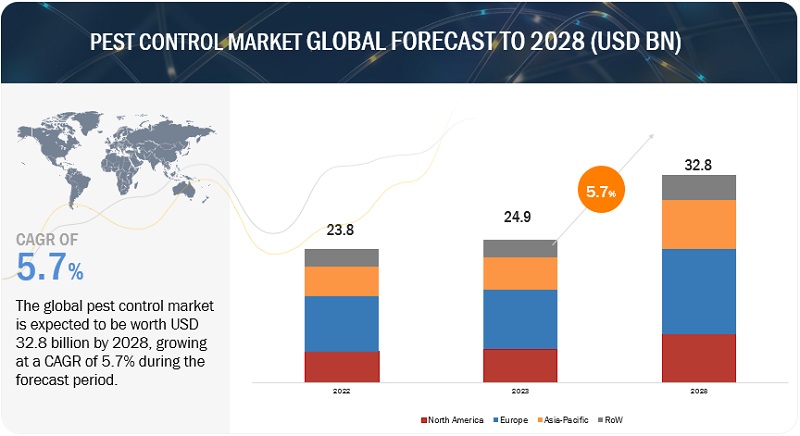
The global pest control market is witnessing steady expansion, projected to grow from USD 24.9 billion in 2023 to USD 32.8 billion by 2028, at a CAGR of 5.7%. This growth reflects rising awareness about pest-related health risks, increasing urbanization, and the growing need for effective pest management across residential, commercial, and industrial sectors.
As pest infestations continue to impact homes, businesses, and agricultural landscapes, the demand for advanced, safe, and efficient pest control solutions has surged. Here’s a detailed look at the trends reshaping this fast-evolving market.
Why Is the Demand for Pest Control Rising?
Several key factors are driving the increased utilization of pest control products and services:
- Growing Awareness of Health Risks: People worldwide are becoming more conscious of the diseases and health risks associated with pests. This heightened awareness is prompting homeowners and businesses to adopt proactive pest management practices.
- Rapid Urbanization: Urban expansion and higher population density create environments where pests thrive. Cities, in particular, experience increased infestations, leading to greater reliance on pest control products—especially in residential settings.
Download PDF Brochure: https://www.marketsandmarkets.com/pdfdownloadNew.asp?id=144665518
Residential Segment Leads the Market
The residential sector holds the largest share of the pest control market. Homeowners rely heavily on pest control solutions to maintain clean, safe, and comfortable living environments.
From ants and cockroaches to spiders, termites, and rodents, residential areas face a wide range of pest issues. As infestations rise, so does the adoption of pest management products in homes, fueling the segment’s rapid growth.
Insects Dominate the Pest Type Segment
Insects account for the largest share of the pest control market by value. Climate change, global warming, and rapid urbanization have contributed to a surge in insect populations, including:
- Bedbugs
- Mosquitoes
- Cockroaches
- Flies
- Other disease-carrying species
Since insects are major irritants to both humans and livestock—and often act as vectors for harmful diseases—effective insect control remains a priority worldwide.
Sprays: The Preferred Mode of Application
Among all application methods, sprays hold the largest market share. Their widespread popularity is attributed to:
- Convenience and ease of use
- Quick coverage and uniform distribution
- Ability to target specific areas through varied nozzle designs
- Reduced risk of affecting non-target species
Liquid spray formulations remain the go-to solution for both residential and commercial users seeking fast and reliable pest control.
Chemical Control Methods Lead the Market
The chemical segment continues to dominate due to its proven effectiveness and rapid action against pests. Key advantages include:
- Immediate control during outbreaks or infestations
- Cost-effectiveness and easy application
- Reliability across diverse weather conditions
- Availability of stable and long-lasting formulations
For many users, chemical pest control offers the most consistent and dependable solution, especially when urgent intervention is required.
Request Sample Pages: https://www.marketsandmarkets.com/requestsampleNew.asp?id=144665518
North America: The Largest Regional Market
In 2022, North America accounted for the largest share of the global pest control market. Growth in the region is supported by:
- Rising adoption of sustainable pest control practices
- Strict regulations in industries like food production and healthcare
- Continuous advancements in pest control technology
- Increased consumer awareness about hygiene and safety
Technological innovations have also led to more eco-friendly and targeted pest management methods, boosting market demand across the US and Canada.
Leading Companies in the Pest Control Market
The global pest control landscape features several major players that continue to innovate and expand their offerings. Key companies include:
- Bayer AG (Germany)
- Corteva Agriscience (US)
- BASF SE (Germany)
- Sumitomo Chemical Co. Ltd. (Japan)
- Syngenta AG (Sw Switzerland)
- Rentokil Initial plc (UK)
- Anticimex (Sweden)
- Rollins, Inc. (US)
- ATGC Biotech Pvt Ltd. (India)
- Ecolab Inc. (US)
- FMC Corporation (US)
- De Sangosse (France)
- Bell Laboratories (US)
- PelGar International (UK)
- Fort Products Limited (UK)
These companies play a crucial role in shaping product innovation, sustainability initiatives, and global market expansion.