The Security Solutions Market Competitive Landscape is evolving as businesses, governments, homeowners, and critical infrastructure operators increasingly invest in technologies that protect people, property, facilities, and assets. Rising safety concerns, urbanization, infrastructure development, and the expansion of smart cities are increasing demand for advanced security systems. At the same time, artificial intelligence (AI), the Internet of Things (IoT), cloud computing, and intelligent video analytics are transforming conventional security systems into connected, data-driven platforms.
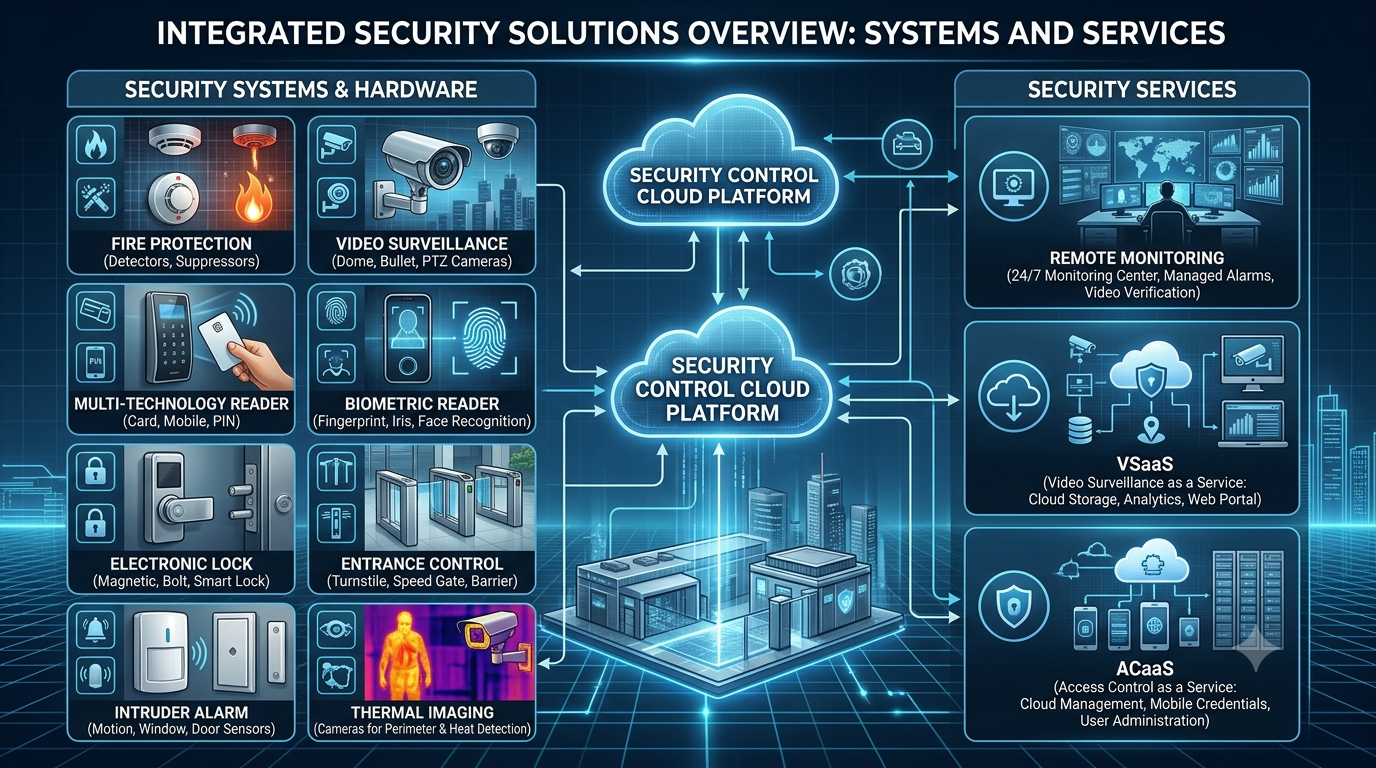
The Security Solutions Market Competitive Landscape is also shifting from competition based on individual products toward integrated platforms that combine surveillance, access control, intrusion detection, fire protection, remote monitoring, and analytics. Companies that can deliver reliable, scalable, and easy-to-integrate systems are well positioned to capture opportunities as security requirements become more complex.
Security Solutions Market Size and Growth Outlook
The expansion of the security solutions market is supported by the need to protect increasingly complex physical environments. Organizations are upgrading legacy security infrastructure to improve incident detection, manage access, reduce operational risks, and coordinate security operations across multiple locations.
The market is projected to grow from USD 370.15 billion in 2025 to USD 523.98 billion by 2030, at a CAGR of 7.2%. Increasing adoption of AI-enabled surveillance, biometric access control, connected sensors, cloud-based monitoring, and integrated security management platforms is contributing to this growth.
Security is becoming a strategic investment rather than simply an operational requirement. Commercial buildings, manufacturing facilities, transportation networks, healthcare institutions, educational campuses, and public infrastructure require systems that can identify potential threats and support timely responses. Meanwhile, residential users are adopting smart cameras, video doorbells, electronic locks, alarms, and app-based monitoring solutions.
These developments are influencing the Security Solutions Market Competitive Landscape by encouraging established companies to expand their technology portfolios and service capabilities. Vendors are increasingly expected to provide complete security ecosystems that combine hardware, software, installation, integration, maintenance, and monitoring.
Key Players in the Security Solutions Market
The market includes global technology providers, specialized security manufacturers, access control companies, surveillance equipment suppliers, and security service providers. Their competitive positions depend on product breadth, technological capabilities, geographic reach, customer relationships, and the ability to integrate multiple security functions.
Johnson Controls
Johnson Controls is a significant participant in the security solutions industry, with offerings spanning access control, video surveillance, intrusion detection, building management, and related technologies. Its portfolio enables customers to connect security functions with broader building operations.
The company’s competitive strategy emphasizes integrated building solutions and digital platforms. By connecting security technologies with building management systems, organizations can improve visibility across facilities and coordinate operational responses more efficiently.
In March 2026, Johnson Controls introduced a new generation of enterprise and commercial access-control and video-security solutions, including C•CURE IQ 3.2, C•CURE IQ VMS, C•CURE IQ Incident Management, exacqVision 26.0, and Kantech EntraPass 9.10. These offerings integrate access control, surveillance, incident management, AI-driven threat detection, and third-party integrations. The developments illustrate how established providers are strengthening their portfolios through connected security platforms.
Honeywell International Inc.
Honeywell International competes through security technologies used in commercial buildings, industrial facilities, and other environments that require integrated monitoring and protection. Its broader building and automation capabilities provide opportunities to connect security functions with building operations and other facility systems.
Product development and portfolio expansion are important elements of its competitive strategy. In June 2025, Honeywell announced its 50 Series CCTV product line, described as its first camera portfolio designed and manufactured locally. This development highlights the importance of regional product strategies and surveillance offerings tailored to specific customer requirements.
As demand for connected security systems increases, vendors such as Honeywell can pursue opportunities by combining surveillance equipment, access management, and monitoring capabilities within broader building-security ecosystems.
Download PDF Brochure @ https://www.marketsandmarkets.com/pdfdownloadNew.asp?id=701
Robert Bosch GmbH
Robert Bosch GmbH is another important participant in the Security Solutions Market Competitive Landscape. The company has established capabilities in security and building technologies, including video surveillance, access control, and integrated systems for commercial and institutional applications.
Bosch competes through technology development, system reliability, and integration capabilities. Customers operating complex facilities often require solutions that can connect with existing infrastructure while maintaining consistent performance across multiple locations.
As AI and analytics become more prominent, the ability to improve event detection, support efficient monitoring, and integrate security data with operational systems can help providers differentiate their offerings.
ADT Security Services
ADT Security Services is a recognized provider of security and monitoring services, particularly in residential and small-business markets. Its offerings address needs such as intrusion detection, alarm monitoring, video surveillance, and connected home security.
The company’s competitive position is supported by its service-oriented model and relationships with customers who require ongoing monitoring and support. Remote access, mobile alerts, connected devices, and smart home integration are increasingly important as consumers seek more convenient ways to manage home security.
For service providers, recurring monitoring revenue and customer retention can be as important as the sale of security hardware. The development of flexible packages and connected services therefore represents a key competitive opportunity.
Hangzhou Hikvision Digital Technology Co., Ltd.
Hangzhou Hikvision Digital Technology is a major supplier of video surveillance and security technologies. Its product portfolio includes cameras and related systems for residential, commercial, industrial, and public-sector applications.
The company is investing in intelligent surveillance capabilities that can improve threat detection and reduce unnecessary alerts. In July 2025, Hikvision announced its DeepinView X-Series Bullet Cameras, powered by its Guanlan AI models. The products were designed to enhance perimeter protection by extending video content analysis capabilities and reducing false or redundant alarms.
This type of product development illustrates the growing role of AI in the Security Solutions Market Competitive Landscape. Vendors are competing not only on image quality and hardware specifications but also on analytics, detection accuracy, and the ability to convert video footage into actionable information.
Other important companies in the market include ASSA ABLOY, Secom, Dahua Technology, Siemens, and Axis Communications. These participants contribute to competition across access control, surveillance, security services, and integrated building protection.
Strategic Developments Shaping the Competitive Landscape
Companies in the security solutions market use product launches, partnerships, acquisitions, platform development, and regional expansion to strengthen their positions. These strategies allow them to respond to changing customer requirements and compete in an industry increasingly influenced by software and connected services.
Product Innovation and Portfolio Expansion
Product innovation remains an important competitive strategy. Companies are developing security cameras, biometric readers, electronic locks, intrusion detection systems, and integrated platforms that provide improved functionality and operational flexibility.
The introduction of AI-enabled surveillance products demonstrates the industry’s shift toward intelligent security. Rather than relying solely on continuous human monitoring, modern systems can analyze video streams, detect unusual activity, and prioritize events that require attention.
Johnson Controls’ enterprise security portfolio developments and Hikvision’s AI-powered camera launches demonstrate how established companies are investing in enhanced analytics and integrated security operations. Honeywell’s CCTV portfolio expansion also reflects the importance of developing products for specific markets and customer needs.
For companies competing in the Security Solutions Market Competitive Landscape, successful product innovation requires a balance between performance, affordability, compatibility, cybersecurity, and ease of deployment.
Partnerships and Technology Integration
Partnerships help security providers combine complementary technologies and extend their market reach. A surveillance manufacturer, for example, may work with software developers, building automation providers, cloud service companies, or system integrators to deliver a more comprehensive solution.
Integration is particularly important for customers managing multiple buildings or geographically dispersed facilities. They may need a single platform to coordinate video surveillance, visitor management, access permissions, alarm notifications, and incident reporting.
Providers that support open interfaces and compatibility with existing infrastructure can reduce deployment complexity for customers. Strategic collaborations can also help companies enter new verticals, expand distribution networks, and deliver specialized solutions without developing every capability internally.
Cloud-Based Security and Recurring Services
Cloud-based platforms and remote monitoring are changing how security systems are deployed and maintained. Instead of managing every component locally, organizations can use connected platforms to access alerts, review events, manage permissions, and monitor multiple sites remotely.
Video surveillance as a service (VSaaS) and access control as a service (ACaaS) provide subscription-based models that can reduce the need for large upfront investments in certain deployments. These models also create opportunities for vendors to develop long-term customer relationships through software updates, monitoring, maintenance, and support.
The expansion of recurring services can improve revenue visibility for providers while giving customers more flexible options. However, success depends on reliable connectivity, strong data protection, clear service-level commitments, and effective management of cybersecurity risks.
AI and Intelligent Analytics
AI is becoming a major area of differentiation in the Security Solutions Market Competitive Landscape. Intelligent analytics can support object detection, facial recognition where legally permitted, behavioral analysis, anomaly detection, and automated event classification.
These capabilities can help security teams process large volumes of video and sensor data more efficiently. In commercial buildings, AI-enabled systems can support perimeter monitoring and access management. In transportation and industrial environments, they can help identify unusual activity and improve situational awareness.
AI also creates opportunities for software-led differentiation. Providers can improve detection models, develop new analytics features, and integrate intelligence across several security products. Nevertheless, organizations must consider privacy requirements, bias, false alerts, data governance, and the need for human oversight.
Technology Trends Influencing Competition
Technology advancement is reshaping product development and competitive strategies throughout the security solutions industry.
AI-powered video surveillance: Intelligent cameras and video management platforms are increasingly designed to identify relevant events, filter unnecessary alerts, and support faster investigations.
Biometric access control: Fingerprint, facial, and other biometric technologies are being adopted where stronger identity verification is required. Adoption depends on security performance, privacy obligations, deployment costs, and user acceptance.
IoT-enabled security: Connected cameras, alarms, locks, sensors, and monitoring devices allow security components to exchange information. This can improve visibility and support more coordinated responses.
Cloud and remote monitoring: Cloud-enabled platforms help organizations manage security systems across multiple locations and provide remote access to alerts and system status.
Integrated security management: Customers increasingly prefer platforms that connect video surveillance, access control, fire protection, intrusion detection, and incident management rather than managing disconnected systems.
Cybersecurity and data protection: As security systems become more connected, protecting devices, user credentials, stored video, and communication channels becomes increasingly important. Vendors must account for secure updates, access permissions, encryption, and system resilience.
These trends encourage companies to compete through complete solutions rather than isolated hardware. They also create opportunities for specialized vendors that can deliver differentiated analytics, interoperable software, or security capabilities tailored to particular industries.
Market Segmentation and Competitive Opportunities
The security solutions market encompasses multiple system types, service models, and end-use verticals. Each segment presents distinct competitive requirements.
By System
The system category includes fire protection systems, video surveillance systems, access control systems, entrance control systems, intruder alarm systems, and thermal imaging systems. The market also includes products such as biometric readers, multi-technology readers, and electronic locks.
Video surveillance is an important area of innovation because of increasing demand for real-time monitoring, evidence collection, perimeter protection, and intelligent analytics. Providers are differentiating their offerings through AI capabilities, improved detection performance, and integration with broader security platforms.
Access control is also evolving as organizations adopt electronic credentials, biometric readers, mobile access, and centralized permission management. Companies that can integrate these technologies with visitor management and surveillance systems may be better positioned to address complex customer requirements.
By Service
Services include fire protection services, video surveillance services, access control services, security system integration, remote monitoring, VSaaS, and ACaaS.
System integration is important for customers that operate multiple security technologies and need them to work together. Remote monitoring and cloud-based service models create opportunities for recurring revenue, while installation and maintenance services help vendors build long-term customer relationships.
The ability to provide reliable technical support and integrate equipment from different vendors can be a competitive advantage, especially for large commercial and institutional customers.
By Vertical
Security solutions are used across residential, commercial, government, transportation, retail, banking and finance, education, industrial, energy and utilities, sports and leisure, healthcare, and military and defense environments.
Residential customers are adopting connected cameras, smart locks, alarm systems, and mobile monitoring tools to protect homes and improve convenience. Commercial customers need scalable security solutions for offices, retail facilities, hospitality properties, and large campuses.
Government and critical infrastructure applications place particular emphasis on reliability, perimeter protection, access restrictions, and operational continuity. Industrial facilities may require specialized solutions that protect personnel, equipment, and restricted areas.
The diversity of these applications encourages vendors to develop industry-specific offerings and build partnerships with integrators that understand local requirements.
Regional Outlook and Competitive Positioning
North America held the largest share of the security solutions market in 2025, supported by established security infrastructure, adoption of advanced technologies, and demand from commercial, government, and residential users. The region’s market is projected to grow from USD 142.9 billion in 2025 to USD 199.7 billion by 2030, at a CAGR of 6.9%.
Asia Pacific is expected to be the fastest-growing region, driven by urbanization, infrastructure development, smart city initiatives, expanding commercial facilities, and greater adoption of connected security technologies. Opportunities are emerging across residential buildings, transportation systems, industrial facilities, and public infrastructure.
Europe also represents an important market, with demand influenced by infrastructure modernization, security requirements, building technologies, and regulatory considerations. Meanwhile, the Middle East, Africa, and Latin America offer opportunities linked to infrastructure projects, commercial development, and the modernization of security systems.
Regional competition depends on more than technology. Companies must also consider local regulations, customer budgets, installation capabilities, service networks, data protection requirements, and the availability of qualified system integrators.
Challenges in the Security Solutions Market Competitive Landscape
Despite favorable growth prospects, companies face several challenges. One of the most significant is the complexity of integrating modern systems with legacy infrastructure. Customers may operate equipment from multiple vendors, use different software platforms, and have inconsistent data standards. Integrating these systems can increase costs and extend implementation timelines.
Cybersecurity and privacy are also major considerations. Connected cameras, access control devices, and cloud platforms may expose sensitive information if they are not properly secured. Vendors must continually strengthen device security, software updates, identity management, and data protection practices.
Cost remains another barrier, particularly for small businesses and residential customers. Advanced systems may require investment in hardware, connectivity, installation, subscriptions, and maintenance. Companies that offer modular products, flexible pricing, and easier deployment may be able to address a broader customer base.
Finally, security providers must manage the risk of false alarms, evolving threats, technology obsolescence, and shortages of skilled installation and integration professionals. Companies that can address these challenges while maintaining reliability and customer trust may strengthen their competitive positions.
Future Opportunities and Strategic Priorities
The outlook for the Security Solutions Market Competitive Landscape remains positive as organizations move toward proactive, connected, and intelligence-driven protection. Several opportunities are likely to influence future strategies.
First, AI-enabled surveillance and analytics can help providers differentiate their products by improving event detection and operational efficiency. Second, cloud-based monitoring and subscription services offer opportunities to expand recurring revenue. Third, integration with smart buildings and IoT infrastructure can help security companies address customers seeking centralized management of facilities.
Emerging markets also provide opportunities as cities, commercial buildings, industrial facilities, and residential communities invest in modern security infrastructure. Providers that combine scalable technologies with local distribution, installation, and after-sales support may be well positioned to expand in these regions.
Strategic priorities will include improving interoperability, strengthening cybersecurity, developing privacy-conscious AI capabilities, and simplifying system deployment. Partnerships between hardware manufacturers, software developers, cloud providers, and system integrators may become increasingly important as customers seek comprehensive solutions.
For established companies, continued innovation and portfolio integration can help defend market positions. For emerging providers, specialized analytics, cost-effective solutions, and flexible service models may offer routes to differentiation.
Conclusion
The Security Solutions Market Competitive Landscape: Key Players and Strategic Developments reflects an industry transitioning from standalone security products toward intelligent, connected, and integrated protection systems. Johnson Controls, Honeywell International, Robert Bosch, ADT Security Services, and Hangzhou Hikvision Digital Technology are among the key participants competing through product development, technology integration, and service expansion.
The market is projected to increase from USD 370.15 billion in 2025 to USD 523.98 billion by 2030, at a CAGR of 7.2%. AI-powered surveillance, biometric access control, cloud-based monitoring, IoT connectivity, and integrated security management are expected to remain important areas of innovation.
As competition intensifies, companies that combine reliable hardware, intelligent software, effective integration, strong cybersecurity, and responsive customer support will be better positioned to address evolving security requirements. Strategic partnerships, recurring service models, and regional expansion will also shape future competition. The ability to deliver secure, scalable, and interoperable solutions will be central to long-term growth in the security solutions industry.
Frequently Asked Questions (FAQs)
1. What is the projected size of the security solutions market?
The global security solutions market is projected to grow from USD 370.15 billion in 2025 to USD 523.98 billion by 2030, at a CAGR of 7.2%.
2. Who are the key players in the Security Solutions Market Competitive Landscape?
Major players include Johnson Controls, Honeywell International, Robert Bosch, ADT Security Services, and Hangzhou Hikvision Digital Technology. Other participants include ASSA ABLOY, Secom, Dahua Technology, Siemens, and Axis Communications.
3. What strategic developments are shaping the security solutions market?
Important developments include AI-enabled product launches, integrated security platforms, technology partnerships, cloud-based monitoring, access control innovations, and expansion of recurring security services.
4. How is AI transforming the security solutions market?
AI supports intelligent video analytics, automated event detection, anomaly identification, and more efficient monitoring. These capabilities can help security teams prioritize incidents and improve situational awareness, although privacy and accuracy remain important considerations.
5. What are the major growth opportunities in the security solutions market?
Key opportunities include AI-powered video surveillance, biometric access control, cloud-based monitoring, security system integration, smart building technologies, IoT-enabled devices, and infrastructure modernization in rapidly developing regions.
About MarketsandMarkets™
MarketsandMarkets™ has been recognized as one of America’s Best Management Consulting Firms by Forbes, as per their recent report.
MarketsandMarkets™ is a blue ocean alternative in growth consulting and program management, leveraging a man-machine offering to drive supernormal growth for progressive organizations in the B2B space. With the widest lens on emerging technologies, we are proficient in co-creating supernormal growth for clients across the globe.
Today, 80% of Fortune 2000 companies rely on MarketsandMarkets, and 90 of the top 100 companies in each sector trust us to accelerate their revenue growth. With a global clientele of over 13,000 organizations, we help businesses thrive in a disruptive ecosystem.
The B2B economy is witnessing the emergence of $25 trillion in new revenue streams that are replacing existing ones within this decade. We work with clients on growth programs, helping them monetize this $25 trillion opportunity through our service lines – TAM Expansion, Go-to-Market (GTM) Strategy to Execution, Market Share Gain, Account Enablement, and Thought Leadership Marketing.
Built on the ‘GIVE Growth’ principle, we collaborate with several Forbes Global 2000 B2B companies to keep them future-ready. Our insights and strategies are powered by industry experts, cutting-edge AI, and our Market Intelligence Cloud, KnowledgeStore™, which integrates research and provides ecosystem-wide visibility into revenue shifts.
To find out more, visit www.MarketsandMarkets™.com or follow us on Twitter , LinkedIn and Facebook .
Contact:
Mr. Rohan Salgarkar
MarketsandMarkets™ INC.
1615 South Congress Ave.
Suite 103, Delray Beach, FL 33445
USA: +1-888-600-6441
