The US Humanoid Robot Market Analysis highlights the growing role of artificial intelligence (AI), advanced robotics, and intelligent automation in transforming industries across the United States. Humanoid robots are designed to replicate aspects of human movement, interaction, and task execution, allowing them to operate in environments originally built for people. With improvements in machine learning, computer vision, motion control, and sensor technologies, these robots are progressing from experimental platforms toward practical applications in manufacturing, logistics, healthcare, retail, and personal assistance.
According to MarketsandMarkets, the US humanoid robot market is projected to grow from USD 857.9 million in 2025 to USD 4,601.0 million by 2030, registering a compound annual growth rate (CAGR) of 39.9% from 2025 to 2030.
The US Humanoid Robot Market Analysis also reflects a broader transition toward physical AI, in which intelligent software interacts with the physical world through robotic systems. As developers improve robot mobility, dexterity, perception, and decision-making, the market is creating opportunities for technology companies, component suppliers, robotics startups, and industrial end users.
US Humanoid Robot Market Growth and Key Drivers
Increasing Adoption of AI-Powered Robotics
Artificial intelligence is one of the most important technologies shaping the US Humanoid Robot Market Analysis. AI enables humanoid robots to interpret sensor data, recognize objects, understand instructions, navigate environments, and adapt to changing situations. Unlike traditional industrial robots programmed for narrowly defined tasks, AI-enabled humanoid robots aim to perform a wider variety of activities with less task-specific programming.
Machine learning helps robots improve task execution using training data and operational feedback. Computer vision enables object detection and spatial awareness, while advanced control algorithms help coordinate balance, movement, and manipulation. The integration of generative AI and large-scale models is also creating opportunities for more natural human-robot interaction.
These capabilities are particularly relevant in environments where tasks vary frequently, including warehouses, healthcare facilities, retail settings, and manufacturing operations. Continued advances in AI models and robotics hardware are expected to support the commercialization of humanoid robots in the US.
Labor Challenges and Demand for Automation
Labor availability, repetitive work, and workplace safety concerns are encouraging organizations to explore additional automation solutions. Humanoid robots offer the potential to perform certain physical tasks in environments designed for human workers without requiring extensive changes to existing infrastructure.
In manufacturing, these robots may support material handling, component movement, inspection, and repetitive assembly activities. In logistics, they can be developed for picking, transporting items, sorting, and warehouse support. Their practical value depends on reliability, cycle time, payload, operating costs, and the ability to work safely around people.
The US Humanoid Robot Market Analysis therefore needs to consider not only technological capabilities but also measurable business outcomes. Organizations are more likely to expand deployment when robots demonstrate consistent performance, reduce operational bottlenecks, and provide an attractive total cost of ownership.
Download PDF Brochure @ https://www.marketsandmarkets.com/pdfdownloadNew.asp?id=40542925
Growth in Healthcare and Personal Assistance
Healthcare and personal assistance represent important potential application areas for humanoid robots in the United States. An aging population and increasing demand for support services are encouraging research into robotic assistance for daily activities, patient engagement, mobility support, and selected repetitive tasks.
Humanoid robots may also support reception, information delivery, and service functions in healthcare facilities. However, applications involving direct patient care require careful evaluation of safety, reliability, privacy, and regulatory considerations. Robots are more likely to complement human caregivers than replace the judgment and interpersonal skills required for complex care.
In personal assistance, natural-language interaction and improved environmental awareness could make robots more useful for household support and everyday activities. Commercial adoption will depend on affordability, ease of use, dependable performance, and clear value for users.
Technology Advancements Transforming the Market
AI, Machine Learning, and Physical AI
Physical AI combines intelligent software with robotic hardware to enable machines to perceive, reason about, and act within real-world environments. For humanoid robots, this approach can improve task planning, object recognition, navigation, and adaptation to unfamiliar situations.
Developers are working to connect vision-language models, learned motor skills, and real-time control systems. These technologies can help robots interpret natural-language commands and translate them into physical actions. However, executing tasks safely in unpredictable environments remains technically challenging.
The US Humanoid Robot Market Analysis increasingly involves evaluating how well a complete robotic system integrates AI models, onboard computing, sensors, actuators, and control software. Success will depend on dependable real-world performance rather than demonstrations alone.
Advanced Sensors and Machine Vision
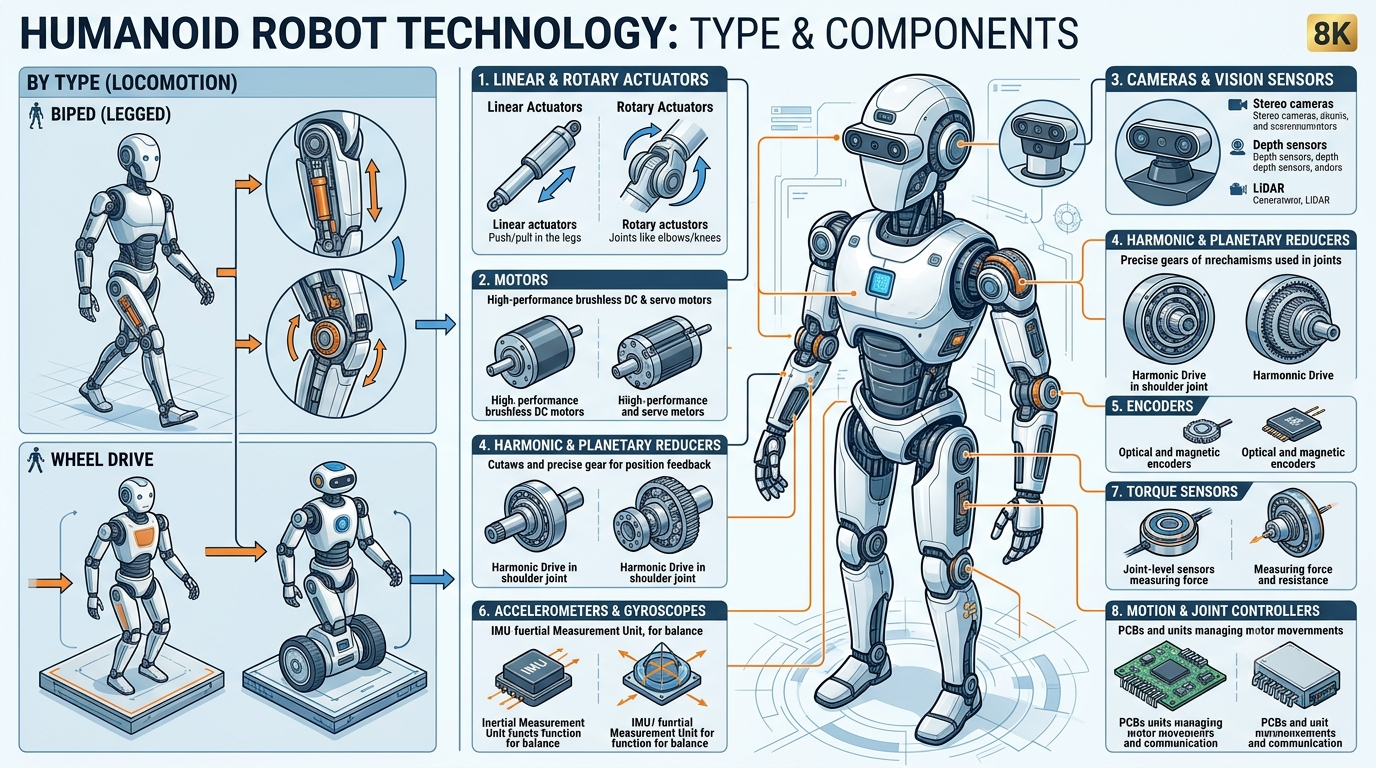
Sensors provide the information humanoid robots need to maintain balance, identify objects, estimate distances, and interact with their surroundings. Important technologies include cameras and vision sensors, gyroscopes, accelerometers, position sensors, tilt sensors, and torque sensors.
Computer vision helps robots interpret scenes and identify objects, while inertial sensors support posture estimation and balance control. Torque and position sensors enable more precise movement and can help robots detect resistance during physical interaction.
Sensor fusion combines data from multiple sources to produce a more complete understanding of the environment. Improvements in sensor accuracy, processing speed, and integration can help robots operate more reliably in warehouses, factories, and service environments.
Actuators, Motors, and Motion Control
Actuators and motors are essential for translating software commands into physical movement. Humanoid robots require coordinated control of their legs, arms, hands, and joints to walk, maintain balance, manipulate objects, and respond to external forces.
Electrical actuators are attractive for many designs because they support precise control and integration with electronic systems. Pneumatic and hydraulic technologies may also be relevant for specific force and motion requirements. The selection depends on payload, speed, efficiency, noise, complexity, and maintenance needs.
Advanced motion and joint controllers coordinate multiple components in real time. Harmonic and planetary reducers can help deliver the torque and precision required for robotic joints. As manufacturers improve these components, humanoid robots may become more capable, energy-efficient, and suitable for sustained commercial use.
Battery Efficiency and Onboard Computing
Battery performance and computing architecture strongly influence robot operating time, mobility, and responsiveness. Humanoid robots must power motors, sensors, communications, and onboard processors while managing heat and weight.
Efficient processors and optimized AI inference can reduce energy consumption and improve response times. Battery improvements, intelligent power management, and more efficient actuator designs can extend operating periods and reduce charging interruptions.
Some systems may use a combination of onboard computing and remote processing. Onboard systems support time-sensitive control, while cloud or edge infrastructure can provide additional computing resources for selected tasks. Reliable operation still requires robots to handle safety-critical functions locally when connectivity is unavailable or delayed.
Market Segmentation and Application Opportunities
Biped Robots and Wheel-Drive Robots
Robot mobility is a major consideration in the US Humanoid Robot Market Analysis. Biped robots use two legs to move through environments designed for humans, including stairs, corridors, and uneven surfaces. Their human-like mobility can offer advantages in settings where conventional wheeled robots face physical obstacles.
However, biped robots face engineering challenges involving balance, energy consumption, fall prevention, and dynamic movement. These factors can increase design complexity and maintenance requirements.
Wheel-drive humanoid robots offer an alternative for environments where floors are relatively smooth and predictable. Wheels can improve mobility efficiency and simplify navigation in certain warehouses, hospitals, and commercial facilities. The choice between biped and wheel-drive designs depends on the operating environment, task requirements, and total system cost.
Hardware and Software Development
Hardware is a core part of humanoid robot development because it includes the physical systems required for movement, perception, and interaction. Major components include actuators, motors, sensors, controllers, power systems, and computing units
Software is equally important for coordinating these components. Robotics software supports perception, navigation, task planning, motion control, and human-machine interaction. AI models can improve adaptability, while simulation software enables developers to test behaviors before deploying them in real environments.
The integration of hardware and software is a significant competitive factor. Companies that optimize the entire robotic system may be better positioned to improve reliability, simplify deployment, and reduce operating costs.
Manufacturing, Logistics, and Industrial Operations
Manufacturing and logistics offer potential early deployment opportunities because these environments contain repeatable physical tasks and measurable productivity targets. Humanoid robots could assist with material movement, machine tending, packaging, inspection, and selected warehouse activities.
Their ability to use human-oriented workspaces may reduce the need to redesign facilities around specialized automation. Nevertheless, traditional industrial robots and autonomous mobile robots remain effective in many structured tasks. Humanoid systems must demonstrate comparable or superior performance where flexibility justifies their additional complexity.
In the US Humanoid Robot Market Analysis, the business case for industrial deployment will depend on uptime, task completion rates, safety, integration costs, and the number of tasks a robot can perform without extensive reprogramming.
Potential applications include reminders, household assistance, basic item retrieval, and social engagement. These applications require reliable speech recognition, safe movement, privacy safeguards, and straightforward user interfaces.
Commercial adoption will depend on whether robots can provide consistent benefits at a price that individuals, care providers, or institutions can justify. Safety standards, accessibility, and public acceptance will also influence deployment.
Competitive Landscape of the US Humanoid Robot Market
The competitive landscape includes established robotics developers, technology companies, automotive manufacturers, and emerging startups. Participants are competing across robot design, AI capabilities, component engineering, software development, and commercialization strategies.
Agility Robotics
Agility Robotics is a US-based robotics company focused on humanoid robots for practical work environments. Its Digit robot is designed for mobility and material-handling applications, making logistics and industrial operations relevant areas of interest. The company’s competitive position depends on the ability to demonstrate reliable performance, integrate with customer workflows, and scale deployment.
Boston Dynamics
Boston Dynamics is known for its work in dynamic robot mobility, balance, and control. Its robotics expertise provides a foundation for developing systems capable of navigating complex physical environments. Continued advances in mobility, manipulation, and autonomous behavior are relevant to the broader development of humanoid robots.
Tesla
Tesla is developing its Optimus humanoid robot program, drawing on capabilities in AI, manufacturing, electronics, and battery technology. The company’s manufacturing experience could support efforts to scale production if the robot reaches suitable levels of reliability, affordability, and task performance. Commercial adoption will depend on demonstrated capabilities and successful integration into practical workflows.
UBTECH Robotics and Other Participants
UBTECH Robotics, headquartered in China, participates in the wider humanoid robotics landscape and is included among the companies identified in the US market report. Its presence reflects the international nature of competition in humanoid robot development.
Other companies, including Samsung, SoftBank Robotics, PAL Robotics, and Honda, contribute to the broader ecosystem through robotics research, hardware development, AI integration, and potential service applications. Competitive positions may change as companies introduce new products, establish partnerships, and expand deployment.
Competitive Strategies and Differentiation
Companies are using several strategies to strengthen their positions:
- Technology development: Improving AI, perception, manipulation, balance, and motion control.
- Strategic partnerships: Collaborating with component suppliers, software developers, and enterprise customers.
- Pilot deployments: Testing robots in manufacturing, logistics, and service environments to demonstrate practical value.
- Manufacturing scale-up: Working to reduce component costs and improve production consistency.
- Application specialization: Focusing on use cases where humanoid mobility and flexibility can provide measurable benefits.
Over time, the market is likely to reward companies that combine advanced technology with dependable operation, effective service support, and a clear economic case for customers.
Challenges Affecting Market Expansion
Despite strong growth potential, the US Humanoid Robot Market Analysis must account for several barriers to widespread adoption.
High development and deployment costs remain a major challenge. Humanoid robots require sophisticated actuators, sensors, computing systems, batteries, and control software. Manufacturing these components at scale while maintaining reliability can be difficult. Companies must lower total ownership costs to compete with conventional automation solutions.
Technical reliability and safety are also critical. Robots operating around people must maintain balance, recognize obstacles, handle unexpected situations, and avoid causing injury. Performance in controlled demonstrations does not necessarily translate into reliable operation across different facilities and real-world conditions.
Limited general-purpose capability presents another challenge. A robot that performs one task successfully may require additional training or software development to handle a different task. Collecting real-world training data, validating new behaviors, and maintaining consistent performance can increase deployment time.
Finally, workforce acceptance, cybersecurity, privacy, and integration with existing systems can affect customer decisions. Manufacturers must demonstrate that humanoid robots can work safely alongside employees and provide measurable operational benefits.
Future Outlook for the US Humanoid Robot Market
The US Humanoid Robot Market Analysis points toward continued growth as AI, robotics hardware, and advanced computing become more closely integrated. With the market projected to reach USD 4.60 billion by 2030, the United States is positioned to remain an important center for humanoid robotics innovation and commercialization.
Several developments are likely to shape the market’s next phase:
- Physical AI: More capable AI systems will help robots understand instructions, recognize objects, and adapt to changing environments.
- Improved manipulation: Advances in robotic hands, tactile sensing, and motion control will expand the range of tasks robots can perform.
- Industrial deployment: Manufacturing and logistics will remain important testing grounds for measuring productivity and operational value.
- Lower component costs: Improvements in actuator design, electronics, and manufacturing processes may support more affordable systems.
- Human-robot collaboration: Better perception and safety controls could enable robots to work more effectively alongside people.
- Commercial service applications: Personal assistance, caregiving support, and other service uses may expand as reliability and affordability improve.
Companies that establish strong component supply chains, develop scalable AI systems, and validate real-world applications will be better positioned to compete. The pace of adoption will depend on how quickly these developments translate into reliable performance and attractive economics.
Conclusion
The US Humanoid Robot Market Analysis: Technology Advancements and Competitive Landscape demonstrates how AI, sensors, actuators, and intelligent motion control are advancing the next generation of robotics. Growth opportunities are emerging across manufacturing, logistics, personal assistance, and caregiving as organizations investigate more flexible automation solutions.
The market’s projected growth from USD 857.9 million in 2025 to USD 4,601.0 million by 2030 reflects rising interest in humanoid robots and their potential applications. However, successful commercialization will depend on reliability, safety, cost reduction, and the ability to deliver measurable value in real operating environments.
As technology advances, competition will increasingly focus on complete robotic systems rather than individual hardware or software innovations. Companies that combine strong engineering, effective AI integration, scalable production, and customer-focused deployment strategies will be well positioned to participate in the evolving US humanoid robotics industry.
Frequently Asked Questions
1. What is the projected size of the US humanoid robot market?
The US humanoid robot market is projected to grow from USD 857.9 million in 2025 to USD 4,601.0 million by 2030, at a CAGR of 39.9%.
2. What are the major factors driving the US humanoid robot market?
Key drivers include advances in AI and machine learning, growing demand for automation, labor challenges, improvements in robotic mobility, and expanding applications in manufacturing, logistics, healthcare, and personal assistance.
3. Which technologies are shaping the US humanoid robot market?
Important technologies include AI, computer vision, sensor fusion, advanced actuators, motion and joint controllers, machine learning, and energy-efficient onboard computing.
4. Who are the key players in the US humanoid robot market?
Key participants identified by MarketsandMarkets include Agility Robotics, Boston Dynamics, Tesla, Samsung, UBTECH Robotics, PAL Robotics, and Honda Motor Co.
5. What challenges could limit humanoid robot adoption in the United States?
High costs, technical reliability, safety requirements, limited task generalization, workforce acceptance, and integration challenges could affect the pace of commercialization.
About MarketsandMarkets™
MarketsandMarkets™ has been recognized as one of America’s Best Management Consulting Firms by Forbes, as per their recent report.
MarketsandMarkets™ is a blue ocean alternative in growth consulting and program management, leveraging a man-machine offering to drive supernormal growth for progressive organizations in the B2B space. With the widest lens on emerging technologies, we are proficient in co-creating supernormal growth for clients across the globe.
Today, 80% of Fortune 2000 companies rely on MarketsandMarkets, and 90 of the top 100 companies in each sector trust us to accelerate their revenue growth. With a global clientele of over 13,000 organizations, we help businesses thrive in a disruptive ecosystem.
The B2B economy is witnessing the emergence of $25 trillion in new revenue streams that are replacing existing ones within this decade. We work with clients on growth programs, helping them monetize this $25 trillion opportunity through our service lines – TAM Expansion, Go-to-Market (GTM) Strategy to Execution, Market Share Gain, Account Enablement, and Thought Leadership Marketing.
Built on the ‘GIVE Growth’ principle, we collaborate with several Forbes Global 2000 B2B companies to keep them future-ready. Our insights and strategies are powered by industry experts, cutting-edge AI, and our Market Intelligence Cloud, KnowledgeStore™, which integrates research and provides ecosystem-wide visibility into revenue shifts.
To find out more, visit www.MarketsandMarkets™.com or follow us on Twitter , LinkedIn and Facebook .
Contact:
Mr. Rohan Salgarkar
MarketsandMarkets™ INC.
1615 South Congress Ave.
Suite 103, Delray Beach, FL 33445
USA: +1-888-600-6441

