The Exoskeleton Technology Market Competitive Landscape is evolving as robotics, artificial intelligence (AI), advanced sensors, and wearable technologies create new opportunities across healthcare, manufacturing, construction, and defense. Exoskeletons are wearable robotic systems designed to support or restore human movement, reduce physical strain, and improve strength, endurance, and mobility. As organizations seek solutions for rehabilitation, worker safety, and physical assistance, manufacturers are investing in product innovation, strategic partnerships, and broader commercialization.
Competition in the exoskeleton industry is shaped by companies developing powered and passive systems for different body parts and applications. Medical exoskeletons focus on mobility assistance and rehabilitation, while industrial systems aim to reduce fatigue and musculoskeletal strain during physically demanding tasks. Defense applications emphasize endurance and load assistance. These varied requirements encourage companies to differentiate themselves through system design, comfort, control accuracy, reliability, and application-specific capabilities.
Exoskeleton Technology Market Competitive Landscape: Market Overview
The Exoskeleton Technology Market Competitive Landscape includes medical technology companies, robotics developers, industrial automation providers, and specialized wearable robotics manufacturers. These companies compete across product performance, clinical and workplace suitability, distribution networks, technology development, and customer support.
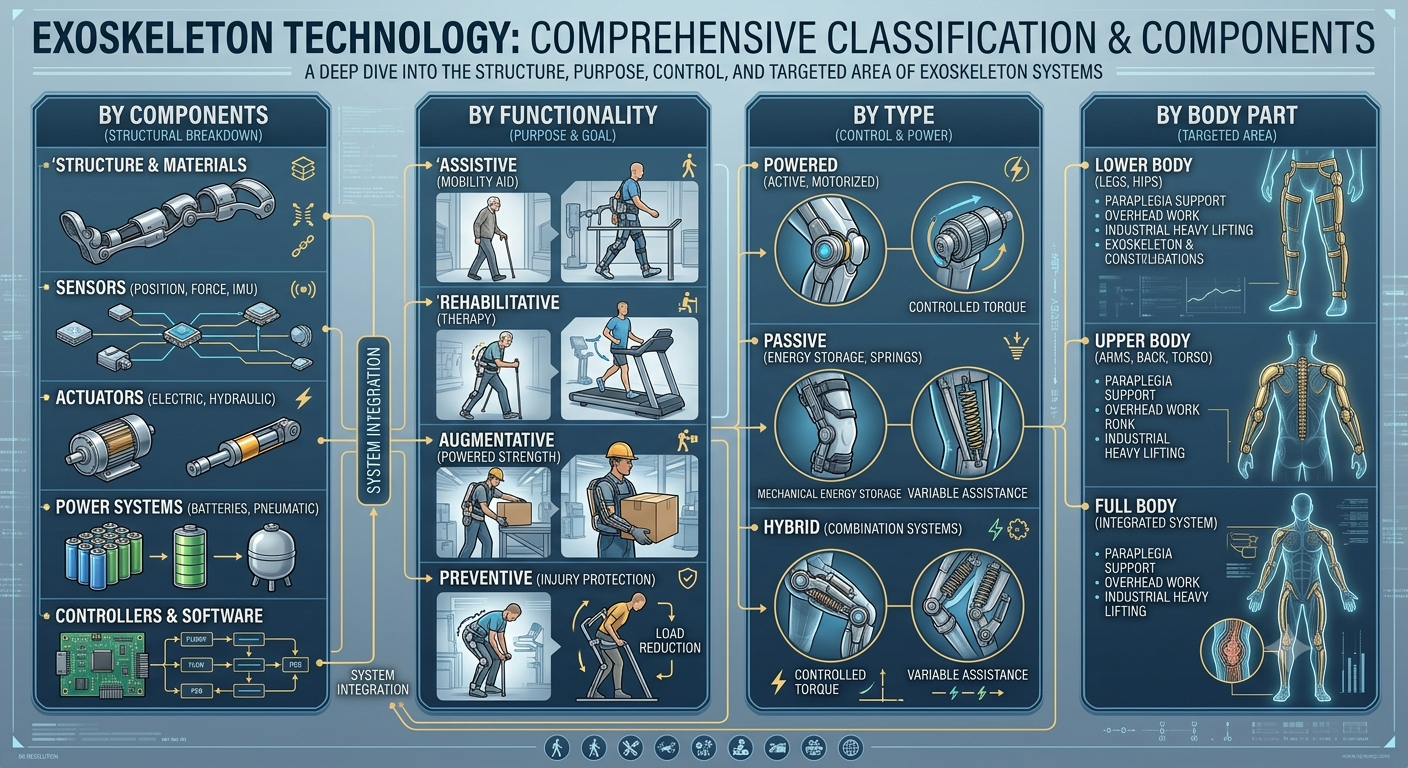
The market encompasses several product categories, including powered, passive, and hybrid exoskeletons. Powered systems use motors or other actuators to assist movement, while passive systems generally use mechanical structures and springs to redistribute loads or support posture without powered movement assistance. Hybrid designs combine different assistance mechanisms to address specific user requirements.
Components also play a central role in market differentiation. Sensors detect body position, movement, force, and user intent; actuators generate or assist movement; controllers coordinate system responses; and power systems provide the energy required for operation. Software increasingly connects these elements to deliver more responsive, personalized assistance.
Key Players in the Exoskeleton Technology Market
Several companies are helping shape the Exoskeleton Technology Market Competitive Landscape through product development, rehabilitation solutions, industrial applications, and international partnerships. Important participants identified by MarketsandMarkets include Ekso Bionics, Ottobock, DIH Medical, Comau, Myomo, CYBERDYNE, Lifeward, Hyundai Motor Group Robotics LAB, B-Temia, and other specialized developers.
Ekso Bionics
Ekso Bionics is known for wearable robotic systems designed to support mobility and rehabilitation. Its technologies are intended to help individuals with mobility impairments participate in structured rehabilitation and movement training. Clinical engagement and collaboration with rehabilitation providers are important approaches for expanding the use of medical exoskeletons.
A key competitive priority for medical exoskeleton suppliers is demonstrating that products can be incorporated into clinical workflows while meeting the needs of patients and therapists. Ease of use, training requirements, safety, and ongoing technical support can influence purchasing decisions alongside the capabilities of the hardware.
Ottobock
Ottobock is an established medical technology company with expertise in mobility and assistive solutions. Its presence in the exoskeleton industry benefits from its broader understanding of patient needs, rehabilitation environments, and mobility-related technologies.
For companies operating in medical exoskeletons, competitive differentiation depends on combining effective movement assistance with user comfort, fit, reliability, and practical clinical integration. Partnerships with healthcare institutions and the development of service capabilities can also support adoption.
DIH Medical
DIH Medical participates in the rehabilitation technology market with robotic and virtual reality-enabled solutions. Its competitive approach includes developing rehabilitation technologies and working with healthcare organizations to expand access to advanced therapy systems.
Download PDF Brochure @ https://www.marketsandmarkets.com/pdfdownloadNew.asp?id=40697797
Strategic Developments Shaping the Exoskeleton Technology Market
Strategic developments are central to the Exoskeleton Technology Market Competitive Landscape because companies must improve product performance while expanding their reach across healthcare and industrial markets. Partnerships, product launches, distribution agreements, and technology investments are helping suppliers address customer needs and develop commercially viable solutions.
Strategic Partnerships and Distribution Expansion
Partnerships with hospitals, rehabilitation centers, distributors, and industrial organizations allow exoskeleton manufacturers to demonstrate products in real-world settings. For medical applications, these relationships can support staff training, therapy integration, and access to potential customers. In industrial environments, partnerships help companies evaluate whether wearable systems fit specific tasks and workplace safety requirements.
Product Innovation and Application-Specific Designs
Product innovation is another major competitive strategy. Companies are developing devices for different body parts, including upper-limb, lower-limb, and full-body systems. They are also refining designs for particular activities, such as walking, rehabilitation exercises, overhead assembly, and repetitive lifting.
Application-specific development enables manufacturers to address practical user requirements instead of relying on generalized designs. For instance, a shoulder-support exoskeleton for industrial workers requires different performance characteristics from a powered lower-limb system intended for gait rehabilitation.
Manufacturers are therefore emphasizing adjustability, lightweight construction, ergonomic fit, ease of donning and removal, and compatibility with existing workflows. These improvements can help reduce adoption barriers and make exoskeletons more useful in everyday environments.
Research, Development, and Technology Integration
Investment in research and development supports advances in sensors, actuators, power systems, control algorithms, and wearable materials. Manufacturers are also exploring AI and Internet of Things (IoT) technologies to make devices more responsive and easier to monitor.
These investments can improve movement prediction, assistance levels, performance monitoring, and maintenance planning. However, successful commercialization requires more than technical advancement. Companies must demonstrate that innovations deliver measurable benefits for users and justify the total cost of ownership.
Expansion into Industrial and Healthcare Markets
Companies are pursuing growth across multiple sectors to diversify their revenue opportunities. Healthcare providers use exoskeletons for rehabilitation and mobility assistance, while industrial organizations evaluate them for ergonomic support and workplace injury prevention. Construction and defense applications create additional opportunities for specialized solutions.
A diversified application strategy can help companies reduce dependence on a single customer segment. Nevertheless, each market has different requirements for product validation, procurement, training, and ongoing support, making targeted commercialization strategies essential.
Technology Trends Influencing Competitive Positioning
Technology development is changing how companies compete in the Exoskeleton Technology Market Competitive Landscape. Systems must provide useful assistance while remaining comfortable, safe, and practical for extended use.
Artificial Intelligence and Adaptive Motion Control
AI-enabled control systems can use movement data and sensor inputs to adjust assistance to a user’s actions. More responsive control can support smoother transitions between movements and improve the coordination of wearable robotic components.
Over time, adaptive algorithms may help personalize assistance according to user ability, task requirements, and rehabilitation progress. However, these capabilities need appropriate validation, dependable operation, and safeguards against unexpected movement.
Advanced Sensors and Human-Machine Interaction
Sensors are essential for detecting posture, joint movement, force, and body position. Improvements in sensor accuracy and integration can help exoskeletons respond more effectively to user intent.
Sensor data can also support performance monitoring and system diagnostics. As sensor technology develops, manufacturers will need to balance measurement accuracy with comfort, durability, power consumption, and device cost.
Lightweight Materials and Ergonomic Design
The weight and fit of an exoskeleton can influence whether users accept it for daily activities. Heavy or restrictive designs may limit movement, increase fatigue, or interfere with work tasks.
Companies are therefore pursuing lighter structures, improved joint alignment, adjustable support mechanisms, and more natural movement. Ergonomic improvements are especially important for industrial applications, where workers may need to perform varied tasks throughout a shift.
Battery Efficiency and Actuator Performance
Powered exoskeletons depend on actuators and energy systems to generate movement assistance. Better power efficiency can help extend operating time, while improved actuation and control can support more precise movement.
Manufacturers must also manage heat, noise, durability, charging requirements, and maintenance. The ability to deliver reliable assistance without making the device excessively heavy or expensive remains an important area of competition.
Connected Devices and Data-Driven Monitoring
IoT connectivity can support remote monitoring, performance analysis, and maintenance planning. In healthcare settings, relevant data may help therapists review training sessions and track selected measures of progress. In industrial environments, monitoring can help organizations evaluate equipment utilization and identify maintenance needs.
Connected functionality also creates responsibilities around data privacy, cybersecurity, interoperability, and system reliability. Companies that address these requirements alongside product performance may be better positioned to serve larger institutions.
Market Segmentation and Areas of Competition
The Exoskeleton Technology Market Competitive Landscape varies by component, functionality, type, body part, mobility, and end-use vertical. Each segment presents different technical and commercial priorities.
By type: Powered, passive, and hybrid exoskeletons address different levels of assistance. Powered systems use active mechanisms to support movement, while passive devices provide mechanical support without powered assistance. Hybrid designs combine features to address particular needs.
By component: Sensors, actuators, power systems, controllers, and software contribute to overall device performance.
By body part: Lower-extremity systems support walking and gait training, while upper-extremity devices assist arm and shoulder movements. Full-body systems are designed for broader physical support and may serve specialized industrial or defense applications.
By mobility: Mobile exoskeletons allow users to move through real-world environments, whereas stationary systems are typically used in controlled settings. Mobile systems have broad relevance to rehabilitation, industrial work, and mobility assistance.
By vertical: Healthcare, industrial operations, construction, defense, and other applications each have distinct requirements. Healthcare emphasizes rehabilitation outcomes and patient suitability, while industrial buyers often prioritize worker comfort, task compatibility, productivity, and injury-risk reduction.
This segmentation encourages companies to focus on differentiated products and services. Manufacturers that understand the needs of specific users and procurement environments can develop more targeted commercialization strategies.
Regional Dynamics and Competitive Opportunities
Regional market conditions influence how exoskeleton companies approach manufacturing, partnerships, distribution, and commercialization. Markets differ in healthcare infrastructure, industrial automation levels, reimbursement arrangements, workplace safety priorities, and investment in robotics.
North America offers opportunities associated with rehabilitation technologies, industrial automation, and investment in advanced robotics. Partnerships with healthcare providers and industrial customers can help manufacturers validate products and expand adoption.
Asia Pacific presents opportunities linked to manufacturing capabilities, industrial development, and robotics innovation. Companies operating in the region can target workplace assistance and healthcare applications while exploring partnerships with local distributors and technology providers.
For global suppliers, regional expansion requires more than product availability. Companies must consider regulatory requirements, local service coverage, training, affordability, and the ability to meet the needs of different customer groups.
Challenges Facing Exoskeleton Market Participants
Despite strong projected growth, several challenges influence the Exoskeleton Technology Market Competitive Landscape.
High Initial Cost and Total Cost of Ownership
Exoskeletons can require significant investment in equipment, training, fitting, maintenance, and technical support. These expenses may limit adoption among smaller businesses, healthcare facilities with constrained budgets, and individual users.
Companies can address this barrier by improving manufacturing efficiency, offering suitable service models, and demonstrating the practical value of their products. Buyers also need to evaluate long-term costs rather than relying solely on the purchase price.
Comfort, Usability, and Worker Acceptance
Devices that restrict natural movement or are difficult to wear may face resistance from users. Poor fit, excessive weight, limited adjustability, and interference with routine tasks can reduce effectiveness in real-world environments.
Manufacturers must involve end users in product development and testing. Demonstrating that devices can be used safely and comfortably in the intended environment is important for sustained adoption.
Safety, Validation, and Regulatory Requirements
Medical exoskeletons may need to meet applicable medical-device requirements, while industrial systems must be evaluated for workplace safety and task suitability. Manufacturers need appropriate testing, documentation, user training, and maintenance procedures.
Clear evidence of performance and well-defined operating limits can help build confidence among healthcare professionals, employers, and end users.
Commercialization and Scalability
A technically advanced product may still struggle to achieve broad adoption if distribution, training, servicing, or manufacturing capacity is insufficient. Companies must build relationships with customers and ensure that support is available throughout the product lifecycle.
Scaling also requires balancing product customization with standardized manufacturing. The ability to serve different user needs without making products prohibitively expensive will remain important to long-term competitiveness.
Future Outlook: What Will Shape the Competitive Landscape?
The future of the Exoskeleton Technology Market Competitive Landscape will depend on how effectively companies translate technological advances into useful, affordable, and reliable products. AI-enabled controls, improved sensors, more efficient actuators, lightweight materials, and connected monitoring capabilities are likely to remain important areas of development.
Medical applications may benefit from continued advances in rehabilitation and mobility assistance, while industrial customers are likely to evaluate exoskeletons based on ergonomic benefits and suitability for specific tasks. Construction and defense applications may create further opportunities for systems designed to support physically demanding activities.
Competitive strategies are also likely to emphasize partnerships with hospitals, rehabilitation networks, manufacturers, distributors, and research institutions. Companies that combine product innovation with effective commercialization, user training, and after-sales service may strengthen their market positions.
However, long-term success will depend on evidence of real-world value. Lower costs, comfortable designs, dependable operation, and clearly demonstrated benefits will be essential for expanding adoption beyond specialized deployments.
The Exoskeleton Technology Market Competitive Landscape is becoming more dynamic as established medical technology companies, robotics specialists, and industrial automation providers pursue opportunities in wearable assistance. Ekso Bionics, Ottobock, DIH Medical, Comau, Myomo, CYBERDYNE, Lifeward, and other manufacturers contribute to a diverse ecosystem serving rehabilitation, mobility, and industrial needs.
Frequently Asked Questions
1. What is the outlook for the Exoskeleton Technology Market?
The global exoskeleton market is projected to grow from USD 0.56 billion in 2025 to USD 2.03 billion by 2030, at a CAGR of 29.4%, according to MarketsandMarkets. Growth is supported by applications in rehabilitation, mobility assistance, and industrial ergonomics.
2. Who are the key players in the Exoskeleton Technology Market Competitive Landscape?
Key companies include Ekso Bionics, Ottobock, DIH Medical, Comau, Myomo Inc., CYBERDYNE Inc., Lifeward Ltd., Hyundai Motor Group Robotics LAB, B-Temia, and other specialized exoskeleton developers.
3. What strategic developments are shaping the exoskeleton industry?
Important developments include product launches, partnerships with healthcare providers, regional distribution agreements, research and development investments, and integration of AI, advanced sensors, and improved motion-control technologies.
4. Which technologies are influencing exoskeleton market competition?
AI-enabled motion control, advanced sensors, improved actuators, lightweight materials, battery efficiency, and connected monitoring systems are important technologies influencing product development and competitive differentiation.
5. What are the major challenges facing exoskeleton manufacturers?
Major challenges include high initial costs, user comfort and acceptance, safety and validation requirements, maintenance expenses, and the need to establish effective distribution, training, and support networks.
