The magnetic current sensor market is gaining momentum as industries increasingly adopt electrification, renewable energy systems, electric vehicles (EVs), and industrial automation. Magnetic current sensors enable accurate, non-contact measurement of electrical current, helping equipment manufacturers improve safety, monitor power consumption, and optimize system performance. Their ability to provide electrical isolation while measuring alternating current (AC) and direct current (DC) makes them important components in modern power electronics.
According to MarketsandMarkets, the global magnetic current sensor market is projected to grow from USD 2.05 billion in 2026 to USD 4.20 billion by 2032, registering a compound annual growth rate (CAGR) of 12.7% from 2026 to 2032. Increasing demand for precise current measurement across automotive, industrial, consumer electronics, and energy and power applications is supporting this expansion
As electronic systems become more sophisticated, manufacturers are investing in sensors that offer greater accuracy, faster response times, smaller form factors, and improved energy efficiency. Innovations in Hall-effect sensing, magnetoresistive technologies, and closed-loop measurement are creating new opportunities for the magnetic current sensor market through 2032.
Magnetic Current Sensor Market Forecast and Growth Outlook
The magnetic current sensor market is expected to experience strong growth as current monitoring becomes increasingly important across electrified systems. These sensors detect the magnetic field generated by current flowing through a conductor, allowing measurement without requiring direct electrical contact with the conductor. This non-invasive approach can improve electrical isolation and simplify integration into equipment operating under demanding conditions.
One of the primary factors influencing the magnetic current sensor market forecast is the expanding use of power electronics. Electric vehicles, charging stations, battery energy storage systems, industrial motor drives, and renewable energy installations depend on reliable current measurement to manage power flows and protect sensitive components.
The automotive sector is particularly important because magnetic current sensors support battery management systems, traction inverters, onboard chargers, and electric motor control. Industrial manufacturers also use these sensors to monitor equipment performance, improve energy utilization, and support predictive maintenance.
The market’s projected expansion reflects a broader shift toward intelligent electrical systems. As power conversion becomes more complex and energy efficiency gains importance, demand for sensors that combine precision, reliability, and compact integration is expected to increase.
Key Drivers of the Magnetic Current Sensor Market
1. Growing Adoption of Electric Vehicles
The expansion of electric mobility is a major driver of the magnetic current sensor market. EVs contain multiple electrical subsystems that require continuous current monitoring, including battery packs, traction inverters, electric motors, and charging systems.
Magnetic current sensors help battery management systems monitor current flow during charging and discharging. Accurate measurements support battery protection, power management, and performance optimization. In traction inverters and motor-control systems, current feedback helps regulate torque delivery and improve operating efficiency.
The growing deployment of EV charging infrastructure also creates opportunities for sensors capable of measuring current reliably under changing loads. As automotive manufacturers pursue improved efficiency, safety, and electrification, magnetic current sensing is expected to remain an important enabling technology.
Download PDF Brochure @ https://www.marketsandmarkets.com/pdfdownloadNew.asp?id=187942507
2. Expansion of Renewable Energy and Energy Storage
Renewable energy installations rely on power conversion equipment to connect solar photovoltaic systems, wind energy systems, and battery storage to electrical networks. Magnetic current sensors help monitor current in inverters, converters, and energy management systems.
In solar installations, current measurement supports power conversion, system monitoring, and fault detection. Battery energy storage systems also require accurate sensing to manage charging and discharging cycles and maintain safe operating conditions.
The increasing integration of renewable energy into electricity networks is creating demand for reliable sensing technologies. Magnetic current sensors can contribute to improved monitoring and control as energy systems become more distributed and digitally managed.
3. Industrial Automation and Energy Efficiency
Industrial facilities increasingly use automated production lines, variable-speed drives, robotics, and connected equipment. These applications depend on accurate electrical measurements to maintain stable operation and identify potential equipment problems.
Magnetic current sensors support motor control, power supplies, industrial converters, and machine monitoring. When integrated with industrial control systems, sensor data can help operators identify abnormal current patterns, reduce unnecessary energy consumption, and support predictive maintenance programs.
The adoption of smart manufacturing and Industrial Internet of Things (IIoT) technologies is reinforcing the need for sensors that provide dependable measurements and can be integrated into connected monitoring systems.
4. Growing Demand for Compact and Reliable Electronics
Consumer electronics and embedded systems increasingly require compact components that deliver dependable performance with low power consumption. Magnetic current sensors can be integrated into power supplies, battery-powered devices, charging equipment, and electronic control circuits.
As electronic products become smaller and more multifunctional, sensor manufacturers are focusing on integration, packaging, and performance improvements. These developments can help reduce system complexity while supporting efficient power monitoring across a broader range of devices.
Emerging Technologies Shaping the Magnetic Current Sensor Market
Hall-Effect Current Sensors
Hall-effect technology is a major part of the magnetic current sensor market because it supports non-contact current measurement across a wide range of applications. These sensors detect magnetic fields generated by electrical current and convert them into electrical signals that monitoring and control systems can interpret.
According to MarketsandMarkets, Hall-effect current sensors are expected to account for 74.4% of the magnetic current sensor market in 2026. Their broad adoption is supported by reliability, cost-effectiveness, and suitability for automotive, industrial, consumer electronics, and energy applications.
Continued improvements in sensitivity, packaging, and signal conditioning are helping Hall-effect sensors address increasingly demanding power-monitoring requirements. They are expected to remain important in battery systems, motor drives, power supplies, and charging equipment.
Magnetoresistive Sensing Technologies
Magnetoresistive technologies are emerging as an important innovation area. These include anisotropic magnetoresistance (AMR), giant magnetoresistance (GMR), and tunnel magnetoresistance (TMR). They use changes in electrical resistance in response to magnetic fields to enable current measurement.
These technologies offer opportunities for high sensitivity, compact integration, and low-power operation. Their capabilities make them suitable for applications that require accurate measurement in space-constrained electronic systems.
MarketsandMarkets identifies XMR technologies, including AMR, GMR, and TMR, as a rapidly growing technology category. Their potential applications include EV battery systems, power conversion, motor control, renewable energy equipment, and industrial electronics.
As sensor designers improve magnetic materials, signal processing, and integration, magnetoresistive solutions could become increasingly attractive in applications where measurement precision and compact size are important.
Closed-Loop Current Sensing
Closed-loop magnetic current sensors are gaining attention because of their accuracy, linearity, and dynamic response. These sensors use feedback to compensate for the magnetic field generated by the measured current, helping produce a measurement signal that closely represents the current being monitored.
They are especially relevant in EV powertrains, industrial motor drives, renewable energy converters, and other power electronics systems where measurement errors can affect performance.
MarketsandMarkets projects the closed-loop segment to register a CAGR of 13.7% during 2026–2032. Demand for high-accuracy measurements, rapid response, and electrical isolation is expected to support adoption in demanding operating environments.
Magnetic Current Sensor Market Segmentation
The magnetic current sensor market can be examined by sensor type, loop type, and industry vertical. Each category addresses different requirements related to accuracy, cost, response time, and operating conditions.
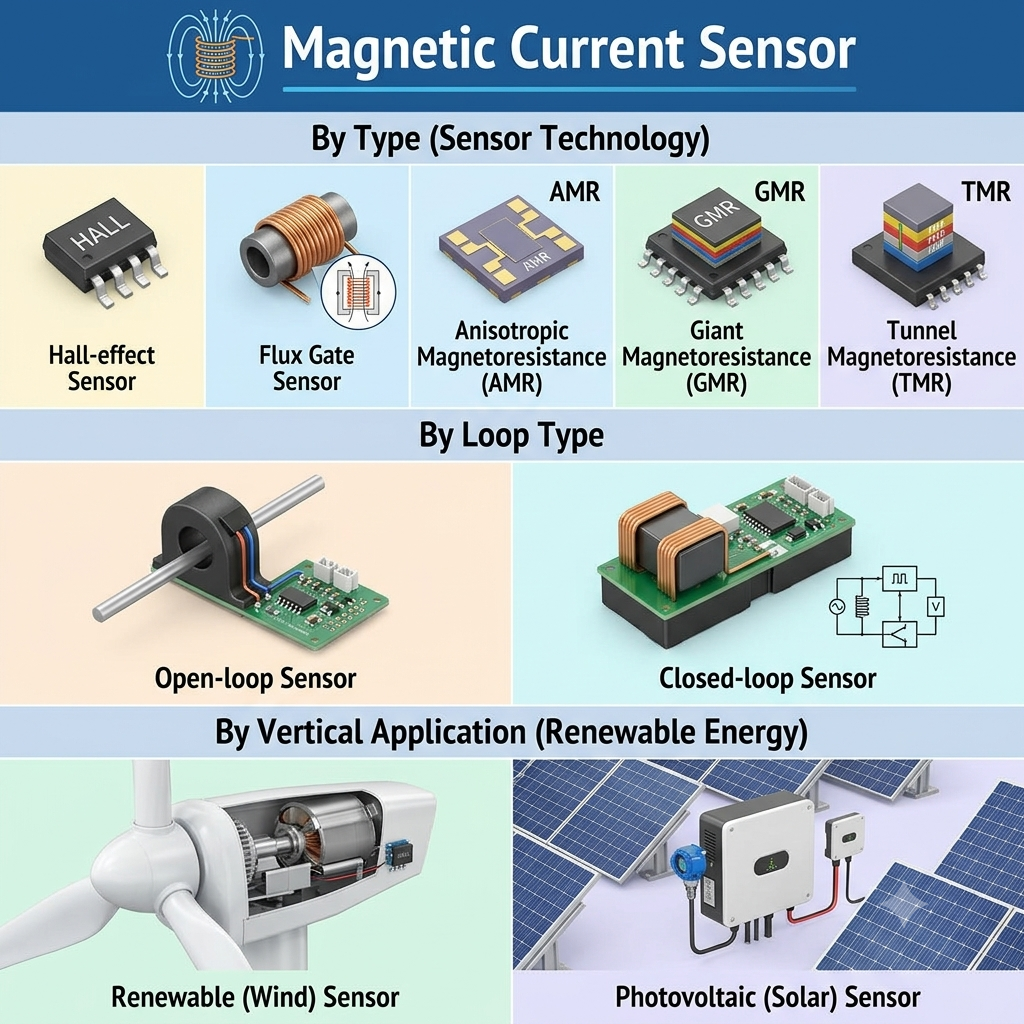
By type, the market includes Hall-effect, fluxgate, AMR, GMR, and TMR sensors. Hall-effect technology benefits from broad applicability and cost-effectiveness, while magnetoresistive technologies offer opportunities for higher sensitivity and compact designs.
By loop type, the market includes open-loop and closed-loop sensors. Open-loop designs can be attractive for applications requiring simpler, cost-effective measurement. Closed-loop designs are suited to applications that prioritize accuracy, linearity, and dynamic performance.
By vertical, automotive is an important application area, followed by industrial, consumer electronics, and energy and power applications. Renewable energy and photovoltaic systems also create opportunities as power generation and storage equipment become more widely deployed.
These segments illustrate how the magnetic current sensor market serves both high-volume electronics and performance-critical industrial applications. Manufacturers that align sensor architecture with specific customer requirements can address diverse opportunities across the value chain.
Regional Growth Prospects Through 2032
Asia Pacific
Asia Pacific is expected to be the fastest-growing region in the magnetic current sensor market, with a projected CAGR of 14.6% during 2026–2032. The region benefits from its automotive and electronics manufacturing base, growing EV adoption, renewable energy investments, and expansion of industrial automation.
China, India, Japan, and South Korea are important markets for automotive electrification, electronics production, and advanced power systems. These industries require current sensors for battery management, power conversion, motor control, and equipment monitoring.
Investments in semiconductor manufacturing and smart infrastructure are also supporting demand for advanced sensing components. As regional manufacturers expand production capabilities and adopt connected technologies, Asia Pacific is expected to provide significant growth opportunities.
North America
North America offers opportunities through EV development, data-driven industrial operations, renewable energy projects, and advanced electronics manufacturing. The deployment of battery storage, charging infrastructure, and automated production equipment increases the need for dependable current measurement.
Demand is also supported by efforts to improve power efficiency and equipment reliability. Sensor suppliers that provide high-performance products, strong technical support, and integration capabilities can benefit from these applications.
Europe
Europe represents an important market due to its automotive engineering base, industrial automation capabilities, and emphasis on energy efficiency. The transition toward electric mobility and the integration of renewable energy are creating demand for accurate current sensing across vehicles, charging systems, and power conversion equipment.
Industrial facilities also require current monitoring to improve energy utilization and equipment performance. These factors create opportunities for sensor manufacturers serving automotive suppliers, industrial equipment makers, and energy technology providers.
Competitive Landscape and Key Market Participants
Competition in the magnetic current sensor market is shaped by technological performance, reliability, cost, integration capabilities, and customer relationships. Companies are developing and expanding sensor portfolios to serve automotive, industrial, consumer electronics, and energy applications.
Prominent companies identified by MarketsandMarkets include:
- Allegro MicroSystems, Inc.
- Infineon Technologies AG
- TDK Corporation
- Asahi Kasei Corporation
- LEM International SA
Other participants and specialized suppliers contribute to the market through sensor development, magnetic materials expertise, application-specific designs, and manufacturing capabilities.
Competitive differentiation increasingly depends on more than measurement accuracy alone. Manufacturers must address temperature stability, response time, electrical isolation, electromagnetic interference, packaging constraints, and long-term reliability. Automotive and industrial customers may also require extensive validation and compliance with application-specific safety standards.
Product innovation, strategic partnerships, portfolio expansion, and investment in research and development are expected to remain important competitive strategies through 2032.
Challenges and Opportunities in the Magnetic Current Sensor Market
Despite favorable growth prospects, the market faces several challenges. Maintaining accuracy across temperature variations, external magnetic fields, and demanding electrical environments can increase design complexity. Different applications also require different trade-offs between performance, size, cost, and power consumption.
Price competition can create pressure on manufacturers, particularly in high-volume applications. Integrating sensors into existing electronic architectures may require additional engineering, calibration, and testing. Automotive and industrial deployments can also involve lengthy qualification processes before new components enter production.
However, these challenges create opportunities for innovation. Improved magnetic materials, advanced packaging, integrated signal conditioning, and digital calibration can help manufacturers improve performance and simplify system integration.
Additional opportunities are emerging from battery storage, smart grids, industrial IoT, EV charging infrastructure, and high-efficiency motor drives. Sensors that provide reliable measurements while reducing power consumption and overall system complexity could gain traction in these applications.
Future Outlook: Magnetic Current Sensor Market Through 2032
The magnetic current sensor market is positioned for continued expansion as electrification and intelligent power management become more widespread. According to MarketsandMarkets, the market is forecast to reach USD 4.20 billion by 2032, growing at a CAGR of 12.7% from 2026.
Future development is likely to focus on higher measurement accuracy, faster response, smaller sensor packages, and improved integration with power electronics. Hall-effect sensors are expected to retain a significant role because of their broad applicability, while magnetoresistive technologies and closed-loop designs offer growth opportunities in performance-sensitive applications.
Electric vehicles, renewable energy systems, battery storage, and industrial automation will remain important demand drivers. Asia Pacific is expected to be a key growth region, supported by its manufacturing ecosystem and increasing investment in electrification.
For manufacturers, the ability to combine technical performance with cost efficiency and application-specific design will be essential. As connected electrical systems become more sophisticated, magnetic current sensors will continue to support safe, efficient, and reliable power monitoring.
Conclusion
The magnetic current sensor market is evolving alongside advances in electric mobility, renewable energy, industrial automation, and power electronics. Demand for accurate, non-contact current measurement is encouraging innovation in Hall-effect, magnetoresistive, and closed-loop sensing technologies.
With the global market projected to reach USD 4.20 billion by 2032, sensor manufacturers have opportunities to serve a growing range of applications. Companies that invest in miniaturization, integration, reliability, and high-performance measurement solutions will be better positioned to address changing customer requirements and emerging industry needs.
Meta Description
Explore the Magnetic Current Sensor Market Forecast through 2032, including emerging technologies, Hall-effect and magnetoresistive sensors, growth drivers, regional opportunities, and industry trends.
Frequently Asked Questions
1. What is the projected size of the magnetic current sensor market by 2032?
The global magnetic current sensor market is projected to reach USD 4.20 billion by 2032, growing from USD 2.05 billion in 2026 at a CAGR of 12.7%.
2. What are the key factors driving magnetic current sensor market growth?
Key growth drivers include EV adoption, renewable energy expansion, battery storage deployment, industrial automation, and increasing demand for accurate current monitoring in power electronics.
3. Which technology accounts for the largest market share?
Hall-effect current sensors are expected to account for 74.4% of the market in 2026, supported by their reliability, cost-effectiveness, and broad application range.
4. Which segment is expected to grow rapidly through 2032?
The closed-loop segment is projected to grow at a CAGR of 13.7% during 2026–2032, driven by demand for high-accuracy and fast-response current measurement.
5. Which region is expected to grow fastest in the magnetic current sensor market?
Asia Pacific is expected to register the highest growth rate, with a projected CAGR of 14.6% from 2026 to 2032, supported by automotive electrification, electronics manufacturing, renewable energy, and industrial automation.
About MarketsandMarkets™
MarketsandMarkets™ has been recognized as one of America’s Best Management Consulting Firms by Forbes, as per their recent report.
MarketsandMarkets™ is a blue ocean alternative in growth consulting and program management, leveraging a man-machine offering to drive supernormal growth for progressive organizations in the B2B space. With the widest lens on emerging technologies, we are proficient in co-creating supernormal growth for clients across the globe.
Today, 80% of Fortune 2000 companies rely on MarketsandMarkets, and 90 of the top 100 companies in each sector trust us to accelerate their revenue growth. With a global clientele of over 13,000 organizations, we help businesses thrive in a disruptive ecosystem.
The B2B economy is witnessing the emergence of $25 trillion in new revenue streams that are replacing existing ones within this decade. We work with clients on growth programs, helping them monetize this $25 trillion opportunity through our service lines – TAM Expansion, Go-to-Market (GTM) Strategy to Execution, Market Share Gain, Account Enablement, and Thought Leadership Marketing.
Built on the ‘GIVE Growth’ principle, we collaborate with several Forbes Global 2000 B2B companies to keep them future-ready. Our insights and strategies are powered by industry experts, cutting-edge AI, and our Market Intelligence Cloud, KnowledgeStore™, which integrates research and provides ecosystem-wide visibility into revenue shifts.
To find out more, visit www.MarketsandMarkets™.com or follow us on Twitter , LinkedIn and Facebook .
Contact:
Mr. Rohan Salgarkar
MarketsandMarkets™ INC.
1615 South Congress Ave.
Suite 103, Delray Beach, FL 33445
USA: +1-888-600-6441

