Quantum computing is entering a new phase of technological development, with increasing attention shifting from individual quantum processors toward interconnected quantum systems. As organizations explore more powerful and scalable computing architectures, quantum networking is emerging as a strategic priority for the quantum computing industry.
Quantum networking enables quantum devices to exchange quantum information through specialized communication channels. By connecting quantum computers, processors, and other quantum technologies, it has the potential to support distributed quantum computing, secure communication, and more advanced information-processing capabilities.
The growing interest in quantum networking reflects a broader industry objective: moving beyond isolated quantum machines and building interconnected quantum ecosystems. Advances in quantum communication, photonics, quantum repeaters, and quantum information science are creating new opportunities for this emerging technology.
The quantum computing market is projected to reach USD 20.20 billion by 2030 from USD 3.52 billion in 2025, at a CAGR of 41.8% during the forecast period.
Quantum Computing Market Growth Creating Demand for Interconnected Systems
The growing investment in quantum computing is strengthening the need for technologies that can connect quantum processors and support larger computing architectures. According to MarketsandMarkets, the global quantum computing market is projected to grow from USD 3.52 billion in 2025 to USD 20.20 billion by 2030, registering a CAGR of 41.8% during the forecast period.
As quantum hardware advances, scaling performance through individual processors alone presents technical challenges. Quantum networking offers a potential pathway to connect separate quantum systems, enabling them to exchange quantum information and support distributed computing. This makes networking an important part of the broader quantum technology ecosystem.
Key takeaways
- Quantum networking can connect separate quantum processors and support distributed quantum computing.
- Quantum entanglement and quantum teleportation are important foundations of quantum communication.
- Quantum repeaters and photonic technologies are essential for extending network capabilities.
- Quantum networking can support secure communications and distributed quantum sensing.
- Government investments and research partnerships are accelerating technology development.
- IBM, Google, Microsoft, AWS, IonQ, Rigetti, and other companies are strengthening the broader quantum computing ecosystem.
- Quantum networking faces challenges related to decoherence, signal loss, quantum memory, cost, and interoperability.
- Data-center-scale quantum interconnects are an important near-term development priority.
Distributed Quantum Computing Creates New Opportunities
Distributed quantum computing is one of the most important potential applications of quantum networking. It involves connecting multiple quantum processors so that they can coordinate computational operations and work together.
Building increasingly powerful quantum computers within a single physical system can create challenges related to hardware complexity, cooling requirements, connectivity, and error management. A modular approach could provide an alternative by distributing computing capabilities across interconnected processors.
Quantum networking can help establish communication links between these processors. Through quantum interconnects, researchers aim to transfer quantum information and establish entanglement between separate computing nodes.
This capability could support larger quantum computing architectures and expand the range of computational problems that can be addressed.
Potential applications include:
- Drug discovery: Supporting molecular simulation and research into complex biological interactions.
- Materials science: Helping researchers investigate advanced materials and chemical properties.
- Financial services: Supporting research into portfolio optimization, risk analysis, and complex financial modeling.
- Artificial intelligence: Exploring quantum-enhanced approaches to selected machine learning and optimization problems.
- Energy research: Supporting simulations related to batteries, catalysts, and energy materials.
Although distributed quantum computing remains an emerging field, it represents an important long-term opportunity for the quantum computing ecosystem.
Download PDF Brochure @ https://www.marketsandmarkets.com/pdfdownloadNew.asp?id=144888301
Quantum Entanglement and Quantum Communication Strengthen Network Capabilities
Quantum entanglement is a fundamental principle supporting the development of quantum networks. It describes a relationship between quantum particles in which their states are correlated, even when they are physically separated.
Entanglement can support quantum communication protocols and distributed quantum computing architectures. Researchers are exploring methods to generate, distribute, and maintain entanglement between distant quantum devices.
Quantum teleportation is another important concept. It enables the transfer of an unknown quantum state using shared entanglement and classical communication. It does not transport matter or transmit information faster than light, but it offers a method for transferring quantum information between network nodes.
These capabilities are important for building interconnected quantum systems. However, maintaining entanglement over long distances is technically difficult because quantum states are sensitive to environmental disturbances and information loss.
Research into quantum memories, photon sources, detectors, and quantum repeaters is helping address these limitations.
Quantum Repeaters and Photonic Technologies Support Network Expansion
Quantum repeaters are expected to play an important role in extending quantum communication over longer distances. Conventional communication networks use amplifiers to strengthen signals, but quantum information cannot simply be copied because of the no-cloning principle.
Quantum repeaters are designed to overcome distance-related challenges through techniques such as entanglement swapping, quantum memory, and entanglement purification.
These systems can help establish entanglement across multiple network segments without directly amplifying unknown quantum states.
Photonic technologies are equally important because photons can carry quantum information through optical fibers and other communication channels. Developments in single-photon sources, photon detectors, optical switches, and photonic integrated circuits are supporting the development of quantum communication infrastructure.
Research institutions and technology companies are working to improve the efficiency, reliability, and integration of these components.
As these technologies advance, they could support more practical quantum networks connecting computing facilities, research laboratories, and specialized quantum infrastructure.
Quantum Networking and the Development of the Quantum Internet
The quantum internet represents a long-term vision of interconnected quantum devices and networks. It could enable quantum computers, sensors, and communication systems to exchange quantum information through specialized infrastructure.
Unlike the conventional internet, which primarily transfers classical information, a quantum internet would support communication protocols based on quantum mechanics.
Potential applications include distributed quantum computing, secure communication, networked quantum sensing, and advanced scientific research.
Quantum networks could also support applications where multiple sensors need to work together. For example, interconnected quantum sensors may enable highly precise measurements for navigation, environmental monitoring, and scientific experiments.
However, the development of a large-scale quantum internet requires substantial progress in network infrastructure, quantum memory, repeaters, communication protocols, and interoperability.
The technology is still at an early stage, and practical deployment will depend on continued research and successful integration of these components.
Quantum Security Becomes a Strategic Consideration
Security is another factor increasing interest in quantum networking. Quantum communication technologies can support specialized security applications, particularly quantum key distribution (QKD).
QKD uses quantum states to establish shared encryption keys between communicating parties. Certain implementations can help detect attempts to intercept quantum communication because measurement can disturb the transmitted quantum states.
Government agencies, financial institutions, defense organizations, and telecommunications providers are exploring quantum communication as part of broader security strategies.
However, quantum networking should not be considered a complete replacement for conventional cybersecurity. QKD has practical limitations related to infrastructure, distance, cost, and implementation. It also does not protect every part of a communication system from cyberattacks.
Post-quantum cryptography (PQC) is a separate but closely related development. It focuses on classical cryptographic algorithms designed to resist attacks from future quantum computers. Organizations will need to evaluate both quantum communication technologies and PQC as part of their long-term cybersecurity strategies.
Government Investments and Research Partnerships Accelerate Development
Government initiatives and research collaborations are playing an important role in advancing quantum networking. The development of quantum infrastructure requires long-term investment, specialized research capabilities, and coordination between different technology sectors.
Public research programs are supporting the development of quantum communication testbeds, photonic technologies, quantum memories, and networking protocols.
In the United States, research initiatives involving national laboratories, universities, and government agencies are exploring quantum networking and distributed quantum computing. Similar efforts across Europe and Asia are contributing to quantum communication research and infrastructure development.
Technology companies are also collaborating with telecommunications operators, universities, and research organizations to develop practical networking solutions.
These partnerships are important because quantum networking involves multiple interconnected technologies. Progress in hardware, software, communication infrastructure, and quantum information science must happen together to support commercial applications.
Major Technology Companies Strengthening the Quantum Computing Ecosystem
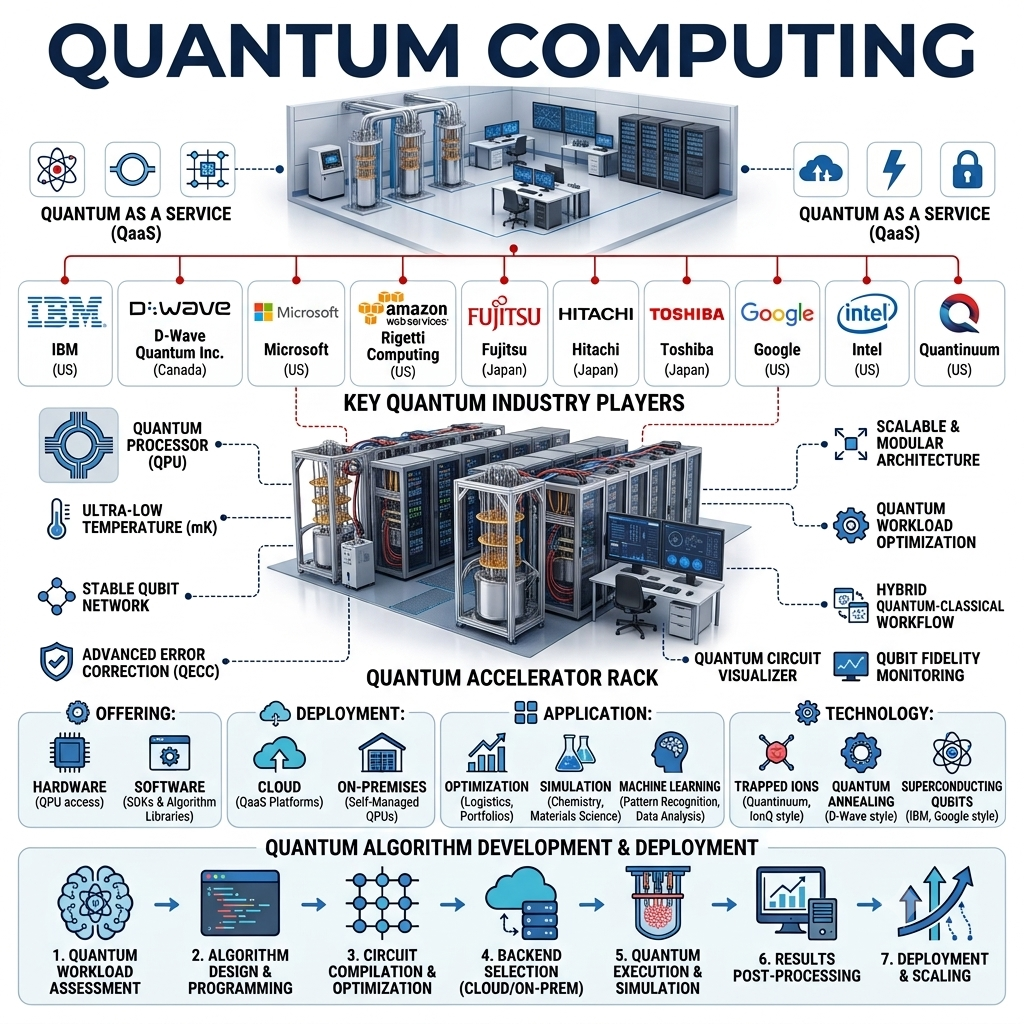
The competitive landscape of the quantum computing industry includes established technology companies, specialized quantum hardware developers, software providers, and research-focused organizations.
Major companies identified in the quantum computing market include:
- IBM: Develops quantum computing hardware, software, and cloud-based quantum services.
- Amazon Web Services: Provides access to quantum computing technologies through its cloud ecosystem.
- Microsoft: Invests in quantum computing hardware, software, and development platforms.
- Google: Conducts research and development in quantum processors and quantum computing technologies.
- Intel: Develops semiconductor and quantum hardware technologies.
- Rigetti Computing: Focuses on superconducting quantum processors and quantum computing systems.
- D-Wave Quantum: Develops quantum annealing systems and quantum computing solutions.
- Quantinuum: Develops quantum computing hardware, software, and related technologies.
- IonQ: Focuses on trapped-ion quantum computing systems.
- Toshiba: Participates in quantum communication and quantum technology development.
These companies operate across different parts of the quantum computing ecosystem. Their activities in quantum hardware, software, cloud infrastructure, and communication technologies contribute to the broader development of interconnected quantum systems.
As the industry evolves, collaboration between quantum processor developers, photonics manufacturers, telecommunications providers, and research institutions will become increasingly important.
Key Challenges Affecting Quantum Networking Adoption
Despite its potential, quantum networking faces several technical and commercial challenges that must be addressed before large-scale deployment becomes practical.
Quantum decoherence: Quantum states are highly sensitive to environmental disturbances. Maintaining quantum information over time and distance remains a major challenge.
Signal loss: Photons can be lost during transmission through optical fibers, limiting communication distances and network performance.
Quantum memory limitations: Reliable quantum memories are essential for storing quantum states while network operations take place. Improving storage duration, efficiency, and integration remains a research priority.
High infrastructure costs: Quantum networking requires specialized equipment, optical components, detectors, and supporting infrastructure. These requirements can increase deployment costs.
Interoperability: Connecting quantum devices developed using different hardware architectures requires compatible interfaces, communication protocols, and control systems.
Commercial readiness: Many advanced quantum networking applications remain in research and demonstration stages. Organizations must establish clear use cases and demonstrate practical value before widespread adoption.
Addressing these challenges will require continued investment in research, component manufacturing, testing infrastructure, and industry collaboration.
Future Outlook: Quantum Networking as a Foundation for Scalable Quantum Computing
Quantum networking is expected to become an increasingly important part of the quantum computing industry’s long-term development. As organizations seek to scale quantum processors and improve system capabilities, interconnected architectures could offer new opportunities for distributed computing and advanced communication.
The development of quantum repeaters, photonic integrated circuits, quantum memories, and efficient quantum interfaces will influence the pace of progress. At the same time, advances in quantum software and network management will be necessary to coordinate operations across connected systems.
In the near term, quantum networking is likely to progress through specialized applications, research testbeds, and short-distance demonstrations. Data-center-scale quantum interconnects could become particularly important as developers explore modular quantum computing architectures.
Over the longer term, quantum networks may support more geographically distributed computing systems, advanced sensing applications, and broader quantum communication infrastructure.
The projected growth of the global quantum computing market to USD 20.20 billion by 2030 highlights the increasing commercial interest in quantum technologies. While quantum networking is a distinct enabling technology rather than a direct measure of quantum computing market growth, its development could significantly influence the industry’s ability to scale.
Ultimately, companies and research organizations that advance reliable quantum hardware, communication interfaces, and network infrastructure will help shape the next generation of interconnected quantum computing systems.
