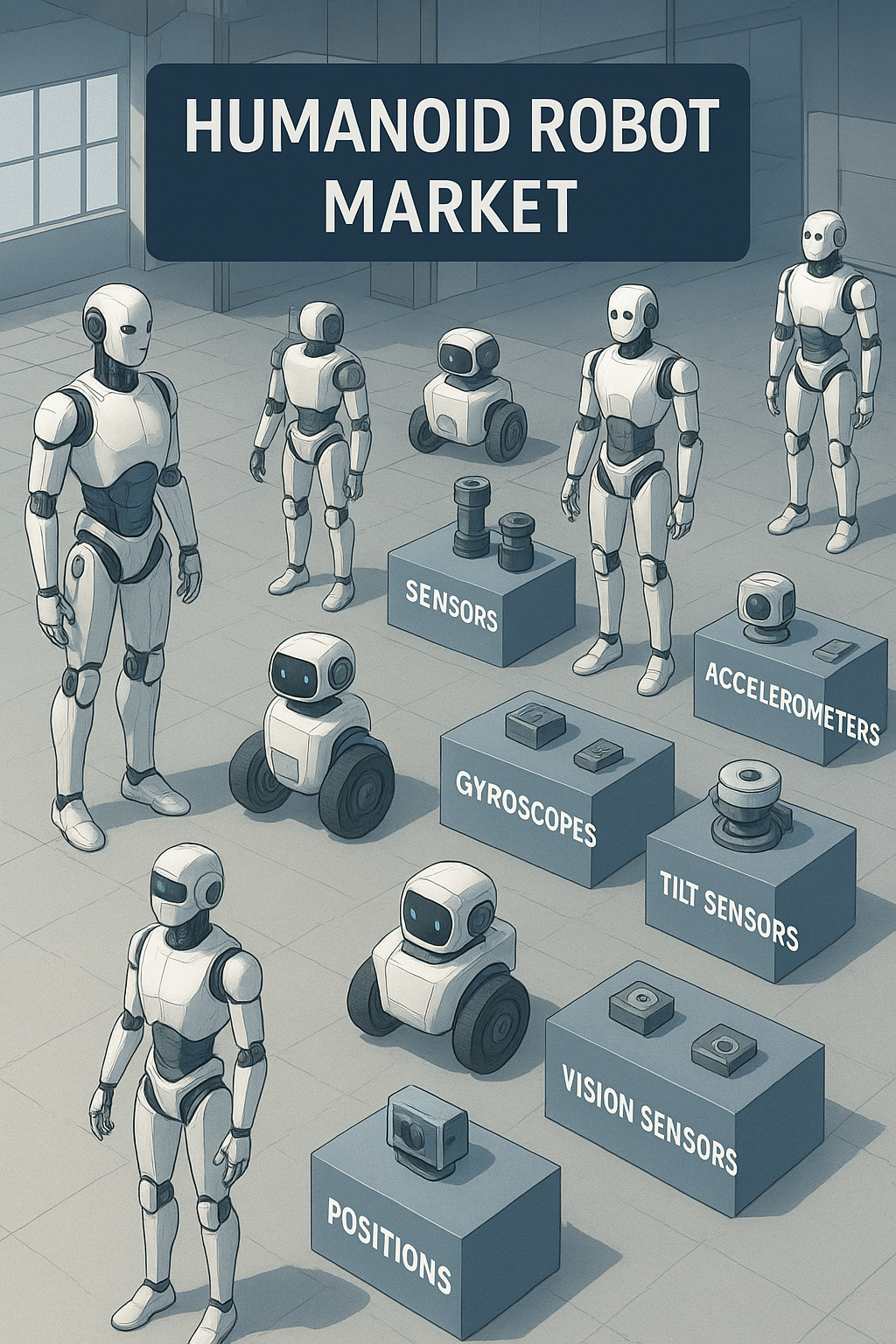
As humanoid robots move from research labs to real-world applications, the demand for sophisticated sensor systems becomes increasingly vital. Sensors act as the sensory organs of these robots, enabling them to balance, perceive, interact, and respond to their surroundings much like humans. The global humanoid robot market is expected to grow from USD 2.92 billion in 2025 to USD 15.26 billion in 2030, with a CAGR of 39.2%. This rapid expansion is being driven by advancements in artificial intelligence, mechatronics, and sensor technologies that allow robots to function autonomously and safely in human environments.
Gyroscopes: Enabling Dynamic Balance and Orientation
Gyroscopes are crucial for measuring angular velocity and play a foundational role in maintaining balance, orientation, and posture in humanoid robots. These sensors are embedded within inertial measurement units (IMUs) and work alongside accelerometers to provide real-time data about the robot’s movements. In bipedal robots, where balance is particularly complex, gyroscopes ensure stable locomotion and allow the system to recover from disturbances like slips or sudden direction changes.
By 2030, gyroscope technology is expected to become more compact, precise, and energy-efficient. Modern MEMS (Micro-Electro-Mechanical Systems) gyros are being integrated into smaller form factors, making them suitable even for compact humanoid robots. Reduced drift, better signal stability, and seamless integration with control algorithms will enhance a robot’s ability to perform agile movements and navigate dynamic environments safely.
Accelerometers: Sensing Motion and Acceleration
Accelerometers measure linear acceleration and are essential for detecting movement, vibrations, and impacts. When paired with gyroscopes in an IMU, they provide comprehensive motion data that helps robots determine their orientation and movement speed. This information is vital for tasks such as walking, climbing stairs, detecting collisions, and implementing fall prevention strategies.
The evolution of accelerometers is expected to follow a path toward improved sensitivity, reduced noise, and better energy efficiency. Sensor fusion—combining accelerometer data with inputs from vision systems and torque sensors—will provide more accurate and contextual feedback. This will be particularly beneficial for humanoid robots operating in unpredictable environments like homes, hospitals, or public spaces.
Download PDF Brochure @ https://www.marketsandmarkets.com/pdfdownloadNew.asp?id=99567653
Tilt Sensors: Supporting Posture Awareness
Tilt sensors, or inclinometers, measure the angle of tilt or slope in a single or dual axis. Though simpler than full IMUs, tilt sensors play an important supplementary role in determining a robot’s static orientation relative to gravity. They are especially useful in posture correction systems or in areas where low-cost, low-power feedback is adequate.
While tilt sensors are less complex than gyroscopes or accelerometers, their reliability in applications with low dynamic movement makes them valuable in the sensor suite. Over the next five years, we expect their usage to persist mainly in auxiliary roles or in cost-sensitive robotic platforms. Integration with accelerometers and gyroscopes will enhance system redundancy and reliability, ensuring that humanoids remain upright and oriented even in challenging conditions.
Position Sensors: Controlling Precision and Movement
Position sensors, including rotary encoders, potentiometers, and resolvers, are fundamental for tracking joint angles and limb positions. These sensors enable robots to articulate limbs precisely, making them indispensable in walking, grasping, object manipulation, and fine-motor tasks. Without accurate position sensing, the robot’s movements would be imprecise, jerky, and potentially hazardous.
As humanoid robots evolve to perform more delicate and dexterous functions—such as serving food or assisting in surgery—high-resolution, contactless position sensors will become increasingly important. Optical and magnetic encoders are likely to replace traditional potentiometers due to their durability, precision, and miniaturization. This progression will support robots in achieving smoother, more human-like motion, especially in joints with high degrees of freedom.
Vision Sensors: Eyes and Brains of the System
Vision sensors are among the most transformative elements in humanoid robotics. Cameras, stereo vision systems, depth sensors, and LiDAR modules enable robots to see, recognize, and interact with their environments. These sensors are used for facial recognition, obstacle avoidance, object detection, mapping, and gesture recognition. Essentially, they serve as the eyes—and, increasingly, the brains—of the robotic system.
Advancements in computer vision, powered by deep learning and AI, have enabled robots to interpret visual data in real-time. Between 2025 and 2030, vision sensors are expected to see the highest growth in usage and market value among all sensor types. Depth perception technologies like RGB-D cameras and time-of-flight sensors are becoming more compact and affordable, making them accessible to a wider range of humanoid platforms. Vision sensors are critical not just for autonomy but for enabling safe, intuitive interaction with humans—a capability essential for service, educational, and healthcare robots.
Torque Sensors: Sensing Human-Like Force and Compliance
Torque sensors measure the rotational force applied at joints or actuators. They are fundamental to enabling compliant motion—meaning that a robot can detect resistance, adjust its grip, or move gently when interacting with objects or people. These sensors play a vital role in ensuring safety during physical human-robot interaction (pHRI), especially in tasks involving direct contact, such as assisting elderly individuals, lifting objects, or performing collaborative work.
Torque sensors are evolving from external modules into integrated joint and fingertip elements. Advances in tactile and strain gauge technologies are driving this integration, making robots more capable of adaptive, human-like manipulation. By 2030, we anticipate significant growth in torque sensor adoption, particularly in robots designed for caregiving, hospitality, and retail environments, where safety and gentle interaction are paramount.
Market Drivers and Industry Trends
Several macro and micro trends are accelerating the adoption of sensors in humanoid robots. The miniaturization of sensor hardware, driven by advancements in MEMS and nanotechnology, is enabling more compact and lightweight robots. Simultaneously, software innovations—particularly in AI, machine learning, and edge computing—are unlocking the full potential of sensor data through real-time interpretation and decision-making.
Human-robot interaction standards are also influencing design priorities. Robots that can interact safely and effectively with people need multi-modal sensing, including vision, force, and proximity sensing. As humanoid robots become more common in homes, hospitals, and public venues, compliance with safety and ethical standards will necessitate robust and redundant sensor systems.
Forecast: Sensor Market Share in Humanoid Robots by 2030
By 2030, vision sensors are projected to account for the largest share of sensor-related value in humanoid robots, potentially comprising 30–40% of total sensor costs. Torque sensors will follow closely due to their growing importance in interaction and manipulation tasks. Inertial sensors (gyroscopes, accelerometers, tilt sensors) and position sensors will continue to be vital, but their market share may plateau as their performance stabilizes and prices fall due to mass production.
The evolution of humanoid robots from novelty to necessity will depend heavily on how well these sensors are integrated and utilized. Future designs will likely feature sensor fusion architectures—where data from multiple sensor types is combined to create a holistic, contextual awareness of the environment. This will allow robots to operate more autonomously, react more intelligently, and interact more naturally.
Conclusion: A Sensor-Centric Future for Humanoids
The journey of humanoid robots from concept to commercial reality hinges on their ability to perceive, move, and interact like humans. Sensors provide the foundation for these capabilities. Between now and 2030, the integration, miniaturization, and optimization of sensors—particularly vision and torque sensors—will shape the trajectory of the humanoid robot industry.
Companies and researchers that focus on high-performance sensor design, efficient sensor fusion software, and safe human-robot interaction protocols will be the leaders in this fast-growing field. As robots increasingly enter daily life, the quality of their sensors will determine how useful, safe, and accepted they become in our world.
FAQ:
1. What is the current size and future outlook of the humanoid robot market?
The global humanoid robot market is expected to grow from USD 2.92 billion in 2025 to USD 15.26 billion in 2030, with a CAGR of 39.2%.
2. Why are sensors important in humanoid robots?
Sensors are critical because they serve as the “sensory system” of humanoid robots. They enable the robot to perceive motion, maintain balance, detect orientation, interact with objects, and safely work alongside humans. Without high-quality sensors, humanoid robots cannot function autonomously or reliably in real-world environments.
3. Which types of sensors are most important for humanoid robots?
The most essential sensors include:
- Gyroscopes – for orientation and balance control
- Accelerometers – for motion detection and stability
- Tilt Sensors – for posture monitoring
- Position Sensors – for joint angle feedback and movement coordination
- Vision Sensors – for visual perception, object recognition, and navigation
- Torque Sensors – for force sensing, safety, and compliant motion during interaction
4. Which sensor type is expected to grow the fastest by 2030?
Vision sensors are projected to experience the fastest growth, as robots become more reliant on visual perception for interaction, navigation, and object manipulation. These include cameras, depth sensors, LiDAR , and stereo vision systems.
About MarketsandMarkets™
MarketsandMarkets™ is a blue ocean alternative in growth consulting and program management, leveraging a man-machine offering to drive supernormal growth for progressive organizations in the B2B space. We have the widest lens on emerging technologies, making us proficient in co-creating supernormal growth for clients.
The B2B economy is witnessing the emergence of $25 trillion of new revenue streams that are substituting existing revenue streams in this decade alone. We work with clients on growth programs, helping them monetize this $25 trillion opportunity through our service lines – TAM Expansion, Go-to-Market (GTM) Strategy to Execution, Market Share Gain, Account Enablement, and Thought Leadership Marketing.
Built on the ’GIVE Growth’ principle, we work with several Forbes Global 2000 B2B companies – helping them stay relevant in a disruptive ecosystem. Our insights and strategies are molded by our industry experts, cutting-edge AI-powered Market Intelligence Cloud, and years of research. The KnowledgeStore™ (our Market Intelligence Cloud) integrates our research, facilitates an analysis of interconnections through a set of applications, helping clients look at the entire ecosystem and understand the revenue shifts happening in their industry.
To find out more, visit www.MarketsandMarkets™.com or follow us on Twitter, LinkedIn and Facebook.
Contact:
Mr. Rohan Salgarkar
MarketsandMarkets™ INC.
630 Dundee Road
Suite 430
Northbrook, IL 60062
USA : 1-888-600-6441
