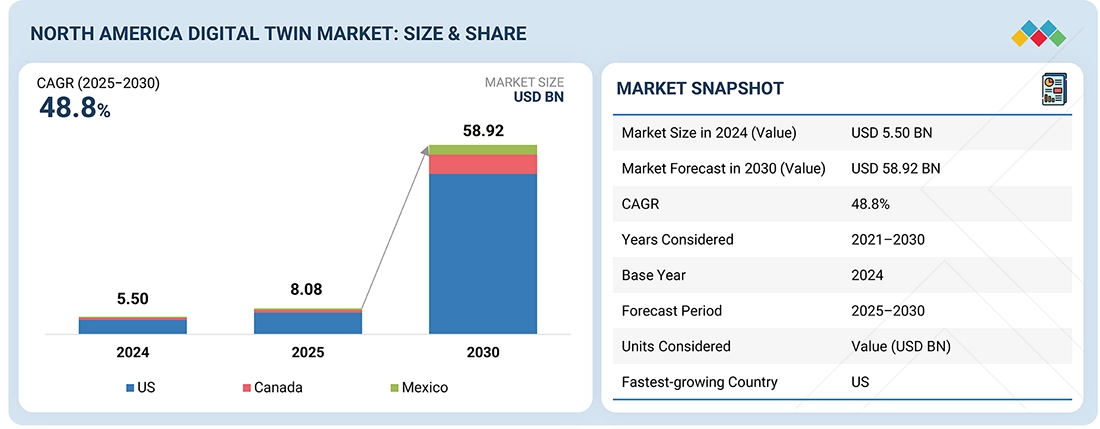
The North America digital twin market is projected to grow from USD 8.08 billion in 2025 to USD 58.92 billion in 2030 at a CAGR of 48.8% during the forecast period.
The North America digital twin market is gaining strong momentum as organizations increasingly adopt advanced digital technologies to improve operational efficiency and decision making. Digital twin technology enables the creation of virtual replicas of physical assets, systems, or processes, allowing businesses to simulate real world conditions and monitor performance in real time. As industries across North America accelerate digital transformation initiatives, digital twins are becoming a critical tool for innovation, cost reduction, and risk mitigation.
Download Sample PDF:
https://www.marketsandmarkets.com/pdfdownloadNew.asp?id=204844899
Market Growth and Regional Momentum
The market in North America is witnessing rapid growth due to early technology adoption, high investments in digital infrastructure, and a strong focus on automation and data driven operations. Enterprises across the region are prioritizing smart manufacturing, predictive analytics, and system optimization, which directly support the adoption of digital twin solutions. The presence of advanced cloud platforms and mature Internet of Things ecosystems further accelerates market expansion and scalability.
Dominance of the United States in the Region
The United States holds the largest share of the North America digital twin market. This leadership is supported by a strong industrial base, widespread use of advanced software solutions, and continuous innovation across sectors such as automotive, aerospace, healthcare, and energy. Organizations in the country leverage digital twins to improve product development cycles, enhance asset reliability, and support complex system modeling. High spending on research and development and a robust startup ecosystem also contribute to sustained market dominance.
Enterprise Adoption and Organizational Scale
Large enterprises are the primary adopters of digital twin technologies in North America. These organizations manage complex operations and large asset bases, making digital twins highly valuable for monitoring performance and predicting failures. With access to skilled professionals and advanced IT infrastructure, large enterprises can integrate digital twin platforms with existing enterprise systems. At the same time, small and medium sized enterprises are gradually entering the market as cloud based deployment models reduce upfront costs and complexity.
Industry Applications Driving Demand
The automotive and transportation sector is a major driver of the North America digital twin market. Manufacturers use digital twins to optimize vehicle design, improve production efficiency, and support the development of electric and autonomous vehicles. Beyond automotive, industries such as energy and utilities, construction, aerospace, healthcare, and telecommunications are increasingly adopting digital twins. These industries use virtual models to manage infrastructure, improve service reliability, and enhance operational planning.
Role of Advanced Technologies in Market Expansion
Technological advancements play a vital role in shaping the digital twin market. Integration with artificial intelligence and machine learning enables predictive insights and automated decision making. Internet of Things sensors provide real time data that enhances model accuracy, while cloud and edge computing support scalable and low latency deployments. Visualization technologies further improve user interaction with digital twins, making insights more accessible across organizational levels.
Challenges Impacting Market Adoption
Despite strong growth prospects, the North America digital twin market faces certain challenges. Data security and privacy concerns are significant, especially in critical infrastructure and healthcare applications. Integrating digital twins with legacy systems can also be complex and time consuming. Additionally, the lack of standardized data models and interoperability between platforms may slow down adoption for organizations operating across multiple systems or vendors.
Emerging Opportunities and Future Potential
The future of the North America digital twin market presents numerous opportunities. Smart city initiatives, renewable energy projects, and grid modernization efforts are creating demand for advanced system modeling and simulation. Healthcare digitalization and building performance optimization are also emerging use cases. As sustainability and efficiency become strategic priorities, digital twins are expected to play a central role in planning, monitoring, and optimizing complex environments.
Ask for Sample Report:
https://www.marketsandmarkets.com/requestsampleNew.asp?id=204844899
Competitive Landscape and Innovation Trends
The market features a competitive landscape with established technology providers and innovative solution developers. Companies are focusing on expanding their digital twin portfolios through strategic partnerships and technology enhancements. Continuous innovation in analytics, simulation, and platform integration ensures that digital twin solutions evolve to meet diverse industry requirements and changing business needs.
Conclusion and Market Outlook
In conclusion, the North America digital twin market is set for sustained growth driven by strong digital infrastructure, diverse industry adoption, and continuous technological innovation. While challenges related to security and integration remain, the benefits of improved efficiency, predictive capabilities, and enhanced decision making continue to drive demand. Digital twins are expected to become a foundational element of digital strategies across industries in North America.
